Get every episode summarized
Each time Fresh Air publishes, we email you a written briefing from the transcript — the topics, who appeared, and any specific claims, with the ad reads skipped.
Email me new episodesFree for 3 shows. No card needed.
About this episode
Fresh Air is made possible by:
“This message comes from Sony Pictures Classics. The New York Post calls Hachan Shakerbooty a delirious gem. Academy Award nominee, Rinku Kakuichi, stars as a woman drawn back to Tokyo's ballroom dance scene after a tragedy.”From the transcript
Also, Ken Tucker reflects on three of Dolly Parton’s performances that he says demonstrate her range and her unique takes on romance and heartbreak.
See pcm.adswizz.com for information about our collection and use of personal data for sponsorship and to manage your podcast sponsorship preferences.
NPR Privacy Policy
Get every episode summarized
Each time Fresh Air publishes, we email you a written briefing from the transcript — the topics, who appeared, and any specific claims, with the ad reads skipped.
Email me new episodesFree for 3 shows. No card needed.
Know when Roy Cohn turns up
Follow Roy Cohn and once a week we email you every new episode they appeared on — including guest spots the show notes never mention, because we read the transcript.
Follow Roy CohnFree. Pick your own day and time.
Hosts & guests


Transcript ready
432 searchable segments. Every word is indexed and playable.
Full transcript
Fresh Air — The Roy Cohn Playbook, from McCarthyism to Trump. Machine-transcribed; use the interactive transcript above to jump the player to any line.
This message comes from Sony Pictures Classics. The New York Post calls Hachan Shakerbooty a delirious gem. Academy Award nominee, Rinku Kakuichi, stars as a woman drawn back to Tokyo's ballroom dance scene after a tragedy. Only in theaters September 25th. This is Fresh Air. I'm Terry Gross. Back when Donald Trump was getting his start as a real estate developer in his father's business, wanting to branch out from apartments in the burrows to more ambitious buildings in Manhattan, and trying to find a place for himself among wealthy New Yorkers, celebrities, and power brokers. His lawyer, and mentor, was the infamous unethical Roy Cohn. Cohn's rules became Trump's rules, writes my guest, Kai Bird, in his new biography of Cohn called American Scoundrel. Kai Bird also co-wrote the definitive biography of Robert Oppenheimer, called American Prometheus, which was the basis of Christopher Nolan's Oscar-winning film,
Oppenheimer. Early in Roy Cohn's career, he prosecuted Julius and Ethel Rosenberg, Uncharges of Espionage. They were sent to the electric chair. In the 1950s, when Senator Joe McCarthy led the subcommittee then investigated and smeared alleged communists and gay people, ruining their careers and sometimes their lives, Cohn was the subcommittees legal counsel. This in spite of Cohn being a closeted gay man himself, Cohn moved on to a more lucrative career as the lawyer for leaders of New York's crime families. He was connected to several prominent New York politicians and helped Ronald Reagan get elected president. Cohn was indicted by the Justice Department on three occasions of bribery, perjury, and extortion, and other white collar crimes, and was always acquitted. But in 1986, after being accused of bribery and fraud, he was disbarred. This was just a few weeks before he died of AIDS, which he always denied having, claiming it was liver cancer.
Bird says, Cohn's story is important because of what it teaches us about the fragile character of American democracy. Cuy Bird, welcome to Fresh Air and congratulations on the biography. You say that Roy Cohn's rules became Trump rules. Now, there were a couple of Cohn rules that became Trump rules that I was familiar with, never admit you were wrong, denied, denied, denied. Then when there are charges against you, delay, delay, delay. Can you think of an example where all three were used by Roy Cohn? Yeah, during the time when in the 60s when he was indicted three times, Roy Cohn delayed the courtroom proceedings as often as he could. He denied the allegations. He attacked the judge in particular by name. He followed these rules throughout his life, and he was a routine rule breaker. The rules were for the little guy, not for him.
So did all of that help him get off on those charges? Well, the evidence was really quite overwhelming. I argue in the book, along with my co-author, my wife Susan Goldmark, that he was partly just damn lucky. On one trial, a juror's father suddenly fell dead and the judge felt compelled to declare a mis-trial. On another occasion, Roy's own lawyer suffered a heart attack in the courtroom, just as he was about to give the summation. The trial judge was going to declare a recess, and Roy steps forward and says, Judge, I'll do my own summation. He did, and this was to his advantage, of course, because he had not chosen to take the witness stand, so he hadn't been subjected to cross-examination, but he was allowed over two days to spend seven hours defending himself, and he did so brilliantly, and apparently got some of the jurors weeping,
and they acquitted him 12 to zero. Okay, other rules like sue, counter sue, or threaten to, and basically send the message that whether you win or lose, it's going to be a headache if you don't give in. So, this was routine. He left unpaid debts all over Manhattan for little things, like dry cleaners, his liquor bills, limousine bills, and when sued in small claims court, he would delay delay, and eventually the people he owed money to would give up and or settle for a dime on the dollar, and he was shameless. So, what lessons do you think President Trump learned from Roy Cohn about paying bills and paying taxes? He copied this behavior. He too was notorious for not paying his bills, and sort of using the
negotiating tactic of delay, delay in order to bargain down the bill in question. And famously, Donald Trump, we don't know what taxes he's paid, and the little that we do know, indicate that he has somehow managed to find tax shelters and pays very little, comparatively speaking. Another Roy Cohn rule, don't tell me the law, tell me the judge, because he knew how to like which judge would be favorable to him, or which judge he could manipulate. I assume that's what he meant. Yes, exactly. And Roy grew up, you know, the son of a judge, a respected judge, Albert Cohn, from the Bronx, appointed during the Roosevelt administration, a liberal Democrat, but he grew up being introduced by his father to all sorts of lawyers and judges. And when he became a lawyer himself at the age of 20, he cultivated other judges
as friends. And again, he was very transactional, even as a young man. He would do favors for these people, and then knock on their door to ask for a favor and return. Well, Trump kind of did him one better on, don't tell me the law, tell me the judge, because as president, he's appointed judges. He's appointed Supreme Court justices. And some of those people, I mean, they've ruled on things that Trump has done. Can you talk about that a little bit? Oh, the head of the Justice Department was Trump's personal lawyer. Yes, yeah. Well, Roy would have approved. And this is sort of the most insidious and long-lasting legacy of Roy's. You know, he was a lawyer, but he really didn't care about the law. He practiced his law over the phone. He tried to avoid taking any notes or records, and he taught this too to Donald Trump. You don't leave a paper trail.
Don't leave a paper trail. It's evidence. And so you see, even to this day, Trump gets annoyed when people start taking notes. He just likes to do everything verbally and over the phone and to wing it. So Trump got a lot from Roy Cohn, favors opening doors, legal representation. What did Roy Cohn see in Donald Trump? Because Donald Trump was not a name yet. He was not known yet when Roy Cohn started representing him. Well, you know, Roy loved just doing favors for influential people. And he told his good friend the gossip columnist Cindy Adams that this young Donald Trump was going to go someplace and maybe even to the White House someday. And you know, I had four telephone interviews with Trump about Roy Cohn. Very strange interviews that maybe 10 minutes each.
And in my first phone conversation, you know, it's a cold call. I just, I was given a number and Donald Trump picked up. Hello. And he had no idea who I was. I said, I was doing a biography of Roy Cohn. And he says, Oh, that's terrific. That's terrific. He was such a wonderful man. He was a great lawyer. We won a lot of cases together. He went on and on effusively about Roy. He misses him genuinely. And I think they really were friends. Do you think he thought it was going to be a very positive portrayal? I don't know what he was thinking. But obviously he has a very positive view of Roy Cohn. He's not ashamed to be associated with him. And this is sort of a mystery to me because I can't understand how anyone could read this book and read the stories
about what Roy did and some of the despicable things he did and see, you know, that it's backed up with 1,300 footnotes and not be sort of ashamed. When Senator Joe McCarthy in the 1950s headed the subcommittee that was investigating alleged communists and gay people and ruining many careers and ruining many lives along the way. Roy Cohn was the subcommittee's legal counsel. How did he get that position? His friends Walter Winchell and George Sikolski to prominent journalists at the time who were friends of Roy, promoted him to get this connection. But by that time, of course, you know, Roy, even though he was very young, he was only
26 at the time. He'd already prosecuted the Rosenberg case. He'd already prosecuted another famous alleged communist spy case called the William Remington case. He had taken on prosecution of alleged communists at the United Nations. He was an expert in this field. And his only rival for the job was ironically enough Robert F. Kennedy, the young future attorney general. And Joe McCarthy for one reason or another chose Roy Cohn, I think because he had more experience. And yet Bobby Kennedy was selected as a deputy counsel. And it's important to note that they immediately took a strong disliking to each other. At one point, they almost got into a fist fight. And Roy later explained that, you know, he believed, ardently believed that
the prosecutions that he suffered through the three indictments in the 1960s were brought against him by Robert Morgenthau on the instructions of attorney general, then Bobby Kennedy. And that it was a political vendetta. What were Cohn's main contributions to the McCarthy subcommittee, which like really smeared a lot of people? Yeah, you know, Joe McCarthy, I think, was largely politically speaking an empty vessel. He wasn't really an ideal log. He stumbled into this anti-communist witch hunt and investigations, sort of on a whim. But Roy came to it with a passion and an expertise. And he really became Joe McCarthy's brains. You know, McCarthy was, well, he was functioning alcoholic at that point.
And Roy really guided him. And they were very successful in launching, sort of, what was really a political campaign against the newly inaugurated Eisenhower administration. You know, Roy was hired in early 1953. And he was beginning to go after Dwight Eisenhower himself, the former general, the current president. And a Republican. And a Republican. For not being a Republican enough and for not being anti-communist enough. During the McCarthy era, Roy Cohn interrogated witnesses. And what was his technique? Well, he was brutal. He was relentless. He openly asked male government civil servants about their sexual orientation and their, you know, have they ever
had relations with a man. And, you know, some of these civil servants testified openly and then were fired. Some tried to take the Fifth Amendment. You know, he destroyed the lives of hundreds if not thousands of people. And meanwhile, you know, Roy Cohn was totally in the closet, leading this real double life. Yet having people fired because they were gay, whether they were, you know, out or in the closet, I guess that didn't bother him. It did not bother him. For all of his life, he was in the closet. And he was particularly in the closet in the 1950s. You know, as a public figure, you know, someone who, the age of 27 during the Army McCarthy hearings, his image was on the cover of Time magazine. He knew that as a public figure, he could never admit to this. That would be the end of his career. But it was certainly a factor in his life. And he managed to sort of lead a
double life, you know, back in New York, he during the day was a straight heterosexual, powerful lawyer to the Mafioso. And at night, he was cruising gay bars, two of which he himself owned. So in terms of, you know, trying to outmen who were gay or smearing them because they were gay, for people working in the government, the argument that McCarthy and Warikon used was that they were security risks because gay people in the closet could be easily blackmailed. You know if he thought that he could be blackmailed? I think he was, I think he was supremely confident in his ability to leave it lead a double life. So no, he had no fear. He was brazen in the 50s, but also, you know, later in the 70s, he public-resolved, of course, the gay community in the 1970s and 80s,
just despised Warikon. They knew exactly who he was. They knew he was, gay, they saw him in their venues in gay bars in New York. And they, you know, they heard the rumors too about the sex parties that he organized. It was like he was so brazen in his hypocrisy. It's astonishing. Did Trump know that Warikon was gay? Oh, Trump definitely knew that he was gay. You know, in the 70s, you know, when Studio 54 opened up in 77, Roy took Donald Trump to Studio 54 frequently. And in the 80s, Roy was sort of more out. He was never publicly out, but you know, he was surrounded in his law firm by young gay men. And anyway, so Donald Trump knew. And
at one point, Roy called up Trump to ask for a favor for one of his boyfriends who was dying of AIDS, in fact, and asked if he could be housed in one of Donald Trump's hotels. And Trump arranged for it. And the young man stayed there for a few or four months. And when he died, Trump sent a bill to Roy. Do you see any connection between Warikon being closeted and going after gay people during the McCarthy era? And Trump's anti-DEI, anti-LGBTQ approach? Yes. When they first met, it was when Trump was being sued by the feds for racial discrimination, in housing and queens, in their apartments owned by the Trump organization. And it was very blatant. It was an open and shut case. And of course, Roy famously said,
oh, you should fight it. You know, you should sue the feds. Let's hold a press conference and announce a hundred million dollar defamation suit against the federal government. You know, it was a nonsense suit. And it was dismissed within two months. But Trump loved this. And Roy was sort of a social racist. Roy used all sorts of terrible slurs. One, he picked up from his mother, Dora, who used the Yiddish slur for black. And he himself, though he was Jewish, he used similar slurs about Jews. I mean, Roy's sort of politics on these kinds of issues, affirmative action he opposed. He thought this was inappropriate and wrong. And that it was discrimination against whites. His politics are very similar to what we see in Donald Trump today. You know, the politics
is really interesting in that you see Roy Cohn in the 60s and 70s. He's very resentful of intellectuals. He's a graduate of Columbia University, but he hates the Ivy League schools. He favored hiring young law associates who were not Ivy Leakers. He was suspicious of immigrants. He was anti-black. He was an isolationist. He wanted America to be America first. Well, this is all the politics that we see today in the Trump administration. It's the same politics of resentment. And Trump, too, went to an Ivy League school. And like Roy Cohn, was born into a high profile family with money. Yeah, absolutely. So there are a lot of parallels. Well, let me reintroduce you again, because we need to take another break. My guest is
Kai Bird, author of the new book, American Scoundrel. It's a biography of Roy Cohn. We'll be right back after a short break. I'm Terry Gross. And this is fresh air. This message comes from Wise, the smart way to manage your money around the world. With Wise, you can send, spend, and receive money in over 40 currencies at the mid market rate. Learn more at Wise.com. TZNC's apply. This message comes from Thumbtack. Recommendations can be great. Maybe someone recommended this podcast, and here you are. But home projects are different. If a podcast isn't your thing, you lose a few minutes. If you hire your cousin's neighbor to mount your TV, you might end up with a lopsided screen and wall damage. That's why Thumbtack works. It matches people with top rated local pros, with photos, reviews, and credentials, all in one place. For your next home project, try Thumbtack. Hire the right pro today. The Emmys were a big night for a lot of shows. We really love the pit and pluribus,
picked up awards and widow's bay really cleaned up. We'll tell you why we're quite happy with ears, crop of winners, and a recap on pop culture happy hour. Listen via the NPR app or wherever you get your podcasts. Hey, it's Ray from Cart Talk. You tied up all the depth and thoughtful care that goes into NPR shows. Want some good old fashioned goofing around and stumbling to figure out what's going on? Well, I've been taking occasional car questions again. You can hear them by signing up for NPR Plus. Along with lots of other bonus content, just go to plus.npr.org. This is Fresh Air. I'm Terry Gross. Let's get back to my interview with Kai Bird, author of the new book, American Scoundrel. Roy Cohn's dark journey from Joe McCarthy to Donald Trump. In the 50s, when Senator Joe McCarthy led the subcommittee that investigated and smeared alleged communists and gay people, Cohn was the subcommittee's legal counsel. He went on to become the lawyer for leaders
of New York's crime families. He was connected to wealthy New Yorkers and power brokers and used those connections to get favors, including favors for Donald Trump. He did his best to avoid paying bills and taxes and found ways to hide his money from the feds. Cohn was undyeded by the Justice Department on three occasions of bribery, perjury, and extortion, another white collar crimes, and was always acquitted. But in 1986, after being accused of bribery and fraud, he was disbarred. Just a few weeks later, he died of AIDS, which he always denied having, saying it was liver cancer. So, after Joe McCarthy was pressured to fire Roy Cohn, when Roy Cohn was the legal counsel for McCarthy's subcommittee that was really active in the witch hunt against alleged communists, Roy Cohn then went on to do other things. He became a divorce lawyer for very wealthy people, and he represented leaders of the five mafia families of New York. What kind of
cases did he take? Well, he represented, for instance, John Gutty, Teflon Don, Mafia Don, who one day in the early 70s walked into a bar in Staten Island with two of his associates, walked up to an Irish mafia also from a different clan, obviously, and confronted this man and held him down, and one of his associates pulled a gun and point blank, fired into his head and killed him. This was done in front of 20 witnesses in a bar. John Gutty fled. He was eventually arrested, and Roy Cohn became his lawyer. And in the end, Roy got John Gutty off on manslaughter charges, not murder. He pleaded it down, and he got him a four-year sentence. John Gutty served only two and a half years and got out and then proceeded to go on to a worse crime. He killed another mafia,
so in order to sort of climb up the ladder himself. And this was due to Roy. How did the relationship between Donald Trump and Roy Cohn change as Trump became more famous and more powerful? Yeah, in the beginning, the power imbalance was quite evident. Roy was the older man and the more powerful. But as the years rolled by, the relationship sort of evolved, and Roy became more obsequious to Donald Trump, and he paid more attention to Donald's needs than the reverse. But there was a genuine friendship there. And one thing that Roy did for Donald Trump that I think is overlooked is before he died, he went to his old buddy from Horace Man School,
Sineu House, the publisher of CondiNAS magazines and the owner of Random House. And Roy suggested to Sineu House that he should get one of his editors at Random House to sign up Donald Trump to do a memoir. This is how the art of the deal came about. And that book was published after Roy died, but it became a national bestseller. And it virtually turned this very parochial New York celebrity developer into a national figure, prominent businessman as such. And of course that, as we know, led to the TV show, The Apprentice, and that led to Donald Trump launching a political campaign for the presidency. So there's a direct connection between all of that, and it starts with Roy Cone's relationship with Sineu House. Roy Cone got AIDS early in the AIDS epidemic.
Yes. So how did that change Donald Trump's relationship with Roy Cone? Well, Trump, when he learned that Roy was probably dying of AIDS, he began, by all accounts, to sort of keep his distance. He began to take less, relied less on Roy Cone's legal advice and went to other lawyers. But he never broke with him. And in fact, to his credit, he invited him down to Mar-a-Lago soon after he acquired that new estate in Florida. And hosted a fabulous dinner, and there were many toasts to Roy Cone. And at the end of the dinner, when it was all over, Trump apparently told his staff to take the silverware and clean it in peroxide. Well, let me reintroduce you again if you're just joining us, my guest is Kai Bird,
author of the new book, American Scoundrel. Roy Cone's dark journey from Joe McCarthy to Donald Trump. We'll be right back. This is Fresh Air. This message comes from in PR sponsor Raymond James, a firm where wealth management, banking, and capital market solutions start with the connections between people. That's the power of personal disclosures at RaymondJames.com. Hi there, I'm Brittany Loose, and not to brag, but I host a really fabulous podcast. It's called It's Been a Minute. I love making it, and I think you'll love listening to it. Over the last year, hundreds of thousands of listeners have been tuning in, and I gotta say, if you haven't yet, you're missing out. Listen to the It's Been a Minute podcast from NPR today. This message comes from BetterHelp. Imagine carrying a backpack every day. Inside it, every conversation, every mistake, every expectation. It is easy not to notice how heavy it is until someone asks if you want to put it down.
Sometimes feeling better starts exactly like that. Better isn't one-size-fits-all. Better is personal. It's therapy tailored to the individual to help lighten what you carry. Match with a therapist who truly understands. Visit BetterHelp.com slash NPR. This is Fresh Air. Let's get back to my interview with Kai Bird, author of the new book, American Scoundrel, Roy Cohn's Dark Journey from Joe McCarthy to Donald Trump. Cohn was Donald Trump's lawyer and mentor. Because one of Roy Cohn's rules was like, don't leave a paper trail. He didn't leave a paper trail. That's not good for a biographer like you. You had a fine. Yeah, you had a fine alternate means. You had the FBI files you're over to CAD after suing. You had some notes from other people's work. Jeremy Strong who played Roy Cohn in the movie The Apprentice, which was about the relationship between Trump and Roy Cohn. He turned over his research to you. But you also found that
Michael Steip from REM had an archive of Roy Cohn stuff that he bought at auction. What was in that that was of use for you in your biography? That was a surprise. We had no idea the extent of what Steip had. We reached out to him and eventually met him at a studio in Lower Manhattan. He took us inside and put three boxes on a desk of what he called Roy Cohn memorabilia that he had picked up at an auction house. We opened the boxes and there are 150 family photographs, childhood pictures, two copies of his last will and testament. 220 page unpublished manuscript of his of a memoir that he was trying to write. A little thing like a silver-sid Gareth box engraved
to Roy Cohn from Jean and Joe McCarthy. Biographers go on a treasure hunt and occasionally they find treasure and you just have to keep relentlessly knocking on doors and talking to people. This was particularly difficult because Roy burned all his papers. He destroyed everything partly because he was not paying his taxes for 20 years. There is no private archive. One of the photos, and I can't remember whether this was in Michael Steip's collection or you found it someplace else, but Robert Mabel Thorpe, who started off doing celebrity photos and then ended up doing a lot of very controversial photos of gay men, often engaged in a sexual act. This was a huge controversy because he had some funding from the NEA and National Endowment for the Arts. That was part of the whole controversy about federal funding for the Arts and what should
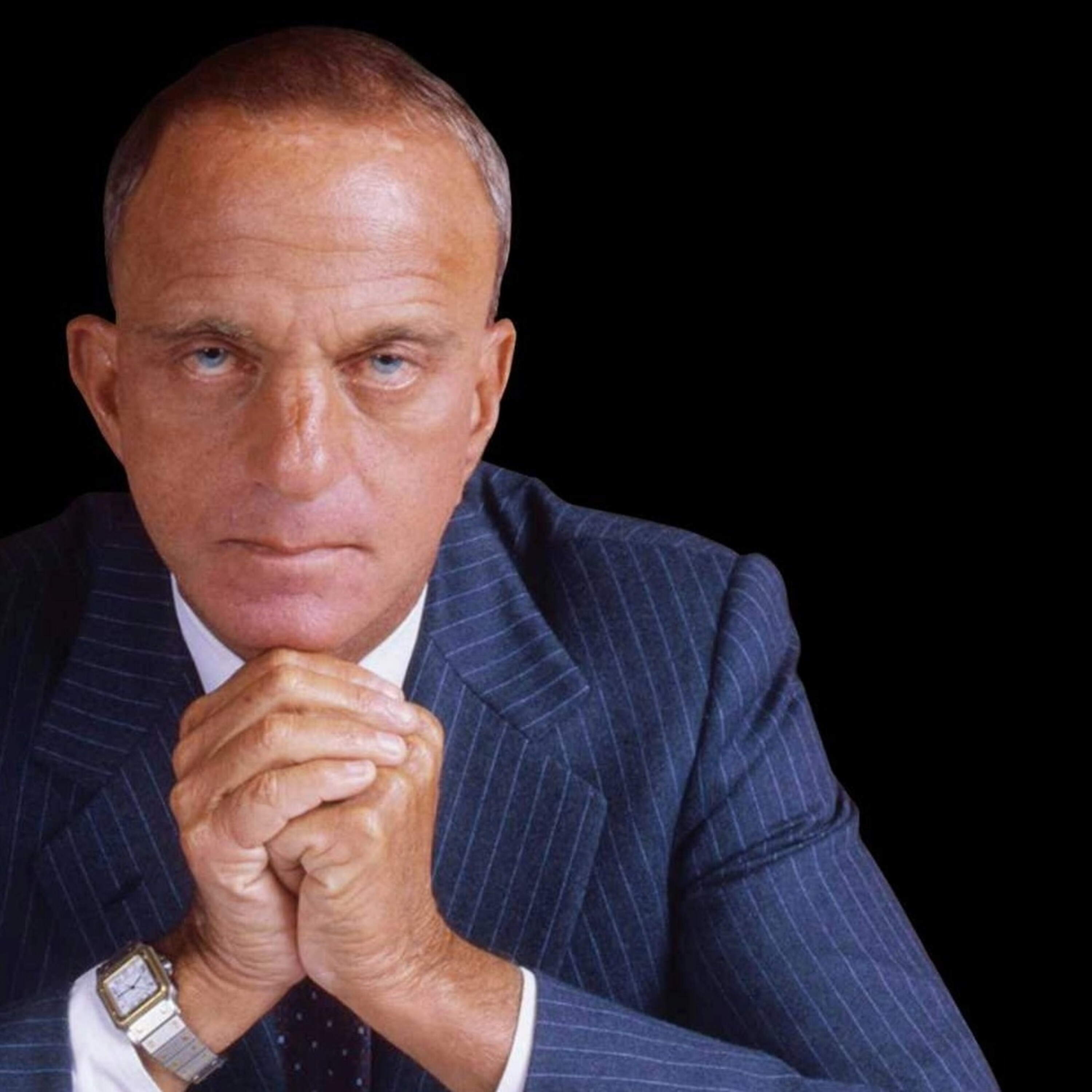
be allowed to be funded. But anyhow, so the Mabel Thorpe photo of Roy Cohn, Roy Cohn was looking just kind of like angry and threatening in it, right? Oh yeah, it's a frightening photo. It's an image of Roy looking straight into the camera with just his face and you see nothing else of his body, no hands, nothing, and his face is sort of floating in a sea of blackness. He looks like Satan or something, but it's a powerful photo, a piece of art. When I first saw that photo, I said, man, that's the cover. I reached out to the Mabel Thorpe Foundation, but they very quickly decided that they could not license this photo because of the political nature of our book and the fact that it might jeopardize their non-tax profit status. I was outraged. I thought this was a
terrible decision, terrible reflection of Mabel Thorpe of all people who was himself a victim of first amendment controversies. I appealed and wrote a strong email suggesting this was like bending the knee and anticipation. Anyway, we lost. We had to scramble and find another photographer who had taken a photo in 1981. It's a fabulous photo, but it's not what I originally wanted. So because the Mabel Thorpe photo showed an angry mean expression on a close-up of Roy Cohn's face, it reminded me of a photo that Trump seems to really like of himself, where he has a scowl on his face. Yes, that's his official White House portrait, the Scowling Trump, and he takes it directly from Roy. Roy loved to be depicted by artists and photographers as sort of tough, mean, and ugly.
He actually had a sense of humor about himself. He could be self-deprecating. So he once said to someone that he had a problem with all these photographers taking these images of himself that were unflattering, but then he walked by a mirror and he understood. This is the image that he wanted to project. He wanted to be fearsome. I think Trump himself routinely in his office in Trump Tower, he would point to a photo on the wall of Roy Cohn and said, would you rather deal with him if he was in a tough negotiation? And the image is a scowling Trump. Because Roy Cohn was such a hypocrite when it came to homosexuality, because he was closeted, but attacked gay people during the McCarthy era and ruined the lives of a lot of
gay people as a result, are you surprised that nobody ever publicly outed him as a hypocrite? Well, we write in one chapter at the tail end of the book about Richard DuPont, gay man who became a business partner of Roy's and was at one point one of his lovers, but Richard DuPont had a business venture in Manhattan that Roy became a partner of and they had a falling out, Roy sort of sold the property out from under Richard. Richard DuPont went on a campaign of revenge, and he specifically tried to publicly out him, publishing a magazine, devote it with articles, devoted to Roy Cohn describing his private life with cartoons depicting Roy and sex acts. It was an outrageous public outing. He went to the sidewalk outside Roy Cohn's townhouse and
all up and down the sidewalk used white chalk to say, Roy Cohn is a s***. So eventually, I mean, he harassed him. He would appear at airports about to get on a plane and suddenly he told that by the airline that someone had called up and canceled this reservation. Well, Richard DuPont was doing this and eventually Roy complained to involve people, Robert Morgan Thou, the New York District Attorney, and got more- He prosecuted him in the past. Who had prosecuted him three times in the 60s. But Morgan Thou looked at this case and said, yeah, this is a verifiable case of harassment. And he indicted Richard DuPont. There was a trial and DuPont eventually spent I think 18 months in prison. And the press wouldn't pick up on the publication that DuPont did.
That's right. The New York Times didn't report on it. So Roy Cohn managed to escape outing, too. He did. But in the afterlife, there was angels in America, which depicts him as closeted. And on the AIDS quilt, he's identified as bully, victim, coward. Yes. So it caught up with him, but he was already dead when it did. No. No, this was sort of one of the curiosities that we had to explain in the book. You know, how could Roy operate in such a hypocritical fashion, being a heterosexual, powerful lawyer in the daytime and then having this sex life in the gay world, owning gay bars and such at night? And everyone knew about it. You heard that Roy Cohn's story is important because of what it teaches us about the fragile character of American democracy. What is the lesson you think his story teaches?
Well, the lesson of Roy Cohn is that McCarthyism was not defeated. It didn't die. It wasn't an aberration in the 1950s. And I suddenly realized as an historian that, you know, we Americans are a country of immigrants, a multicultural country, a country of civil liberties and the First Amendment. But every few decades, we go through a period of paranoia. So we had a red scare in the 1920s. We had another red scare, the McCarthyite, which comes in the early 50s. And we're now going through another such period. And, you know, in the 1950s, there were several thousand civil servants who lost their jobs as a result of what Roy Cohn and Joe McCarthy did. And today it's become much worse. It's a much more serious assault on our democracy, a much more serious politics of vendetta. We're hunting down illegal immigrants and
deporting them in large numbers. It's a very divisive time. And I think that explains the importance of Roy Cohn. Well, Kaybird, thank you so much for talking with us. Thank you. Thank you for having me. Kaybird's new biography of Roy Cohn is called American Scoundrel. This is Fresh Air. This message comes from an PR sponsor, Raymond James, a financial firm offering wealth management, banking, and capital markets services that are inspired by people. Before Raymond James financial advisor's build plans, they build relationships so they can craft individual strategies designed to achieve priorities and pursue what's possible. That's the power of personal. Disclosures at RaymondJames.com. Raymond James and Associates Inc. member NYSE SIPIC. This message comes from Thumbtack. Some tasks can feel easy, but home projects can bring second guesses. Is that noise normal? Is that water damage? Who should be called? That's where Thumbtack comes
in. Just upload a photo or voice note. And it uses AI powered search to match with the right top rated local pro. So instead of guessing, there's clarity and confidence when hiring. For your next home project, try Thumbtack. Hire the right pro today. Support for NPR and the following message come from the William and Flora Hewlett Foundation, investing in creative thinkers and problem solvers who help people, communities, and the planet flourish. More information is available at Hewlett.org. This is Fresh Air. When Dolly Parton died, she left behind a vast body of work scores of albums and hit singles that now document her half century of music making in country, folk, pop, and bluegrass. A Rock Critic Ken Tucker has chosen three of Parton's performances that he says demonstrate her range and her unique takes on romance and heartbreak.
The death of Dolly Parton continues to reverberate, and I hope as people continue to feel her loss, that more of Parton's music is uncovered, rediscovered, and heard by many for the first time. Because Dolly was a heck of a lot more than I will always love you and code of many colors. Her voice and her image were so powerful that they frequently obscured the subtlety of her writing. So does this year amount of music she created. With all that in mind, I've chosen three Dolly Parton performances I love, and that illustrate different aspects of her achievement. The first is from 1969, a song she wrote called, Don't Let It Trouble Your Mind. It's a breakup, ballad, but it comes at its subject from a typically original angle. In the lyric, Dolly hasn't actually broken up with the guy yet. Instead, she senses that he wants to,
but maybe hasn't worked up the nerve or doesn't want to hurt her feelings. She tells him she's not so sure about him either, and she'd rather they separate than continue a lukewarm relationship. It's the prettiest kiss-off song you'll ever hear. But I'd rather live alone than live with someone who doesn't love me. And I'd rather have you go then stay and put me down by thinking you're above me. I love a very so on that fits best that we are in one.
And if you don't love me leave me and don't let it trouble your mind. You've waited much too long to leave. It's also worth noting that Rianne and Giddens recorded a wonderful version of that song on her debut album in 2015. The second song I want to play is one of the many duets part and recorded with Porter Wagner in the late 60s and early 70s. When they met, he was a big star. She was young and looking for a break, and he would introduce her on his TV show as Miss Dolly. As duet partners, they were different from the other great male female duo of that period, George Jones and Tammy Weinette. Those two were married, singing about restlessness and adultery. With Porter and Dolly, it was an employer singing with an employee, a mentor with his mentee. Harmonizing with the older man, Sharpen Dolly's debate skills, his songwriting helped her develop
counterarguments to male complaints about women. Soon, it was a series of musical quarrels between equals, with the students surpassing the professor in skill and life knowledge. All this was frequently expressed in a humorous way, as in the rowdy novelty song called Run That By Me One More Time. You can hear Dolly run rings around Porter Wagner in her performance here. She's loose and funny and way more expressive than he is. He ends up playing the straight man to her comedic energy. Run That By Me One More Time to make sure that I heard you
right. I hope you don't expect me to believe that line. That'd be crazy, but I don't, and I know a lie when I hear one. Would you run That By Me One More Time? The last song I want to play is one of Parton's best story songs, but one that is now little known. It's called My Blue Ridge Mountain Boy from 1969. Its plot could easily comprise an entire novel. A young woman from Virginia follows her ambition to New Orleans, breaking the heart of the calo young man she was dating back home. She's frustrated in her efforts and exploited, reduced to prostitution, and now dreams of the boy she left behind, knowing that he's moved on from her. It's classic Dolly Parton, who was always proving that you can be sentimental without being mockish, soft-hearted without being soft-headed.
I could have chosen three completely different first-rate Dolly compositions. Indeed, I could have done three songs a week here and not run out of material for years. If you want to keep Dolly Parton's memory alive in your life, you've got a treasure trove of unfamiliar, perennially fresh music to keep reminding you of her forever. Ken Tucker is Fresh Air's rock critic. It's been a long dark night, and I've been waiting for the morning. If you'd like to catch up on Fresh Air interviews you missed, like this week's interviews with Colin Kaepernick, actor Daniel Brooks, or New Yorker writer Dexter Filkins,
unjarried cushioners' dual role negotiating peace deals and personal business deals with some of the same countries. Check out our podcast. You'll find lots of Fresh Air interviews, and to find out what's happening behind the scenes of our show and get our producers recommendations for what to watch, read, and listen to, subscribe to our free newsletter at WHyy.org slash Fresh Air. Fresh Air's executive producer is Sam Brigger, our technical director and engineer is Audrey Bentham. Our interviews and reviews are produced and edited by Phyllis Myers, Roberta Shorrock, Ann Rebel DeNotto, Lauren Crenzel, Teresa Madden, Monique Nazareth, Susan Nykundi, Anna Bauman and Nico Gonzalez Whistler. Our digital media producer is Molly C. Vinesper. They are a challenger directed today's show. Our co-host is Tanya Mosley. I'm Terry Gross.
It's been a long, long time since I've known the taste of freedom. Those clinging back. Happy Birthday, my dear. I've been like a cat, a churrito. This message comes from a thumbtack. Recommendations can be great. Maybe someone recommended this podcast, and here you are. But home projects are different. If a podcast isn't your thing, you lose a few minutes. If you hire your cousin's neighbor to mount your TV, you might end up with a lopsided screen and wall damage. That's why thumbtack works. It matches people with top rated local pros, with photos, reviews, and credentials all in one place. For your next home project, try thumbtack. Hire the right pro today.
How do products end up on big box shelves? Well, we have plenty of money. Pitch, deep planet money, board game. I'm trying not to think how much of a big deal it is and how much work has gone into it. It's really big. Is it helpful if I remind you how big it is? It's sort of the whole thing. We go inside the minds of the people who decide what goes on store shows. Listen to planet money on the NPR app or wherever you get your podcasts.
More episodes
More from Fresh Air

‘Showbiz!’ entertainer Murray Hill became what he didn’t see
Fresh Air

Michael Douglas
Fresh Air

Best Of: Kyle MacLachlan / Inside the ‘romance scam’
Fresh Air

Celebrating minimalist composer Steve Reich
Fresh Air