Get every episode summarized
Each time On the Media publishes, we email you a written briefing from the transcript — the topics, who appeared, and any specific claims, with the ad reads skipped.
Email me new episodesFree for 3 shows. No card needed.
About this episode
On the Media is made possible by:
“This week we saw a rare coming together of the Washington Press Corps. From WNYC in New York, this is on the media. No TV coverage of President Trump today, no still photographs either. It's an act of solidarity over Trump's selective White House media ban.”From the transcript
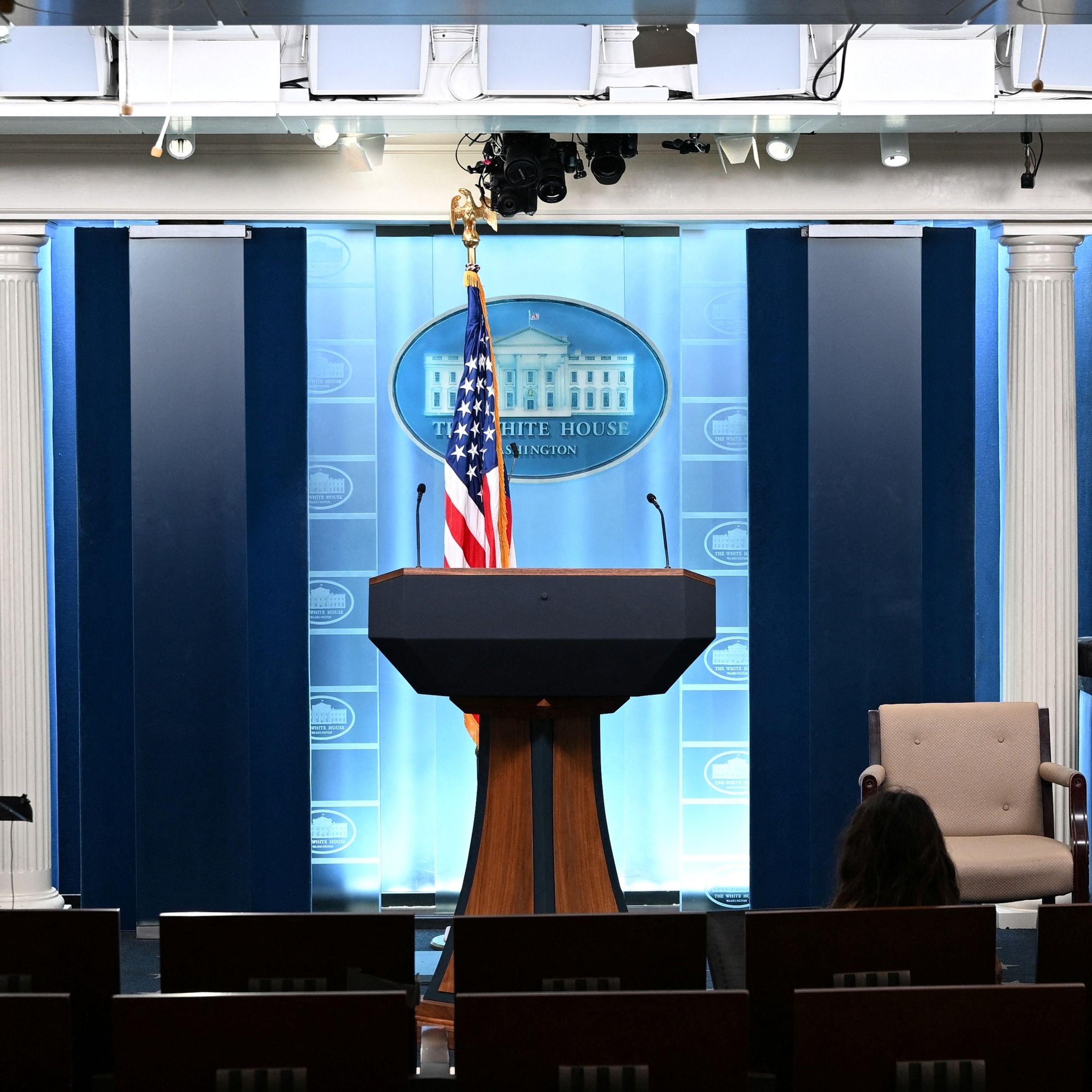
When the president barred Politico, CNN, and MS Now from the White House, the press pool boycotted the president, leaving him without his usual TV coverage. On this week’s On the Media, why media outlets finally banded together. Plus, the legal debate over journalists’ access to the country's highest office.
[01:00] Brooke Gladstone and Micah Loewinger get together to chat about The White House Press Pool’s walkout, why it took so long for them to take collective action, and what it means for the relationship between Donald Trump and the media.
[16:12] Brooke Gladstone speaks with Roger Parloff, senior editor at Lawfare, about about the Trump administration’s legal justifications for banning outlets, and what he learned from attending the hearings this week.
[31:38] Brooke also sits down with Sonja West, professor of the first amendment at the University of Georgia School of Law, about the history of press access being granted, and denied by the White House.
On the Media is supported by listeners like you. Support OTM by donating today (https://pledge.wnyc.org/support/otm). Follow our show on Instagram, Bluesky, TikTok and Facebook @onthemedia, and share your thoughts with us by emailing [email protected].
Hosted by Simplecast, an AdsWizz company. See pcm.adswizz.com for information about our collection and use of personal data for advertising.
Get every episode summarized
Each time On the Media publishes, we email you a written briefing from the transcript — the topics, who appeared, and any specific claims, with the ad reads skipped.
Email me new episodesFree for 3 shows. No card needed.
Transcript ready
756 searchable segments. Every word is indexed and playable.
Full transcript
On the Media — The White House on Mute. Machine-transcribed; use the interactive transcript above to jump the player to any line.
This week we saw a rare coming together of the Washington Press Corps. From WNYC in New York, this is on the media. I'm Brooke Gladstone. No TV coverage of President Trump today, no still photographs either. It's an act of solidarity over Trump's selective White House media ban. The media outlets attorney Ted Butreau said that our key witness is President Trump himself because he is making our case for us. There's something wrong with a country that can allow people to write purposely, and it says, now, if they want to write them that's fine. But I don't have to let them into my, into the people's house. I think in the end, he is saying that the White House is my castle and I can let in who I want and I can throw out who I want. With the ban lifted for now, this battle may have been won, but the President's war on the press continues. It's all coming up after this. On the media is brought to you by progressive insurance.
Here's a helpful fact you might not know. Drivers who switch and save with progressive save over $900 on average. Pop over to progressive.com, answer some questions and you'll get a quick quote with discounts that are easy to come by. In fact, 99% of their auto customers earn at least one discount. Visit progressive.com and see if you can enjoy a little cash back, progressive casualty insurance company and affiliates, national average 12 months savings of $946 by new customers surveyed who saved with progressive between June 2024 and May 2025. Potential savings will vary. MWNYC in New York, this is on the media. Michael Lohinger is out this week. I'm for Gladstone. So the event long awaited but seemingly inconceivable finally happened. Tonight in an unprecedented and escalating challenge to a free press, President Trump
declared a ban on three news organizations, CNN, MSNOW and Politico. No, not bad. This. The development here, the other members of the so-called TV pool NBC, CBS, ABC and Fox news networks say they will not step in to fill the duty CNN was previously assigned to provide of White House TV coverage today as the president prepares to attend UN General Assembly here in New York City. No TV coverage, no still photographs either. It's an act of solidarity over Trump's selective White House media ban. Can a president who craves cameras survive and visibility? We'll get to the solidarity later, but first a quick refresher on the TV press pool. For reasons of efficiency and space restrictions, pool members rotate coverage of the president in tight spaces like the Oval Office Air Force One on trips to Mar-a-Lago and such and then share their video with the rest of the press corps. Now per a judge's order, CNN and MSNOW and Politico are allowed back in the White House.
A 14-day reprieve is their case moves through the courts. As of this writing Friday, it seems that the White House TV press pool boycott of the president has ended. And while the uproar has dialed down for now, it's left us with a lot to learn and ponder. For instance, the depth and breadth of the president's loathing of the media. Here he is on his first campaign trail and at Kinssen, New Hampshire. They're scum, they're horrible people. In Mount Pleasant, South Carolina. Absolute scum, remember that scum. His February 16, 2017 post-election White House press conference. Tomorrow they will say, Donald Trump, ransom raves at the press. I'm not ranting and raving, I'm just telling you, you're dishonest people. But, but, I'm not ranting and raving. I love this, I'm having a good time doing it. As he ever. And he soon followed up with an infamous post labeling the press the enemy of the American
people. Thereby joining the historic ranks of others who've used the same phrase, like, Gerbels and Hitler, Lenin and Stalin, Mao Zedong and Robespierre. So today, just hours after President Trump called fake news and enemy of the people, his administration refused to allow several reporters into an off camera on the record session with press secretary Sean Spicer. The press outlets included CNN and the New York Times. Now what he did last week he's done before, just less extreme. In 2018, he kicked CNN's Jim Acosta out of the White House after a few exchanges like this. President, I'd like to ask one of the members of the United States to ask on the Russian investigation, are you concerned that you may have not concerned about anything with the American giant investigation because it's a hoax? That's enough, put down the mic. You are a rude, terrible person. You shouldn't be working for CNN. But a court order restored Acosta's credentials. In the president's second term, he pushed the envelope even further on personal insults
aimed with particular malice at women, like Bloomberg News White House correspondent Catherine Lucy asking about the release of the Epstein files. She gloried in sliming ABC's Rachel Scott, who in his eyes had another black mark against her being black. Noxious reporter in the whole place. Let me just tell you, you are an obnoxious, actually a terrible reporter and it's always the same thing with you. And CNN's Caitlin Collins, just because. You are the worst reporter. No one to see. CNN has no ratings because of people like you. You know she's a young woman. I don't think I've ever seen you smile. I've known you for 10 years. I don't think I've ever seen a smile in your face. You know why you have to. Trump expelled the Associated Press from the People's House. Twice yesterday, officials banned Associated Press reporters from covering events in the White House. Press Secretary Caroline Levitt says it's because the AP has declined to call the Gulf of Mexico,
the Gulf of America. A court ordered AP's White House return while the case is litigated. Still is. Meanwhile, defense secretary Pete Hexeth imposed unworkable restrictions on Pentagon reporters, pulling credentials of those who wouldn't comply. Pretty much all of them. But he was thwarted again by a judge. So he dug in, closing journalists on-site offices and ending free access to the building. And he's also appealing. On Monday, far-right newsmax tried to cover Trump cutting the ribbon on his new helipad, but his words were lost in the whore and the whine of an idling helicopter. OK, so there is no microphone because there's no microphone because the pool cameras aren't there. So maybe Tim, this is one example of backfiring just a little bit. Obviously, the ramifications are right here. Can't hear what the president's saying. White House tried to seize back the narrative with a launch of Trump TV on YouTube.
Next day, a bullwork reporter responded with a piece titled, I watched six hours straight of Trump TV. Please help me. What's most striking about the president's latest attack on the press corps and so much the extreme nature of it? It was the press corps's reaction to it. The war, as our executive producer, Katarajar's observed, is a strange word to apply to such a disparate and disorderly cohort. Is there a line that once crossed can actually draw them together? Back in 2009, in Barack Obama's first term, no doubt still smarting from the relentless stream of snarky suspicions, Fox News pundits raised about his birthplace, he tried to exclude Fox News from a TV network pool interview with Kenneth Feinberg, the Treasury Secretary's executive pays are. Fox's usual foes, the so-called lame stream media rallied to its defense.
But these alliances are quite rare and short-lived. This one is different. The first question that came to my mind when I was reading about this is why now? Mike and I discussed it and thought you might want to listen in. So we recorded it. Why is the White House press pool standing together? Why not sooner? In the first Trump administration, we had on the press critic, Jay Rosen, who in 2017 had this blog post called Send the Interns. This is just a year into the first Trump administration. And send the interns was about, um, don't cover Trump. He lies all the time. We have to bring his words to the American people, I suppose. So send the interns. Don't waste resources on covering a congenital wire. Exactly. Why are you sending your star reporters to see in a room and do battle with him and inevitably
come out looking humiliated, called terrible names, lied to? Are you not taking your best reporters and having them do investigative work? Anything other than just giving this man a platform to say whatever he wants. And finally, nine years later, it seems in a very roundabout way after quite a bit of damage done to our country and the institution of journalism, they finally stood up. Why now? Well, the media, like politicians, they tend to have one year to what's going on among the public. They don't want to get too far ahead. They don't want to get too far behind what is permissible, what will hurt their credibility, what won't. And Trump, given that he is less popular than he has ever been, given that he is more extreme, more off the wall than he's ever been, given that there's really no place to go anymore.
Yeah. Like, it had to happen eventually and now is as good a time as any. Yes, you know, it's funny. I was thinking about that moment at the end of the Wizard of Oz where Dorothy realizes that she can go back to Kansas whenever she wants. I love this. And is it Glinda, the sort of benevolent sorceress? The good witch of the North. The good witch says you had the power all along. You've always had the power to go back to Kansas. I hear that why didn't you tell her before? Because she wouldn't have believed me. She had to learn it for herself. And that's all fine and good for the end of a movie. But why did it take nine years to get to this point? I think that it takes a certain amount of courage because if you say we're going to boycott, you've just shown that you are not independent actors, but a block. This is a block, obviously, to protect the future of journalism in this country, to keep
accountability alive. The stakes are enormously high, but they risked playing into a Trump narrative. Also their bosses want them to compete. They want to offer a unique product. This undermines that whole business model. So there are lots of things arguing on the other side, but how enormous did the stakes have to be before the press realized that, as you say, and I really love this, they had the power all along. I think by banning MSNOW, CNN, and Politico, he sort of forced them to see themselves as a group, as a coalition, which is the very thing that they have failed to do thus far. I think a great bit of his success has been divide and conquer. He goes after each outlet one by one. He sews each one one by one. He asks the reporter, where do you come from? I hate that outlet. He has different names for each one.
But by lumping them together, he's laid out the carpet. He did the work that they didn't want to do, which was come forward as a unified front. For instance, with the Pentagon press corps, they, months ago, gave up their access to the Pentagon because they refused to sign on to a new list of rules that would restrain their ability to ask officials' questions outside of certain, specially handled scenarios. I mean, it was pretty extreme. I think that the Hegsf restrictions that you had to sign was the practice run for what we have now. And I'm really curious to see what comes next. I do think that all of this bullying, all of this aggression towards the press has worked. I think that he has succeeded in making these outlets and these journalists feel puny. In a way, they have internalized many of the insults that he has spewed at them over
the years. And I think that in effect, they have kind of obeyed in advance. They have sort of ceded the power they had all along because they were afraid to wield it. They were afraid to make a stand. And as much as I want to, you know, celebrate this moment in this bit of progress, I think it's also worth taking stock of the failure to this point. I think we should. I think I see the cause just a little, little sliver of disagreement here. I don't know if they internalized the idea that they were the scum of the earth or slime. I think that the press was in a prolonged state of utter confusion over the fact that the former ideas about civil discourse had gone up and smoke that the chess game, that the press and the powerful play, according to certain rules, Trump just threw the board over. And they didn't know what to do.
They didn't come up with any new rules. Maybe that's what we're seeing the beginning of. One of the ironies of all this is that Trump's obsession with how he's covered and his ratings on the broadcast networks, it's kind of imbued some of these outlets with more importance, his narcissism, his impulse to put the news media at the center of the story, like right now, by trying to ban these outlets. He's giving them more viewership. He's giving them more powers, giving them more authority. Last year, if he had banned these outlets, I think it would have provoked a much bigger response in the news, but I think it would have instilled in me much greater fear. You think it would have triggered a bigger response in the news than there is now? I think it's pretty big. The press are having a field day with this. I just think that the aura of the story is really different. There was a moment where it felt like his power was limitless.
In large part because everyone around him was playing along. What feels different about this moment is that the will to play along is... Waining. It's waning. It's not quite there. Even though this is the action of a would-be dictator, it's not quite as frightening because it just seems like he has no other moves left. He looks desperate. It's kind of funny, isn't it? It is kind of funny. I mean, the jokes on us, really. Back in my theater days, I was in a play by John Webster. It's a 17th century play called a White Devil. Believe it or not. And there was a line I remember. The character spid against the wind and the filth returned in his face. I love that. Coming up turns out size matters when it comes to press freedom.
This is on the media. This week on the New Yorker Radio Hour, the entertainment mogul Ariah Manual on dealing with Donald Trump who was once his client. The president I talked, you're most important client, and I say to him, you can't make me any money anymore. I don't agree with self-enrichment, and I think it's wrong. Ariah Manual joins me on the New Yorker Radio Hour from WNYC. Listen wherever you get your podcasts. This is on the media. I'm Brooke Gladstone. So as we know, I judged this week temporarily, restored Politico's MSNOWs and CNN's access to the White House press room. But on Thursday, the White House had yet to formally agree to allow CNN back into the press pool, even though it was on rotation. So no TV networks were there to document Trump's evening event with China's Xi Jinping.
By Friday morning, CNN, along with the rest of the press pool, was herring footage of Xi and Trump outside the White House, and CNN and her Pamela Brown assured her viewers. CNN's access to the White House has been restored, and the TV pool appears to be functioning as normal. Van or no Van, the president does have a certain amount of, let's call it, latitude and choosing who gets to cover events in smaller, arguably non-public spaces. As of Friday, there had been no event in the tight confines of the Oval Office or Air Force One. So we don't know whether he will choose to exclude CNN or MSNOW if they come up in the pool rotation and possibly trigger another TV pool boycott. So we've called on legal experts for clarification. Roger Parloff is a senior editor at Law Fair. He regularly life posts court cases and hearings, and he was watching the initial hearing on Wednesday
and then on Thursday for the government's response. Welcome to the show, Roger. Thank you, Brooke. Really appreciate you're having me. The Justice Department lawyer arguing the president's case was Michael Vellchick. That's a name actually familiar to some of us. Last year, the Boston Globe reported that when he was a student at Harvard, he wrote a paper for his Latin class from the perspective of Adolf Hitler and in his separate email to a friend, said that mine comp was the quote, favorite book I've read this year. What can you tell me about Judge Kelly or the lawyer for the media outlets, Theodore Boutress? Judge Kelly, I spent a fair amount of time with. I covered the proud boy's case every day. So I forget how many months that was. I think he's a very good judge. He's a Trump appointee, but he and he was very down the middle in that case. He's very deliberative, possibly to a fault. It took some time sometimes, but he wants to get things right.
In those cases, he gave very stiff sentences after the defendants were convicted of seditious conspiracy and in one case, a lesser crime. And Ricca Egetario, he sentenced to 22 years if you remember. Right. And he handled the Jim Acosta case in 2018 during the first Trump administration, which was a very similar, if much smaller in dimension type of case. So that gave us some feeling for where he was coming from. He ruled in Acosta's favor and Acosta got his White House credentials back. Anything to say about Theodore Boutress? In fact, he was in that case as well. He was CNN's attorney there. He's been in a lot of the pertinent cases. He's one of the premier first amendment litigators in the country, especially appeals. Yeah, I've seen him in a Zooian things. Tell me how the Trump Justice Department justified the ban.
You say it was really a post-hoc reconstruction of what actually happened. Yeah, President Trump announced this ban suddenly at 3.04 pm in a tweet on Friday. And it went into effect the next morning. The reasons he gave were that these were fake news outlets, which is his term for outlets that are critical of him. But then four days later, the day before the temporary restraining order hearing, the government gave its response. And they made two pivots. They tried to convert this to a national security issue. They claimed that these three publications had allegedly published sensitive and classified information, although they also went back to the falsehood theme. And then they issued three letters retroactively. They were odd letters, no human being signed them.
They were signed by the White House press office. There was no letterhead. One of the peculiar things about these letters is that the press passes were withdrawn on last Saturday morning, but the letters were sent this week. And they said, you have an opportunity to respond and push back against these allegations by 5 pm on Friday. So actually way too late. You say that's post depravation due process. Now can we talk a little bit about the national security claim they made? Because these articles that the Justice Department cited covered the war with Iran, FBI director Cash Patel, and the construction of Trump's White House ballroom. Some of these stories contained no classified information. It had no relation to national security whatsoever. And we've since learned that one of the stories that the Justice Department used to justify
banning political was based on an authorized background briefing given by a quote, senior administration official speculation is that it was JD Vance. You point out that many of these articles weren't even written by those reporters with a press pass. Yes, and actually Judge Kelly brought that out in his ruling too. These letters named for each publication, maybe three or four stories they were taking issue with. And very often they were not written by people with press passes, which draws into question the whole theory that the remedy has anything to do with the alleged problem. And in two of those cases, the story in question that had been written by somebody with a press pass. That CNN's Betsy Klein. Yes, her story written back in January. She had had her press pass renewed this June five months later, months before her press
pass and everyone else's at CNN was pulled. So it didn't make any sense. It was obviously post-hoc. It was obviously pretextual and Judge Kelly said that as well. Let's get to the constitutional protections that these news outlets rely on. The press doesn't have unlimited entitlements. They can't enter a building where officials work just because they're journalists. They need special passes. But what about the Brady briefing room in the White House? It's a theater that's used for press conferences. And obviously, the press is invited in. It's called a non-public forum. You need a press pass so you can be credentialed. The secret service looks at you. But once you get it, you really can't be deprived of it because of what's called viewpoint discrimination, which is First Amendment protected. But these reporters were also barred from the Brady press room.
Does that have particular significance? Yes. Because the Brady press room is clearly, as you said, a non-public forum. When First Amendment jurisprudence judges have developed a series of concepts to describe the spectrum of behavior we're confronted with. So at one end of the spectrum, you would have a public park with a soapbox and anybody could get up on the soapbox. But there are other forums where people speak and have some First Amendment protection but less like a public airport. And so you have the traditional public forum, a limited public forum, a designated public forum, and then this non-public forum. That's sort of what the Brady press room is. And this has been implicit at least since 1977 ruling involving a reporter named Robert Sherrill. It doesn't specifically talk about that press room.
But it says that even though there are First Amendment and Fifth Amendment rights associated with the right of a White House correspondent to get a press pass and not to have it taken away. It's been given among all the judges at least in the District of Columbia that the Brady briefing room where a lot of bona fide journalists are invited in, you could not exclude somebody based on viewpoint discrimination or as retaliation for First Amendment protected speech. And by depriving somebody of their whole hard pass as a type of viewpoint discrimination as was obviously done here, it's not really contested, would violate those principles. And in fact, what the government said in its response brief is that it believes that DC Circuit law on this subject going back all the way to 1977, so that's 49 years needs to be overruled.
It wants to ultimately take the position at the Supreme Court level that all of this law is mistaken. And the White House is not a forum in any respect and the president can let in whoever he wants and it more importantly exclude whoever he wants. Right now, the Brady briefing room is where those of us who watch those things on C-SPAN or elsewhere see the reporters in their designated seats. That's right. There's that area on the North lawn where people stand up and you see them speaking there. There's a lot of other spaces. The more controversial spaces are the ones that are little. Yeah, exactly. And that brings me to my next question because when you look at the president's ban last year of the associated press from the Oval Office much smaller than the briefing room and the Air Force one even smaller because the wire service wouldn't refer to the Gulf of Mexico as the Gulf of America.
So this case was different. Explain why. Well, first of all, that case is still being litigated. So the outcome of that case we still don't know. We did get a DC Circuit ruling in emergency stay motion. That ruling which is unpublished and is supposed to be non-presidential did go in the direction the government would like by non-presidential. You mean it wouldn't serve as a precedent? That's right. It's not binding on Judge Kelly, though he might consider it. He would pay attention to it. In that case, the majority, it was a split decision two to one. It's a panel of three judges. The two judges said that these smaller spaces, the Oval Office Air Force one, that this is not a forum at all and that he is free to exclude people even for arbitrary reasons including retaliation. There was a dissent by Judge Piller that said that was inconsistent with all prior precedents
and that case is still being litigated. The reason the majority in that case ruled the way they did earlier I mentioned this spectrum. The soapbox in the park, the airport and the briefing room and then the little tiny space like Air Force one. And further to the far end of that spectrum is the president inviting one individual into his office for a one-on-one interview. So if President Trump invites Maria Bardromo into his office for a one-on-one, that doesn't mean he also has to invite Jim Acosta or you or me. That's not a forum at all. And everyone agrees with that. In fact, that same 1977 ruling Cheryl actually sort of says that in passing that obviously he can speak to individually one-on-one whoever he chooses.
You know, it's interesting because during the Obama administration for a while he was holding lunches with a selected group of correspondents and those excluded really got mad and so he discontinued those lunches. That's again the fuzzy ends of this spectrum. Right. Anyway, the majority panel in that stay ruling thought these White House pool areas, the Oval Office and the Air Force one were more analogous to the one-on-one get-together than they were to the Brady briefing room. So what did we learn from all this about Trump's long-term designs on the precedent set in Cheryl V. Knight? Yeah, well his lawyers were explicit in their response papers that they want Cheryl overruled. Judge Kelly has no choice but to follow it, it's binding precedent.
Even the DC Circuit panel can't overrul it. It would have to be the end bank DC Circuit which means the full court about 11 judges, active judges or it would be the Supreme Court. So that sounds like the direction they're going. Draw the beat on this one. What is Trump saying? I think in the end he is saying that the White House is my castle and I can let in who I want and I can throw out who I want and I can raise it to the ground as I have with one third of it without consulting anybody. It's his castle. I think that's the takeaway. So do you think this was a well thought out litigation plan? I'm speculating here but no. It has the appearance more of tantrum which after the fact the lawyers came in and tried to spruce it up and we've seen that pattern in the past. Okay. Roger, thank you very much.
Thank you Brooke. Roger Parlov is a senior editor at Law Fair. Coming up, our legal precedent and constitutional principles and protections really enough to shield the freedom of the press. This is on the media. On the next radio lab we went out and asked people what they think about grass. I love it. I like the smell. It brought up feelings. Playing cats for all the memories. Oh, go rudges. But did you know grass is the key to one of the most incredible stories of human history. On the next radio lab, grass. Grass. Grass. Grass. Grass. We bring you Grass Apes. Listen wherever you get your podcasts.
This is on the media. I'm Brooke Gladstone. So it was some 60 years ago that Robert Sherrill, the Washington correspondent for the nation, was denied a press pass. 11 years later, the DC Circuit Court of Appeals ruled that Sherrill had not been given due process and that the First Amendment limited the right of the White House to arbitrarily deny a press pass to a journalist. This Cheryl case was really just sort of sitting out there and never had gotten a whole lot of attention. Kanye West is a professor of the First Amendment at the University of Georgia School of Law. So even people who practice in this space who know a lot about the rights of the press, Sherrill was just not a case that we talked about. I don't think I really even taught it in my media law classes. And I think a lot of people also think, sure, I can't just walk into the press brief ring room and say, I have a few questions for the president. So why can't they kick out anybody that they want to kick out?
But that's not how the law works. And I think when you think about it a little bit more, it becomes pretty clear how it can't be how the law works. Because if we did it that way, then we would let the president simply have a so-called press pool in the White House that was completely just filled up of people who were giving him the kind of coverage that he really wanted. And that is not a press pool. And this fits very neatly within the First Amendment jurisprudence about once the government has established this forum where they say we are creating this space for expressive activity, then they cannot discriminate on the basis of viewpoint. And President Trump tried to revoke Jim Acosta's pass in 2018 after a tense exchange. In 2019, he tried to suspend the pass of Playboy magazine's Brian Karam after an altercation in the Rose Garden. These cases have been covered in the media as First Amendment cases, but actually they
got their press passes back because the courts ruled that their constitutional right to do process had been violated, right? That is absolutely right. And it makes it kind of interesting to me why we are in the place we are today with what we saw going on this week because we do now have this series of cases, multiple cases coming from the Trump administration where the same basic facts have happened. They wanted to take away a pass from a reporter. The court told them you couldn't do this and the reason they said is because you didn't provide the appropriate process. But I almost hesitate to say it because the last thing I would want to do is give the Trump administration a roadmap on how they could do this. But the truth is this would be a much harder case if they had taken the steps that the courts in these cases in Cheryl, in the Acosta case, in the Karam case, had told them if they had said, here's the set of guidelines we're going to enforce.
And then whenever the reporter did something that they didn't like, if they said we are taking you away your press pass because of X and a point to something in the guidelines, if that reporter a chance to appeal or be heard about that and then take it away, then we would be having a conversation about what was their true motive for doing this, right? Did they really take it away because of this neutral interest that was in these pre-announced guidelines? Like national security? Like national security or is this pretextual because you didn't like the coverage that we gave you? And that would be a harder discussion in the courts to have. But as they continue to just not provide this process, to me anyway, these seem like very easy cases. Plus, if Trump hadn't said the quiet part out loud. President Trump writing the following on Truth Social, quote, I am proud to announce that effective immediately. I am banning fake news CNN, MSNOW, who recently changed their name from MSNBC due to lack of viewership and credibility and political from the White House as a result of their constant
reporting of fake news. She goes on to write media outlets shouldn't be able to constantly write or report fiction and lies when they're covering the president of the United States, the Trump administration or the United States of America, other fake news media outlets to follow. Thank you for your attention to this matter. Why did you mean this fine now? Is there a particular reason? There's no reason. No, no, just because you know, it's really just a few million stories over the last few years you get sick of it. And in fact, the media outlets attorney Ted Bucho's, he said this in court, he said that our key witness is President Trump himself because he is making our case for us that these passes were taken away because you didn't like our coverage and that's the one thing you can't do. And we do have a counter example from the Biden administration? That's right. So, the Biden administration apparently was listening to these cases where we should say that the Acosta and Karim cases were in Trump's first administration.
That's correct. And the Biden administration did the things that the judges in those cases said that you were supposed to do, which is they set out ahead of time accreditation standards that were considered to be neutral. In this case, what they said was you can get a White House press pass if you first get accredited by either the Supreme Court press gallery or the Congressional press gallery. It is a little bit odd and I do think there could be reasons to challenge that this isn't the right way for them to do it. But nonetheless, they at least did some of the steps that the judges were telling, which is they told us ahead of time, these appear to be relatively neutral standards. They're not based on are you conservatively leaving news outlet or liberal news outlet or what have you written about us in the past. And when we had a reporter who challenged this because they either couldn't or didn't want to be able to first go get that other accreditation, the court said, no, this was fine because you followed this standard and there was nothing viewpoint based about who
gets the passes and who doesn't. You're referring to the Biden administration winning against Cameroonian journalist Simon Atiba who lost his press pass and the decision was upheld in court probably because of lack of accreditation. And then there's Trudy Feldman, a freelancer who was suspended from the White House for 90 days in 2001 after she was caught going through a press aides desk. So there are legitimate reasons a reporter can lose access to the briefing room. Right. Absolutely. Why and how the administration decides to go about doing this? So when defense secretary Pete Higgseth essentially booted the Pentagon press corps from the building by trying to make them sign rules that would profoundly compromise the news gathering process, how does that apply here? The issue there was a little bit different than what we've seen with these due process
cases. There they did try to give us the rules. In fact, that was the whole issue as they wanted everyone to sign on to these credentialing rules and basically every news outlet refused and instead went to court challenging them. But there the legal problem at first anyway was that the judge found that the standards the Pentagon had set out were too broad and too vague. And we care about laws being clear enough for us all to understand what kind of conduct is going to be allowed or not allowed in any area of the law. But much like with due process, we have an extra concern about what we call vagueness when it's the first amendment because if people can't clearly understand ahead of time what they're allowed to say or not say what they're allowed to publish or not publish, we are at a great risk of a chilling effect or at a great risk of people simply choosing not to speak or not to publish things they have a constitutional right to say or to publish. So when we have a rule that is unclear, we call it unconstitutionally vague and that is
what the court decided with that initial Pentagon ruling was that it wasn't a problem that they weren't telling us ahead of time. The problem was that the rules they had set out were too vague. The president apparently wants the Supreme Court to overturn the precedent in Cheryl V. Knight. Do you think any of these cases will go to the Supreme Court? So there's always two separate questions that are within that one question. The first question is whether someone will ask the Supreme Court to get involved in it. And then there's the question of whether the court itself will decide to take any action. So the first question is will the Trump administration go to the Supreme Court? They like to go to the Supreme Court? They go to the Supreme Court frequently. I would not be surprised at all if we ended up seeing something eventually making its way to the court. The bigger question is obviously is whether anybody at the court would be interested in reevaluating the Cheryl case of taking this.
I feel like even if you were interested in exploring more closely the powers that the president has to control the access of the press to the White House grounds or Air Force One, this is not the best vehicle to have a real discussion about what exactly the boundaries may or may not be of when the president could do something like take away somebody's press badge. So what do you think about the state of the free press in the US and the strength of the legal protections that undergird it? I've actually spent my whole career studying the constitutional and legal protections for the press. And long before the Trump administration, I was writing about how we were all a little overly confident about our legal press rights today that there were more gaps in the protections than people realize, particularly when it comes to constitutional protections, that the
truth is the Supreme Court has been very hesitant to embrace the idea that there might be unique rights and protections. Members of the press need in order to effectively do their jobs on our behalf, the jobs of checking the government and delivering to us newsworthy information. Is that why the case is so often hinge on due process instead? It is true that the court is very hesitant to certainly ever say that the press has additional rights that members of the public don't have. And something like this is a case that raises that issue, right? What we are talking about here are having special rules for the press and what those rules should look like. Now in this case, I think we do have some basic First Amendment principles that are still at play, which is once they've created the forum, once they've given somebody liberty interest like a press badge, you can't just take it away based on viewpoint discrimination. But there are other situations where the Trump administration has pushed boundaries and
shown us that we might not have all of the legal protections for the press that we think we need or we may be thought that we have. Now that being said, we have a lot of press freedoms and we have a very strong First Amendment. But we see people getting picked up and cuffed and taken downtown for expressing free speech rights. In the Bush administration, somebody was arrested for wearing a t-shirt. Oh, we have absolute issues still about all of our free speech rights and we've definitely seen that in the Trump administration, also to different ways that this administration has tried to limit our free speech rights. We've seen them looking at every possible lever they have as a way to try to weaken or undermine the press. And the law we have supporting the press has sometimes held and sometimes it's not been as strong as we would like it to be. So what would you propose as a remedy? I in particular have an interest in the First Amendment's press clause because the Supreme
Court's jurisprudence has over the decades put all of its focus on the First Amendment's speech clause. Our speech clause is incredibly powerful. It is robust. It gives us rights that we all enjoy. I think that's wonderful. But we also have in the First Amendment text that tells us Congress shall now abridged our freedom of speech or of the press. And the Supreme Court has honestly given very little to know emphasis on what that press freedom actually means. Here's something that keeps me up at night. We always talk about how if Trump actually defied a judge's order, I mean, not just for a minute, like in this case, but for good, then we'd be in a constitutional crisis. On Thursday, reporters from MSNOW, CNN, and Politico were still being barred entry to the White House after the judge ordered that they be let back in.
The judge issued that order really early in the morning and maybe the White House hadn't gotten the message by the time the reporters arrived. But if the timing had been different, would that have sparked a constitutional crisis? What would that have looked like? What would be the consequences of that? Yeah. Our system relies on the idea that when the federal court speak, the other branches will respect what it is that they have said. And we've had certain times in our history where that has been challenged. And certain times where we agree that we had a moment of constitutional crisis. One of the most famous ones was when a number of the Southern states refused to follow the Supreme Court's ruling in Brown versus Board of Education and refused for a very long time to actually desegregate their schools, even though the Supreme Court had spoken. Now in these cases, we haven't had the administration explicitly refused to follow a ruling of the Supreme Court. So maybe not quite constitutional crisis yet, but just because we don't say it's a crisis,
doesn't mean that it's not serious. I think it is very serious when we have a federal judge issue a clear order and the White House chooses not to comply with it. It took a second trip back to court and more pressure before it looks like the system was going to hold. I don't think that's something we should just brush away. And again, so many of our legal principles get heightened when we're talking about First Amendment rights. Yeah, you say that there's a special harm that one thing that is looked at differently with the First Amendment is delay? Yes. The courts have said that even a delay in your right to speak is in itself its own kind of First Amendment violation. And that concept is heightened when we are talking about the news. So if we have major news outlets who believe there is news reporting that they should be doing every day or every hour or every week that a government stops them from doing that,
that isn't itself its own special kind of harm. Even if the information comes out later, the delay itself was a moment in which our free press believed there was information that should have been published that we as the public weren't able to receive. And we saw this in the Pentagon Papers case where we had the New York Times under a federal injunction saying they could not continue publishing their stories about the Pentagon papers that had been leaked in that case. And the Supreme Court took this very seriously. They acted incredibly quickly in that case because they knew it was a problem, even if we were later going to get these stories that simply the delay in speech was in itself its own kind of First Amendment violation. So I think that adds even more to what I consider the constitutional seriousness of a situation like this one if the Trump administration had continued to not obey the federal judges order. So when do we ring the alarm bell?
I don't know. I think there's a lot of alarm bells ringing. It's nice when it holds for a while. But yes, I definitely think we're keeping an eye on the moment if it ever comes where the administration doesn't follow what the Supreme Court says. But that doesn't mean we can all just shrug at the smaller moments of constitutional defiance by the Trump administration. Sony thank you very much. Thank you so much. This on U.S. is a professor of First Amendment law at the University of Georgia. It's sick. I mean, there's something wrong with a country that can allow people to write purposely negocers. Now, if they want to write them, that's fine. But I don't have to let them into my, into the people's house. And that's the show. On The Media is produced by Molly Rosen, Rebecca Clark Calendar in Candice Wong.
Travis Mannin is our video producer. Our technical director is Jennifer Munson with engineering from Jared Paul, Sam Bear, and Greg Ripon. Eloise Blondio is our senior producer. And our executive producer is Katya Rogers. On The Media is produced by WNYC. Micah Lowinter will be back next week.
More episodes


