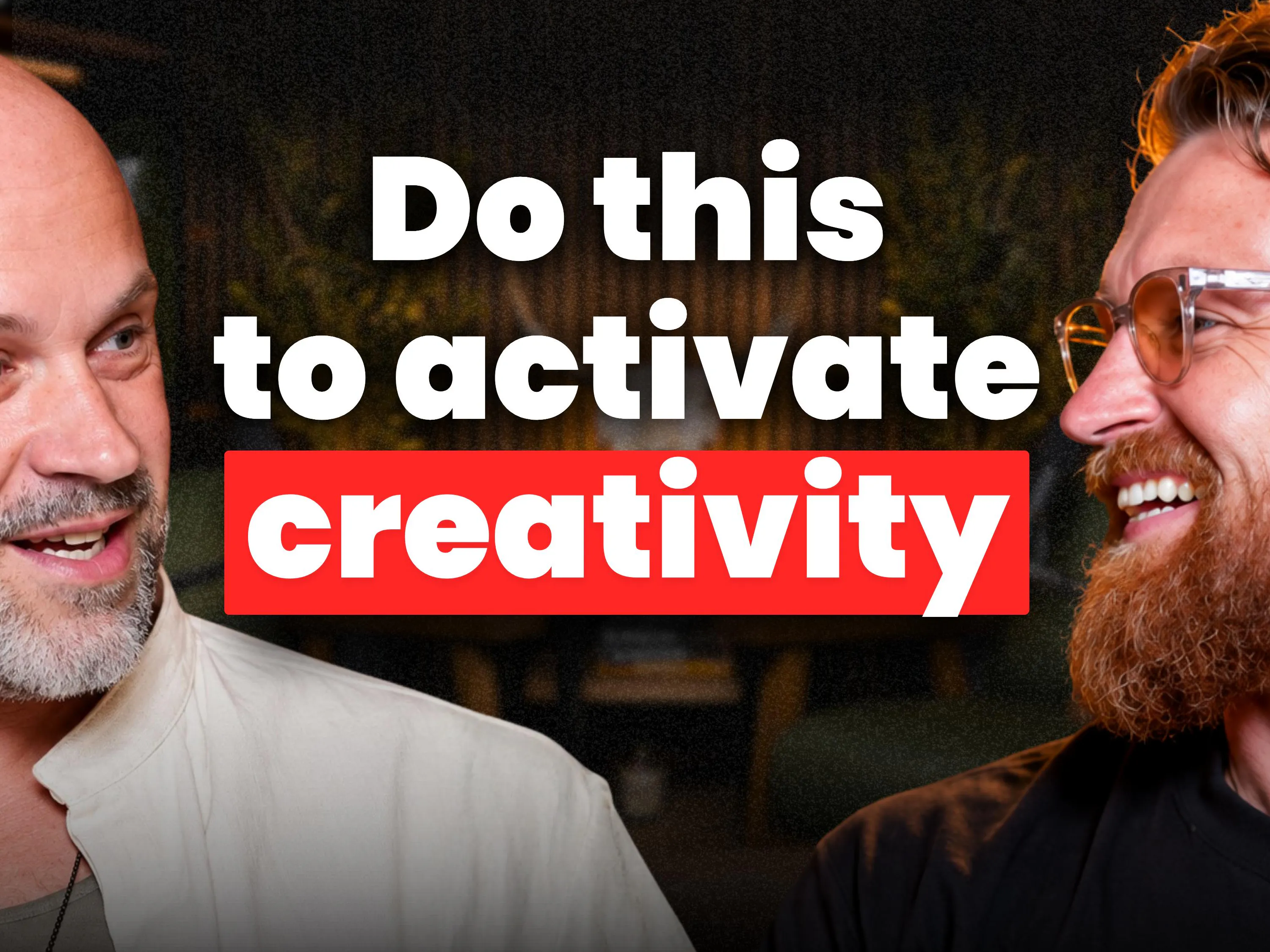
This Ritual Allows You to Channel Creativity on Command | James McCrae
Get every episode summarized
Each time Radical Health Radio publishes, we email you a written briefing from the transcript — the topics, who appeared, and any specific claims, with the ad reads skipped.
Email me new episodesFree for 3 shows. No card needed.
About this episode
“Try to explain to me what it's like to know that 100 million people have experienced your poem. All I did was post on Instagram one day and then it just took on a life of its own. There's a phrase I like to say, it's not about being good at creativity.”From the transcript
Get every episode summarized
Each time Radical Health Radio publishes, we email you a written briefing from the transcript — the topics, who appeared, and any specific claims, with the ad reads skipped.
Email me new episodesFree for 3 shows. No card needed.
Hosts & guests


Transcript ready
815 searchable segments. Every word is indexed and playable.
Full transcript
Radical Health Radio — This Ritual Allows You to Channel Creativity on Command | James McCrae. Machine-transcribed; use the interactive transcript above to jump the player to any line.
Try to explain to me what it's like to know that 100 million people have experienced your poem. All I did was post on Instagram one day and then it just took on a life of its own. There's a phrase I like to say, it's not about being good at creativity. It's about creativity being good for you. It will just relax you. It's good for your mental health. It's you're truly energizing. But also, if you're not happy with the life that you have, creativity is how you can find a new way forward. It took a lot of twists and turns and I had to pivot my career many times. I learned that the same creativity that can make someone good at painting or writing or music, you can apply that creativity to your life. Hello friends. My guest today is the poet James McCray. And we begin this conversation discussing his incredibly viral poem instructions before visiting Earth. So I thought it might be nice to actually read you his poem before diving into the conversation. So here it is, instructions before visiting Earth by James McCray.
In the event that you wake up and find your soul separated from sauce and manifest into material form, don't panic. Your condition is only temporary. You have been selected for the opportunity of human incarnation. This 3D simulation is designed to break up the monotony of eternity by giving you a fully immersive experience as a distinct ego identity. Your body will serve as your physical avatar as you navigate a dense and dramatic reality. There will be many distractions causing you to forget your true nature and origins. You will experience a range of emotions from joy to loneliness to despair. But remember, no matter what trials and traumas you encounter, your soul remains perfectly safe. At times you may feel lost or afraid and this is totally normal. If you ever need guidance, simply slow down your busy mind and bring awareness to the quiet place inside of yourself. On this planet, nothing is permanent. People and things will come and go. You will fall in love and form sentimental attachments only to lose everything that you hold dear.
So cling to nothing too tightly, even yourself. And when it's time to let go, let go with grace, for nothing is owned, only borrowed. And as you walk among the people on the planet, try to be a good guest, tread lightly. Remember that you are only visiting, so don't make a mess. Listen more than you speak. Give more than you take. Don't keep your soft heart locked inside a glass cage protected from wear and tear. You'll never make it out alive and time passes quickly. So come back with some battle scars and good stories to tell. Now, ladies and gentlemen, let's get into it with Mr. James McCrye. James, try to explain to me what it's like to know that a hundred million people have experienced your poem, instructions before visiting Earth. Yeah, that's a good question. I've been thinking about that. It's a huge number, dude. It's hard to even understand what that means, I think. And it's still like an unreleased poem. Right. Quickly, the book hasn't come out yet. It's funny because I've been writing poetry my whole life since I was like 14. So I've written hundreds and hundreds and hundreds of poems that no one will
ever read. And a few months ago, I just sat down just to write another one. And it was called instructions before visiting Earth. And I used that title as a prompt. I was like, if there were hypothetical instructions before visiting Earth, what would they be? And I just made it up. And in hindsight, I was pulling from a lot of references that I've studied over the years from the Vedic traditions to Buddhism, to Indigenous wisdom, to a Course in Miracles. And I sort of synthesized it together into a short coherent poem. And I just posted it on Instagram one day, not thinking anything of it. And it just little by little just started to go viral. And before I know it, like there's a famous DJ that put it in his set, Ekochela. Oh, no way. And there's this like, couture fashion line in Paris that created a fashion collection based on it that was covered in Vogue. Wow. And then people just keep recording
videos of themselves reading it. So it's like, all I did was post on Instagram one day. And then it just took on a life of its own. Literally, yeah. I just think back to all of those hundreds and hundreds and hundreds of poems that I wrote that no one, again, has ever read and never will read. But as a writer, it takes that practice and that repetition. So then eventually, you'll just accidentally write something that is impactful. So it's cool. I think that being an artist is sort of being a vessel for source. So I'm just grateful to have been able to channel it through me. And now it really has a life of its own. So it's satisfying as a writer to see something that people really connect with. Yeah, it's very satisfying. I like that framing of letting it come through you. And I'm curious about what your relationship to that is. Different people have called it different things over the course of time, like the muse or connecting to source.
Like, sometimes I've been a creator myself in many different domains, but predominantly on just what is now being called, yeah, content, basically just sharing thoughts. And the best ones that I find, and never, they're always surprising, like you said, like you don't really think much of it. You're just sharing something that almost doesn't even feel like it's yours. It's like moving through you and it just feels very flowy and you're not overthinking it. There's no strategy around it. You're not engineering a hook or any of that bullshit. You're just sharing from the heart. And it's interesting to me to try and like figure and decode what that is. Like for you, is it a process of clearing? Is it a process of stillness? Is it just alchemy and the chaos? Is it all of the above? How does one become an alchemy of what is going on? All of the above. I think that there's various parts of the mind. And the mind isn't just one thing because we've got the conscious mind and the subconscious mind. You've got your ego, but you also have your intuition. So I think being a creator is about widening your capacity to access your subconscious.
Because that subconscious is a very mysterious place. It's like we don't own it. We own our conscious mind, but that's very limited. I compare it to using a computer. If you're on a computer, using your conscious mind is like accessing only the hard drive. So there's some files that you stored locally on your device and you can sort of access them and move them around. But if you can open up a portal to the subconscious, that's like connecting to the internet. Yes. Because suddenly you can download files from sources beyond yourself. And I think that's the name of the game when it comes to creativity. So that subconscious realm, the ancient Greeks called it the muse as a metaphor. There's this goddess spirit that would come and whisper ideas into your ear. Carl Jung would say it's the collective unconscious. And it's this kind of shared space that we all have access to. And we can all borrow ideas from there. That's why some people around the world will have a similar
idea at the same time. We're tapping into the same collective unconscious. And I think that various forms of channeling, whether you're channeling in a seance or you're channeling other dimensions or aliens or some people would channel Jesus or just even that relationship with God through prayer. I think these are all portals into that subconscious realm and your intuition is the portal that gets you there. So for me as a writer, it's so important to cultivate mindfulness. Just to keep that portal open. So I meditate every day before writing. And you know, even I'm less into like psychedelic experiences these days. But certainly having tapped into those realms from time to time over my life, it sort of gives you a familiarity of the territory. You at least know that
there's more true reality that something exists out of that. Something going on out there that we're not quite sure what it is. But it's available. It's available. And it's sort of about getting comfortable letting go of this known world that is represented by your conscious mind. And sort of loosening your grip to what's known. And venturing into the unknown of your subconscious and seeing what you find. So I think being an artist is sort of being an explorer of consciousness. You go venturing into the unknown and you're driven by curiosity. And you just stumble across new ideas and then you bring them back in the form of creative expression. I think that's the best art is. Yeah, that's cool. It's, I've always been fascinated by like young, you mentioned young and I've learned about his stuff vicariously through other teachers and then even dove into some of his books directly. And it's not the easiest stuff to get into, particularly at first because
it's almost like it's so interesting. He's got such an interesting thing going on, young worries, highly intellectual, but he's very out there in a satiric at the same time. And if you try and read it just through the the mind's understanding of logic and understanding it's very hard. Like there's this inner standing though when you're reading these things. It's why you poem did so well because what it is doing, it is resonating with people not necessarily the mental level. They're not going, yes, what a logical sound argument James is making here. No, it's something inside of them is going like, oh, yes, like that's it. That's that's like this connection to whether it's the shirt on conscious, like the collective unconscious or that deep wisdom that knows in our bones that were made for more. But it feels to me like a lot of people I think are disconnected from their subconscious. They're almost locked out in a certain way by the noise of modernity. I'm sure because you create, because you write and because this is the nature of your work is to try and get people to tap in. Like what do you experience as being what separates people from that? What is
blocking them from better intuition? A lot of things. I think it's the way that society is set up. You know, I think that another access point to the subconscious is through our own bodies and sensitivity to your body. Because I think that feeling and the energy we hold and our emotions, there's a subtle intelligence there that is beyond what the conscious mind can access. And I think that modern society in so many ways has us all on high alert big time. You know, there's always a new crisis and with the internet, we can see things that are happening around the world every day that are horrific beyond words. And we're supposed to process them. And so we're overly locked into this ego mindset. And the ego has a role and a purpose, right? Like it's sort of like
the part of us that tries to protect us. Like I am an individual. And if there's a threat, like I'm going to be on high alert and like be locked in to protect myself from that threat. And most of life should not be in that state where you're in this hyper vigilant part of your brain that's always turned on. But that's the world we live in. So it's so important to tune that out. Like it's so important to quiet the noise. There's so much noise. There's so many opinions. That's unbelievable. Everyone's got a hot take. And it is overwhelming for everyone. And it's so important just to soften the grip of our own mind and just like sink into the body and feel comfortable in your own animal body. And that's why self-care is so important. And just
like being healthy so you have a good relationship with your body. Because that's going to just put you in a relaxed state. That's going to soften that edge of the ego. Because you need to be able to listen. And if you're always on alert, it's really hard just to relax into that state of listening. So just being sensitive to your body and what it's telling you and in cultivating that relationship goes a long way. I picked up this nugget from an old Alan Watts video. I was listening to it coincidentally early one morning, a while back going to the gym to move my body to have that relationship. And he just referenced this little thing and he called it the cult of seriousness. He was calling modernity a cult of seriousness. And since then it's just been so sticky for me. I've been talking about it a lot. And I think one of the core tenets of the cult of seriousness is it's put people up in the head exactly as you were just describing. And literally Tony Robbins has that line. If you live in in your head, you might as well be dead because it's a disembodied experience
to be up here, to be constantly consuming, to be constantly run by the mind, this prediction and protection machine, this fear factory. And it does really cut you off from this intuitive highly intelligent. You said it's a subtle intelligence, which I love that distinction because at first, it is a subtle intelligence, but don't mistake subtle for being less intelligent. Once you tap into it, it's profoundly more intelligent, I think than the mind. The mind is on its own ego trip because it thinks it's so intelligent. Oh, look at me. I know all these things about all this stuff. And the reality is we don't know shit about fuck as they say. But the body can find a home there, even in the unknown. But if we're so disconnected because of culture, this cult of seriousness, fear, productivity, dismorphia, always something to do, always optimizing, oh, you were doing great. Now there's AI. You can do 10 more things in the same amount of time. And man, it's just, it very much gets us stuck in our head. It very much disconnects us from this. And I think it's very important to have this conversation about just how, like finding a path back to, however you
get there, for some people, it might be dense meditation, you mentioned breath work. There's so many avenues to get back in. But firstly, we need to break the spell, the illusion that people are under that there is even a possibility to not be so stuck up here because I think so many people are stuck in between areas. You know, the mind is very good at solving problems, but life is not a problem to solve. Yeah, well said. Right. So I try to think as little as possible. Like certainly there are times when you need to think in problem solve and plan. And the mind is great for those things. But if you see everything in your life as a problem to solve, you're going to be on a never ending hamster wheel and you're going to drive yourself crazy. So it's like being comfortable with the unknown. Because I think that's what worry is. Worry is the mind trying to cling to a semblance of control and certainty. Yeah. You want, we want to know what's happening in the world. We want to know where it's all going. We're very comfortable when we have it all figured out and we're very uncomfortable
when we're in that unknown place. And the truth is that this whole reality is unknown. Yeah. You know, we can only know like what can the mind actually know? We can know very little things. We can know how to you know, drive our car to where we need to go and we can we know how to turn on our computer. But we certainly have no idea how that computer truly works. We don't know science only can prove so much. Religion can only direct us to certain things. It doesn't really know something conclusively. So I think it's so important to recognize how little we know and be okay with that. And to be comfortable in the uncomfortable and appreciating the mystery of existence. Because this is all a mystery. Where do we come from? Where are we going? We have guesses, we have metaphors, but we can't know for certain. We shouldn't try to know for certain.
Yes. Well, you know, maybe when we'll maybe we'll know when we die. Yeah. That's how it feels. But I think that being alive in this 3D human experience is it's an experience. Yeah. You're not supposed to, you don't get it a reward for figuring it all out because you're not going to do it. I don't think the truth of the universe is comprehend the ball to the human intellect. So it's like, yeah, figure out what you need to do and you know, strategize how you need to, you know, do what you have to do. But for the most part, sink into that mystery and appreciate the unknown with a sense of awe and reverence for this vast indescribable reality that we're all living in. Yeah. And that shifts you into maybe like a little bit more gratitude for the for how profoundly strange things seem at this current moment. Now I'm sure granted that every generation before us has felt something similar, like, dude, it's just getting so weird. And this might be the end of the world. That's probably the oldest religion in the books, right? It's thinking that the sky is falling. But it does feel,
because we're alive right now, very strange, very complex. But maybe if you release the grip, as you said, on needing to know what that all means and just can be in awe and wonder and mystery and heartbreak and bliss and all of the above, there's just this what it is. And there's only one way to find out, which I think is death. And oddly enough, we've got a culture obsess with not dying. And it's just like the whole thing is so sticky. It's so sticky. It's funny. It's like we're all it's like the kid in the car on the road trip and they keep saying, are we there yet? Are we there yet? And it's like no, they got hours to go, but the kid wants to know, but they can't know. It's sort of like that. But no, we certainly are in an interesting inflection point in human history. I like how Terrence McKenna, oh, I love that you go in here. Novelsy, dear. Frased it. Yeah. Terrence McKenna talked about how more stuff happens in one day today, more stuff, more data, more activity is happening in one day, two day, then happen over the course of a million years, a billion years ago.
In other words, we're sort of at that we've been accelerating as a species for a long, long time. I'm sure the printing press was a huge technological innovation. So was the industrial revolution with factories and then cars and airplanes and computers. And now it's just like that snowball has picked up so much momentum. And now it's just barreling down the hill with so much force. There's no stop. And there's no stop. So I do have sympathy for how much we are on high alert as a society because we are going into weird places. I also think that humans do nothing better than adapt. That's what we do. And we'll continue to adapt. And I think that that's how we develop superpowers. Frankly, you only can pull out of yourself what you
have to in order to meet that moment. It's like you hear about someone who's, if there's a baby that's trapped under a car, you can summon the force to lift it up. Superhuman strength in that moment that was very human. Exactly. It is not accessible again in the ordinary consciousness of not needing it. Right. So I feel like we're facing such just crazy acceleration. And we don't know where it's going. And I think it's going to pull out of us an intelligence and this power. And I mean like an inner power, not like a force power, but this sort of inner power of intuition and wisdom. Yeah. To meet the moment that we're in. Yeah. And that's how we'll get through it. Yeah, I hope so, man. I feel similar. I feel hopeful in that sense because I think we're all collected. It's the same bad trip for all of us, let's say, in the sense that as it is going to get increasingly more complex, the genie is out of the bottle at this point, let's say. And McKenna
talked about this in terms of, you know, if you just look at history and as much as there has been troubles and strife, you can't deny that the complexity of the modern day is more complex than arguably it's ever been, at least in our known history. And that we as the humans are the most complex thing in nature, because we are everything that nature is plus AI and art and poetry and sex and violence and politics and religion and all of these things. So it's just so complex. And I think it's going to get to a point where we, we do realize what you started this conversation with, we can't navigate that from the head because we don't have the maps, we don't have the tools, and we're entering into a brand new world almost on a weekly basis at this point. The mind probably can't find its space in, but maybe something else like a better integration between the mind and the spirit, the soul, whatever you want to call it, an integration of the higher self and awakening of the higher self, perhaps forced through this uncomfortableness. Like you, you mentioned psychedelics earlier, like one of the things that people who have gone into that realm of experience oftentimes is, and they might reframe it now and say, actually, there is no
bad trips. There's just difficult trips because you do end up getting what you need kind of thing. And maybe that is what we're doing right now culturally. 100%. I love that analogy. It's like, this is the bad trip. This is the bad trip that we need to wake up. And I think ultimately, what we need is a new myth. Yeah. You know, because throughout history myths have been the bedrock of civilization, the oldest technology we've got. Yeah. Yeah. I mean, all of our laws and values in any given society is extracted from the mythology of that society. In other words, there were parables and stories, maybe some are true and others aren't. Maybe some are based in truth, but expanded upon. And these become these stories that we've together, a people. Yeah. And it's like this shared understanding of morality and what life is.
And we've accelerated so much that we have lost touch with any semblance and connection with our own mythology. And part of that is due to human migration over the years, myths are often very localized. And then once you sort of transplant it and move from Europe to America, from Adjunis, or whatever, you sort of lose connection with those that indigenous heritage where mythology is rooted. And now we're all just sort of living around the world. And there's been a lot of just like cross-pollination of cultures, which is great. But it leaves us without this unifying myth to bind us together as a society. So I always talk about art as being a place to plant the seeds of new mythology. Like what are the, what are these unifying myths that we can plant in the collective consciousness today that can take root and grow into the values and the laws
of of a culture? It's a great quote from Plato in his book The Republic where he talked about the power of music. And he said that I'm going to paraphrase, but he said that the state should always fear when new modes and styles of music come into fruition because new modes of music can fundamentally shift the culture. And it's funny because he meant that as a way to actually suppress new music in order to preserve this republic. But on the flip side, it shows the power of art to impact culture. It does, yeah. And I think that laws and culture and society are downstream of art. Because again, art is coming from the subconscious. Art is an act of channeling
from spirit. So that's where truly, truly original ideas can come in is you download them from source. There's not a lot of downloading from source that happens in politics. No, they're reacting to the culture. Yeah. But culture responds to the artists who are downloading from source. So it's like you have to download new ideas and plant them into the collective unconscious and give them a chance to spread. Yeah. And this is the essence of memes and memetics. Right? A meme is the smallest unit of an idea. So that word actually was invented by the evolutionary biologist, Richard Dawkins. And he was using it to compare how ideas spread to how genes spread in biology. Like a gene is the smallest unit of biology. And they replicate and
they spread. And occasionally there is a gene mutation. And if that mutation is advantageous to that biological system, over time, that will become the predominant gene. And this is the nature of evolution. So memes are the same thing in the world of culture and ideas. A meme is just one little idea. And if it's advantageous to that culture, it will spread and it will replicate. And it can go viral in a society. So in a way, we're all, if you're an artist, if you're a propagator of ideas in any form, you're planting memes in the collective conscious. And then they spread and then will eventually become the predominant strand of ideas in that society. And then the politics have to react to that. Well, it's such a fascinating reframe. And the politics in
some respects are, let's call it the dominator culture, not just to paint politics as a bad guy here. But in some ways probably resists also these new memes because newness is changed. The ego doesn't like change. Everything is at egoic and head-e society. And also we've unfortunately got ourselves in this position where much of the institutions that are supposed to look after has been captured by corporate interests. And now they've become businesses, essentially. And business is heartless. It's mostly at the expense of the people, not for the people. So that's why, you know, when you were saying that, I'm getting flashbacks of like, okay, of course, like the psychedelic 60s. That was a huge movement. And look what it birth. Like a half of the crowd over here, experiencing a whole radical different way of being, the solution of ego, a oneness. And then the government saying like, oh, of course, we've got to respond to this. But what we're going to do because these these hippies now don't want to go and fight in our foreign walls. They're now standing outside of our buildings protesting like, wait, why are we going to Vietnam and killing
these people? Like, what is this all about? What is this? So now what do you do? Well, you respond to that in an unhealthy way and you launch the war on drugs, which was never a war on drugs. It was a war on consciousness because it was inconvenient to have that adaptive phase. And then you just go generationally, like the 70s had a moment, the 80s, the 90s. It's always responding. So when you look at it from that zoomed out perspective, I think you spot on. It is like, culture is being seeded by these new ideas, this new art, whether it's music and politics and these top down systems are just trying to like adapt to it, stump some of it out probably. It's so that's such an interest in a refreshing reframe. I'm sure there's a biological equivalent of what tries to stop the new genes from spreading. So I guess they serve a role in nature. I mean, that's ultimately what I believe as well as everything serves a role in nature. Right. And it would make sense why there would be gatekeepers trying to stop new ideas from spreading because ultimately they're trying to protect the system because the system is what we have and
it keeps everyone relatively safe and like, it's hard to create a whole new system. Correct. So it's only logical that people would try to defend that system. Yes. So I think there's a natural response to that resistance, but it's a dance. And it's about, you know, oh, can it, can it, some ideas break through and then the movement gets you know, halted. Yeah. And then the next generation comes along and try something different. Yeah. Or, you know, they're going to zig instead of zag and little by little, that's how it works. There's no, nothing's easy in life. Nothing, nothing just happens. There's always going to be resistance to everything. And that's part of the duality of humanity. Right. So we're all playing a role. I don't believe will ever be in a perfect utopia because we all have different ideas of what that utopia would be. Right. And we've got to make space for everyone. It's like, I really am so annoyed by like the, for example, like the right left division or the division between
men and women. It's like, we have a right hand and a left hand for a reason. You know, I'm a right handed person, but I still value my left hand. And it's, you're not a serious person. If you're like so ideologically rigid that you can't even understand where the other side is coming from. Yeah. So we need to come together. You know, men and women are not in opposition to each other. Yeah. The right and the left side of the political spectrum are not in opposition to each other. They balance each other. We need them both. We need the hippies and the cops. Yeah. Right. But we need to stop looking at each other as enemies and see how we can work together to create a future that's good for us all. Yeah. Amen, brother. I mean, because it's a very slippery slope when we do get so ideologically trapped that we might literally believe. No, that
other side or I'm so identified with my right handedness that I would rather have two right hands on this side of my body and just chop this useless one off. And obviously you'd do that and be like, well, maybe that was a bit silly, but we can get captured very easily. And we've seen it play out historically again that in the perceived name of doing good, people will do awful things because they believe it's in the pursuit of the greater good. But you're committing atrocities and evil in the name of good, which is a paradox that I can't resolve because it doesn't seem that that is what is good. You know, like we, we touch on religion politics. These things where people have differences of opinion and it's healthy. It's necessary. That's kind of like pressure testing with these ideas. You said resistance is required. And I agree. And it's probably because if there wasn't any resistance, you know, it's too easy. It's not pressure tested. Like it needs to go to resistance to show that it's got legs, right? It needs to be resilient enough to root into the soil and actually birth root one day. And I think that you're just the way our culture is set it up right now. And sometimes to me, you know, it feels, it feels like it's on purpose a lot of the time. It feels like
it is because fear is the mind killer. So like you, you do want to convince, you know, the people to split down the middle and hate the other people because then it just produces like a paralysis almost where you can manipulate them like little pawns in the game then. And the, the, the old cliches that we need one another and we need to come together, the cliché for a reason because the bloody true. But try telling some people that right now that have been so ideologically captured and they're like, yeah, whatever, that's just if you shit, like they need, we need to get rid of all these people. And it's like, it's dangerous, man. It's slippery slope. It's very dangerous. When you can justify atrocities because it's my team that's doing it. So it's okay. Yes, some of it's done on purpose for sure. That's why it's so important to have sovereignty over your own consciousness. Correct. Like please don't believe everything you see in the media. Just because you have a favorite talking head doesn't mean that they're right about everything. And you know, check yourself for like again, check into your body to what feels true. Like,
I like to watch the news just to see what, you know, what's being pushed on any given day and and and what the political theater is playing out. It's entertaining. Yeah. But you can't take it too seriously because there's so many things happening behind the scenes and it is engineered to divide us. And it's like, I think that there are elements of capitalism that are amazing and capitalism has helped, you know, rise people out of poverty. But at the same time, there are socialist ideas that make sense as well. It's like, it's not an either or. It's a symbiotic relationship of ideas. And we can't reach those new ideas unless we can really have empathy for the other side of the story, right? And this goes back to planting new myths. Like what?
And I think that it's so important to start in the imagination. Again, you can't solve everything with the mind. Like, I can't solve the economy or, you know, the left right divide or so many things that are happening in the world right now. But I can imagine beyond that duality and every new idea that has ever been proposed in the world began in the imagination. Correct. It's like before you can build something, you need to plan it. But before you can plan it, you need to dream it. So it's like, I feel like we're all fighting on this level of the reality of it. And it's like, you can't fix things or create anything new on that level. You need to go back into the soil of the consciousness and dream and imagine. And it's like, you know,
people might think that being a dreamer is a waste of time. But that's where every new idea begins. So it's like, let's just like step away from the conflict for a second, step away from the nuclear reactors that we're playing with in society. And it's like, loosen that grip, sink into your body, and just try to feel into a better possibility. And then sit with that feeling long enough. And then the ideas will start to bubble up. The author William Burrows had a great quote where he said, the mind will answer most questions if you just sit down and wait. So true, man. So it's like, don't force solutions. You can't solve everything with force. But slow down, sink into your body, take a breath, and
literally wait until the idea bubbles up into your mind. That's how I write, for example. It's like, I don't write on the level of consciousness. I sink into my body and feel my way into it until the word sort of trickle up. You get the first little thread kind of thing. Yeah, it becomes sort of a sensation. And then eventually it'll become like a bit of an idea. And then that idea will turn into words. So it's like, this is the place of creation. This is the womb. And this is the soil where you really need to let go and take a step back and sort of let it happen. Yeah. And that that womb space you describe, that soil that is in the metaphorical darkness, not in the light of awareness. Like it's a process of going down and in, you know, like subconscious again, right? And what happens there is like, I think what you're describing, you're hitting the nail on the head is like, what we are stuck in right now, it seems, is deciding what is or is not possible based on the past. Because we are under the illusion from the head again that, well,
we can't have this utopia because we've never seen it. So that's why we're defining that we cannot have it. But all of a sudden, if you just, like you said, you basically just said, unlimited mind for a moment and just imagine daydream. I remember getting told off so much at school for daydream. Hey, stop daydream and focus, focus. And in my adult realization is that I killed that part of myself because school taught me that it wasn't productive today dream. And I had to relearn it. I had to relearn how to dream again. And anything significant that I've done in my life has come from the dream state, the daydream, and the sitting down and being like, let me just try to continue going inwards into the space of creation and see what little nugget I'll see I can plant there. And to know that the day you plant the seed isn't the day you eat the fruit and the ego is going to come back online and say, that's a ridiculous idea. Steve, what are you talking about? But then, you know, develop the courage, the relationship, like probably the moment you start painting, the moment you start writing, the moment you start playing an instrument, the first time you do it, it's not very good. Is it? I imagine your first poem wasn't that good. I imagine the 14 year old you writing poems wasn't saying like, one day a hundred million people are going
to read my poem, but you just kept doing it. You just kept going back to the well, creating something new. And I think that's what we need, like culturally, of course, but that's a big thing to like fix culture, but what's not a big thing is to invite each individual that hears this, to create something in the life, to participate in this creative act, whether it's a poem, whether it's a book, whether it's, I don't know, just even create a new bloody identity for Alika, but just create something. I couldn't agree more. I think that we are born to create. It's like in our design, and you can even look at religious texts that say that humans were made in the image of God. The ultimate creative. Yeah, what is God? It's like we can argue over God's name, you know, but what we know, what God represents in our sort of shared mythology is that God is the creator of all things. So by extension, we are like baby gods who are here to practice the act of creation in our own ways.
And it's just part of our design. You know, you look at a frog, it's born to jump. It's in its design. You know, a bird is born to fly. I don't need to explain that to you. It's obvious. And you don't need to explain it to a bird either. That's what's interesting. No, because we need to explain to humans. And you look at us and how we're made up. We do have these amazing minds that have access to imagination and intuition, which are portals into other dimensions. Truly, that's what intuition is. So portal into the unseen, the unknowable, but you can extract nuggets of truth from it. And we have these amazing, like the tongue is such an amazing part of our body that allows us to form syllables, to communicate, to sing through our vocal cords. And we take for granted how miraculous our hands are. There's no other animal in the world that has
such amazing fingers and thumbs with this level of dexterity. I mean, what we built with these handsmen, look around to hold tools and to make new tools and to hold a pen to write or a paintbrush to paint or to press the keys on a piano that we also invented. We are just humanity is just there is just this endless flood of creation that moves through us. And that's our nature. And that doesn't mean you have to be a painter or a poet or a sculptor or a musician. We can create anything, you know. Being a parent is certainly a creative thing. First of all, you're literally creating humans, but you're also sculpting their mind. And starting a business is among the most creative things you can do. You know, there's the term you make money, you make it, you make it because you're creating revenue streams. And that's an act of creation. So it's just about like having sovereignty over your own energy and not living in this
fear state, this reactionary survival mode that society pushes us into. And that's easier said than done because so many people are in survival mode for a reason because they're literally just trying to get by. But I think whether or that might just be having a creative hobby, you know, think about the dad and the garage that's doing woodworking in the evening to get, you know, to relieve the stress from his stressful day job or just having a practice is going to be good for your mental health. There's a phrase I like to say, it's not about being good at creativity. It's about creativity being good for you. So it will just relax you. It's good for your mental health. It's like spiritually energizing. But also if you're not happy with the life that you have, you know, creativity is how you can find a new way forward. Yeah, well said.
You know, it wasn't easy for me to build a career as a writer, right? That took a lot of twists and turns and I had to pivot my career many times, right? And it's like I learned that the same creativity that can make someone good at painting or writing or music, you can apply that creativity to your life. It's like, how do I get that job that I want? And how can I, you know, I feel like like I snuck into the advertising industry, you know, I went to school for graphic design. Yeah. And then I got a job as a graphic designer. So I like to say that I snuck into the business world through the back door as an artist. But then once I was in, then I could pivot and look around and reinvent myself. And then I became like a brand strategist. So just this art of personal reinvention, I think is so vital. If you're not happy with your life, you're not happy with who you are, you have permission to reinvent yourself whenever you want. You mentioned Alan
Watts. I think he's a great quote where he says, you are under no obligation to be the same person. You were five minutes ago. So like we are all artists, but I think our greatest work of art is ourselves and how you show up in the world. And you can decide who that is. We don't have to carry on the patterns and the traumas of our ancestry or just like what is expected by those around us. Yeah. We can, we can venture off into the unknown and create a new identity and a new life. And you can invent yourself and create yourself. Yeah. Hello, friends. I have a really quick favor to ask. We are honored that you are listening to this show. And I hope you're enjoying it. But we can make it even better with your help. If you like, subscribe and share radical health radio. We promise to make it even more radical. Your support means the world. Let's get back to it. What? I'm curious what childhood was like for you in school and things like that. I'm like, when did this awareness dawn upon you? This idea of being a creative as one of the highest goods
to pursue? Because in some ways, I reflect on my difficult time in the public education system because it was rubbing up against this. I felt like more caged almost. And I didn't know how to integrate that until like a way later. Like when I was 27 and I started to piece this together through, you know, inner work and stuff like that was, was, was, were you always creative? Did you fit into the mold? Was this a later thing in life through some kind of experience? Where did it find you? I was always creative and I credit growing up in the middle of nowhere. You know, I grew up in the middle of nowhere in like a rural Minnesota. So there's pros and cons to any where you grow up, right? So I wasn't exposed to a lot of culture and like things like that, but I had space to wander and my imagination had space to wander. And there was no expectation to become a doctor or a lawyer, right? Like if you grew up in a city, there's like competitive
pressure to get into the right schools from a young age. The somebody training is around us called it be more of a somebody go after the thing that the culture was, you know, the doctors a good example, right? Because we worship them. So even a kid has to get into that mindset of early on. So I sort of was able to evade that because that just wasn't an expectation where I grew up. So I was able, I guess, to keep that inner child alive longer than I would have if I was born in a city, for example. And also I discovered poetry because I went to a couple different schools growing up and then there was a few years in middle school where I was homeschooled. And that's when I started writing poetry. And I don't think I would have done it unless I was homeschooled because first of all, I was home. So I was able to just have more space to myself. And like I found my mom's poetry books. So I was able to like discover that and like learn this
language. I felt like I had opened, I was opening my mind and my capacity to feel. And it was like a very expansive discovery. And you know, I think that, and I also kept that a little hidden because I think I wasn't sharing my homes with my friends because they wouldn't have understood they would have made fun of me. Right. So I sort of had poetry is vulnerable. It's vulnerable. So I sort of had to keep that private. So if I have I had been going to school at that time and especially middle school is when kids are really like forming clicks and it's brutal and people are getting made fun of. And meanwhile, I'm just at home writing poetry. So it's so important to like not get sucked into all of the insanity of society and just like carve out a space where you can be still. And I think that stillness is something that we are so desperate to avoid. Yeah. Because every second, you know, especially with our phones and our the internet and then and
TVs and the news, it's like there's a constant bombardment of information. And I like to say that ahead that's two full of information has no room for inspiration. It's very well said, man. So you know, inspiration is it there needs to be a gap in your thoughts that allows that inspiration to come through. This is what meditation does. It allows you to find that little gap between your thoughts. But then it opens up that gap. Yeah. More and more and more and more. And that's just the nature of channeling. That's the nature of creativity. Opening up the gap between your thoughts. And you can only do that by being comfortable with stillness. Why do you think so many people are uncomfortable with stillness? Because they definitely are. Myself included. What is that? Well, I think there's so we live in a world that's so stimulating right now. Yeah. Right. And it's like it's it's a bombardment of information. And it's overwhelming. But it's addictive. Because information is fun. And it's like it seems important. Like how many times
you scroll on social media? And you're you're you're almost like looking for something that's important or looking for a breakthrough. And you're like searching for something. We'll fix my life. Right. I've been scrolling for half an hour. But the next piece of content I find is going to be the one. Yeah. It's like and I do it too. And it's okay. Like I think that it's okay as long as you don't make it your master. Yeah. Like I compare I like to compare different homes of art and like on one side of the spectrum you've got an artist like Georgia O'Keefe who is this landscape painter in New Mexico. And she just lived a quiet life and did these like really beautiful flower paintings. Right. And it's very peaceful. Because that was her world. One of my favorite artists is John Michelle Basquiat who is a New York graffiti artist. And New York City in the 80s is a lot different than New Mexico. New Mexico landscape that Georgia O'Keefe was living in. Right. So Basquiat was bombarded with stimulation and information
and is that's reflected in his paintings. Yeah. It's their chaotic. They're messy. There's random words and numbers. And it's like a mind dump. Yeah. But I think that you can create art out of anything. Right. I think scrolling Twitter or whatever and just like being aware of what's happening out there. It's okay to do as long as you don't become a slave to it because you can actually take that and create art with it. Yeah. Any any any any. You optimize it. You alchemize it. Right. So like some of my poems do get into weird conspiracy theories or a reflection of this hyper division that's happening in the world. And it's like you can acknowledge it, address it and transmute it into creative expression rather than just being the victim where you're only so true. Consuming. It's so true. Yeah. It's so good. I'm curious more about like being a poet. And I know actually, I don't know whether you know, this is inspired by Ram Das much, but like this
idea of becoming a nobody, you know, because I saw that and you're right. And I think maybe even just yesterday, like basically getting rid of as many labels as possible because labels, I don't think there's any label you can put on yourself that isn't inherently limiting. Even the good ones. You know, like I'm a I'm a parent. Awesome. But it's still like if if by identifying your whole being in one thing, you are inherently closing yourself off from other things too. But like identifying as a poet, a creative and artist, when when did that become the predominant thing for you? Like this, this is I'm going to make this happen. And does it? How do you continue to be? How do you continue to keep alchemizing? Like why is it important for you? I guess why is it important? Well, you know, I again, I started writing poetry and I was like 14 and and and I really fell in love with it. And it felt like a calling. It felt like I had sort of I didn't I didn't know if I was good or not, but it felt like a calling. And a lot of my mentors, because some mentors are
people we know in real life. And some mentors, especially as an artist are those who came before us who's work we can study. Right. So my mentors were writers and poets and songwriters and I felt a connection to lineage. I think it's so important no matter what you do to have a sense of lineage. And this is, you know, clear and like religious traditions. It's like there's a lineage. Look at a look at look at the ancient practice of yoga. Everyone in the world who does yoga learned it from a teacher and that teacher learned it from another teacher who learned it from another teacher. And it goes back thousands of years. So there's this sacred lineage they call it the golden thread of teachers. So I'm obsessed with connecting with a lineage and that might be a creative lineage. And for me, I always identified with what I would call these mystic poets. And
me could be that kind of it goes back to yeah. The the Sufi mystics like Hafez and Rumi. And it manifests all over the place, you know, in the UK William Blake was a famous, you know, mystic poet Ann painter. And you know, as an American, I identify with American writers and the lineage of American literature. And that might be someone like Walt Whitman who in so many ways you could see, you know, you could see Buddha in his in his writing, right? And then someone like a more modern writer like Alan Ginsburg was influenced by Blake by Whitman. And then he reinvented that mystic poetry for his age. And that's what created the beat generation, the beatniks. And then the beatniks inspired songwriters like Bob Dylan and Patty Smith who took that mystic poetry and brought it
into rock and roll. So cool. And then it's seeped out into the culture in a in a bigger way. So I've always felt that this was sort of this family of mine that I was connected with and had a lineage with. So I always felt a bit maybe of a even a responsibility to carry that courage. Yeah. You know, but it's not easy. You can't really apply for a job as a poet. No, yeah. No. And I thought, you know, even in high school, I was like, well, I don't know what I want to do in college. And I was like, can I be a poet? Is that is that even possible? And I thought about these people like Whitman and Ginsburg. And I'm like, I'm like, they did do it. So it's possible. So I sort of like held on to that belief. But of course, life takes all sorts of twists and turns. And I did have a period of being a starving artist and sort of just doing that. And that wasn't fun. Did it never leave you though? Like, even though it might not have always gone to plan. And there was
probably financial questions and stuff. Was it still something that you always did? Were you always writing? But it took forms. I didn't always write poetry. I stopped writing poetry for a long time while chasing like professional success. And I was lucky to have a creative career again in advertising versus a graphic designer, then as a brand strategist, which is a creative job. It is. Yeah. It's not the most deeply personally fulfilling creative jobs. But as far as scratches, the careers go, it's not so bad. I would do things on the side. Like I had even when I was a designer, I had a blog where I would talk about like the philosophy behind design. So I was always writing and like weaving in personal philosophy. It was less poetic. But I always had creative outlets. And even I got my first book was published by Hay House when I was working for an ad agency in New York City. So I was, I would write every morning, go to work, do what I had to do, come home,
pour a glass of wine, work on the book. And that eventually got published through a series of serendipitous events. And it wasn't until the very tail end of my advertising career when I felt totally stuck. And it's like it just wasn't working anymore. And I was pushing and I wasn't going anywhere. And I had this moment of just complete surrender because like I didn't know what to do. I felt stuck. I felt lost. And I just completely surrendered being like I don't know what to do. Like, and I think that surrender is so important because what that does is it creates room for grace to enter. But you have to surrender and let go and admit like I don't have the answers. Yeah. I'm not just again as an intellectual exercise like, oh, I'm confused. Like it's it's a full like it's a deep full body surrender like I need help like yeah, help God universe,
creator, higher self, give me some. I can't do this on my own and you surrender. And then that's when grace can come in and intervene. And little by little I started writing poetry again. And I completely had to relearn how to do it. Yeah, yeah, yeah. Find my new find a new voice, right? But I just sort of like one step in front of the other little by little, like don't worry about if what you are making is good. First of all, it's subjective. Some people are going to like it. Some people are not for anything, no matter how big and popular it is, people are not going to like it. Nothing's for everyone. Don't try to make something for everyone. Let people not like it. Art is subjective. Also, you're not going to come out of the gate being good, right? It takes time to develop your voice. There's a great quote by the jazz musician Miles Davis. He said,
sometimes it takes a long time to sound like yourself. Yeah. So yeah, little by little, you know, one word at a time. Listen, life is one day at a time. Writing is one word at a time. Don't worry about reaching this grand conclusion. Paste yourself. One word at a time, one day at a time, let the path unfold before you. Yes. Yes. And just trust it and keep putting one foot in front of the other. And if that's what you're really called to do, just commit to that path. Yeah. And there's going to be detours. There's going to be dead ends. That's part of life. That's part, that's the hero's journey. That's right. You're going to find monsters and trials and tribulations. You're going to go into the underworld. You're going to question whether you're going to question everything. Yeah. You're going to feel like an idiot. You're going to get swallowed by the whale and think it's over. But then that moment of grace comes in and rescues you from the belly of the whale. Yeah. And then you're on your way eventually back home as a new version of yourself. And
that's life for a poet or anyone. You're describing a timeless and very important lesson, which is this be more concerned with the pursuit than the outcome. You know, I think our cultures become so outcome oriented. Well, I'm not going to do this creep stuff unless I can monetize it or something or gain a certain amount of followers. But by doing that, then the metric by how you're defining whether it's successful or not is whether it's putting dollars in your bank account or it's giving you the validation you want through a screen and not just letting the pursuit of it and the process of it actually transform you. And it's become a cliche and like self-help psychology 101 because it's true. Like if you're only focused on the outcome, you're missing the most important part, which is the pursuit. So this gets really interesting because we are entering into a world I think were not only do we need more creators and I don't just mean content creators, creators of all kinds. But with that comes more content creators and more people are seeing like, well, maybe maybe I should create something. Everybody else is doing it. You can just
talk to your phone now and it might change your life. But they might be coming at it more from this outcome oriented mindset. Are you said something that I want to pull up here is like, you talk about creativity as a ritual versus the machine, if you will, of hustle culture content production. Like this need to just like produce for the sake of producing instead of producing something because it's yours and uniquely just letting it unfold. So I'm sure you get questions a lot about aspiring creators and that culture is shifting into more of a creator economy. What do you think are some of the lessons that you try and impart? There are some of the wisdom that you try and leave somebody that's potentially thinking about creating something and putting it out into the world. Yeah, it's interesting, right? I saw some statistic about the types of jobs that Gen Z aspires towards. And it's like the content creator influencer is like top of the list. And I'm a content creator. The reason I'm able to have a viral poem is both, I think, the
strength of my writing, but the fact that I've been creating content for years and building an audience where it had the chance of being seen. Yeah, right. And it had a chance of being up spreading. It's a good point. There's somebody out there that just wrote the most beautiful poem in the world and nobody's seen it. Could be. Yeah, could be. So, you know, I think people like to belittle this term content and content creator. It seems like it's a lesser art thing. It's like it's trying to be an influencer. Yeah, you're making content. Yeah. So, content is just all that is is it means like something that's created to live on a digital platform. It doesn't mean it's cheap. It's like there's a term in advertising that content is king, which means that like we live in this ecosystem of digital platforms. But those digital platforms are nothing without the content. The content is what people are there for.
And the whole platform is the delivery mechanism of the content. So, it's just it's a technical term related to digital platforms that people are sensitive about right now. It's like I don't want to make content. I want to make art. It's like well, you can have you considered making art with your content. Correct. That's what I'm thinking about. Yeah. It's like there's a book is a thing and like a poem is a thing and content is a thing. They're all different categories of art. They're all art. They're all art. So, we live in an ecosystem where digital platforms are pervasive. And it makes us like it's good and bad right because creativity has never been more accessible. Correct. And literally anyone could post a video today, even if they've got very few followers and if the idea is good, it can be seen around the world. Yeah, it's wild by millions of people. Yeah. You know, I found my voice online when I started making memes. We talked about memes,
but I became like a one second meme word of vibrations. Is that your meme page? Because I see when I am like a curate meme dumps, but I just go I steal like an artist and I try to give credit what credits do. But in a lot of the memes, I see this tag like words of vibrations and I know that sure tagline online too. Yes. I change my handle a few times, but I change it towards our vibrations right around the time I started making memes. Okay. Cool. So, you're a fine meme creator, sir. I've seen a lot of your memes. Thank you. Yeah. I created and taught the first ever meme school. That's a little bit. So that's why I actually have a class where I teach the art and science of making memes. That's incredible. Yeah, I don't put my handle on it anymore because I like to keep I like the minimal I just keep my design simple now. It's like if people know it's me grade, if they don't all live with it. But I saw first hand like when I stopped trying to when I accepted social media for what it was and not trying to fit something in it that didn't really belong.
If that makes sense. And it's like, well, I think memes are sort of like a native art form to social media. Yeah. Well said. And I'm like, I'm going to take my creativity and apply it towards making memes and use that as an art form. Instead of writing a book, I'm going to make memes and that's going to be my book for for a while. And I would try to, you know, turn different spiritual ideas. And at the time, I was probably making memes even about like conspiracy theories or psychedelics, things like that, consciousness. And yeah, I could give a speech about that or I could write an essay about it. But when I turn it into a meme, it became so much more relatable. Yeah, dude, they're so relatable. And because it's like a joke, it's sort of just like it hits you in the gut rather than the mind. It's like did they have such power to convey an idea in a way that feels very disarming, you know, exactly. Yeah, they're great. I love memes. It's almost like giving medicine with the spoonful of sugar at times. So it's like you can, it's a delivery mechanism.
It depends on us off. Yeah. For ideas. So I saw like how much of an impact these digital platforms could have. So it's great. You know, I think we're all feeling content fatigue. Because like you said, everyone's a creator now. And you've got multiple platforms. So I think it's important just to find the right relationship with it. Yeah. It's easy to get sucked in once you start creating content to chase the algorithm or to worry too much about your metrics like this post only got so many likes. And it's always silly too because people like, oh, I only have, let's say I only have a hundred followers and people are like, I only have a hundred followers. Can you imagine like standing up in front of a room to speak to a hundred people? I know. It's crazy. Right. That's phenomenal. I know. Right. It's like, yeah, I might not look like a big number compared to a famous person. But you still have the ability to reach people. You do. And only a hundred people, like if I stand up to give a talk in front of a hundred people, I feel pretty good about the attempts. Really. Right. So, um, yeah, we have these skewed ideas.
So skewed of metrics. And you have been in the game for a long time. So you'll understand what I'm saying here. But this, this week I talked a little bit about this on my social media because I was like, this doesn't make sense to me. I've been creating content online on social media predominantly for like eight years or something. And as I did this last year was basically increased my volume, saying the same things I've almost always been saying, of course, the more refined because I've got way more reps now. But I used to post like two or three times a week maybe for years. And I just made a commitment. What if I post, what if I did post every day? And it was good in the sense that it made me take the pressure off the creative process because I realized very quickly if I'm going to post every day, I don't have hours to spend on a post anymore. I've got to do it very quickly. And that meant it just reduced all the fluff. And I was just like, well, if I'm going to post every day, it can either be a meme or it can just be a thought that I have what I'm going to do. And I'm going to commit. And anyway, it really helped my social media growth. And I've never been one to chase the numbers or curve that much about it. But this last 30 days, you get those little insights, right? 12.2 million views in 30 days. And I saw that number
keep going up. And I'm like, that is so hard to compute. And then I realized, I look at my number. I'm like, Oh, you're about to hit 85,000 followers. That's pretty cool. But you know what? Felt way more special than this arbitrary number of 12 million views of 85,000 followers. Like the first thousand felt so much more meaningful when I actually realized like what it did in my body. Like, oh, 1000. Like that's a lot of people. Yeah. And now over here, like whatever ex that is and going like, well, maybe it'll be 100K. And then you're going to get there and you're like, well, it is, it's just just so bizarre. It's so bizarre. I also think it's so important not to get too obsessed with what I call vanity metrics. Yeah. Because the follow button is a shallow metric. Doesn't if you're, if you're, you know, if you're trying to sell something or, you know, sell your services, just because someone follows you, does not mean they're going to buy your services. It's sort of a cheap action to follow someone because they'll all unfollow you just as quick. Just as quick. And people who have a lot of followers, you know, I, I don't even look at this
because I cringe to see it. But like every time I post something, I guarantee you I get tons of unfalows. Yeah. And I happen to also get followers. So it sort of balances out and over time it does grow. But deeper connections are way more important than just reach for the sake of reach. Like if you're saying something just to go viral, one viral video will not do much for you. It'll, it'll give you an ego hit that day. And then when you're next to video and your next video failed to go viral, you're going to feel. Yeah, it's almost a car. Parable about yourself. It's like, it's like cocaine. It's like you get really high for a brief period of time. And then you come down. And it's like you feel miserable. Yeah. So don't do cocaine and don't chase vanity metrics. It's funny. They're so closely, they're probably close to the link that you think with the
dopamine magic effect of like chasing the numbers of chase of the cocaine. Literally. Oh my good. But like what do you have to say? Like what is your purpose in the world? Like I think of social media is it's the town square that we all meet into exchange services and ideas. And it's a big conversation that we're all having at the same time. And it's like, well, what is your voice in the conversation? If everyone out there is talking and pitching something and sharing something, well, when you have the microphone, what do you have to say? And it's got to be deeper than whatever's trending that day. It's like, who are you in the world? And what is your purpose in being here? And how can you show up with your own original voice and your own original style? To impact people's lives and focus on that. I say focus on your message, not your metrics. And your true metrics will grow in proportion to the clarity of your message. Bingo. Yeah. Bingo. And that's that's way more important, man. I know people wouldn't buy
this because we're so wrapped up in the vanity metrics, but I would take an audience of 10,000 diehard, like ride or dies than a million just vanity metric fluff because you're an entertainment page, you know? Totally. And at the end of the day, I've still never seen anybody pay the bills with the followers. I mean, like optimize for impact, optimize for intentionality, optimize for those things and you'll have income. But if you just optimize for chasing metrics, it doesn't guarantee anything other than you're stuck on the wheel of some sour of social media, just constantly chasing that thing. And that's probably very, very exhausting. In this realm of creation, artistic endeavors and the pursuit, how does, how do you feel about AI? Hmm. I think like most people, I have mixed feelings about AI, certainly scary in some ways, just in terms of its ability to disrupt society and reshape it as we know it. And we're already
seeing that, you know, just the the mass layoffs that companies are having and really just starting to have, you know, there's no question that it's going to replace many jobs and it already has been and that leaves us in a really precarious place as a society. It was like, what do we do when the unemployment rate is out of control? Yeah. And we're already getting to that point. So it's scary. And I think there's going to be a necessity for some sort of, you know, social safety net that hopefully could even be funded by the profits of these AI companies. Yeah. Yeah. Right. So that's sort of the dark dystopian side of it, which is real. And I don't want to minimize that. At the same time, it's another tool and humans do nothing but adapt. And when it comes to creativity, there are good ways to use it and there are bad ways to use it.
And it's good at certain things and it's not good at certain things. It's like I have yet to see an AI poem that I'm yeah touched by. And AI artwork serves a purpose if you just need a graphic for your fly. Your flyer. Never going to move. It doesn't feel like it has the capacity to move it kind of ugly. But they serve a purpose. So they it's good. It's a great tool. You know, I I've been using AI to code my website. So I built my whole website with AI. It's incredibly effective. And then you can use it for other things. It's like, oh, can you design me a PowerPoint presentation that matches my website? And it's like done. So it's a great sort of personal assistant or like design coding assistant. But it's not the artist. No, no, it's a tool in the tool kit. Right. And like I went to graphic design school. So I was trained on Photoshop and Illustrator
and like these tools, these digital tools. So I got I was very comfortable with them. And it's like at no point is like Photoshop is a tool for a designer. It's not the artist. AI is just the next level of that. It's not going to replace intuition, ingenuity, human creativity. But the artist can use it as a tool to extend their own abilities in whatever it is they're making, whether they want to build an app or it's a great research tool. Yeah. If you're writing a novel and need to know all these historical nuances about what you're writing about. It's great for that. It's a great thesaurus to be like, what are some other ways of saying this? Because like maybe sometimes I don't want to use the same word twice or the same phrase. And I'll be like, what are some alternative ways to say this phrase without repeating it? And it's great sort of brainstorm partner for that. So yeah, in short, it's terrifying, but also magical. And using it as a tool will just extend your own
capacity to create. Yeah. Yeah. That's how you wield it, right? It's like whenever somebody picks up a really sharp knife, somebody's like, well, be careful. That's a sharp knife. Fire. It's like, well, yes, but the knife has never jumped off a table and stabbed anybody. You know, the reason it becomes dangerous is how it's wielded. Sure. And I think it's very similar with all of these. These are all tools, right? There's the Jim Quick quote. He's got a he's got a banger. He says technology is a tool, but if it uses you, you become the tool. Basically, mic drop. Yeah. I like that. Oh, damn. Okay. So I think you're right. And it is going to be very interesting what it does. Yeah. Those conversations about the future, you know, of the workplace and potential UBI and all different, like, I just it's moving fast and it's going to be wild and it's going to be wonderful. And I think, you know, regardless, the best thing you can probably do as an individual is stay at least centered on your own creative act again, you know, create through all of this. If it feels really scary, I'll comeize that into something that makes it less scary. If it feels
beautiful, create something with that energy. I don't know. There's this great Chinese proverb that says, may you be born in interesting times. And at very least, we can say that we do indeed live in interesting times. And it's entertaining if nothing else. Yeah. Yeah. And there's a lot of there's a lot of fodder for the creative machine. If you'd fine tune that creative, like you said, you can drop into the wide web of all manner of things right now, both heartbreaking and blissful. And then, you know, just, I'll comeize it. That's what that act is. Like, oh, let me turn this into a song or a poem in your experience has how do you feel about like sometimes you hear people say stuff like, you know, the best poems come from heartbreak, you know, the best songs come from like these deep emotional, like, wells. Has that been your experience? Not necessarily have break per se, but like deeply emotional, maybe even turbulent times produce the best art,
perhaps? Yes and no. I think it depends on kind of art you want to make. I think about like a painter like Andy Warhol, who whose work could not be less emotional. But it's still, I find it interesting and beautiful and innovative. So I think that their art doesn't have to be emotional. Yeah. But it can be a rich, a rich well to draw from. I think that grief in particular is such a and heartbreak. They're, they're sort of inescapable emotions. In other words, they're hard to bypass. And because they're hard to bypass, it sort of like brings you into this relationship with your body and the present moment, or it's like, you can't just ignore it and then like watch sports, or whatever. It's like, you've got to sit with it. And if you try to avoid it, it's going to continue to fester until you address it. So it forces you to be present with what you're feeling. Yeah. And then as a writer, it's like, that's sort of a gold mine because you're trying to
give words to this deep, nuanced feeling. So it's sort of like this well that you're pulling from and you're transmuting it into something better. It's like, that's the art of transmutation. It's like turning lead into gold. And that's what I love about heartbreak. And that's what I love about the craziness in the world today because it gives us things to transmute. Yes. And as a human, as an artist, what more do you want than things to transmute? It's like, we're alchemizing lead into gold every day. Every time we create, every time we feel our grief, we feel our heartbreak, we feel and sympathize with the victims of atrocities around the world. And it's hard. It's not fun. I don't think life is supposed to only be fun. You know, I believe that we do return to eternity in some form. I think the soul lives on.
I don't know what that looks like. I don't claim to. I don't want to. I don't need to. I don't know if consciousness continues or if it's just like that energy goes back to the source, the way river, you know, runs into the ocean. But life goes on. And I think that the human experience on earth is meant to be one of contrast and polarity. And it's, you could say it's a school. You could say it's an experience. You could say it's a simulation. And we're here to learn, to experience, to grow and to do what we can to transmute that darkness into light. Mike drop. And that's a wonderful place to bring this one into Land Brother. It's been a pleasure. This is so fun. It's such a, it's a topic that's near and dear to my heart. And yeah, man, I appreciate your work. When I first heard the poem, it just, like I said, it hit like a ton of bricks in the best way. And then there's
the beautiful side of the social media game that I could track you down very quickly. Yeah, I'm getting a DM very quickly. I'll find out you're only 20 minutes down the road. There we go. And then we can make a conversation like this happen. So there's so much good to this world. There's a lot of wacky stuff. There's a lot of nefarious intent sometimes. But like you said, may as be born in interesting times when we certainly are. And that makes some good material for an artist. So keep sharing your voice, man, and keep sharing your art. And hopefully this encourages other people to do so as well. Where can people go to keep up with what you're up to and what you're excited about and all that stuff? Yeah, go to jamesmacra.com or words are vibrations on Instagram. I've got different classes and books and things like that. The book version of instructions before visiting earth is coming out next year and the pre-order will be available soon. Let's go. That's exciting. I'm very cool. Congratulations. Much, much deserved. Thanks. Thanks for having me on. It was great to hang with you. All right, friends and time travelers and whatever else you are. We'll
see you next week. Peace out. Bye bye. Thanks for joining us for another episode of radical health radio. If you liked that episode, good news is we've got hundreds of others just like it and YouTube things you would love this one in particular. So I think you should check it out. We'll see you next week.
More episodes
More from Radical Health Radio

The Neuroscience Habits That Improve Brain Performance | Brandon Cowling
Radical Health Radio

The Worst Consequence Of The Modern Food System | Chef Aran Goldstein
Radical Health Radio
We're Stuck In A Cult of Seriousness - Here's How to Get Out
Radical Health Radio
How Skye Mackintosh Got Jacked in 20 Mins/Day With No Gym
Radical Health Radio