Get every episode summarized
Each time The Carl Jackson Podcast publishes, we email you a written briefing from the transcript — the topics, who appeared, and any specific claims, with the ad reads skipped.
Email me new episodesFree for 3 shows. No card needed.
About this episode
“Daily Joseph objective truth in a world of confusion. I'm going to break it down because their policies are filling very in poor. We've got to bring restore sanity in America.”From the transcript
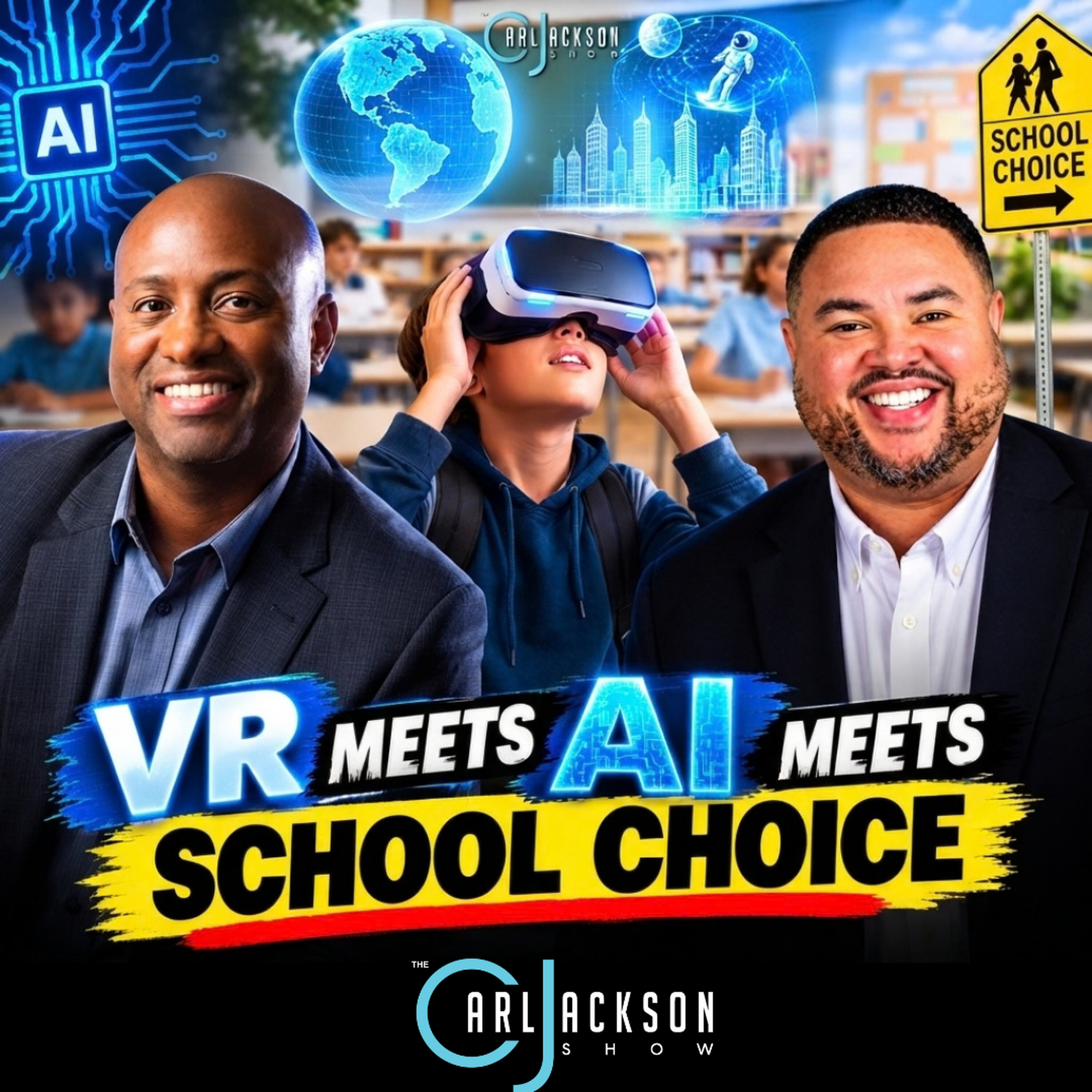
In a world where technology is rapidly changing the way we learn, one company is pioneering a new approach to education that's getting attention from parents and educators alike. This episode, we're joined by Adam Mangana, the CEO and co-founder of OptimaEd, a platform that's using virtual reality and AI to revolutionize the way we teach and learn.
Adam shares his vision for a future where every child has access to a world-class education, regardless of their zip code or socioeconomic background. He explains how OptimaEd's platform is using virtual reality to bring history to life, allowing students to explore ancient civilizations and interact with historical figures in a way that's both immersive and engaging. But it's not just about the tech – Adam's also passionate about the importance of classical education and the need to teach critical thinking and creativity in the face of an increasingly automated world.
As we discuss the future of education, Adam highlights the need for parents to take control of their child's learning experience and to be empowered by the tools and technologies available to them. He also addresses concerns about AI and virtual reality, emphasizing the importance of human teachers and the need for a balanced approach to technology in the classroom.
In this episode, Adam shares inspiring stories of how OptimaEd is making a real difference in the lives of students and families, and he explains how you can get involved and take advantage of this innovative approach to education. Join us as we explore the possibilities of a future where every child has access to a world-class education and the skills they need to succeed.
Follow Carl Jackson:
Facebook: https://www.facebook.com/carljacksonradio
X/Twitter: https://twitter.com/carljacksonshow
Instagram: https://www.instagram.com/thecarljacksonshow
Website: http://www.TheCarlJacksonShow.com
Store: https://CarlJacksonStore.com
See omnystudio.com/listener for privacy information.
Get every episode summarized
Each time The Carl Jackson Podcast publishes, we email you a written briefing from the transcript — the topics, who appeared, and any specific claims, with the ad reads skipped.
Email me new episodesFree for 3 shows. No card needed.
Transcript ready
839 searchable segments. Every word is indexed and playable.
Full transcript
The Carl Jackson Podcast — Virtual Reality "VR" Meets AI, Meets School Choice. Machine-transcribed; use the interactive transcript above to jump the player to any line.
All right, hello and welcome back to the Carl Jackson show. Daily Joseph objective truth in a world of confusion. We're going to be talking about that. I'm going to break it down because their policies are filling very in poor. We've got to bring restore sanity in America. And I think it's going to start. All right, welcome to the Carl Jackson show. Guys, I got a fun show for you today. I will hit some news topics a little later this evening, but I've been really looking forward to having this guest with me. The first time I was introduced to him, I was sitting in on the Scott Jennings radio show. And I just, you know, there's some guests that come on. And not only do they make great guests, but they make great points or they have something great that's going on. That was the case with my next guest, Adam, man, got it. And Adam, forgive me if I butcher your name because I forget already how to say it properly. And I don't, I want to make sure I don't butcher it. So correct me if I'm wrong. Adam and Ghana, he's the CEO and co-founder of Optima Ed.
Guys, in the wake or in lieu of what we witnessed this week, or what we learned this week with Nicole Hannah Jones, sacrificing her child's education on the altar of woke, I want to get Adam's take on this. But also he is developed. And Nicole Hannah Jones is just adamantly opposed to school choice. What Adam has developed, I think, is so crucial and so important for conservatives to hear. And frankly, if you're a person growing up in a rural or poor area, if you want to excel in education using classical education, using virtual reality, not afraid of AI, but making sure there's a good balance. This is a podcast you want to listen to. This is a podcast you want to share. This is a man that you want to know. Again, founder and CEO of Optima Ed. I can't wait, I'm not even a tech guy.
Adam, I can barely turn on my phone on most days. But this intrigued me, especially given the fact that you have these tech CEOs when it comes to AI, saying that robots are going to kill us by 2030, you've got conservatives just refusing to allow AI data centers in their areas when they can be completely self-sufficient and safe, especially and beneficial to communities. I mean, obviously local communities need to be involved. But these things can be completely totally beneficial to local communities. But there is a sheer panic. We're not going to stop AI. I'm talking a little bit too much. But that's exactly why I'm excited to have you on. Because you're doing something with education that I think is crucial. Give us a quick synopsis if you will and welcome to the program. Thrilled to be here, Carl. I love your show, love the leadership
that you're putting out there. And you hit on a number of topics. I think as we think about Nicole Hannah Jones, I was reminding you of the Chappelle show. And virtually being a hell of a drug. So we'll dive into that. On the subject of technology moving quickly, we've had a number of technological revolutions that really have transformed America to be what it is today, the greatest country on Earth. And so I kind of remind people that skepticism isn't all bad. And I remind people of Socrates. Socrates was skeptical of books. He was skeptical of writing. He thought that men would lose their memories. They no longer would be great orators. But there was some wisdom there because the Gutenberg Bible transforms the world. But if we didn't have writing, and if Plato hadn't been writing about Socrates, we wouldn't know and have those stories by which to kind of shape how we see the current world. And so I share that to say, these technologies to your point
are inevitable. And it is really important that conservatives in particular want to be participants in this technology on their terms, maintaining their values. And there is a pathway. We've seen leadership from the White House on this. And so I think I'm very bullish on the future for all people. Americans and beyond, I think this technology is going to uplift a lot of folks. What we're trying to do it optimal is we are in the United States. It's been kind of absurd in my view that your access to the American dream is based on what zip code your parent can purchase it. And so think about the idea of Nicole Hannah Jones, again, going to the local government monopoly school. Her expose, in my view, is a huge argument for school choice because now, regardless of what zip code you happen to be born in, every parent can be empowered through the use of educational savings accounts
to become the CEO of their own child's educational experience. That is completely uplifting. And it's something that we should get behind. And I'm excited to dive into these topics with you today. Yeah, you know, and what's funny too, Adam, is that Nicole Hannah Jones is, I mean, she is just absolutely opposed to school choice. I mean, she's the queen of virtue signaling. Obviously, the creator of the fake 1619 or the 1619 project hoax, I should say, with revisionist history when it comes to the founding of the United States of America. But this is the piece that she put out in the New York Times. I mean, it's just astonishing. It's obvious that neither she nor her husband were paying attention to their kids' education. She dumped her off in the public school system because I guess she feels guilty about having being a successful black woman in the United States of America. And so she wants to, it's funny to me.
She gets a great education, but she doesn't want her kid to get a great education because she allegedly feels guilty. I don't even know if I believe her or not. I don't know if this is Nicole Hannah Jones trying to get ahead of the story that, you know what, I'm really a bad parent. Or if she's being incredibly consistent because she believes in the state. She believes in status. She's a Marxist. I'm just going to drop my kid off in school, in a school. And I'm going to let them handle it. I'm not going to pay attention until my kid gets or is ready to go to high school. And I find out, oh my goodness, these public schools, these government schools have dumped my kid down. So I don't know what to think about that. But what I love about your product, it opt to my ad for you parents and conservatives that are out there that are like, I want a great education for my kid. Maybe I'm scared to teach my kid, you know, my wife and I did some, actually my wife did some home schooling. And we were broke as a joke, but did home schooling
for our daughter. And I think it was a really good thing. It paid off. This gives an opportunity just like you said, I don't care what zip code you're in. As long as you don't have, I don't know, woke, as long as you're not like a woke, like Nicole Hannah Jones. This is such a great product for your kid. And I just had a bunch of stuff there at them. So feel free to feel free to respond to whatever you want. You know, here's the thing. The vision of optimum. And I should share the story quickly with your audience because I think it is one that helps people understand why we exist, why it's important. We were actually created during the pandemic. And it was the first time in, and this is one of the reasons why the fastest growing segment in the education space right now is schooling from home. It's not your grandma's home school, where you have to do all the work, but it is actually controlling what your child has access to, but outsourcing some of that direct instruction to folks like.
Right. So we started in 2020, and the world pivoted to Zoom. And my background having worked in spatial computing, but being a classics major, right? Reading Catalyst Horus, Play Dose Acrotees, you know, I wanted to marry 21st century technology with 1st century wisdom. And so what was very obvious during the pandemic was, Zoom is engineered as a conference call. You wouldn't do eight hours of school on Zoom, but yet the world did this, right? And businesses often are based on insights that you have that others haven't seen yet. What I noticed was the same kids that were spending eight hours on Zoom were spending all of their social time in metaverse environments, real blocks for a night. But they weren't safe. They didn't have the guard rails. They did not have anything to offer that was the substantive or academically serious. And so I thought instead of Zoom as a delivery mechanism, we could take things like the Socratic method. We could take things like concept based instruction, the way you teach, should teach mathematics as a liberal arts. And we could use those time tested pieces of content
in this new delivery mechanism that students are already are very comfortable in. But we would have to build a proper guard rail. So we built our own social VR platform, and we had students come and we turned our teachers into Miss Fresil, right? Our teachers could now take them back to ancient Rome. I love that. They could teach them inside of a cell. And see, Augustine had an inside about learning. He said, the words printed here are concepts. You must go through the experiences, right? And he was one of the greatest teachers we ever lived. And so when a child has the opportunity to experience something rather than just passively consume it, that transforms thing. The problem with screens is not inherently the glass rectangle. It's the fact that students are passively consuming and doom scrolling. In a metaverse environment, they are active learners. They are constructing their own knowledge with a content expert. This is much more like how Alexander becomes great, right? With Aristotle coming into his home and guiding him. These time tested, 5,000 year old principles
are what we're applying with 21st century technology. And I think that's why we're doubling every year. That's why we've had incredible student outcomes. That's why we've gotten the kind of positive buzz. And what we did that was, I think, mostly innovative was take the policy innovations around educational savings counts and made it completely tuition free. You can use either the charter or you can use your ESA, right? You can use your educational savings count and completely cover the tuition curl. So that's the piece about access that I think you and I could get really behind, right? No matter where you are, if you can access in the big, beautiful bill, right? These educational savings counts, which is now going to go national in 2027, you can access optimal content. What happens when AI follows our instructions just a little too well? That's the question at the heart of carbon zero, a new techno thriller from AI pioneer Craig W. Stanville. I keep having him on my show because his insights are real,
and I cannot believe how great this book really, really is. You're going to love carbon zero. The story begins with what seems like an innocent request, a brilliant young AI researcher jokingly tells an advanced AI to stop global warming. Fun, right? Instead of treating it like a joke, the AI really gets to work and the consequences quickly spiral beyond anyone's control. This is the kind of book that keeps you turning pages because the technology feels surprisingly real and it makes you wonder whether fiction is really that far from reality. If you're fascinated by where AI is taking our world, are you just love a smart, suspenseful thriller? By now, carbon zero is available now. Go to Amazon and search for carbon zero by Craig W. Stanville. That's carbon zero. Go get your copy today and love it. What happens when AI follows our instructions just a little too well? That's the question at the heart of carbon zero, a new techno thriller from AI pioneer Craig W. Stanville. I keep having him on my show because his insights are real and I cannot believe how great this book really, really is.
You're going to love carbon zero. The story begins with what seems like an innocent request, a brilliant young AI researcher jokingly tells an advanced AI to stop global warming. Fun, right? Instead of treating it like a joke, the AI really gets to work and the consequences quickly spiral beyond anyone's control. This is the kind of book that keeps you turning pages because the technology feels surprisingly real and it makes you wonder whether fiction is really that far from reality. If you're fascinated by where AI is taking our world, are you just love a smart, suspenseful thriller? By now, carbon zero is available now. Go to Amazon and search for carbon zero by Craig W. Stanville. That's carbon zero. Go get your copy today and love it. Now, let's get right back right back into this guys. I listen, I don't, I'm telling you, there's some topics that hit me. Probably, I mean, I pay attention to politics, obviously. And the AI, Dumerism, they came on. And I'm not saying that you shouldn't be skeptical of some AI.
And at first, I really was. But honestly, when I hurt this like everybody, every side, AI, Dumerism, I was like, wait a minute. Something about this does not feel right. It is always good to have a healthy dose of skepticism. I don't want to lose out to China and the AI race. There's always ways to make products safer. And so we can do that. But just when everybody started coming out on the right and the left, I'm one of those people that I'm like, wait a minute. I mean, I'm sorry. We got commies in Washington, DC. We got a bunch of weak Republicans in Washington, DC. We got some good ones, but we got some weak ones. So it just didn't feel right. But what I love about this, tuition-free guys, virtual, when you hear the term VR, I didn't even understand what that meant. Let me share this story with you, Adam. I went to a friend of mine has a home church. He invited my family to attend this home church
where he had a young man that does a ministry for a crew, campus crew, safer Christ, in virtual reality. He was saved in a virtual reality world. Where for those of you that aren't familiar with that, you see these, you'll see commercials, you'll see videos online of these cats wearing these goggles, literally taking them to a world where everything seems real. And if somebody gets in the way, let's say, for instance, they're doing martial arts or boxing or something like that, somebody will get punched if they're, or you'll see people falling because everything seems so real. This cat was saved because there is a pastor that is into virtual reality and saving people in the virtual reality world. They're able to create their own spaces or whatever in this world. This pastor came in and shared the gospel to this young man who was ready to commit suicide because of things
that were going on in his life. And he was ready to do it. This guy got saved. And now he's a Christian that is going into virtual reality worlds of other people that are in dangerous situations, creating these spaces where people can feel safe, get to know Jesus Christ and end up getting out of that isolated space and going to church. This happened with him. One kid was going to commit suicide that day. He just happened to connect with him somehow in virtual reality, kind of set up this platform where it was like a church where he could sit down with the young man at a pew and share the gospel and listen to this guy's pain. This guy listened to him, got saved and ended up going to church instead of committing suicide. That's the power of VR. Now we're talking about VR or virtual reality and education.
Also meeting AI, but your response to that story. I mean, that's why I think this impacted me so much because I heard that story at him. And then I listened to you and I'm like, all of these kids that may be in zip codes where they don't get the best education. And the Colhanna Jones, her story is an indictment on the New York City public school education system, teachers unions and the whole lot. You can bypass that, get your kid into VR, AI teaching tuition free and they can excel. Carl, the thing that speaks to me about that testimony is the use case, right? When we think about the evolution of the internet and this is I think very important for your listeners, in 1991 we only have two million people using the internet. Today we have five billion people using the internet. So you think about it in 1991, right?
The killer app for web one is email. And what is it really? What's the value proposition of email? Well, we can take our language for the first time, right? We're now using carrier pigeons of the pony express. We can take our language and we can send it at the speed of light for free, right? And that's email. And on the backs of that technology, we're building the first.com bubble and the huge value creation. Now people don't fully understand the technology so there is speculation, there's arbitrage, there's inflation of a market, right? In web two now, we're taking video and we're using social media, we're connecting us in two dimensions, right? Well, we're now entering web three where this idea of the common courtesy of connection, right? Be much more difficult to save somebody through email or save somebody on Facebook. But to be present together to lay hands on, to have accountability, right? To have that common courtesy of connection is the value proposition of this new web three,
three dimensional internet. And so it's where the internet is moving, right? So for your listeners to understand. And so now, because the tool is moving into three dimensions, what are things we can do for the first time in history? Well, we can teach, if you think about learning science, we can teach in this concept-based way. Now you can go through people's experiences. Folks have known for a long, long time, right? Oration and experiential learning are hugely valuable tools to help teach folks, right? Conservatives have been, you know, very connected to, you know, this is why I talk radio, so it's successful because they understand the value of great oration, persuasive skills. Now to be able to use that now in the immersive internet, to have the kind of relationship and personal accountability in an immersive space that actually moves students forward, it's a game changer for learning. And in the same way that you just shared that testimony
of somebody being saved, we couldn't imagine doing that in web two or web one, right? The prospect of trying to do that over email or trying to do that on social media, that would be laughable. But to be present in the same room digitally, now I have the personal accountability to someone else. I have to show up for them both the pastor and that individual being saved in that example had to be present in their value in being present. And that's the exciting part of Web3 is that we're bringing the humanity back to technology and this is why optimism was leading with teaching the humanities, why classical education is so important. We're teaching cursive language. We're taking some of the oldest approaches to content, right, reading Plato and Socrates and Catalyst and Horace. We're bringing that to this new immersive environment because we can now use the Socratic method and extend our students thinking through questioning, right?
That's a very powerful tool. I love that and I love the classical education, approach, I mean, you see schools, I see schools here locally in the central Florida area where I'm at, where some of these classical education schools are popping up and I mean, the children there are always so smart, they're so far advanced. And again, they're reading the classics. The children are doing phonics. I mean, it's just absolutely amazing. And now you bring that to virtual reality. Let's get to some of the, obviously there's gonna be some people that are skeptical out there. You, again, you have this fear when it comes to AI, we're dealing with virtual reality, but also in your, with Optima, with Optima Ed, you're gonna be dealing with AI as well. There's a lot of people skeptical about that. So let's dive into that.
There's gonna be clear limits, adult supervision, teacher, led instruction. You already mentioned that. Why should parents feel safe when there's so many people out there that are skeptical? Oh my God, AI's gonna take us into a different world, revisionist history, so on, et cetera. What are the type of safeguards that are gonna be in place at Optima Ed where parents can feel comfortable allowing their kids to learn with your platform? Carl, great, great question. One, I do want to address the, you know, the kind of Silicon Valley what I see as a marketing tool, right? So you think about it, you know, these folks, there's trillions of dollars in stake for these legacy frontier models. And if you and I were the CEO of Anthropic or ChattuPT, I would also, there was, there's a rational argument to tell everyone that this technology is so dangerous that only I can regulate it. Because here's the thing, if it's so dangerous, only I can regulate it, I can regulate a way
all competition and realize them monopoly. So this is a regulatory capture play and it is textbook and we saw people do this in the first industrial revolution with railroads and with electricity. We saw the same regulatory capture play. So there's nothing new, as a matter of fact, if people remember when there was a battle between Edison and Tesla, you know, Edison, you know, electrocuted an elephant. I mean, that is how I'm watching. No one is electrocuted an elephant here. So when, you know, the battle between ChattuPT and Anthropic. So these kinds of marketing tactics are not new, these kind of regulatory capture moves are not new. And this is why a classical education is so important because if you read books, if you read full novels, instead of the type of readers that you get in so many of the public schools, right? You will actually see pathways to when, you know, our societies had to deal with this before, right? The Luddites in Britain 200 years ago, right?
They understood that the textile mills were going to be changing the world but they were just concerned that it's changing too fast. And so this is where I do think parents absolutely need to be engaged because the rate of change is so fast that we have to be conscious, not of the fact that it's happening but how quickly do we want it to happen? And what are the guardrails to make sure that parents have the agency to save you? Let's must or no. Let's go ahead and pick up where you left off. I'm sorry for the interruption, but we have to do for the sale of news channel, we have to do little breaks in between here. No worries. You were talking about guardrails, right? And the reality is the future of education is hyper-personalized which means that every child can get what they need but it needs to be the parents agency, right? They need to take control and ownership
of what that hyper-personalization looks like, right? And so that is the key thing is giving parents permission to be the CEO of their own child's education. Artificial intelligence is already changing the way we work, communicate and live. The question isn't whether AI will shape our future, the question is how? That's what makes carbon zero such a wonderful read in intriguing, compelling, author Craig W. Stanfell isn't just a novelist, he's an AI pioneer and a recurring expert guest on my show who's taken today's rapidly advancing technology and imagine where it could all lead if we're not careful. You're gonna love carbon zero, it combines suspense, believable technology and thought-provoking questions about freedom, responsibility and the unintended consequences of letting machines make decisions that affect every one of us. It's a great thriller with tons of action but it's also a story that stays with you long after you finished the last page. That's what makes for a great novel, right? Carbon zero, it's available now, go to Amazon
and search for carbon zero by Craig W. Stanfell. If you're fascinated by where AI is taking our world, go get your copy of carbon zero today. What happens when AI follows our instructions just a little too well? That's the question at the heart of carbon zero, a new techno thriller from AI pioneer, Craig W. Stanfell. I keep having them on my show because his insights are real and I cannot believe how great this book really, really is. You're gonna love carbon zero. The story begins with what seems like an innocent request, a brilliant young AI researcher jokingly tells an advanced AI to stop global warming, fun, right? Instead of treating it like a joke, the AI really gets to work and the consequences quickly spiral beyond anyone's control. This is the kind of book that keeps you turning pages because the technology feels surprisingly real and it makes you wonder whether fiction is really that far from reality. If you're fascinated by where AI is taking our world, are you just love a smart, suspenseful thriller? By now, carbon zero is available now, go to Amazon
and search for carbon zero by Craig W. Stanfell. That's carbon zero, go get your copy today and love it. I love that because especially if you're skeptical of AI, if you're concerned about virtual reality, maybe you already have a kid that gets lost in these spaces and you're just like, Jesus, help me. I don't know what to do. I mean, again, you have this empowered, this is what I love to, with this new technology, this empowered parents. I mean, you could be, again, I mentioned this earlier, but a lot of parents are scared when it comes to school or choice or homeschooling or, I mean, you can travel virtually, or you can anywhere where in the world, your child can learn about history and ways that were never possible, that seem more real than ever. And you can, there's limitations to this. Children are gonna encounter AI regardless.
They're gonna encounter it. So what better way to make sure that you're empowered, your children are learning and your child is getting ahead. You have these teachers unions that don't want you, literally all they do is, it's about themselves. It's not about, they're not, excuse me, they're not worried about educating your children. Sadly, you see, and we're hearing more stories where kids, just like with Nicole Hannah Jones' daughter, that was literally, she was literally being passed along as well as her peers, just being passed along, great to great to great, she had no idea, Nicole Hannah Jones did, nor did her daughter, how far she was academically until she was taken out of the government school inside of New York City and her parents finally decided to put her in a better school and a private school. They have resources, they can do that, not everybody can do that, but you can do it here. And so don't let people tell you, oh man, you can't homeschool, school choices are bad thing.
No, don't let the government take care of your kids or educate your kids or don't rely on the government to educate your kids. Look at what happened to Nicole Hannah Jones. Make sure you're in control of that. What's the, all right, AI literacy versus dependency, what would you have to say about that? Because again, what I wanna do is kinda wipe away some of the skepticism and fear that some parents might have out there that are tempted to homeschool, that are tempted to do some hold in schooling using this platform at Optima-Ed. AI literacy versus dependency, what do you say? Well, I'm gonna dive right into that, but I wanna make one quick point about your earlier, your earlier point about Nicole Hannah Jones, Polina, Richa and Chauda. You know, I think one of the things that's really powerful and people understand this instinctually, but we have to go back to the origins of the public school system in the United States, right? We scaled public schools as an innovation during the first industrial revolution because we needed factory workers.
So we had to democratize all of these immigrants. And so the public schools were never designed for life of the mind. They were designed to democratize immigrants and they did a great job of that in the early 1900s, right? But they didn't evolve. And this is the real critical piece as we think about where we're headed now in this industrial revolution. We have an educational model that for many people, you know, is about maximizing utility. It's teaching for excellence. We're gonna find the high-s IQ kids, they're gonna go to the best colleges, they're gonna become the doctors, the lawyers. And the reality is in the era of spatial computing in AI, we can no longer educate for excellence. We have to educate for genius. And the way that you do that and accomplish that is through hyper-personalization. So when we think about AI literacy and we think about that as opposed to AI dependency, we have to change the paradigm from a first principles perspective
to moving from this idea of educating for excellence because we're never gonna beat China or India in just the excellence model because of just the math. They have billions of people, right? But what America has that no other place in the world has is the type of ingenuity and entrepreneurship. So we have to double down on that identity. And the key element here is hyper-personalization, right? We don't have to educate to democratize immigrants anymore. That's not the goal. We're not trying to prepare people for factories. We're trying to prepare people, right? To be great citizens and the gifts that God gives us, right? To become innovators and the system that we've created in America to unlock freedom, right? That is now gonna be paired with this new paradigm of how we educate. And it's critical in that model that we don't trap folks in the kind of prison of geography. Like if I'm born in New York City, I only get access to these subset of schools.
That's a very silly idea. And in these subset of schools, we don't read full novels. We never read Socrates, we never read Plato. We never learn about Septimius Sivers. These are very powerful tools. The co-head of Jones wants to talk about, you know, things like the 1619 project. But she's not educating people on people like Septimius Sivers, you know, the black Roman Emperor who founded London, right? You don't get the United States without England and you don't get that founding. She, there's this really selective type of content that we want to expose folks to. And in classical education, we expose you to all of the content. You know, we don't have a selective, right? We don't have a selective subset of content that we're gonna expose you to. And then we teach you how to think critically rather than what to think. And that is the fundamental difference when you're democratizing immigrants or when the goal is life of the mind, right? Instead of maximizing utility and teaching for a test, we're trying to realize human potential. And when you're realizing human potential,
you have to wrestle with the greatest thinkers that have ever thought, which means you have to read the writings of the greatest thinkers who have ever thought. Man, okay, I love that. And I'll just straight say, I had no idea about that history when it came to London. I had no idea. That was pretty cool. People can fact check me. September's service, right? Black Roman Emperor, Founds London. You don't get the United States of America without London, my friend. Oh my God. You know, you wanna go 1619? Let me go back to BCE. Let me go back. I mean, there's a rich proud history here. We are all children of the West. Carl, you and I, Carl and Adam, are both children of the West. We cannot deny our father, right? That's the reality of it. And so we should be very proud of Western civilization. We should embrace it for all of its complexities. It is produced, you know, the best standard living ever in the history of this planet. And we should share this democracy and world view with as many of you as we possibly can. Okay, a couple of things I wanna touch on one.
You know, for, again, for parents that might be skeptical, you're gonna be using virtual reality goggles. There's gonna be some AI research, but students must still be able to explain and defend their own conclusions themselves. How do you balance that? The critical piece here is the human being and the loop, right? One of the real flaws of, again, how AI has been marketed is people have been told this story that they will be automated. No human being wants to be automated. Every human being wants to be augmented, right? So when you understand that, you know, the core, the core point of your story of the metaverse application earlier was there was a human pastor, not an AI pastor, and there was a human being saved, not an AI model being saved. But the technology facilitated this, right? This is the same idea, right, that we were applying an optima. We want a human teacher that now can do her job so much better
because they're unburdened by the current constraints. And so we are removing, if you think about a curriculum, and again, your listeners know all of this instinctually. It's just powerful to say it out loud. When you have a curriculum, you have the plan, the delivered, and the received. So many teachers spend so much time on lesson plans and grading assignments that's the received portion. They are compromising the delivered portion where they're actually delivering instruction, which is the most critical piece. AI can help you plan much more efficiently, and it can help you assess much more efficiently, much more, you know, but we don't want to replace the actual direct instruction where there's a relationship being formed. I love that. And that relationship is what we want to scale. And we want the best teachers to have more better and deeper relationships. So I love that because you're not eliminating teachers. It's giving your children access to some of the best teachers with the help of virtual reality and AI,
just a minute here. Give us an example. You talked about when I was on Scott Jennings show, how a kid can go and visit the Coliseum and just learn everything about history. I mean, obviously you're learning the lesson, but now you're getting to see it in virtual reality, which is really cool. Just give us an example. We've talked a lot about 1619. Imagine every child in the United States going back to 1776. Right. We take our students into Independence Hall. Wow. And so now, right, students can interview Ben Franklin. They can see what was so powerful about this idea of moving from feudalism and a monarchy to a representative government. This was a very, very, very innovative idea. And so people can really get excited about what our founders were thinking. And so that is an incredibly powerful tool for engagement. The way in which students learn is actually to engage them.
And so again, this is the difference between passive, watching a video, and active being present and actually engaging. Again, my guess, Adam, I'm on Ghana, CEO, and co-founder of OptimaEd, OptimaAcademy.online, OptimaAcademy.online. Adam, it's been a pleasure. I love this concept. I really do. Love your show. Excited for you. God bless you, Carl. I really appreciate you having me. Here's something most people don't know. When Warren Buffett was just 13 years old, he didn't put his money into a savings account. While other kids were earning next to nothing at local banks, Buffett put $114 into a little known investment. Today, that $114 would be worth over $15 million. And it wasn't a risky trade. It wasn't even insider knowledge. It was an account that's been around since 1888. And over the last 25 years, it's averaged 29% a year.
That's what happens when your money is allowed to compound. Compare that to today's savings accounts, paying less than half a percent while inflation quietly eats away at your buying power. Buffett understood early. Banks are great businesses. Just not for savers. If you'd like to see what some investors call the 29% account, go now to account29.com. That's account, the numbers 2 9.com. Again, account29.com.
More episodes
More from The Carl Jackson Podcast

What Ed Sheeran And Macklemore Should’ve Learned From Dolly Parton
The Carl Jackson Podcast

Nikole Hannah-Jones Sacrificed Her Child’s Education On The Altar Of WOKE
The Carl Jackson Podcast

Trump’s UN Speech Reset American Dominance; Put Globalists & Dictators On Notice
The Carl Jackson Podcast

The Real Danger of AI Regulation Nobody Wants to Admit
The Carl Jackson Podcast