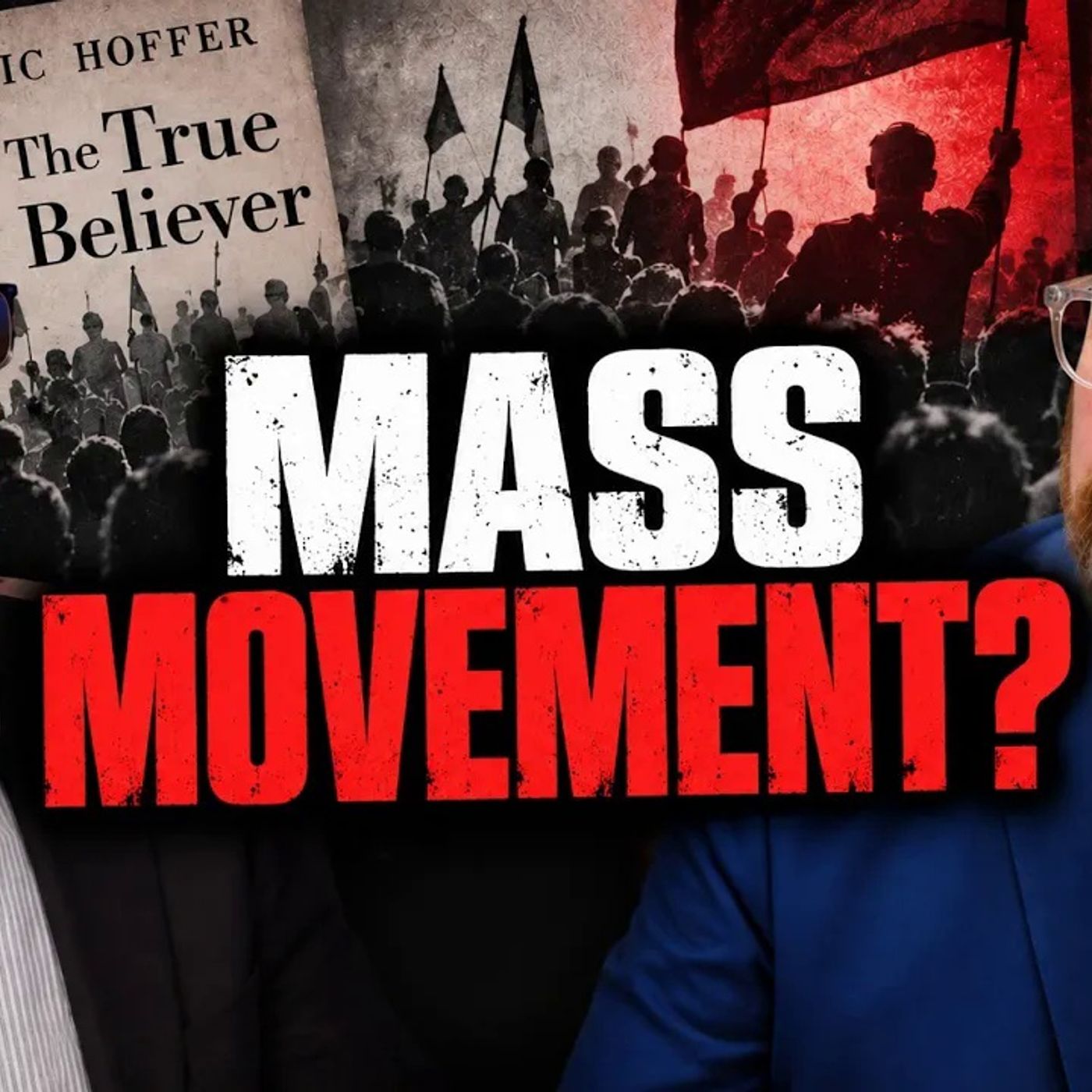
What Makes People Join Mass Movements? | The Magistrate
Get every episode summarized
Each time Eschatology Matters publishes, we email you a written briefing from the transcript — the topics, who appeared, and any specific claims, with the ad reads skipped.
Email me new episodesFree for 3 shows. No card needed.
About this episode
“You may not know this, but I have Exema. But why let Exema take over when you can talk to your doctor about Epglyce?”From the transcript
In this episode of The Magistrate, Josh Howard is joined by Cory Wing to examine Eric Hoffer’s The True Believer, Harold Brown’s work on sensate culture, and the Christian response to revolutionary movements, social unrest, and ideological fanaticism.
They discuss disaffected young men, family breakdown, the search for identity and meaning, and why Christianity offers something fundamentally different from utopian political movements.
How should Christians recognize the forces shaping our cultural moment without being captured by them?
Watch all of our videos and subscribe to our channel for the latest content >Here<
For blog entries, articles, and much more, visit our website >Here<
Get every episode summarized
Each time Eschatology Matters publishes, we email you a written briefing from the transcript — the topics, who appeared, and any specific claims, with the ad reads skipped.
Email me new episodesFree for 3 shows. No card needed.
Hosts & guests
Transcript ready
756 searchable segments. Every word is indexed and playable.
Full transcript
Eschatology Matters — What Makes People Join Mass Movements? | The Magistrate. Machine-transcribed; use the interactive transcript above to jump the player to any line.
Hey, it's Kelly Rowland. You may not know this, but I have Exema. So I get how it can steal your time. But why let Exema take over when you can talk to your doctor about Epglyce? Epglyce, lubricism ab LBKZ, a 250-mg per 2-mg leador injection, is a prescription medicine used to treat adults and children 12 years of age and older, who weigh at least 88 pounds or 40 kilograms with moderate to severe Exema. Also called a topic dermatitis that is not well controlled with prescription therapies used on the skin, or topicals, or who cannot use topical therapies. Epglyce can be used with or without topical corticosteroids. Don't use if you are allergic to Epglyce. Allergic reactions can occur that can be severe. Eye problems can occur. Tell your doctor if you have newer, worsening eye problems, you should not receive a live vaccine when treated with Epglyce. Before starting Epglyce, tell your doctor if you have a parasitic infection. Pay partnership with Lili. Respect your time. Ask your doctor about Epglyce and visit Epglyce.com or call 1-800-LiliRx or 1-800-545-5979. How do Christians understand mass movements and true believers?
Should Christians be wary of the angry young men that we keep hearing about online? What's the Christian response to these dynamics in our day and in our age? This is the magistrate. I'm Josh Howard and I'm joined by the always-dapper Cory Wing. Cory, good to have you, brother. Thank you, Trevor. Again, I actually just watched your episode from last week with our good friend Alex and it was fantastic, by the way. I really enjoyed it and I'm thrilled to be guest hosting again. Thank you. Absolutely, man. It's great to have you back. Love chatting with you. I want to commend you as well. If you're watching the EM Network, please check out Cory's show Take Heart. Comes out on Sundays as well as his own channel that he's had on YouTube for several years now, civically minded. For those who don't know, James Baird, who usually co-hosts this with me is on his, I think, third and final week of paternity leave, having welcomed in, little, little mace into this world. So, James should be joining us next week. I've got a head cold. Cory looks great in his suit as always. We'll see how the episode goes. I want to mention our
sponsors before we get rolling on the subject matter for today. Rockwall Bibles, please check out rockwallbibles.com. You can reach out to them for rebinds of old Bibles. You can check out their offerings on new Bibles. Truly a bevy of different options that you can choose from. Really nice letters and binding jobs. You can reach out to Adam. It's a family run business in the Ozarks. They do great work and we're appreciative of them and their partnership with the EM Network. Today, Cory, you and I are going to talk about two different works, really one in general. So, mutual of ours was reading through this book by Eric Hoffer. And it's an older book. It's from 1951, but it's called the true believer thoughts on the nature of mass movements. And it's essentially, again, Hoffer writing from an atheist perspective. He's not writing from some sort of Christian ideal. And yet he's trying to answer why ordinary people become fanatical participants in these revolutionary, political, nationalistic, or religious movements. This is essentially the question that he's asking. And I thought it was stirring for a couple of reasons. Number one, I think that we
can sort of plunder the Egyptians when we come to these sort of things. I think there's some nuggets of wisdom in the work. I also think there were some things that obviously as a Christian, we would disagree with. You can even hear from that title summary. He kind of lumps in religious movements in the same way that he lumps in nationalist or revolutionary movements. So, there's some kind of category confusion there. And yet there's some things to pick out of this. And when I was, when I was reading this book, and you read it in prep for the episode, which I was grateful for, so we can kind of walk through our thoughts on this. But he's talking in the same ways that I hear a lot of current church leaders and current pastors, theologians, churchmen, discussing sort of angry young men in our day and age. Now, I'm going to speak off the cuff here a little bit. I think that sometimes the angry young men thing is overblown a little bit. And I think that happens in a couple of different ways. So when I say angry young men, I mean the younger generation who are and is primarily men, primarily younger generation who are sort of disaffected with the
current cultural milieu that we find ourselves in. They read the news, they're horrified, they want change. Number one, they're not always angry. A lot of times these young men are actually reacting to the things that you and I react against. They see injustice and wrong and evil, and they want something done about it. That's inherently not in itself bad. And sometimes anger is actually a godly virtue depending on what you're angry at and in what way you're angry. But also it's not always young men. We also hear these reactions from many who are not in fact young. I would not count myself as young. My joints ache and my back hurts. At the same time when churches deal with these sort of issues, I do understand there are some younger people whose reactions are outside the pale of what we would say would be a Christian response to the evils of our day. So they see these things they react in poor ways. However, I think social media skews this perspective. When I look at my local church, because again, you and our church, Mn. Corey, usually I think how is this affecting my church, my area? The churches were networked with close to home. I don't typically see angry young
men in the way they're vilified on Twitter. And I'm not so sure how much that hits other people's churches. What I do see a lot of is younger generations who are disaffected not in a dismissive way. I don't use that term, but truly disaffected with the way cultural swings and wins have gone specifically within the last six or seven years. But thoughts on that, Corey? Well, I just had and I told you this offline, I just had coffee this morning with a Colledict senior at the local university here right around the corner for me. And he was, you know, he's young. He's athletic. He's on their baseball team. He wasn't angry. But again, he was on we talked hour and a half for better about a number of different things, a lot of them theological. And he sees the world that's happening around him because how could you not? You know, Lindsey Clancy got brought up more than once and, you know, what's happened there and how one man was able to kind of stand against insanity. So to your point, I think disaffected is probably
a better word that, you know, it's not bad to notice things. But we are living in a day and an age and I want to be fair here. We are living in a day and an age where a lot of the aforementioned angry young men say that they are vilified for just quote, noticing things, you know, well, I just noticed, you know, XYZ. But again, that's one of the things you hear from these angry young men were to be afraid of is I've just noticed XYZ, whatever they've noticed, a lot of conspiratorial stuff typically. So to say that they're disaffected and that they've noticed certain patterns or certain things, well, I mean, that doesn't make them untrue. And I think that's a perfect lead in for this book that we're talking about because I think that's what this, you know, Eric Hoffer has tried to do is he's trying to say there are patterns. I've noticed some things. But whenever we do that, you run the risk of lumping way too much together, strong-maning arguments and just kind of
getting sloppy with your argumentation in general. So that's kind of what I think about. And this is one of those that we're obviously going to be talking about the ideas that Hoffer raises as opposed to trying to walk through the book. This is not a book review episode. But we do want to talk about the topics. I understand most people probably won't have read Eric Hoffer's book. But some of the things that he raises are interesting. And so to your point, Corey, you were talking about sort of the kind of broad brushstrokes. So one of Hoffer's kind of central insights. The way he approaches this is, by the way, he's treating all these things as a cultural phenomenon that are shared. So he looks at things like communism, fascism, nationalism. He looks at religion, whether it's Christianity or Islam, revolutionary movements. He's looking at all these different movements, again, mass movements, which especially garnered the younger and the disaffected. And we'll kind of walk through those terms because I know those are loaded in our day and age. But he's looking at those things. And he's primarily treating these as sort of a psychological doctrine or
psychological take on these things. He's looking at those who want to, and his framing is that they want to escape the burden of their individual identity or their individual circumstances. So they find their significance by belonging to something greater than themselves, something larger than themselves. Again, in his mind, this is the psychological, primarily psychological explanation for how these mass movements and these social waves sort of garner this widespread adherence. There's a lot there to commend because if you live in our day and age, we're in 2026 in the west, you can look at certain movements that have relatively small, adherent bases. So if you were to think, for example, of a lot of the LGBTQ movements that have come within the past few decades within our own country, if you actually looked at those who are actually a part of those movements, practicing those things, it's actually quite a small number. And yet the movement itself seems to vastly outgrow
the actual adherence to the actual practice or doctrine that they're ascribing to. And I say those words because I'm thinking far beyond just LGBTQ. You could associate this with many different movements within Western culture. The actual adherence to the group, quite small, but then those that they attract from the outside, quite large. And you start to wonder, how do these movements take place? Now, the danger in that, I think, is that for any Christian, when you hear that, and you say, okay, it's about escaping your individual identity to some extent and becoming part of something larger, that sounds awfully close to the Christian faith in many regards. It's not an abandonment of your individual identity, but it is certainly being ascribed to you belong to, I mean, think of Paul's words, you belong to the household of God. It is saying you belong to something far greater and far more meaningful than this world has to offer by itself in its state of sin. So that's where I think you could start to see some of that bias come in, where he is treating religious movements as part of this phenomenon. But I think there's some nuggets there, but any thoughts on this, this is sort of hoffers kind of general conception.
And here's where I would push back. I think you summarized what he was trying to do, perhaps, exceeding the well says, my pushback's not on you. But back in the 1970s, a sociologist maybe is the best term for him. A guy by the name of Terry Borton came up with something that as preachers, we do all the time and really speakers of any kind do this. We did it in sales when I was still doing real estate professionally. He came up with the idea of what's called what, so what now what? So that's Terry Borton from the 1970s. And so I, in fairness, this was written in the early 50s and it was maybe he hadn't heard of that yet. So to hoffers defense, perhaps he hadn't heard of this yet. But when I, when I put hoffers work,
Hey, it's Kelly Rowland. You may not know this, but I have Exama. So I get how it can still your time. But why let Exama take over when you can talk to your doctor about Epglis? Epglis, lubricism app, LBKZ, a 250-mg per 2-ml leader injection is a prescription medicine used to treat adults and children 12 years of age and older, who weigh at least 88 pounds or 40 kilograms with moderate to severe Exama. Also called a topic dermatitis that is not well controlled with prescription therapies used on the skin or topicals or who cannot use topical therapies, Epglis can be used with or without topical corticosteroids. Don't use if you are allergic to Epglis. Allergic reactions can occur that can be severe. I problems can occur. Tell your doctor if you have newer worsening eye problems, you should not receive a live vaccine when treated with Epglis. Before starting Epglis, tell your doctor if you have a parasitic infection. Paid partnership with Lily. Respect your time. Ask your doctor about Epglis and visit Epglis.com or call 1-800-LilyRX or 1-800-545-5979.
It's Fall in America. Make it Count at the Ram Drive-In to Fall Sales event. Make it powerful with our strongest Ram 1500 ever. Make it Move with the Ram Heavy Duty with an available Cummins Diesel and make it Goathe Distance with a 10-year or 100,000-mile powertrain limited warranty. Hurry in now for great deals during the Ram Drive-In to Fall Sales event. Excludes fully electric vehicles applied to 2026 model-year vehicles non-transferable visit MoPAR.com for complete details on a copy of the powertrain limited warranty. Come into the register trademark of Cummins Inc. Ram and Hemie are registered trademarks of FCA-US LLC. Hey, it's Kelly Rowland. You may not know this, but I have Exema. So I get how it can still your time. But why let Exema take over when you can talk to your doctor about Epglis? Epglis, Lebrichizmab, LBKZ. A 250-mg per 2-mg leader injection is a prescription medicine used to treat adults and children 12 years of age and older, who weigh at least 88 pounds or 40 kg, with moderate to severe Exema. Also called a topic dermatitis that is not well controlled with prescription therapies used on the skin, or topicals, or who cannot use topical therapies,
Epglis can be used with or without topical corticosteroids. Don't use if you are allergic to Epglis. Allergic reactions can occur that can be severe. I problems can occur. Tell your doctor if you have newer, worsening eye problems, you should not receive a live vaccine when treated with Epglis. Before starting Epglis, tell your doctor if you have a parasitic infection. Pay partnership with Lilly. Respect your time. Ask your doctor about Epglis and visit Epglis.com, or call 1-800-LilyRX or 1-800-545-5979. This week at Vons and Albertsons, USDA Choice Tri-Tip Rose untrimmed are 599 per pound. Limit 4 Rose with membership were applicable. And medium ripe hassovacados are 99 cents each, with membership were applicable. Plus Kellogg cereals 8.8 to 16.1 ounces, selected varieties, or peppered farm goldfish 5.9 to 8 ounces are 190.9 each when you buy three. Limit 3 offers with membership were applicable. Visit Vons or Albertsons.com for more deals and ways to save. In that framework of what, so what, now what? Or maybe another way you can say that is
present the facts, then give an analysis, and then give an action plan. He doesn't really do any of that. He presents a lot of facts. He does a lot of the what. And he does a fair amount of the so what? He never gets to a now what. And that's probably my biggest beef with this book is he's got a ton of complaints. He spends an entire book complaining about everything around him. And somehow making you know that he's not that. You know, so all of these, these fools that are doing this, this stuff that I'm talking about, you know, they're silly and foolish and collective, you know, this kind of collectivism. But then he doesn't provide any kind of alternative other than like a just, and he doesn't present this. You have to extrapolate this out. This almost raw liberty, you know, like a French libertad, you know, but, but he talks about the French, you know, revolution and lumps that in with this. So, so he doesn't really make any sense. I got to the end of the book and kind of
went, well, it's, it's done. Well, and this is, this is where I think Harold Brown's going to help us out. We're going to get into Harold Brown here in a minute. I'm going to drag him in. Because I think Harold Brown frames it pretty well. Obviously, Harold Brown writes from a Christian perspective, or maybe not obviously, but we'll get there in a minute. Here's one thing, Hoffer said that I thought was interesting because I do agree with you. It's always the, the now what should always be a good question, especially from a Christian perspective. So like, what is the ideal that we're reaching for? Not just how you can describe these things, but something that Hoffer described. So I had early in academia. I had a background in sociology, which is both a blessing and a major curse, but he's describing the sociological concept. And what the way Hoffer lays it out is when you look at a mass movement and it's attracting all these adherents, one of the major major things that it doesn't attract are those that are truly crushed. So he said the people that are truly crushed truly, he describes them as the poorest people within society. And that's not just economically, but it's not, not without that distinction as well.
But he says the poorest in all facets that that could be described as, he said, those are typically not the ones that are attracted to the movement. The ones who are, and I found this interesting, he said are the ones who identify their life and they say my life could have been something, but it isn't. And somebody's to blame for it. He said, when you look at a mass movement, this is typically the ones that it will draw together. Now, I'm going to draw a line right there and say as a as a Christian theologian slash pastor, that's where I would say Christianity is going to be a big difference. Christianity does not draw a line and say my life could have been better and somebody's to blame for it. Christianity, in fact, says my life could have been better and I'm to blame for it, but there's a way made in Christ. However, getting back to offer, he says it's those that look around and they, they essentially put their failure, their humiliation, their, their loss of meaning, their resentment, their economic insecurity, their boredom, their lack of purpose, all of these disaffecting factors and they isolate it on an enemy on a target. And they say my life could have been except for this group. And that then spurs and gives the impetus then for a radical
change and a desire for radical change. I think he's on to something with this one. Having worked through, you know, my again, when I went to my first master's degree was out West and I was at a Western critical theory school. That was that was at the very beginning waves. This was early 2000s. This is in the beginning waves of critical theory kind of starting to explode across the US, but they were right on the cusp of it out West. And this was the sort of, this was the sort of thinking that was endemic to every discipline within this critical thing, critical theory school. There is someone to blame and good news. It's not you. It's actually a group that we can identify and all of your, all of your sort of untetheredness from society, your disenfranchisement. It can actually be blamed on somebody. We're going to tell you who thoughts on this one because I thought this was a very good point. And I see this happening with many who are misdirected, especially maybe online, but just within our culture, there is the propensity to identify a fault that does not lie
within ourselves and within somebody else. And that gives us a meaningful impetus to join these movements. Well, he does. He points that out and he calls them in the book. He refers to them in a number of ways. But the two most common that he kept reoccurring was he calls them outcast and misfits. So he says the outcasts, it was the 50s, by the way. So PC with language was not exactly at the forefront of his thinking, but yeah. The outcasts and the misfits as he calls them, he says, have an incongruent influence in a society and that they shape as much of a society as do the wealthy and the powerful. Now again, I would say absolutely, I agree with him there. And we're seeing that. I'm 48 years old. I'm probably seeing that more now than I've ever seen that in my lifetime. In the last say 10 years, 15 years, I've seen that reality shaping out here in in the United States more than certainly in the time of my of my youth. We had kind of a
monoculture. I mean, I'm old enough to remember the US being somewhat of a monoculture. And where I saw the deviation happen, much like you said for you, you saw some DEI stuff taking place out in the West was when I went off to college. You know, so when I went off to college, I graduated high school 1996. So the internet was just really kind of coming into its own. You know, and the public was being was starting to have more access to the internet. And it was becoming more affordable. AOL was sending out the CD-ROMs, you know, with a thousand free hours. You got to be on a certain age to get that ridiculous joke. We started playing frisbee and using them as a coast. That's the stack of the discs on your desk. That's right. It's right. I remember. So, I mean, this is the early days of kind of societal use of internet. And I say societal use, because it was used in the military and government and all that for decades. But that opened the world to
micro pockets. And those micro pockets could then kind of find themselves in ways that they couldn't prior to that. So, I mean, if you were into, you know, really fringe music, you know, in the 80s, you know, whatever that music was, and I'm not going to say what was fringe, because maybe you won. You didn't know anybody else that was into that weirdo band, you know. And then you, the internet, or when you move off to another area and you start to be exposed to a larger world, you start to meet, you know, what now affectionately everyone says, those are my people. And you start to meet your people, right? And so, I do think he's right in that where there's a galvanization that happens amongst the disaffected or amongst certain people's that band together due to their disparity. You know, so whatever the disparity is, you feel it, they feel it. And now this makes you kind of even if it's an odd bedfellow, you're there.
You're, you're now galvanized in this thing together. So, I do think, as you said, kind of, you know, chew on the meat and spit out the bones, that's some meat that's real. There are some things that are real about that. Where I would push back, and I don't want to give away too much of the where we're going with this. But not to bury the lead either. Truth matters. You know, so, so he lumps Christianity in with all of these other movements. And he would say, what you're no different. Know what makes us different is that we are true. You know, so that's like saying, well, that guy's religious, that guy's religious and that guy's a Christian, they're religious. Well, yeah, we're all religious in that respect. So if you're using that broad term, sure. Yeah. But, but, but we're not the same. And this is, that's where I'm getting at with, with the big takeaway for me from the book. Yeah, this is not, this is not burying the lead either because this is actually next in my notes. So he gets to it. And I think it's into like chapter 16.
He gets to it. And I'm always keyed in on family slash household dynamics and half, half or see, almost called him hopper. Hopper brings this up. I think again, I think it was in chapter 16 of the book, but he talks about how mass movements have to begin. And again, in his conception, mass movements are usually kind of a revolutionary flair to them. He said they have to begin by disrupting and destabilizing the family unit. The household has to be destabilized for these units to go, particularly with those that are entailing a social or economic upheaval. I agree with him on that. What I don't agree with him on is he says, that was the case with Christianity too. And he cites the passage where Jesus said, I've come to set Father against Son. Hopper, obviously, he says, see, so too with Christianity. Now, that's where the truth, the objective truth factor comes in. So when Christ said that such as your legions to the Lord, that it will even set Father against Son, he's not saying Christ, Christ didn't say, I've come to actually disrupt and bring up heaval to the household. In fact, he said the inverse, the opposite. Christ came to fulfill the household and denied it together, even more fully, grace restoring
nature, not destroying it. Hopper, though, sees this. And within mass movements, again, let's just say, let's just say mass movements outside the true faith. I do think he has a point here that they usually begin with a necessary destabilization of the family. And that's not for no reason. That's because what gives you your truest, again, Althusias talked about it as the seedbed of society. What gives you your anchoring and place within society? It begins in the household, to within the home. So if you're going to attract these mass movements, one of the first things you must do is destabilize that that you might have adherence to this mass movement that gives them the meaning you've robbed them of within the home. This is by the way when I was reading this, I was thinking of our friend Chris Wiley's book, The Household and the War for the Cosmos. This is essentially one of the points that Chris Wiley keys in on with industrialization and how taking both parents outside of the home, sort of imposing this ideal of a dual income household, separating parents from the vocation of their children or rather separating the children from
the vocation of their parents. You don't grow up within the cobbler shop that your father owns and learn the trade. Instead, now you go here, he goes there, mom goes there and it separates out the household. Same sort of dynamic that Chris Wiley gets to in his book, which I would commend to anybody who hasn't read that one yet. But this is one I think offer was on to something though, because you see this within most of these movements. Why is it that within the communist movement, within China or Russia? Why is it within, you could list several such movements where the initial stages seem to so viciously target the household and offer says, well, there's a reason for this. Well, I love that you put a word in there and you're a thoughtful enough guy that I'm sure it was intentional. You said the word initial and I think that that's imperative. Yeah. Because you're right, they initially have to do this, but they don't stay that way because you can't stay that way. The only way to perpetuate a movement is to pass it down through the
generations or your movements only get a last one generation. They have to destabilize those kind of familial ties so that they can become your familial ties. So it's a destabilization of the norm to then replace the norm so that then the new norm can be passed along in a familial structure. And that is so incredibly sly, but it's also just kind of creepy. And I guess the other part that just shocked me as I read this was, offers in capability of admitting his own admittance into any such category, that somehow he was this lone ranger that stood outside of human you know, categorical thinking or category at all. He's the lone ranger
outs, but though his points had so much kind of russosque or he mentions Robespierre quite a bit in the book and again that French Liberty movement without seemingly ever realizing that so much of what he is adhering to adamistically is coming out of that enlightenment period. Whether you're talking French, the French enlightenment or what we as guys in the church are always exposed to is the German higher critical side, which is the same. I mean again they're very similar. They share almost identical traits. It ones more kind of sociological than the other one kind of dip more theological, but it's that French enlightenment or German higher critical thought. And that's the whole book. And so I kept wanting to throw this thing across the room going, you are this, what are you talking about? How can you be so blind to your own ignorance? I'm basking in the fact that I made you read this book and you struggled so badly with offers.
This is this blessing muscle that I gave you ahead, Ike this week. And it doesn't stop there, right? So he pushes in on because the whole John, I'm so glad you brought up, you know, John Jacques Rousseau and this thinking of society being that contaminating influence on the otherwise good and pure individual. It doesn't stop there. So this is what Hopper gets into next, at least in at least in my, my sort of summary of his work. This week at Vons and Albertsons, USDA choice tri-tip roast untrimmed are 599 per pound, limit four roasts with membership were applicable. And medium ripe hassovacados are 99 cents each, with membership were applicable. Plus Kellogg cereals 8.8 to 16.1 ounces, selected varieties, or peppered farm goldfish 5.98 ounces are 190.9 each when you buy three. Limit three offers with membership were applicable. Visit vons or Albertsons.com for more deals and ways to save. This summer don't squeeze in, spread out, find homes big enough for your whole guess list on
Verbo. That's vacation rentals done right. Book your stay now. Sometimes flavors need a pinch of salt to unleash their full potential, and life works the same way. Sometimes you just need to get a little salty to keep life interesting and deliciously sweet. Fuel your salty sweet cravings with Kachafa's new salted caramel all in one nutrition shake. Just two scoops provide the complete nutrition your body craves with protein, fiber, grains, and more. Embrace your salty side. Go to kachafa.com and use code fitness for 15% off your first order.
That's kachva.com code fitness. 10-piece McNuggets, fries, and a medium coke all for just $9. Limited time only promotion pricing may be lower than meal pricing. He talks about the need for self-renunciation. Now here's the point at which Kory and I can both just recognize that there are a plethora of such examples any one of which would probably get us booted off YouTube to mention at great length. This is endemic to Western culture so this is the way Hafer lays it out. He says that sometimes being attracted then having been destabilized from the family home from the family in the home and the household these adherence to mass movements have to stop being themselves in order to identify
with this greater cause which again we can say here at this point he's not actually addressing the true faith but we'll continue as far as mass movements go. But this is it becomes what he referred to as a passion for self-renunciation. In other words this this adherent to a mass movement will say I don't like who I am or what I've accomplished or who I've become or the life that I've been given but if I become part of something enormous and heroic and new and good my individual significance will disappear but I'll be made great because I'm part of this movement. He mentions examples those of Nazis, communists, Islamists, nationalist, revolutionaries, he even lumps in religious zealots with these groups. But what he's talking about is the individual being swallowed up by the collective identity. You're sort of worth being absorbed by the worth of the cause but he talks about this in the need for those who go into such movements to self-renunciate not only themselves but their prior group or affiliation. This is where this is where again my mind immediately went to
the plethora of examples of these self-renunciation cycles and almost liturgical expressions of denying who I am and repudiating who I am and my heritage and my place and anything that might have identified me before but now I have this glorified self-worth in this movement which is going to reshape society. Again if you remove the true faith you can see this happening within so many movements within Western culture but thoughts on this one Corey. Yes. By the way he points out, sorry I just asked you to speak and then I've walked all over the... Oh that's good. But Hopper points out he said this is why self-hatred, this is his term, self-hatred and mass fanaticism are closely related terms. A hatred of yourself which usually turns again as we said a minute ago it turns into an identifying of others to hate that were within your own group at one point but a self-hatred kind of being prepared with this mass fanaticism of these movements but go ahead.
Well again is there some... and this is the scary thing about so much of this and I think that you see this all throughout scripture as well and let me qualify what I mean by that so this does not like what you see all of this through scripture. No what you see in scripture is the warning again and again and again and again warnings of lies that masquerade is truth. You know where there's just enough truth to be like well yeah but if you scratch onto the surface even a little you're kind of going but no you know and so is he on to something well of course he's on to something I mean absolutely I worked in the prison system as a young man in my early 20s that is so true in the prison world you know I mean when you go to prison you are a loan and I mean a loan in ways that almost you've never that it's almost impossible to feel outside
of that type of an environment and so what do you see on every television show or movie or anything about prison culture you got to join a group you know if you're going to survive at all you have to join some group you know the Aryan Brotherhood or you're filling the blank right and that's the only way that you're going to have any kind of identifying identifying markers that's the only way you're going to have protection it's the only way that you're going to have any kind of socialization and that's in that weird micro society there is some truth to that right I mean just enough truth that you can again go well yeah I recognize that but truth matters so where where the self-hatred and this is where pastoral minds always go so I don't I don't have to ask Josh how he feels because I he's a pastor yes we as Christians immediately have to admit our sinfulness which I guess to an outsider like
offer or especially an atheist like offer can look like self-hatred yeah I'm a sinner I am functionally apart from God I am my sin has separated me from him and that can look like self-hatred and I'm going to espouse myself out of this bigger thing except that because truth matters and Christianity is the only true religion Christianity is the only true mass movement like unto itself immediately yourself worth is then restored you know so yes I'm a lie to myself but I'm alive in Christ I'm alive in Christ and not only that I'm I'm created in the image of God so I have unique in intrinsic value as an image bearer of the creator I mean so so yes Christianity is going to say you have to admit there's a problem and you're a big part of the problem but immediately the God man Christ Jesus starts to restore your intrinsic worth that he gives every human being
by default of being human but also more uniquely gives to every believer as being in union with Christ you know so I mean it's it's it's it's matters and it's the category like we talked about earlier of grace restoring nature that's right perfecting nature elevating nature however you want to phrase it but it's not destroying nature I feel like when I was reading this book if he just had that one category for the Christian faith which again if all Christians had that category for the Christian faith that would be helpful but if he had that category I think it would do away with a lot of this that yes Christians are called to die to their to themselves and then to be made alive in Christ but that doesn't destroy the person it in fact it in fact elevates restores and one day glorifies that person it doesn't do away with your former identity it actually brings that back into concert union with with Christ as you're meant to be so that one category I feel like would free him from a lot of this this this kind of thinking here's what I thought was interesting so you haven't read this book Corey or I don't think you have I didn't ask you to read it for the show in any case but
Harold Brown who I believe he was a professor at Ted's at a Trinity Evangelical back in the day Harold Brown wrote a book called The Sinsate Culture and I don't I think he wrote this in the early 90s if I'm thinking correctly I should have I should have noted that before the show but um he's essentially tracking stages of a culture and he he's placing us within kind of the final or you could say even terminal stage of being a Sinsate culture and uh it's it's an excellent book and I'd recommend it however this is one thing he gets to and I want I think this tracks um with uh with what with what offer is bringing up here but this is the critique that that uh Harold Brown raises and again this is from a Christian perspective he talks about first the sort of slogans of our Western moment as being pluralism and multiculturalism and before anybody gets their hackles up you have to read how he's defining those it would probably be far more in keeping with the the negative connotations of those words but this is how he describes it he talks about pluralism describing a
situation in which many different philosophies and even religions are present side by side they're on the same playing field no single religion has any sort of official official or practical factual prominence none of them are better or worse than the others they're just simply options on the table and then he said it became prescriptive to mean a situation in which no religion or philosophy may be allowed to claim that it is true and he says this became the practice in the west not just by those outside the church but by Christians themselves that we would say well this is my truth or this is my faith this is my opinion however everyone else is it's on the equal playing field now this is again Harold Brown he continues he said under those situations those circumstances that people in western countries and especially within the United States he said they started to promote the view that all cultures are equal and again when he says culture he's he's he's imbibing a religious impetus within that cultural identification with the exception of their own western culture this is where I found Brown giving a very Christian take on the same sort of thing hopper is
bringing up because what he says is you're to view western culture as inferior so you're to view all cultures and religious expressions is equal within the west and yet somehow western culture and western religion which is which is predominantly been Christianity has to be actually denounced as something of cultural imperialism so most critics of this would say that it was something that was imposed not only upon those in the west but also exported and imported or imposed on those outside of our borders now Brown continues he said that any society that's reasonably stable and durable is an integrated society it fits together you know you brought up earlier sort of a monocultural adherence within the United States been described as a melting pot but it melted into something it was something identifiable so you could think about arts to religion to family structure economic life industrial life all these things would be integrated together and consequently its laws would not be freestanding but it'd be part of the whole that embraces that that social life
so your laws the magistrate the governance should reflect those values here's the last part that I'm bringing up I know this is kind of a long lead into Brown but he says the ideational or idealistic sociocultural system which is kind of his second phase in this progression he said there the ethics and the laws they'll appear as a given but they're they're from a higher order not made by mankind you'd say you know that he brings up the Roman proverb of laws not found it's made it's supposed to reflect the natural order in which God has made it presupposes things like human conduct laws of physics all those things it's a law that comes from above he's he's essentially combating legal positivism you know which again huge ref not reformational a huge enlightenment sort of development now here's what I'm landing at it's fall in jeep country and during the drive into fall sales event get a great deal on four by fours that refuse to be contained like jeep rankler confidence built into every drive with the most awarded SUV ever jeep grand Cherokee and freedom that can't be denied with the open air freedom and jeep gladiator
after 85 years it's no surprise that jeep became america's SUV brand get a great deal during the jeep drive into fall sales event jeep is one more awards over its lifetime than any of the SUV brand jeep and the jeep grill register trademarts of fca uslc he said when a socio cultural system enters that final stage of disintegration which is the sense eight culture where he identifies us again this is back in the I think early nineties they said there's four symptoms that usually appear and here's here's the thought number one there's an irreconcilable dualism between human pride and self glorification on the one hand and a self contempt and self degradation on the other hand so two two sort of things in this dualism that are irreconcilable he also says there's a loss of traditional formalities in society combined with a chaotic syncretism in which irreconcilable elements from various cultures past present and future were sort of jumbled together without any sort of integration you can have your truth i can have mine they can be at polar opposites to one another but they're on the same table then he also points out an emphasis on size and numbers
without reference to quality and also a progressive exhaustion and loss of creativity but but what he's getting at is a situation in which you can venerate on the one hand Gregorian chance and MTV you can you can venerate the bible as well as satanism you can have tomistic philosophy on the one hand and you can have rampant postmodernism thought on the other hand Freud and Augustin classic ballet and break dancing these are his his sort of categories but he said all of that occurs at the same time with no coherence no identity no unity and this leads then into cultural disintegration in the sensei culture brown i think is keying in on something that hoffhr is identifying but without the correct framework and it's the same sort of idea that your renunciation of those things is endemic to a situation in which we can have competing truths which are both accepted and yet ultimately only the one that accepts the true faith or that that adheres to the true faith
and that reflects our cultural values only that one actually has to be repudiated and uh and really repented of though we would claim they're all in the same playing field i thought this is a press yant point what are your thoughts see now you're going to make me get another book um that's a good one now i'm going to actually get this book but but there's a book that i have read um that is so endemic to our culture um that most young people and i guess i'm meaning by young people here i'm i'm i'm meaning i guess 45 and under perhaps i don't remember the year it was written um maybe 40 and under have probably been assigned to this as a textbook especially if you were in a public school which i was not but i but i read the book anyway which is a people's uh history the united states by Howard's in yeah that is exactly what that is um uh the uh people's history the united states by Howard's in which became the just the the the bible for us history classes um for modern
public educators is exactly what is being described by mr brown of of everything except the order that was established by Christians you know again everything that would resemble anything that was normalized as what was uniquely western uniquely christian uniquely american has to be torn down this this noble savagery idea and and that the and that the nobility is within the savagery you know and and again no one likes to say that out loud because it makes you sound so awful and mean and and i do agree with some of the angry young men that we do have to get over that we we we have to get we have to get past that and and to to connect the dots even though i've not read brown but but i think your summary is probably accurate uh so i will accept it as such to connect the dots from brown to to offer offer uses the ancient terms or what what he says of the ancient terms and i'm i assume he did his his study so i'm going again i'm going to assume
that he's correct um the ancient terms of pagani which that one i know is true which we get the word pagan from and heath dweller which we get the he says we get the term heathen from so and and you know the america or the west the european west that was christianized he says hoffhrr says demonized the the pagani and the heathweller or the pagan and the heathen but again truth i know i've said it about ancient i hate to be to dead horse but truth does matter so if paganism and heathenism is actually against the the reality of the world in which we dwell meaning if christianity is true and the world was created by god and he had a plan for it it's his world it's his universe he has a design and we are created for a reason and as good westman and sterians we would say westman's true shorter catechism question one is that reason you know um what it what is the chief
end of man well we that meaning that there is a chief end and here's what it is and then they go on to answer that if any of that's true and again of course the option is well maybe it's not fair enough maybe it's not but if it is then the pagan and the heathen stand opposed to foundational reality that's not the same as a pluralism as defined by brown which says there is no such definitive truth yet outside of definitive truth we know it's not the west we know it's not christianity and and primarily western culture and and you know societal norms you cannot make that statement in a true pluralistic diversified culture that you don't have the cultural milieu you don't have the the the philosophical um wherewithal to make that kind of definitive
statement the thing that i love about christians when they're bold enough to just stand on the truth is no we do make the statements like that because this is if the bible is what it claims to be and by definition we as christian say that it is then we're exclusive we are absolutely making exclusivity claims i make no bones about it and that by definition means everything that stands outside of our exclusivity claims is wrong this is this is where again i think hoffer gets close and and i think he whiffs when it comes to the true faith or the true religion but when he's talking about the enemy distinction because this is this is right in the same same material you're talking about quarry when he talks about the enemy distinction he said that that's something that mass movements have in common is that they need something to oppose which again this goes back to what we were talking about earlier but he said that the the question for the
mass movement is not who am i it's more so who are we fighting or in the way he kind of lays it out you don't need to necessarily have a god within this movement but you do have to have a devil there has to be somebody to assign blame to um this is again where i feel like i can sympathize with what he's getting at if you're to think of the the chinese revolution and you're to think of the struggle sessions and they're they're dragging out mathematicians and and philosophers on the stage and whipping them with canes and making them confess to these things it's it's very much a mass movement where and they're saying your life is bad because of these enemies we're gonna drag them out you're gonna assign blame to them we're gonna have this humiliation ritual they may be executed or just exiled or imprisoned or whatever comes from that but you know who the bad guy is because we just drug them out onto the stage so it's an assigning of an enemy to them however the really important question like you're bringing up is is that actually the enemy so the the problem isn't are there enemies i think everybody would agree with there are enemies to certain movements if you have
if you have a group of Christians in early Rome and there is a there is a man who is intent on killing them that that that's that's that's a that's a threat to that group he's he's he's trying to kill them now again you can throw in all the caveats of we pray they might be saved Paul was an enemy to Christians until god gloriously saved him we should pray for those for those sort of conversions the at the same time Paul was an enemy and so far as he was trying to hurt and harm and kill Christians um the question for hoffers dynamic is not whether it's improper to have an enemy the the question is whether that enemy is actually your enemy because again this this goes so hand in hand with so many of the critical theory movements that have come over the last couple of decades is assigning an enemy and saying look your life is terrible because of this group and assigning it to a racial group or an academic group or a social group or a whatever it might look like and saying they're the ones that have actually the question is not is it proper to have an enemy distinction in that scenario that the question is are they the actual ones that have done
anything to you is that true is it true um just just a thought I kept on having as I was working through his book but thoughts on that one well again is it true or or to say the way Doug Wilson always says by what standard you know yeah but by what standard are we measuring these these things because hoffers making truth claims his whole book is a giant truth claim denouncing mass movements and and the adherence thereof um and again I go back to what I said at the very beginning of the episode and and and making him what exactly which he never gets to what what does he see himself as again a a lone bulwark to use modern vernacular a lone bulwark standing standing in a in a you know empty void just hey I'm mean I'm Eric offer and and they're it's just it's so odd it's just such a bizarreity that I don't understand where he's where he's placing himself
so but it's fall in jeep country and during the driving to fall sales events get a great deal on four by fours that refuse to be contained like jeep rankler confidence built into every drive with the most awarded SUV ever jeep grand Cherokee and freedom that can't be denied with the open air freedom and jeep gladiator after 85 years it's no surprise that jeep became America's SUV brand get a great deal during the jeep driving to fall sales event jeep is one more awards over its lifetime than any other SUV brand jeep and the jeep grill register trademarks of FCA us LLC then then when you take browns you know work that you have summed up or you have a sense of culture even even zins work you have to lay blame somewhere because you are making truth claims of some kind and to have a truth claim again by definition there must be a falsity you know and again it's this is where hopper I think is on to something though because because he points out you know
you're talking about objective truth claims one of the things hopper points out is that adherence to mass movements are typically not dumb it's not that they're unintellectual or not capable of of you know broad thought he said the problem is it is it is something that gives them identity meaning community purpose moral clarity it's it's an emotional appeal I don't think he used the word emotion but that's what I was taking from it so much so that he said if you try to defeat or counter that fanaticism with just facts you're going to accomplish very little they don't they don't necessarily care about the facts so you could you know they could say I'm trying to think of a real just benign example here let's just assume that the whole United States decides that presbyterians are to blame for all the cytoliles like let's just think of a silly one so you come along and say well you know factually you start talking about facts and logic and pointing out things that's not going to actually connect because they've already identified I am in this place and presbyterians are to blame because the psychological appeal is the thing that gives it strength and purpose and
meaning not necessarily the facts on the ground that doesn't actually matter I find this I mean if you've watched the YouTube videos of these guys that do collegiate ministry or I don't know if it's collegiate ministry so much as like they'll confront students on campus and just try to walk through and they're trying to reason through these things with these kids like look this these are facts your conclusion and and these kids again are not dumb they're not unintellectual and yet you can tell that line of argument is simply not connecting they're like no like this is the enemy we we know this to be true I think offers on to something with that point now I agree and I think that ties into one of the points that he made in the book that that really stood out to me which was he said that the in there and ordinately selfish or those that almost champion selfishness and the board that was another I found that to be a fascinating category that he brought out but he did that the inordinately selfish and the board are ripe fields for these types of movements and again to tie into the very young people you're speaking of they possess both you know so so Cliff
I can't remember Cliff's last name but the he's one of these Christian guys that you're talking about that goes out and does a lot of those types of things in college campuses you know kind of middle guy probably you know 50s 60s um he can he can say the most logical thing in the world and to your point the sky is blue at well is the sky really I mean and they just the Charlie Kirk were coming up on his one year anniversary of his assassination same thing Charlie Kirk did this all the time Charlie Kirk would present these just almost inarguable facts but by goodness they were not inarguable because the person on the other end of the microphone would just get red faced you know just go crazy trying to argue a very banal point you know and and I think where offer is on to something true is yes the inordinately selfish which I think the internet I my goodness metta just had to admit as much metta had to just pay out money and admit to Congress
that that they intentionally made it naval gazing that they made it selfish that they made it you know they had psych colleges studying how can we make it more or something that makes you think about only you and when it dings you think about oh I'm getting intention um you know so we are living in an incredibly selfish day and age and an incredibly bored day and age which is crazy because there's more to do than almost at any other time in human history you know more ways to stay busy more ways to stay entertained um I mean you can binge watch something 24 hours a day until you die but we're selfish and we're bored and to hoffers point my goodness that those are ripe fields for these types of movements where something I mentioned earlier is the is the salvation against such things less minister confession number one you know do you want to not be bored do you want to not be selfish well then what is the chief end of man
is there a chief end and if there is what is it and busy yourself getting after it and that's why I think again I know we keep saying hoffers missing the truth you know between the lines because when he talks about one of the things that he talks about toward the end of the book is how these mass movements paint a utopia right and I think he's right I think I think the point that he's missing though is that they promise there's a brighter future there's a greater day coming all of your sacrifices all of your your hardship in this life will be rewarded because this is moving somewhere you hear that with movements today um college students are not ready to up end the world because they think it's going to lead to nowhere they're being taught that this is actually going to bring about something now what I think hoffers missing on is it's fall in jeep country and during the drive into fall sales event get a great deal on four by fours that refuse to be contained like jeep Wrangler confidence built into every drive with the most awarded SUV ever jeep grand Cherokee and freedom that can't be denied with the open air freedom and jeep gladiator after 85 years it's
no surprise that jeep became America's SUV brand get a great deal during the jeep drive into fall sales event jeep is one more awards over its lifetime than any other SUV brand jeep in the jeep grill register trademarts of fca uslc because he loves Christians in with the rest of them on this I think what he's missing is it's promising heaven without christ it's promising it's promising utopia without the work of the kingdom it's it's it's promising peace and peace and goodness on earth without the work of the one true god like he's he's missing the fact that it's appealing to something real and I think that's a huge miss it works because we're made to yearn for that thing what hoffhr misses though is it's giving them a false substitute for the real thing you're supposed to yearn for those things but this is promising it through earthly not just earthly means it's promising it's promising these things through false means and through a false utopia the one thing I want to make sure to get this inquiry because I want to get your thoughts on this because we're already running a little short when he talks about this though my mind went to the way in which you know
we've talked on this channel and on this network before about uh Christian involvement and not abandonment especially of of existing societal structures and uh you know places of education we need good Christians and high university settings those sort of things this is what hoffhr brought up he so he distinguishes I think he laid out three stages within these movements but he talks about how there's first men of words who sort of lay the groundwork for these movements and he puts into that that uh he said the men of words don't create the movements themselves they kind of just uh they're they create this intellectual and moral vacuum into which that movement can occur this has happened within our universities this has happened within higher education in so many regards where it has created over decades an intentional vacuum and the men doing it knew what they were trying to create and then after that you have it sort of he describes it as materialized by fanatics you have the the men come in after the intellectuals and the writers and the the academics
then you have in these agitators who then sort of arrives on the scene with with fanatical speeches of let me deliver utopia for you and then he says it's consolidated by men of actions um the men of actions are finally those who take control of the project and move it forward I found that one really interesting because I think it would be it would be a tremendous mess for us not to realize there have been academics who for decades have been intentionally doing this and I know I'm picking on academics there there's many more you could talk about just the intellectual class in general who have been trying to fulment a reorganization and redefinition of society specifically in the west and have been creating such a space for that to flourish such that when you see someone go out on a college campus and interact with students it shouldn't surprise you that things seem a bit of mess this has been something that's been undergoing in many different ways thoughts yeah I agree um let me let me shift it from academia to to socio-political again civically minded uh uh FDR because because he described you're right he describes the men of words
as usually men of words for a reason they're they're not they're not physically powerful typically they're there they're there's sometimes sickly there's a in FDR so so you have a man like FDR who who is a brilliant thinker I mean I do not want to take anything away from from a guy like FDR um very air you died and able to paint these pictures of look at the world I can create for you especially coming out of something like the uh the Great Depression era um you know which really was on the heels of World War one you know something that that we've been we've been at war in a way that no one in recent memory could even remember you know to the size and scope of that and then the depression you know and so FDR comes along with all of these these plans these ideas this new deal and he even uses that language in the book I remember and and he's this wonderful man of words and then you can go I think an easy connector from there into say the 60s you know and to all of
the social upheaval into that next phase of what offer brings out all through the 1960s and into even into the 70s and and probably carried on even into the 80s and 90s and now here in the 20s or even now into the 2020s you are getting the men of action you know this is how you get the mom Donnie's you know this is how this is where this I mean that's how you get it you know you get the guys that then come in who you know how do we get an AOC how did we get a you know the the squad how why how does this happen because you missed the FDR yeah I mean you you weren't awake for the the word portion you started to notice some things during the fomenting portion um but now here we are in the back end of of that going oh my goodness you know there's so much upheaval well yeah we we we we were asleep during all of that other stuff I do think it's interesting because again like
the examples are numerous but how do you get the the second largest I think it's the second largest city in England that banned the two English flags because they're they're viewed as culturally offensive like yeah when when you read something like that you can have the the quick response which is fine for you know social media I suppose but then you need to have the thoughtful response of wait what led to this and there's been I'm thankful for a lot of Christian works or at least works that are written by Christians so they have the the proper framework of understanding but that are looking at and I'm glad you brought up the 60s because there is very much a let's just say a 60 year time period we should be looking at something has taken place within western culture and you see it in England you see it in the United States you see it in many different areas but it shares a lot of the same characteristics for the last let's just say 60 plus years so something has been happening that's why I found these these books interesting um I found Hoffer's interesting to identify some of the ways in which this can be abused by uh by movements which reject the true faith I found Harold
Brown's work a lot more encouraging just simply because he's coming at this more from a theologian standpoint than a social philosopher standpoint but they're both helpful I think in that regard of something is happening and I think I think Christians have to think a little deeper than I like this flag why wouldn't they fly it that that's fine but why how did you come to the point at which if you asked people in that neighborhood they may not even have the same framework of understanding that you do and you have to trace these things back a little bit to walk thoughtfully through that so that was that was or how we could how we could go tomorrow's september 11th how we could go in 25 years which again not a long time you know that 25 years is not a lot of time uh but how in 25 years you could go from the attacks on 9-11 being perpetrated by who we all know that were perpetrated by to now the mayor of that self-same city is not just a Muslim that's true but
has relation you know a tight relationship with an attorney that defended the I mean it has connections real connections to some of the guys who perpetrated the attack I mean it there has to be such a cognitive disconnect from from the one event to the next that somehow those two things can exist in the same world so I guess the abject life offers work and I'm not red browns and thankfully it's for more of a Christian point of view but the abject lie at the end of all of reading offers work and digesting it for me is that he presents this world where true liberty provides such personal fulfillment that only in experiencing what he defines as almost this true liberty this almost French Renaissance type liberty that only that provides real truth and again really if you distill that down that's a big word salad to really say what you find in Genesis 3 did God say
you know I mean it did God say you know of of there is truth I reject it I'm gonna propose to you an alternative truth that only comes out of abject liberty and I mean that in the most moral comprehensive sense and he projects God as this absentee father kind of like I don't know I'm not suggesting anyone see this movie it was very rough and things you probably shouldn't see but in the 90s there was a film called the devil's advocate with piano reaves and again very similar idea of God's an absentee father the other main character and I can't a very big actor plays when I can't remember I want to be a patino I think plays the devil you know and and the whole thing is did God say I mean it's it's it's it's this is the lie it's always been the lie it's always the lie the devil doesn't have to create new ones because this one's still working you know I mean so so you've got an author in offer and I know this wasn't intended to be a book review and I and I think
we've tried to paint outside the lines to not make it one but you have an author in offer who's exemplifying a a certain worldview that he can't even articulate what he really wants he just knows it's not this I mean and again if you look around open your eyes if you're watching this listening to this open your eyes I see it because I'm big into politics I see it in the political realm on both left and right in fairness I don't know really what I want but I know it's not the other guy you know I you see it in the left you know well we we're against Trump well what do you for I don't know but we're but we're definitely against Trump and that's not that's that's not a philosophical take on anything you know I mean so so you have to be able to tell tell me or you should be able to tell yourself at least what is the actual goal you're seeking if it's just extreme individualism or total anarchy well those have been dismissed by every you know well well spoken
and well thoughtful person over the age of about 12 forever you know I mean I mean that sincerely what I think we as Christians have to keep in mind is we are operating in in the actual truth in reality and and one of the beautiful things that is promised all the way back in Deuteronomy 6 at kind of the tail end of what's known as the great Shema if the Shema picks up in verse 4 Deuteronomy 6 verse 4 and I would say goes to saviors 12 how Moses ends that is he's pointing literally he they're standing there on the press press of the promised land and he says you know you are going to be in places that that you didn't build you're going to be enjoying the spoils of things that you didn't produce and and all of this stuff that that you didn't do and God's just providing carte blanche to you and and this is the add literally the converse of that what hopper is
is is is doing is flipping that on its head of he wants you to live in a world and again I'm just going to say it out loud that here in the west and specifically in American context you enjoy freedoms and and and society and culture built hand built by Protestant Christianity everything you enjoy it is it was given to you by Protestant Christianity and Hopper would say reject them and and and and you know go out and dig your own sister and you know replant the vineyards and the orchards to reflect only you it's the opposite of the blessings that that Moses says that they're going to enjoy you know you get to you get to have the spoils of everyone else's work and God's blessing you with it and he says no don't do that tear it all down build your own very individualized world of complete and total and arctic freedom and and I mean that's just
that's such a misrepresentation of of everything it's a misrepresentation of how any society works of how certainly a democratic republic like america works and and and he kind of says that he kind of says that Christianity in particular is is is incompatible with democracy but again to to wrap this into the name of this very show the founding fathers of of kind of the magisterium that that we enjoy as Americans would love to you know say excuse me sir I'd like to have a word because they they would say now Christianity is not incompatible with democratic republics it is the very foundation of this particular democratic republic yeah so I mean I just I found his argumentation your fan week your fan oh week crud I'm sorry but while you're not wrong and you've said it in a number of times there are truisms till a lot of the things he says some of the things he says are true and but but he can't get out of his own way and he never gives a conclusion and that drove me crazy
consider this a plug for the book if you'd like to read the true believer by a era copper do pick up if you haven't already Harold Brown's book on the sense eight culture it's a it's a good read if you got thoughts on this anybody this listening thoughts or feedback we always love to hear from you guys you can drop us a note in the comments I'm not sure Corey Rire will see it but it will be forwarded to us and you can always reach out to us at eschatologymatters1 at gmail.com Corey I don't know if any closing thoughts but man thanks again for joining me and I hope this is helpful I hope this is profitable to people again this is trying to think Christianly in a time where any any cursor cursory glance at the at the news or at your your feed on your phone will tell you things seem to be in this these hopefully or some some things that might help us navigate those in a helpful way but always always a pleasure talking with you Corey you too buddy thank you so much yep our sponsors steadfastsigars.com promo code eschatology10 rockwallbibles.com
bonaface media grace and truth press grace and truth records it's fall in jeep country and during the driving to fall sales event get a great deal on four by fours that refuse to be contained like jeep rankler confidence built into every drive with the most awarded SUV ever jeep grand Cherokee and freedom that can't be denied with the open air freedom and jeep gladiator after 85 years it's no surprise that jeep became america's SUV brand get a great deal during the jeep driving to fall sales event jeep is one more awards over its lifetime than any other SUV brand jeep in the jeep grille register trademarts of fca us lc
More episodes
More from Eschatology Matters

"Why I’m Not a Christian Nationalist": Responding to J.D. Greear
Eschatology Matters

Stop Living Like the Gospel Loses | Habakkuk 2:14
Eschatology Matters

The Seven Churches Were Standing at Ground Zero
Eschatology Matters

Why Ingratitude Is More Dangerous Than You Think
Eschatology Matters