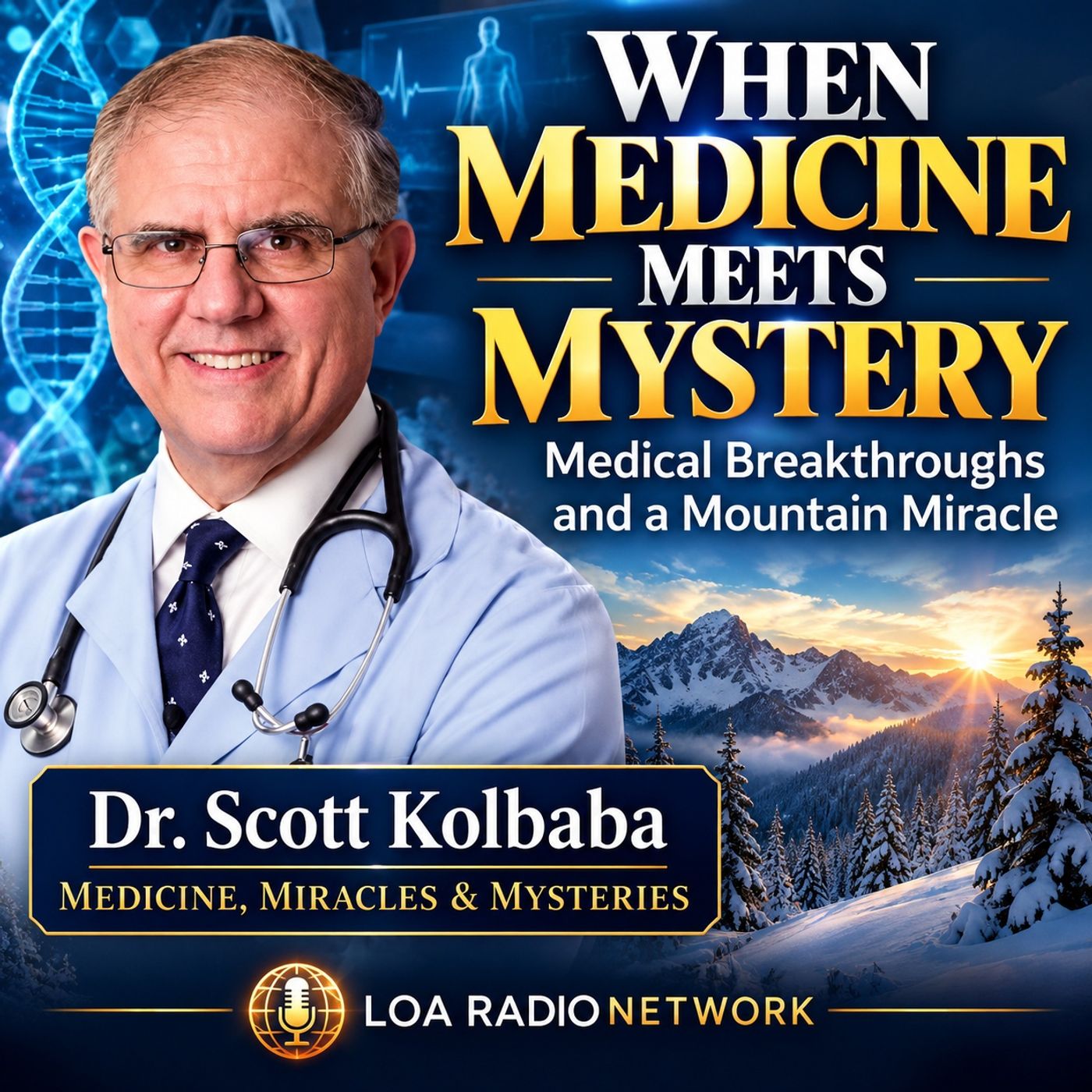
When Medicine Meets Mystery
Get every episode summarized
Each time Create Your Reality: The Ultimate Law of Attraction Show for Conscious Creators publishes, we email you a written briefing from the transcript — the topics, who appeared, and any specific claims, with the ad reads skipped.
Email me new episodesFree for 3 shows. No card needed.
About this episode
Create Your Reality: The Ultimate Law of Attraction Show for Conscious Creators is made possible by:
All brands on Create Your Reality: The Ultimate Law of Attraction Show for Conscious Creators →
“Right now at Subway, try the 499 Sub of the day. Get a different 6-inch sub every day for just 499 each, like Meatball Marinera on Mondays, tuna on Tuesdays, and the BMT on Saturdays.”From the transcript
The remarkable rescue raises questions about coincidence, intuition, medicine, and experiences science does not always easily explain.Medicine, Miracles & Mysteries brings together practical medical knowledge and unforgettable physician stories at the intersection of science, hope, mystery, and the unexplained.
https://www.loaradionetwork.com/dr-scott
Become a supporter of this podcast: https://www.spreaker.com/podcast/law-of-attraction-radio-network-for-conscious-creators--1595897/support.
✨ Subscribe and Stay Inspired!
Listen to more powerful conversations on the Law of Attraction Radio Network, featuring top experts in manifestation, spirituality, and quantum success.
🌐 Visit loaradio explore shows, read articles, and connect with our global Law of Attraction community.
💫 Create a new life by creating new thoughts.
#LawOfAttraction #Manifestation #SpiritualGrowth #JewelsJohnson #LOARadioNetwork
Get every episode summarized
Each time Create Your Reality: The Ultimate Law of Attraction Show for Conscious Creators publishes, we email you a written briefing from the transcript — the topics, who appeared, and any specific claims, with the ad reads skipped.
Email me new episodesFree for 3 shows. No card needed.
Hosts & guests
Transcript ready
392 searchable segments. Every word is indexed and playable.
Full transcript
Create Your Reality: The Ultimate Law of Attraction Show for Conscious Creators — When Medicine Meets Mystery. Machine-transcribed; use the interactive transcript above to jump the player to any line.
Right now at Subway, try the 499 Sub of the day. Get a different 6-inch sub every day for just 499 each, like Meatball Marinera on Mondays, tuna on Tuesdays, and the BMT on Saturdays. It's a different 6-inch sub every day, packed with protein and your choice of chopped veggies for just 499 each. Or make it a meal with chips and a drink for just $2 more. But hurry, it's only for a limited time, and only at Subway. At participating restaurants, prices higher in Washington, Alaska, and Hawaii, and on third party delivery, add on taxes and fees for delivery additional. From the Law of Attraction Radio Network, welcome to Medicine Miracles and Mysteries. Join Dr. Scott J. Colbaba for a fascinating journey into the science, the stories, and the unexplained moments that make medicines so extraordinary. Each episode explores practical insights for healthier living, today's most important medical questions, and remarkable true stories from physicians who have witnessed courage, mystery, hope, and sometimes events that medicine alone cannot fully explain.
Where science ends, the story begins. And now, here is Dr. Scott Colbaba. Hello, this is Dr. Scott Colbaba, a practicing general internal medicine physician, and welcome to my show, Medicine Miracles and Mysteries. On today's show, I'm going to take you to your doctor's office in the future, five years from now, and you're going to experience with me the radical changes that are going to happen as AI enters the world of medicine. Is it good? Is it scary? I'll let you decide. The second half of each show is about the unexplained miraculous stories that I collected from interviewing hundreds of real doctors, chronicled in my best-selling book Physicians Untold Stories. Today's story is a true goose bump tale from a colleague, a trauma surgeon, lost in a blizzard on a Colorado mountain, and how a miracle changed his life. But first, to keep my lawyer happy, our disclaimer, the information in this podcast is for education
and general information about health, wellness, and related topics. It's not intended to diagnose or treat any individual condition, and it should not replace your own physician's advice and medical care. Now let's take a trip together to your doctor's office, five years from now, the year 2031, and you wake up realizing that you're a little more short of breath. You call your doctor's office for an appointment, and fortunately there's a cancellation, and she can actually see you today instead of three months from now. You get to the office, walk into the exam room, and there is a robot dressed in a white coat with big eyes staring at you. Come in patient, it says to you. No! I know that this is what you were thinking, but this is absolutely not what's going to happen. Robots will never replace your physician. What then you ask will the world of AI medicine look like? Before you walk into the office, an artificial intelligence system has reviewed information
from your medical record, medications, labs, blood pressure readings, and other information that was transmitted to your doctor's office from your watch, or another source called your wife. AI notices the changes in your heart rate or kidney function, or interaction between two drugs that you're taking from different specialists. And before your doctor enters the room, she gets an alert on her computer, summarizing in three to four simple sentences, reams of data that AI will condense on the issues that deserve her attention about you that day. And the real miracle, your doctor sits down and looks you in the eye and actually talks to you. You are not looking at her back while she's typing. What a novel concept, getting back to the way medicine was practiced when I first started. So how does she do this? She asks your permission to have her AI scribe on her computer, listen to your conversation,
and record the important medical information and generate a perfect medical chart note. You say yes, but then you think who is listening to this conversation and how long will it be on AI? And will that disease that I caught doing something I shouldn't have done on my business trip in Thailand be broadcast over the internet? These are reasonable questions. So what are the safeguards in place for the AI scribes today? The answer depends upon the health system and the product being used. Safeguards may include encrypted transmission and storage, restricted access and limits on how long audio is retained. You should be told when an AI scribe is being used and you also have the right to decline. But as you can see, the AI scribe will allow physicians to be more personal and it will reduce the paperwork burden by estimated 30%. Instead of spending two hours at night catching up on my charting, I'll be able to watch
the Chicago Cubs baseball and they may actually win. Now since your original problem of shortness of breath, AI will pay particular attention to your heart and lung tests in the past. It will summarize them for your doctor, a process that will also save me considerable time. Then she orders an EKG. AI, yes, AI again will not only interpret the EKG but pick up very subtle changes in the QLRS complex that the traditional chip and even your cardiologists might not see that could indicate an impending problem. So your doctor then orders an EKO and EKG because AI suggested that with the strain pattern on your EKG, this might be the next step. This too is being read by AI, which analyzes every part of your heart and tells your physician that your aortic valve has become more narrowed, more than the echo done two years ago. But you are relieved when your measurements are automatically compared to the current heart association guidelines and it estimates that with your rate of progression, you will
not need a new heart valve for the foreseeable future. You also mention incidentally that to your future doctor that there's a mole on your shoulder that you think is changing. You take a photograph and AI compares your picture with the one that was done last year by your dermatologist. AI flags the study as something that needs your dermatologist's attention. Again, AI does not remove your mole. It does not tell you you have cancer but it alerts you to the fact that it's changing in a way that deserves attention. Here AI is not replacing your doctors. It's helping them be better. I like to think of AI as a tool, just like doing a blood test or an x-ray to help make a diagnosis. That distinction, I think, is really important. And this basic concept is spreading throughout medicine. Just last week I had a lady with thyroid nodules and we were following with an ordering routine annual thyroid ultrasounds. To my great surprise, the interpretation said it was aided by AI.
It was able to more accurately measure the size of the nodules and the characteristics to help and not replace the radiologist to tell me if one should be biopsy because of worrisome anatomy. In ophthalmology, AI is analyzing retinal photographs to help identify abnormalities like diabetic retinal disease that may need further evaluation by trained ophthalmologist. In gastroenterology, AI is reviewing videos of colonoscopes, isn't it your favorite test of all tests to draw attention to polyps that might otherwise be missed? In pathology, imagine AI helping the pathologist determine the percent of cancer cells that are dividing rapidly in a screen that contains thousands of cells to give a more accurate tumor prognosis. Reducing the time pathologists need to spend peering into a microscope all day just might prevent a cross-eyed pathologist. I'm sorry, but my wife liked that one. In hospitals, AI is being used to analyze data from every admission to catch early
signs of sepsis or other life-threatening complications. If you come to my medical office today, you might see me using AI. Last month, I had a new patient come in with a neurologic disorder that I've studied before, but I haven't seen a case for several years and I wanted to update my knowledge. So I asked AI to give me a one-page tutorial. It was perfect, including scientific references, until my patient asked me if I really went to medical school. And that was the end of me losing that much AI in the office. Now I excuse myself and search AI in my private office, but that's our secret. With the AMATS Gold Card, you can earn four times points at US Supermarkets because the best nights in start with the grocery run that makes it happen. And when meals come with four times points, moments around the table add up to even more. Apply today and find out your welcome offer which could be as high as 100,000 points.
Learn more at americanexpress.com slash explore-gold terms and points cap apply. Don't tell any of my patients. My son, Dane, who does a lot of work with AI asked me what I would do if AI gave me an incorrect response. As Dane knows, AI can sometimes make up answers that sound perfectly correct. Or what if AI misunderstands a question or I leave out an important fact. This gets back to our premise for the entire segment that AI is a tool and not a doctor. The safest model going forward with AI and medicine is a partnership, I think. AI can search enormous amounts of information and recognize patterns and check for things we may have overlooked. But the physician still has to ask the most important question. Does this make sense for the patient sitting in front of me right now, this day? A good physician should be able to disagree with the computer without expletives or throwing a pen at the computer screen.
Even calmly go back the old fashioned way to examine the patient and review the lab data. So now that you know everything about AI and medicine, what do you think? Will AI be good for you and your family? My opinion, I think AI will help most physicians and myself be better docs. But there is something that AI may never be able to accomplish. And that is to make the 10 o'clock appointment actually happen at 10 o'clock. Thanks for listening. After the break, we'll move from artificial intelligence to a real-life mystery of medicine, a miraculous story of a surgeon lost in a mountain blizzard. Now, normally, this would be the time for a word from our sponsor. But since this is our premier show, I wanted to say thank you to Jules Johnson and the Law of Attraction Radio Network for giving me the opportunity to host this exciting podcast. Now, to the favorite part of my show, Trouble on the Mountain, the miraculous story of orthopedic
surgeon Steve Heim. Now, I've known Steve Heim for a long time. Steve is quite an orthopedic surgeon. He's also a trauma surgeon. And I'll never forget the morning we had breakfast together. We were meeting to talk about a business adventure that never actually happened. But Steve seemed a little anxious that morning. And I didn't quite understand why. But we finished the meeting. I was almost late for going to the office. I was doing eight o'clock. It was like five minutes to eight. And then as we stood up, Steve said to me, Scott, I've got to tell you this story. I listed it. I'm like, Steve, I'm late for work. I'm usually a little bit late, but I don't want to be too late. Somebody said, let's just sit on for a minute. I want to tell you something. And he started to tell me a story that just was unbelievable. I'll never forget this one of the most incredible stories I've ever heard.
Steve said that he was a little burned out with his work. And he works pretty hard. He's a surgeon. He can be up all night sometimes. And he decided to take a vacation in Colorado. He and his wife and his wife, sister. And so they took off for a long weekend. I think it was a three or four day weekend. And they went to Colorado. And Steve is an expert skier. He goes on the diamond runs all the time. I'm on the bunny hill with fine skiing. But he loves to ski and his wife and his wife's sister are all expert skiers. So they were skiing all morning and they had a great time skiing, relaxing, taking it easy and had a lunch. And then he noticed this mountain off in the distance. And he had kind of a strange feeling about this mountain. And it kind of was drawing him. It was kind of a magnet. He was drawing him to this mountain that he never skied on before. So they decided to go on that mountain and ski down. It was mostly black diamond runs.
And they got to the lift. And when they started to get in the lift, it started to snow a little bit. And as they got up the mountain, he started to snow more and more and more. And pretty soon the wind started to come up. And by the time they reached the top of the mountain, which they'd never been on before, there was a full-blown blizzard. The wind was blowing at 40 miles an hour. Snow was coming down sideways and around the circles. And it was just an incredible mountain blizzard. They could hardly see in front of them. They got out the map to see where they were going. And they had only one way to get down. And that was to ski down. So they started to ski. And Steve and the girls are, again, expert skiers. So they had no problem skiing. But then they came to a patch of trees, pine trees. And Steve, it's automatically expected the girls to be coming with him. I won't say this. I won't say it's a typical surgeon. But Steve expected the girls to follow him. But they actually went to the lift around the pine tree, a grove.
And Steve went straight ahead and suddenly realized that the girls weren't with him. So Steve and expert skier decided to ski through the patch of trees and get to the other side to meet up with the girls. So he started to do that. And the snow was very deep. It was powdery snow. It was probably three or four feet deep, at least. And then he got this feeling in his chest. And have you ever had that feeling worth? It's like it's a feeling of dread and foreboding. Like he was being called to do something that had life and implications. So he didn't know what to do. So he stopped skiing. Now he knew he wouldn't be able to start skiing again because the snow was so deep right there. And he stood there and didn't know what to do. So he took off his skis. And he stood for a little while longer. In the meantime, the wind is blowing around the grove of trees. But it became very quiet and very still in the grove of trees
that Steve was. It was an eerie silence. And he took his skis off and he hold them on his hand. And he decided then to do something that I don't and he doesn't even understand. And that is he decided to climb up the mountain. Now had he gone the other way, he would have met with the girls and been able to ski back down the mountain. But he decided to go in almost the opposite direction, up the hill, up the mountain. And it was a rugged, tough mountain to climb. So he had to climb and he had to walk and climb and walk and climb. And he could hear his boots crunching against the snow because it was getting colder and colder and colder. You know how the snow makes that crunching sound when it gets really, really cold. And that's what he was hearing. And he was huffing and puffing, but he was in pretty good shape. But he came to his large pine tree. And he stood there for a minute not knowing what he was doing. He had no idea why he was climbing up this mountain.
It made no sense at all. And suddenly he looked down and he knew why he was there. There in the tree well, which is the where the snow comes down to the base of the tree, was the shape of a body. A skier must have hit the tree and was unconscious and covered with snow. Steve is a trauma surgeon, so he knew exactly what to do. He brushed off the snow and the male skier looked like he was dead. He had a gray face. But Steve knew what to do. So he put his hand on his cryo artery and his neck. And he had a thready pulse. A thready pulse means that his blood pressure is low. He's probably in shock. And he's probably almost dead. So Steve does exactly what he needs to do. He brushes off the snow. He takes off his jacket. He covers him and his jacket. He puts his head down a bit. And he starts the yell, help, help. Almost no one's coming down the mountain at this time. But there was one of the last skiers.
Her it is cry for help and stop by to see what was going on. So Steve said, you need to go down to the ski and to the phone on the slope and call the ski patrol. You get him up here right away. This guy is almost dead. So the guy took off. Took off. And Steve in the meantime noticed that his leg was in 90 degree angle. So being a trauma and orthopedic surgeon, he broke a branch off the local pine tree there that he was standing near. And he tied his leg together so that you basically set the bone about five minutes later. So he could see the lights from the ski patrol that was coming up with a gurney to load the hapless near death skier onto the gurney and take him down to the lodge. The meantime, Steve's still getting his jacket back on and shivering more from a dremel
and then from cold, realizing that what he had just had seen, he'd been led to the skier who wouldn't have been found until the next, probably the next season because he was covered with snow and that would be a place where no one would look. So he started then, got his coat back on, started the walk in the opposite direction to where the girls actually were still there waiting for him. And then they skied down to the lodge and Steve was still recovering from this incredible experience. He was rewarded there when he got to the lodge with a cup of hot chocolate. The next morning when he got up, he called the hospital to see what happened to the skier. And he found out that the skier was awake, was alive, or the orthopedic surgeon that took care of his broken leg, were very impressed with Steve setting the bone and making it almost a perfect alignment.
And they found out that the person was a plumber from a local area, that had been skiing, but had hit the tree and then been knocked unconscious and would have died had Steve not been led to that very spot where he was. So I said to Steve, after he told me this, I was probably trembling with emotion hearing that story. I said, Steve, what did you think? And he said to me, Scott, that day two people were saved. And he said, what do you mean? And he said, the skier was saved. There's no question that he would have died had I not come up to him that very, very second, but I was saved too. And he said, what do you mean? And he said, let me tell you a brief story about my father. My father and I, two years before this, were skiing in Michigan on a course that was used
by a number of international skiers for cross-country skiing and the Olympics. And my father's an expert cross-country skier and so am I. And we were skiing and I we got separated a little bit. And as we're as we're skiing, I decided to go back because the horn sounded that there was it was getting too cold to be out there. And so we decided to find my dad where he was behind me. And we'd both ski down to the lodge. Well, it happened that when he got back to see his father's, father was laying on the snow. And ash in face, just like the skier that Steve saved two years later. And he realized his father was having a heart attack, he was having chest pain. So he called through with his cell phone, he called it the ski patrol, but the ski patrol would have to take him down to the lodge and then around, which would take quite a long time because it was around the side of the mountain.
But there was a clinic, there was not very far away, perhaps a mile away. But the ski patrol wasn't allowed to take anyone anywhere else but to the back to the lodge. So Steve and Steve is a really husky, strong guy. He could do 300 pushups and 1,000 sit-ups at a time. And he decided to grab his dad, put him on his back. His dad was still alive, but he was suffering badly and run then run to the clinic, which was like I said, about an hour away. So Steve decided to run to the clinic and he was running as fast as he could with his father and his back. His father was moaning with chest pain. And by the time he got to the clinic, his father was unconscious. They laid him on a table on the groney and it just happened that there was another physician there. There was a Northwestern graduate also just like Steve and they did CPR. And this his father never regained consciousness. They did CPR for an hour. And Steve is used to saving people, not losing them.
And after an hour, they decided to call the code and he realized that his father was dead. And Steve said, after that, he realized that he couldn't save everyone and that he felt personally responsible for his father's death. And he was living with that for two years until he happened to come across this skier in the mountains that whose life he saved. And he said to me, you know, Scott, before this, I had the guilt of my father all along. But after this, I realized that I'm not in charge. That someone else is in charge of life and death and that this saving this skier made me, made me release the guilt of not saving my father. So he said that day two people were saved. The skier and myself.
And after that, he was able to go on with his life and be a happier person. And he felt that that evident saving of his, this poor skier saved his life also. That's the story of Steve Heim. And I think it's one of the most incredible stories I've ever heard. And it was the start of my book, Physicians Untold Stories. Thanks for listening. Our next show in two weeks will be on weight loss featuring the GLP ones, Ozempec, Manjaro, Zeppbound. Are they safe? And most importantly, are they for you? Our second half will be a story about a humble Irish midwife, an obstetrician spouse and a desperate delivery, childbirth delivery, and a miracle that saved her life. No one will forget this.
This is Scott Kolbaba. Stay well. Good night. Thank you for listening to medicine, miracles and mysteries with Dr. Scott J. Kolbaba. We hope today's episode gave you something valuable to think about, something practical for your health and perhaps a story you will not soon forget. Join us again for more conversations where medical science, human experience, and extraordinary physician stories come together. Medicine, miracles and mysteries is a presentation of the Law of Attraction Radio Network, where science ends, the story begins.
More episodes
More from Create Your Reality: The Ultimate Law of Attraction Show for Conscious Creators

Stop Chasing, Start Becoming: A Smarter Way to Manifest
Create Your Reality: The Ultimate Law of Attraction Show for Conscious Creators

The Luck Factor: How Opportunity Becomes Success
Create Your Reality: The Ultimate Law of Attraction Show for Conscious Creators

The AI Advantage - Timeless Success Principles for Wealth, Leadership, and Abund...
Create Your Reality: The Ultimate Law of Attraction Show for Conscious Creators

Luck, Rituals & Abundance: The Habits That Shape Success
Create Your Reality: The Ultimate Law of Attraction Show for Conscious Creators