Get every episode summarized
Each time I'm Not a Monster publishes, we email you a written briefing from the transcript — the topics, who appeared, and any specific claims, with the ad reads skipped.
Email me new episodesFree for 3 shows. No card needed.
About this episode
“This BBC podcast is supported by ads outside the UK. Decisions made in Washington can affect your portfolio every day, but what policy changes should investors be watching?”From the transcript
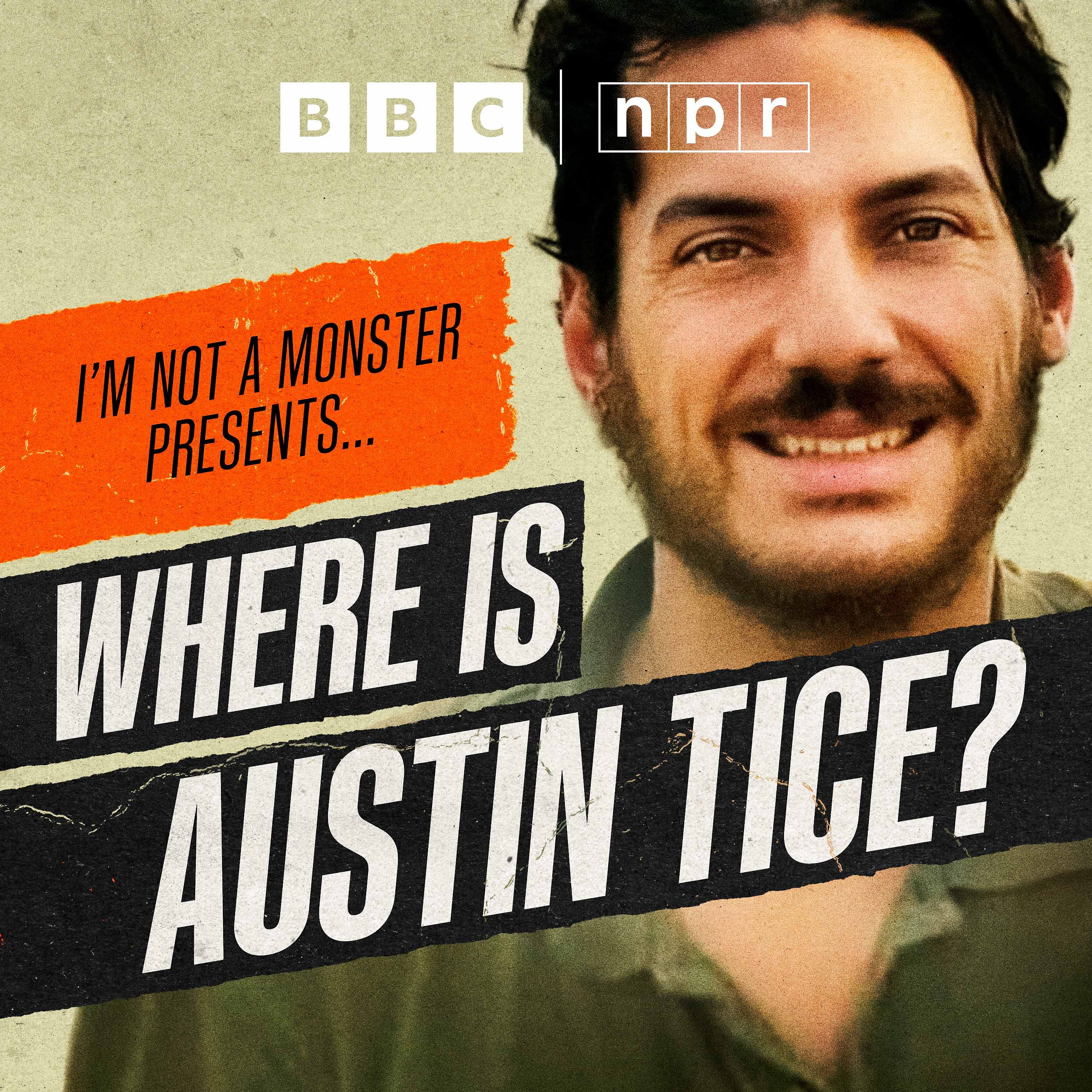
A video appears online titled: “Austin Tice Still Alive”. It shows Austin bound, blindfolded and terrified, surrounded by armed men. But as Josh and Sara dig deeper, the story begins to change. They uncover a trail that leads to the door of the most powerful man in Syria. Austin’s case is like no other.
Archive: CBS; NPR; CNN; khalidfree75; Al Jazeera; BBC; ABC; Middle East Eye.
Writer and showrunner: Josh Baker Investigative producer: Sara Obeidat Series producer: Simon Maybin Field producing: Ouday Al Hussein Additional producing: Lucy Burns Open source intelligence: Thomas Bordeaux & Gabor Friesen Production coordinator: Gemma Ashman Series editor: Clare Fordham Head of BBC News Long Form Audio: Emma Rippon BBC Radio 4 commissioning editor: Dan Clarke NPR producer: Monika Evstatieva NPR editors: Robert Little & Katie Simon NPR executive producer for Embedded: Irene Noguchi BBC World Service commissioning editor: Jon Manel Composer: Firas Abou Fakher Additional music: Karim Chehoury Theme music: Sam Slater Mix and sound design: Tom Brignell
Get every episode summarized
Each time I'm Not a Monster publishes, we email you a written briefing from the transcript — the topics, who appeared, and any specific claims, with the ad reads skipped.
Email me new episodesFree for 3 shows. No card needed.
Hosts & guests
Transcript ready
345 searchable segments. Every word is indexed and playable.
Full transcript
I'm Not a Monster — Where Is Austin Tice?: 5. The Video. Machine-transcribed; use the interactive transcript above to jump the player to any line.
This BBC podcast is supported by ads outside the UK. Decisions made in Washington can affect your portfolio every day, but what policy changes should investors be watching? Washington Wise is an original podcast from Charles Schwab that unpacks the stories making news in Washington right now and how they may affect your finances and portfolio. Listen at Schwab.com slash Washington Wise. That's Schwab.com slash Washington Wise. If you are currently overpaying on software to run your business, remember this number, 10,000. That's the number of new businesses that join Odo per month. Join Odo today at Odo.com that's oddo.com. This episode includes some explicit language. Six weeks after Austin's disappearance in Syria, a video emerges online and it makes international headlines.
There is a new developer on this morning in the disappearance of Austin Tys. A disturbing video clip appeared Monday on the online video clip showing him alive and held by gunmen. Men who appear to be Islamist militants are shown leading Tys up a rocky hill, but it's not clear where. How did you find out about the video? You know how you kind of just wake up and say something here is not quite right? And I walk downstairs and Mark is on the sofa white as a ghost. What is it? I don't want to tell you. I said no. If you could see yourself, you would know that you need to tell me. It had actually been on YouTube for several days, I think, maybe even a week. After speaking to her husband, Mark, Austin's mother, Deborah, watches the video. It's grainy, poorly filmed, shaky, and just 46 seconds long.
Three cars move along a dirt track against the backdrop of a remote mountain side. The last vehicle has its boot open and there's a man inside. Men wearing scarves known as kefiers clutch rifles. They're shoving a man in a ripped green shirt. Then his face comes into frame. It's Austin. He's blindfolded hands-baked. He attempts to recite a prayer in broken Arabic. Then the video cuts. Austin looks like he's suffering. For his mom, Deborah, the video is the only proof that she's had that Austin is alive since his abduction. It must have been incredibly difficult to watch that. I mean, I've watched it and I find
it hard. Well, I mean, for me, I wanted to know everything about it. You know, it was clipped and put together and the fact that they left in O Jesus, O Jesus, I felt like that was very much a message to his mom and that video had all the information we needed to get Austin. The video appears to show Austin held by some kind of extremist group, but we've confirmed that Austin was held by the Syrian regime. So the video doesn't add up because he was in regime custody. Deborah has always believed the video contains clues about where Austin is, and she might be right. It just depends on what you choose to see. When I'm watching this video, I see kind of the same things a very one else sees. The horror of the sky who's bound and blindfolded being dragged up this mountain side.
But I also see clues about where it was filmed, when it was filmed. This is Thomas Bordeaux. He's an investigative journalist who specializes in open source intelligence. That means he pieces together fragments of publicly available data to get answers. He sees details that others don't. When this video came out in 2012, journalists applied the best tactics they had at a time to analyze it. But we have new tactics since, and applying those, we can find new things. By stabilizing it and combining all the frames from the shot, we can get a lot of actually really identifiable features. So there's 25 frames in every second of video, 25 individual pictures. You've basically slowed down and analyzed each individual frame. Exactly. You get a clear view of a mountain range,
road curving around some vegetation, this plowed field. We know it was filmed about midday from the length of the shadows. They filmed this video in a kind of terrain that's only really found in about 20 square miles of Syria. Are you serious? Yeah. There's specific arrangements of trees. There's angles of roads and the way they curb. And even when we get down to it, there's specific rocks. Are you serious? You can match rocks. Yeah. Thomas doesn't think the video was filmed in an area controlled by anti-government forces. But he can't be completely sure. Another details don't add up for me either. The men in the video can't be identified. No badges, no insignia. Nothing linking them to a specific group. And the video is posted on a new YouTube channel, not one belonging to any known faction.
I've watched countless hours of footage from the Syrian war and other conflicts and spent time with rebel groups. Usually when they make a hostage video, they want the world to know they have the prisoner. They want that publicity. But in Austin's case, nobody claims him. And that's unusual. It's this incredible piece of media because it's the last time we know Austin Tyson is alive with visual evidence. Right. Someone made this video with the intention of it misleading. And to get to the actual truth in the video, you have to work past all of that. For years, people have questioned whether the video was staged. Now, Thomas's analysis suggests it was filmed at two different locations in regime-controlled areas. He gives me the GPS coordinates because I want to see if he's right. And what these places can tell us about the video.
I pack my bags, do a 56-page risk assessment, and then head back to Syria. I I've just fallen off a motorbike. I persuaded a group of soldiers that are nearby base to lend it to me because the weather is so bad, cars can't get here right now. Now I'm alone riding through the mountains between Lebanon and Syria. And it's getting dark. Okay, where am I now? Apart from being in a super remote area with absolutely nobody coming to get me for fuck this up. It's so close. It's down this path and we're...
I'm trying to reach the first location Thomas has given me. But it's not easy. The ground is wet and the path that's so clear on my map is barely visible in real life because it's so overgrown. Oh my god, that's steep. Oh my god, this is the valley. This is the valley. Okay, okay, okay, okay, okay. Well, looking for that big rock. Where is it? It's back there. It's there. Right there. This is the spot where Austin is going on a guard and is absolutely terrified. Austin was right here and it is the middle of nowhere. There's nothing around. The coordinates are ever so slightly out. Only slightly though. Oh my god, I'm a map. I'm actually in Lebanon. I'm not in Syria anymore across the border.
Why would they bring him into Lebanon? Yeah. Whoever made the video went to extraordinary lengths to bring Austin here. If I had to guess, maybe they chose this spot because the terrain looks similar to Italy province, a rebel stronghold, or because they hoped this site would never be found. I don't know. But now I want to see what the second location can tell me. I regroup with my colleague Sarah and the next day we head there. It's still hiking as I'm out in. We've probably gone up to a kilometer to go, we think at least. How would you rate this amongst your journalistic experiences? Right now I hate journalism. Getting to the next location is far from easy. It involves a multi-hour hike. And at one point we split up to try and check the area more quickly.
I take a horse ride with some Bedouin shepherds. But it's not the location we're looking for, so I double back to Sarah. Then we hike some more until we enter a valley with a long dirt track, just like in the video of Austin. Well, yeah, that's really similar. So this is definitely where the video was filmed because look over there, you've got the position where the camera was, you've got the track that the track strove down with Austin in the back, and then you've got the tree that's very prominent in the video just there, and the slopes of the valley's match as well. Look at that, there's a military bunker right there. Right on the opposite side. That's why they put the camera this side. This is why they're shooting this way. That makes sense. Because if they'd filmed to the left, they're filming a Syrian military position. Yeah, which means that they would have been on regime territory.
The terrain matches perfectly to what we can see in Austin's YouTube video. This is the second site where Austin was filmed. Thomas was right. This means there's no way Austin was taken by rebel fighters as the video tries to suggest. Because back in 2012, this whole area was controlled by a sad regime forces. But that raises bigger questions. What was the regime trying to do by making this? Why put Austin Tice in this video? I'm Josh Baker and from BBC Radio 4, an MPR's embedded. This is Where is Austin Tice? Series 3 of I'm Not a Monster Presents. Episode 5. The Video With a new Schwab teen investor account, teens can gain hands-on investing experience and build
positive money habits. It's an account co-owned by you and your teen so you can monitor and engage with the account while your teen learns how to invest and manage money. Learn more at Schwab.com. The Video I'm not a fan of the video, but I'm a fan of the video. I'm a fan of the video. To work out who made the video and why, I go back to the recording that we were sent while investigating Austin's driver, the man who abducted him. In that recording, a Syrian regime commander named someone he says who was involved in making Austin's video, but doesn't say much more. Luna Alshibal. She is a well-known Syrian regime figure who worked inside Assad's media operation.
That catches my attention because if the Austin video was staged to send a message, then someone had to shape that message. We need to find out more about Luna. After a few weeks and a lot of cups of tea, we find somebody who's willing to talk, but she's nervous. And you don't want me to use your name? Can you explain why? They're still targeting those people who are still against them. So I received a lot of threatens. You received threats? Yeah, that's why I don't talk to anyone. I used to comment a lot, write a lot, be active in public issues, but after I received some threatens from both sides from HGS and from the flu,
I stepped back. I have small kids. And you see here, you know, the guns and weapons, it's all over. It must be quite scary to consent with that. It is scary. It is. It's no joke. Luna's friend used to work for President Assad's wife, Asma. Now she's one of the many people labeled the Lule, an Arabic word meaning the remnants of a defeated army. In today's Syria, it's used more broadly. For anyone seen as loyal to the old regime. And that label has left her exposed. The new authorities don't trust her. And she says figures from the old regime have warned her to stay quiet, because she knows some of their secrets, including secrets about her friend, Luna. Who is Luna Shibou? She's a very ambitious young lady who was raised here in Damascus.
She has a very strong personality, charming personality. She's beautiful. She's ambitious. And she gives you a lot of, you know, she's very compassionate. She was a Jizira star. She was a star there. She's a very strong young lady who has a very strong personality. Back in 2010, Luna was a well-known anchor for the TV news channel Al Jizira Arabic. In one report I've seen, she stands in a newsroom in a bright pink blazer. She's got dark shoulder length hair. Blue eyeshadows sits beneath thin-shaped eyebrows. She captivates your attention. What she told me is that when she was in Al Jizira, she was in contact with Bashar al-Assad. With the president? Yes. But undercover. And she used to come to Syria. And secretly,
she used to go and meet him. She said this over the dinner once. She used to give information and data she gets from Al Jizira to Al Assad. She was spying. She was spying for the benefit of Al Assad. So she was essentially using her position as a journalist at Al Jizira where you get lots of information from rebel groups to give it to the regime. Yeah. And also trying to make Assad look better. Yes. Yes. We don't know if this is true. But Luna leaves that job and takes up a position at Sirius State Broadcaster. Luna Shibel came back to Damascus. She was all over the Syrian TV, all over. When she comes up in the TV, she stays for like three and four hours. I remember I went out with my friends for like three hours sitting in one restaurant and the TV was full of Luna. It was only Luna on the
TV. So she was starting to get a lot of influence. Yes. Yes. There's a lot of influence. Luna becomes a mouthpiece for the Syrian regime's propaganda. At a time when Assad is desperate to improve how he's seen by the world, to restore his public image to what it had been when he first came to power. When many believed he might be a fresh start for Syria. We have news from the Middle East today. The president of Syria has died at the age of 69. This morning the ruling bath party nominated Assad's 34-year-old son Bashar to succeed his father as head of state. When his father, Hafiz Alassad, died in the summer of 2000. Arrangements were made for Bashar to take over the presidency. The constitution was changed so that the head of state no longer had to be 40 but 34 which his chance would have it was pressure. Al Assad's age at the time. Bashar Alassad was never meant to rule Syria. He was an eye doctor in London. A shy almost geeky
figure I'm told. But when his older brother died in a car crash it put Bashar in line for the presidency. A whole Syrian generation has known no other leader and they're bound to be nervous about the future. Bashar became president, a married Asma. A Syrian woman raised in London. She gave interviews about him. I know the man behind the presidency. I know the father he is to his children and I know the husband that he is to me. And more importantly I know that he's a man who cares. In many ways Bashar was an outsider in his own country and when faced with the complexity of running Syria he fell back on the tools of his father control imprisonment and torture. In 2011, Assad's forces opened fire and murdered protesters and a revolution was born. This uprising has given way to a brutal civil war 17 months into this conflict.
Soon after Assad tried to explain the situation in an interview with Barbara Walters for ABC. Our view is there were peaceful protesters. They were killed, some were tortured. It was a brutal reaction. Every single, every brutal reaction was by individual, not by institution. And that's what I call what I describe as individual mistakes. But not by your command? No, no, no, we don't have another enormous command. There was no command to kill or to be brutal. Assad looks evasive, uncertain, nothing like the strong confident leader he wants the world to believe he is. His reputation is collapsing. Not long after this interview, Austin Tyson arrives in Syria to pursue his dream of becoming a war reporter. And Luna Al Shippel is now head of the
presidential media office working to try and clean up Assad's image. She was controlling a lot of Facebook pages, a lot and hundreds fake accounts. So Luna starts making propaganda for the Assad family. What kind of propaganda is she making? The rebels, they are terrorists, they are backed up from the Americans, from the West, from the Israelis. So she's essentially trying to create material that shows the Syrian people that hey these rebels, they're not rebels, they're terrorists. That's a terrorist. Yes, exactly, exactly. Basically giving Assad a contemporary media strategy. Yeah, all his interviews, all his videos, everything on TV regarding Assad, Luna was behind it. Every single thing. This media operation was essential for the regime.
Many in Syria and a lot of people around the world too supported the rebels. So the regime set out to recast them as dangerous terrorists. They fabricated stories, blamed rebels for things like sexual assault and faked military victories, all to make the opposition look weak. At the same time, they presented President Assad as the only man who could save Syria from extremists. Luna's job was to defend Assad at all costs. She knew that the president will do whatever she wants. Really? Yes. The priority now is for media. Your war is media, your war is social media. So whatever you do, I have to know about it. And he gave her the power. He trusted her in everything. Luna was there in every single step, in every single step, security, government, public issues, media, social media, public diplomacy, image.
Whatever they say, she has to know and she has to approve. President Assad was basically being influenced in your view by Luna. He was listening to that. Big time. Big time. What she says about Luna's power is echoed by others I've spoken to. Luna became one of the few people Assad trusted to protect and shape the regime's image. She was on the front line of his media war. Mobile phone videos of Luna and Assad later leaked online. In one, she giggles beside him as they drive through a damage to Damascus suburb, an area where his forces committed atrocities, including chemical weapons attacks. As they pass by the people who live there, Assad mocks them for being backward and ignorant. When I watch it, it's clear the two of them are
close. She hadn't appeared with Bashar, so she knows everything. The pilot don't clean her. She knows everything. How do you know they were having an affair? People in the palace, they know. Even the people who clean the palace, they know. They know. Because he used to have, if not only with Luna, with other ladies also. He was free. He was abnormal in his sexual relationships. He used to have one of his friends. He's a plastic surgeon. He used to go to the gym. Since he was alone, we used to say those are kinds of great decent things GPS, And we were more from time to time. And then they say I kill my boyfriend. He knows his friend and I could make him go along like this. So I said had absolute power then he could do whatever he wanted.
I just want to step back for a moment. We know the Austin Ties video was faked. Would a sad have trusted her to make that look? Oh, she was responsible. The idea that Luna was responsible for the Austin Ties video is a big claim. I want to know why she believes this. Luna's friend tells me about a time in 2024 when the two of them were sitting by Luna's pole. Luna's brother had gone missing and she was frantic. She was desperate taking pills. I was there, kids were playing swimming together. I asked her who took your brother? She said it's Israeli or Americans because they want to put pressure on me for Austin Ties. She said why would you do anything with Austin Ties? She said because I filmed him. You know the very famous movie when they wanted to kill him and everything. I said yes, she said I filmed that. I got people and I dressed them up and I filmed him.
Why would Luna have wanted to make that video with Austin? Because she wants to convince people that there are terrorists in Syria or not only against Syrians was also against Americans. Is that to try to get the Americans to be more supportive of Assad? Of course, like we are fighting, let's go and fight terrorism together. But what does that mean for Austin? Because surely once he's been in that video, if he's ever released, the Americans will know the truth. So they can presumably never release him after that. Maybe that's why he wasn't released. Luna's friend tells me there's another detail that came up in their poolside chat. Something that happened straight after Luna had finished filming the video of Austin. He saw Luna. And she told me this. She told me this and by word, when we were done, he opened his eyes and he saw me.
That was the killing mistake. So you think the fact that Austin ties saw her face is enough to get him killed? Absolutely. He saw Luna filming him. If he said that Luna was there, the whole empire of the propaganda she made, it will fall. It will demolish. He will lose. Every video she's ever made. Every single word, every thing, it will demolish. From what you know of Luna, do you think Luna would have a pressure of sad to kill Austin? You do? Yes. Yes, of course. Why? Because he saw her. She said that he saw her. So it's no longer even just about protecting Luna. It's about protecting... The kingdom, the propaganda, the media. Luna, she wasn't protecting herself.
She was protecting the regime. So this would mean Luna put Austin in the video to sell the world a story. The rebels you support are harming an American. You're supporting the wrong side. And the theory is, being in that video may have cost Austin his life. In 2024, just months before the regime fell, Luna was killed in a car crash. She'd fallen out of favor with Assad, and many believe she was assassinated. Whatever the truth, what she knew about Austin, died with her. We speak to more people who knew Luna, former intelligence officials, and even insiders from the presidential palace. They confirm a lot of what we've been told, including that she made Austin's video, that Assad sanctioned it,
and that the mountains were chosen because they looked like rebel-held territory. But we find no evidence that Austin was killed. Instead, we discover that as late as 2024, Assad sent a man to speak to the Americans about Austin's ties. And we've found him. Maybe he can tell us what happened to Austin after the video. You've been listening to Where Is Austin Tice? Series 3 of I'm Not A Monster Presents Please share, rate, and review the show. It really does help. If you have any information on Austin Tice, you can email me directly on Josh at bbc.co.uk or message me on social media at Josh Baker Story.
The series is written and showrun by me, Josh Baker. The investigative producer Isara Obidat. The series producer is Simon Maibin, field producing by Uday Al Hussein, additional producing by Lucy Burns, open source intelligence by Thomas Bordeaux and Gabor Friesen. Our production coordinator is Gemma Ashman. The series editor is Claire Fordham. The head of BBC News long-form audio is Emma Rippen, and at BBC Radio 4, the commissioning editor is Dan Clark. At MPR, our producer is Monica F. Stachuber. Editors are Robert Little and Katie Simon, and the executive producer for Embedded is Irene Ngujchi. The composer is Ferras Abelfaker, additional music by Karim Shahouri, theme music by Sam Slater, and it was mixed by Tom Brignal.
Brian Brendan Wright, known as the Milkman, was the UK's biggest cocaine trafficker in the 1990s. There weren't many groups in the UK that could access direct into the Columbia market. When you think of a narco trafficker, you're thinking cold, calculating, likely violent. How did the Milkman build a transatlantic cocaine empire? We just sat down for lunch, and there's Britain's most wanted bloke. Gangsta, the story of the Milkman. Why was he called the Milkman? Supposedly, because he always delivers. Listen first of BBC Sounds. Something is happening in Dawson Creek. A wave of violence has swept over this community of just 13,000 people. It's like the kind of stuff you only hear about on TV. 15 murders in the last five years. Some criminals, I put them into the category of super villains. I'm Timothy Sawa, and from CBC's Uncover and the 5th Estate.
An investigation into deaths and disappearances in Dawson Creek. And what's behind it all? I'm not saying another word. Leave me alone. The Milesio murders, available now on CBC Listen or wherever you get your podcasts.
More episodes
More from I'm Not a Monster

Where Is Austin Tice?: Episode 8 is coming soon...
I'm Not a Monster
Where Is Austin Tice?: 7. The Escape
I'm Not a Monster
Where Is Austin Tice?: 6. A Meeting in Muscat
I'm Not a Monster
Where Is Austin Tice?: 4. The Driver
I'm Not a Monster