Get every episode summarized
Each time Think from KERA publishes, we email you a written briefing from the transcript — the topics, who appeared, and any specific claims, with the ad reads skipped.
Email me new episodesFree for 3 shows. No card needed.
About this episode
Think from KERA is made possible by:
“When you buy business software from lots of vendors, the costs add up and it gets complicated and confusing. It's a single company that sells a suite of enterprise apps that handles everything from accounting to inventory to sales.”From the transcript
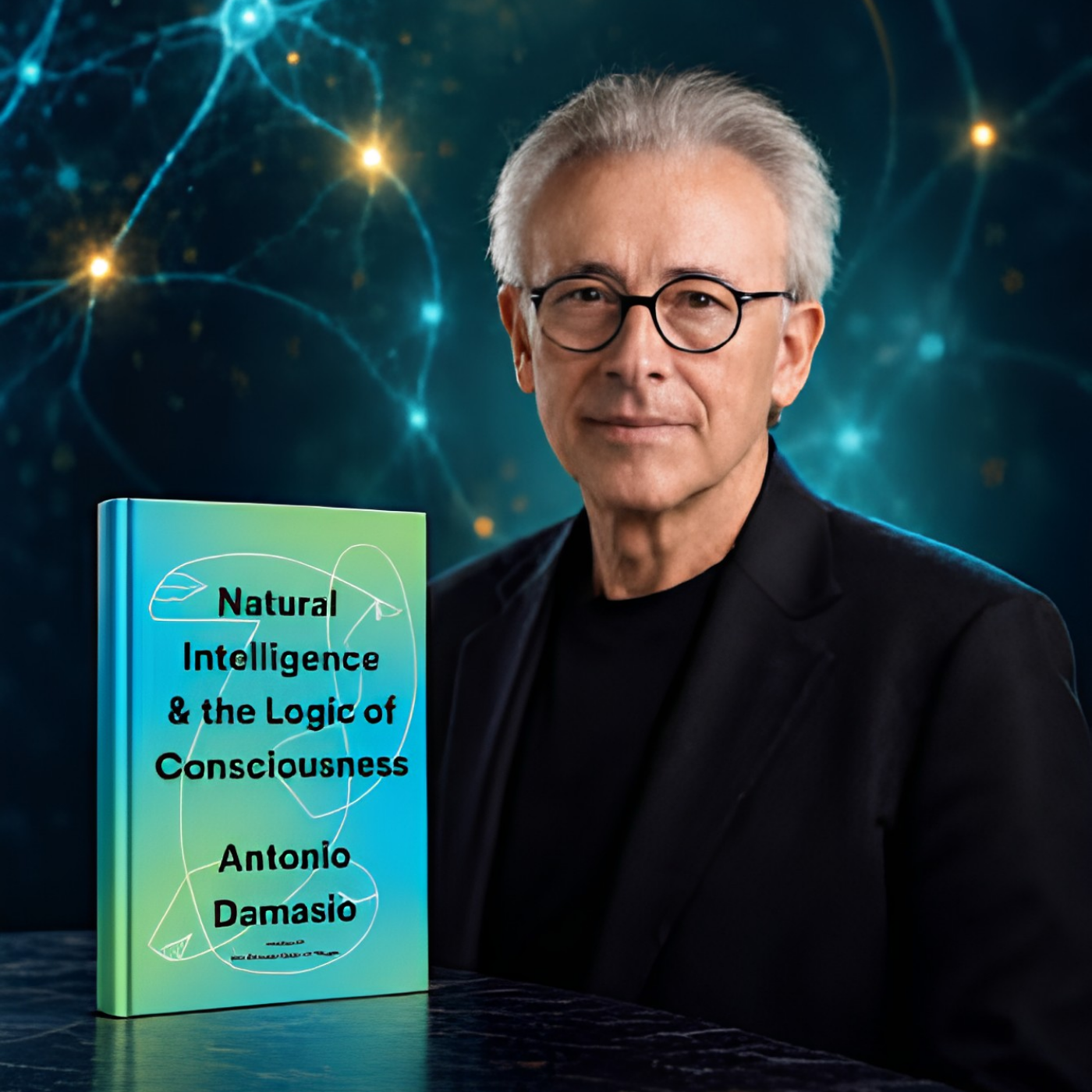
Did consciousness lead to us having feelings, or was it the other way around? Antonio Damasio is David Dornsife Professor of Neuroscience, Psychology, and Philosophy, and director of the Brain and Creativity Institute at the University of Southern California. He joins host Krys Boyd to discuss why he believes consciousness came before feelings and why feelings came early in the evolutionary process. Plus, we’ll ponder how many other organisms are aware of their existence. His book is “Natural Intelligence and the Logic of Consciousness.”
Learn about your ad choices: dovetail.prx.org/ad-choicesGet every episode summarized
Each time Think from KERA publishes, we email you a written briefing from the transcript — the topics, who appeared, and any specific claims, with the ad reads skipped.
Email me new episodesFree for 3 shows. No card needed.
Hosts & guests
Transcript ready
530 searchable segments. Every word is indexed and playable.
Full transcript
Think from KERA — Why consciousness evolved. Machine-transcribed; use the interactive transcript above to jump the player to any line.
This show is supported by ODO. When you buy business software from lots of vendors, the costs add up and it gets complicated and confusing. ODO solves this. It's a single company that sells a suite of enterprise apps that handles everything from accounting to inventory to sales. ODO is all connected on a single platform in a simple and affordable way. You can save money without missing out on the features you need. Check out ODO at odo.com. That's odo.com. Think is brought to you by Progressive Insurance. Insurance isn't one size fits all. That's why drivers have enjoyed Progressive's name your price tool for years now. With the name your price tool, you tell them what you want to pay and they'll show you options to fit your budget. So whether you're picking out your first policy or just looking for something that works better for you and your family, they make it easy to see your options. Visit Progressive.com. Find a rate that works for you with the name your price tool. Progressive casualty insurance company and affiliates price and coverage match limited
by state law. We literally can't imagine being alive without being conscious, but of course all kinds of living things get by just fine without the sort of awareness of their own forms that we have. So if plants and bacteria and sponges can thrive without exactly knowing they exist, why do mammals and birds and probably a lot of fish require that kind of awareness? From KERA in Dallas, this is Think. I'm Chris Boyd. Some scientists have argued that the development of consciousness in at least rudimentary form is what allows a creature to start feeling things. But my guess believes the opposite is true. Antoneo requires an organism to be able to feel in order to develop consciousness. Antoneo Dimazio is David Dornseif, professor of neuroscience psychology and philosophy and director of the Brain and Creativity Institute at the University of Southern California.
His newest book is called Natural Intelligence and the Logic of Consciousness. Antoneo, welcome back to Think. My pleasure. Good to hear your introduction and good to be here. Tell me. So we know that plants can sense sunlight and turn their leaves in that direction. They can sense water and stretch their roots to absorb it. But we don't think of them as conscious the way a lot of animals are. So for purposes of this conversation, what are the minimum requirements for consciousness? Well, let's start with what consciousness really is. If you don't mind, I would just give you a very simple definition and then we can talk around it. And I would say that consciousness is a biological process. And that biological process allows living organisms that have a nervous system to discover spontaneously their own existence and the existence of a universe around them.
So I think that what I really want to emphasize is that consciousness implies a discovery of oneself, a discovery that there's a you there. There's something about you that is discovered when you have consciousness. When you give the very good example of the plant that is even capable of turning leaves slightly in the direction of light, for example. There's no evidence that the plant knows about itself, that the plant is in possession of some notion of what it is. It's doing something that is useful and the doing is very limited because as you know, plants don't move about. Leap turning is the maximum of what a plant can do in terms of movement. And it is, of course, extremely limited. But that said, there's no indication that there's a life in the interior of that plant
that is known by the plant. The great beauty of what we have in our own consciousness, in our own life, is that we know about it. We are constantly being informed in the former feelings, by the way, that we are alive. And this is so incredibly sharp that if something goes wrong in our organism, if we get sick or are about to get sick or if we get hurt, we immediately know it and we know it in our space. We know that something is going wrong and we actually can do something about it. And likewise, if we're feeling well and the world is going well, we also know that. So there's this dramatic difference between the world of creatures like plants or bacteria for that matter. And the world of creatures like us and many animals that are around us and in whom we
recognize that there's something very close to what we feel when we are conscious. Sorry for this long description, but I just wanted to put it in my perspective and that will help you as well. No, this is a good way to get started so that we're all on the same page here. Much of this book explores the function of what you call homeostatic feelings. How are these different from emotional feelings that are maybe more familiar to many of us? Yeah, that's very interesting. That gets you into this marvelous realm of emotion and feeling, two ideas, two concepts, two processes that very often are confused. Most people when talking about feeling very often use the word emotion, that's sort of the popular world, the word. And I want to make there a distinction because that again will help our conversation.
When you talk about an emotion, even the word implies movement. And interestingly, most emotions are about movement and movements that occurs, especially in a face or in the body as a whole. So there is movement and even the term emotion refers to movement towards the outside, movement of what movement of our own body or parts of our body like in facial expressions. When we talk about feeling and you refer it quite beautifully to homeostatic feeling, you talk about something that is happening inside, is happening in the interior of our organisms and even more so in the interior of our minds. Feelings are something that cannot be seen by others. Your feelings and mind are private.
You don't see my feelings, I don't see your feelings. However, I see your emotions when you express them in your face or in your body. So you have this very, this two distinct realms, the realm of feeling which is interior, is in the mind, it's private and the realm of emotion which has to do with movement and which everyone can see. And you also asked quite pointedly about homeostatic feelings, those feelings that are related to homeostasis. And this opens another kind of worms. What is homeostasis? And what is a homeostatic feeling? Well, a homeostatic feeling is a feeling that is expressing the state of your homeostasis and that is warning you, sending you a signal that you should do something to continue in
a state where your life is possible. So that's how we go to homeostasis. What a relapse. Once we do this, we've got it covered. We can all go home. So homeostasis is really about life regulation. A quick definition, I would say homeostasis is equal to talking about life regulation. Homeostasis is a set of rules that must be observed for life to continue. And there's a maintenance of conditions in our body without which our life cannot continue. And of course, this immediately puts you in mind of all those things that are happening on our day to day and that people very often disregard in terms of the concept, in terms of the science, although they don't disregard it at all in terms of their own life.
I'm talking about eating, drinking, being in a place where it's neither too hot or too cold, at least prohibitively hot or prohibitively cold. And so homeostasis is about observing the rules that are necessary for our life to continue. And without which our life is going to stop. If you don't eat for some amount of time, you're going to be not just hungry but sick and even more so with drink. If you don't quench your thirst, you're going to be in a very bad spot. And if you are in a place that is extremely hot or extremely cold, you're not going to survive either. So homeostasis is about respecting certain laws, certain parameters, certain rules without
which your life is going to collapse. And this is very interesting. And of course, it's the great distinction that we have in terms of inanimate objects. And even if they are very complex, you can have a very complex construction, a very complex sculpture, or a very complex technical device, a building and so forth, that can actually survive without constantly and daily, in some cases, hourly, respecting certain laws without which you're just going to collapse. So homeostasis is about that. It's about rules and regulations so that your life can be maintained, which means that this is not a small potatoes issue. This is a very big issue. And this is what we're confronted daily. We are confronted with this need to observe certain things that have to do with our environment
or that have to do with what we do with our own bodies. And just one more thing. We can very easily, in addition to having to observe those rules to maintain our life, we can very easily fall victims of, for example, a virus or a bacterium that invades us and makes us sick. And what happens if we get sick, we put our life in danger. And again, we have warnings that are given that our homeostatic state is no longer good. And those are given in a form of feeling. And that feeling is best to call it a homeostatic feeling. So if you have pain, you're having a homeostatic feeling and it's no good, it's telling you that something is wrong with your life.
And it can be something that you can remedy, can be pain because you hurt yourself and clashed with a heart object. Or it can be the result of having been infected by a virus. And in that case, you not only feel pain or discomfort, you also can feel something very specific, which is fever. And your temperature goes up and that's no good. But again, what I really want to get across to our listeners is that this is all the collection of warnings where you have these feelings that are sentinels. They're guarding the great palace of our life in our bodies. And they're constantly sending us messages to us ourselves that nobody sees but ourselves in our minds. And they say, watch out, this is no good.
Or just to close my long yarn, they can be sending us a wonderful message, which is the message of well-being. And that tells you, relax. Things are fine. Your life is there. All the aspects of your life I take in care of, enjoy your life, enjoy the weather, enjoy the company of your friends or your loves. That's it. And that feeling of well-being, when we experience it, that gives us sort of mental permission to maybe explore, take some calculated risks, progress. Exactly. Exactly. You said it. And it's really interesting because, of course, you have, there's more variety in the bad feelings, in the feelings that are warning us of what's wrong than in the good feelings. The good feelings are more homogeneous. Of course, you can be very subtle and find the distinction between enjoying in the company
of a good friend or enjoying being in love with a person you have just discovered. But the majority of the sentinels, the majority of the warning signs, are really about the bad things. And that makes sense. In evolution, we have encountered more troubles than good things, in a way. And we want to make sure that those troubles are noted and taken care of. Let's get Antonio to really the heart of this book, which is that some researchers have assumed that consciousness evolved and made it possible for those homeostatic feelings to serve us. How did you become convinced that homeostatic feelings had to have evolved first to make consciousness possible in any form? That's a very interesting question. I don't, but honestly, I cannot tell you all the details. I can tell you some steps along the way.
And one thing that is very apparent is that feelings are something that we have every day all the time. You right now are having, of course, feelings of your own state. And I hope they're good feelings that you are in fine shape, health wise, at least you sound like you are in superb shape, health wise. And I'm not so bad either. So that's fine. Those are feelings that are there, they're important, but they're good. But the interesting thing is that how would you know that you have feelings if you were not conscious? How would that feeling that is so important and that is so vital to let your life continue because they're giving you warnings about what may be bad?
How would they come to you if they were not conscious in the first place? So this is actually that numerous other ways in which we can get the data and defend our thinking. But you asked me a very interesting question. How did you get so convinced? And I got so convinced because of this which is so patentally obvious that you could not have feelings, you could not know about those feelings if you were not necessarily conscious about those feelings. So when that finally hit me and I have to confess quite, you know, it's hard to, I should have thought of that earlier. But when I was hit by that thought, I thought that there was a point of no return and that my job would be to make sure that people understood the primacy, the firstness of feelings
and how they had to be conscious, you know that to have that primacy. If they were not conscious, you would not know about them and we would all have been dead a long time ago. So my idea is that consciousness began there and this makes sense because that gives a reason for consciousness to exist because otherwise you might say, well, can we do it without? Of course you can. I mean, look at plants, look at that marvelous complicated life, look at trees that I do not think are conscious that I do not think are feeling. So you can survive without consciousness, but you cannot survive without consciousness if you are a very complex organism such as we are and very complex organism needs two things. It needs a bunch of warning sentinels so that you do not fall in the trap that leads you
into disease and death and that of necessity implies consciousness. So I think that consciousness developed in all probability when life got so complicated that so exquisitely tuned in order to respect on your stasis that you could only continue if you had more and more warning signs of what can go wrong so that you would try to take care of the problem soon and not allow it to go into disease and death. And that's why I think we have such a variety of feelings and why I think they have to be conscious so that they can work as proper sentinels and not just be a bothersome thing. But what about the kind of internal monitoring that happens within our bodies that we are not aware of? You brought up disease earlier, you know, we are exposed to pathogens all the time and
we don't become aware of it because our immune system kicks in before we even get to feeling sick and takes care of this. Is this like a non-conscious homeostatic feeling? Absolutely, it's a non-conscious warning sign or actually it's a non-conscious process period. It doesn't come to qualify as feeling because you don't know about it. So there again, look how interesting it is. If you know about it, that simply means that you are conscious of it, then it can become a feeling. And if you are not conscious of it and you also use the word, we go through all these adjustment processes without knowing it. You know, our immune system, if our immune system is kicked into high gear and we have an infection that is not being controlled, then you get fever and discomfort and you feel
those things and you do something about it. And most of the time, thankfully, the process is covert. We don't know about it. It's not conscious. It doesn't reach the level of feeling. And yet it's there. It's regulating our life in a very clear way. And of course, that's the kind of thing that you find in creatures like plants. They don't need to know because there's so much of their homeostasis that is operating in a very fine tune. I think that, Chris, if you think about it, it's when the organisms develop greater and greater complexity, when they get to be not plants that can be in a place that don't need to move around, but actually get to have movement and get to explore the territory around
them. That's when more complexity needs to come in. And if there is more complexity in our organism, the more and more possibilities for us to get a problem and for the thing to malfunction. And that's when nature, in all its wisdom, invented feeling or, if you prefer, invented consciousness. The two had to be invented at the same time. And that is when things got so complicated that nature said, we need to get somebody, quote unquote, at home to know about this and to do something about this. And these are, of course, the things that you get from the privilege of having movement and being able to explore your territory, which are things that going back to the plants from the beginning of your question cannot do because they cannot move about.
Pelosi, whether you love her, one of the best speakers, the House of Representatives of Everhead, or hate her. That crazy Nancy, she is crazy. She's a force to be reckoned with. We're not letting anything stand in our way. From KQED, part of the NPR network, the speaker, Nancy Pelosi, change the face of power. Find it wherever you get your podcasts. Are you the type of person who walks around the world and finds yourself wondering things? Why are there so many crows out today? Are these eucalyptus trees a fire hazard? What's with that abandoned mansion under the Bay Bridge? So check out the Bay Curious Podcast. Listeners, send us questions, and we find the answers. Find Bay Curious wherever you listen. So as we're talking about more complexity, I want to get into the differences between what you call the feeling and perceptual mind and then the reflective and linguistic mind.
To the extent that consciousness is clearly an evolutionary advantage for any complex organism that possesses it, why doesn't every living animal seem to need access to the level of consciousness available to humans? Like why does my dog, as far as I can tell, never contemplate her own demise? Right. That's very interesting. Again, it has to do with levels of complexity. Or your dog cannot be a philosopher. Although it can have, I'm sure, philosophical moments of reflection. But it has to do with how much of development of complex processes takes place in an organism. And organisms such as ours with this incredibly complicated brain, with this huge expansion
of the several cortex, have ways in which it allows us, ways in which we have explored the world, and in which we have gotten not only incredible advantages and riches, but we have also gotten into more and more risks. And that's something that is quite tied to the part of the nervous system that we generally grossly call our brain, and that has to do with the several cortex. And when you compare your several cortex or mind to the several cortex of your dog, there is a very big difference. First of all, there's a sheer difference in size, and that's okay. Our brains, our several cortex, our cortices are much, much larger. But there's also differences in shape.
And those differences in shape are pointing to parts of the several cortex that in your dog are extremely minor, small, and in us are huge in terms of territory that they occupy. Now there's something that must just pause for a second to call attention to something that is incredibly beautiful. And that is that if you go into the nervous system of ourselves or your dog, and you look underneath the several cortex, you look, for example, at the brainstem, at the spinal court, there the similarity is huge. In fact, there's almost no difference other than a distance, a difference in relative size. And the brainstem, the organization, the deep anatomy of the brainstem is very similar in you and me and your dog.
And actually, in lots of creatures around us, in a fish, in a bird. And what it's telling you is that there's something that those humble parts of the nervous system can do, which are very important in order for the life to be maintained, in the fish, the bird in you and me and your dog. And that's that part that is underneath the several cortex, and that is related to guess what, feeling and consciousness. Those are the ones that bring you into the world of feeling, into the world of consciousness, and that allow you to have the perspective we have on the world around us. It's modest. It's the brainstem that you would say, that's a small area who cares for that. And yet, it is giving you the vitals.
It's giving you the process that allows us to have this conversation. Now, there's something else to have this conversation that your dog cannot have. And that is, in fact, what is coming out of the several cortex is huge structure. There is on top of it all and occupies so much of the volume of your cranium, all of that. Bound box is containing this huge amount of brain where the several cortex is the star. And what that is doing is providing you with the capacity to think, the capacity to add ideas, to interrelate ideas, to use them in a creative way. And as if this were not enough, creating a translation of all of these ideas in the form of language. Because here we are in this wonderful interview.
And we are actually not seeing anything. I'm not, you're probably not, I don't know if you have access to any image of mine. What we are is connecting and communicating using language, using words produced in the form of sentences. And those words and sentences are translating thoughts that are being produced in our cerebral cortexes. And we are, we do not have, language is this really huge capacity to transfer everything that is in our thinking, in our imagery into a code and that code in whatever language you speak allows you to transmit thinking processes. This is really quite beautiful. So that's something that your dog does not have. By the way, your dog has lots of other codes that I use, that it forms languages.
But their languages of just shared languages that have to do with what a position of the body or position of the ears will tell you that he's going on inside, inside that organism that is your dog. It's just that we have had evolutionarily more time and more capacity to develop very sophisticated forms of communication, such as, for example, the one we're using right now, which is language. Why is it significant that this is going to sound technical, but it won't be once you explain it? Why is it significant that some neurons have axons that are not myelinated? Well, you know, they develop in different times and the myelinated neurons are neurons that are very protected. They have less possibility of variation and that's very different from the neurons that can be influenced because they are vulnerable and that of course implies different contributions.
The contribution is that I'm having right now in terms of this conversation and your conversation in relation to me. That can only be done by neurons that are extremely sophisticated and extremely protective. The neurons that allow us our speech and language are totally protected and they myelinated and they are functioning in a very sharp, sophisticated way because they are producing all of these detailed signals that allow you to communicate without having access to, for example, visual images because when you, if I were looking at you, I would see facial expressions and I would not get only what you're saying in terms of words and the ideas behind those words, but I would also see what's on your face and I would get all of that extra information.
Right now, I'm connected to the information that is coming in your words and vice versa with you and so that needs to be extremely sharp, very well protected in terms of the quality of the signal. Antonio, this question I will tell you right now is pretty out there so since we can't see each other, you're free to secretly roll your eyes and I won't know. But some people have engaged in this thought experiment of if we could somehow remove a human brain from a body but keep that brain alive and then connect it to some machinery that allowed it to communicate with the outside world. Could a brain without any sensory input still be conscious in any recognizable way? That is my eyes are not rolling but that's a very interesting question. Let me see if I get it. So you would have a brain, you would take away my brain and you would put it in a vat.
In a vat in a box, in a tank. Okay. Okay, but you had to keep it alive so you would have to have blood vessels, correct? Oh, now we're getting tricky. Yes, I suppose you would. Yes. Aha, you thought it was only your tricks, not my tricks. So we have to have blood circulation so that the cells could be alive because otherwise it would be out in a matter of minutes to hours in some tissues. Okay. Then you would not have access to the state of the body. I think it would be a very strange, I'm just trying to imagine that the situation if you would maintain the brain alive, but you would be having it in a vat. You would not be moving about, you would not be able to see the world out there. You would not be dislocating yourself in that world. It would be mostly concentrated on what you have learned before and it would allow you
a sort of retrospective on your life and it must do, it would be extremely upsetting because you would not be able to get into the now. You would be able to get into the past and you would have to wonder, what on earth is happening to me? Why can't I feel alive right now in a certain place? Why am I in the middle of this tank or vat or whatever and unable to walk about and discover the world? Why am I only looking into the past no matter how good that past could be? So it would be a very strange situation and let me say it's an impossible situation, but you wanted to ask and here's the answer. Well where I'm going with this, where I was hoping to lead is if consciousness requires feeling as a mechanism for regulating the conditions that keep a body functioning properly,
what does this tell us about whether machines can ever achieve something akin to consciousness? Very good. It's marvelous question and beautifully put and I think that your your preface to the question was wonderful. I've not heard it done so that's congratulations to you. The questions about machines are really incredible. So we have right now using artificial intelligence and by the way, the reason, but what I'm sure you realized, the reason why the book is called natural intelligence and the logic of consciousness is that I wanted to call attention to the fact that we are naturally intelligent. We in a nature gave us this gift that allows us to have this conversation right now
and that's all natural. But that natural intelligence is producing something remarkable, which is our consciousness, which is coming out as we discussed earlier from feeling. But all of that makes sense in an organism that is alive and in an organism that is coping with the mysteries of life regulation and maintaining that life. So in order to be naturally intelligent, you have to use that, you have to to maintain life, which means that you're using the tricks that natural intelligence provides you with to maintain your life, to feed yourself, to have drink, to protect yourself from disease and so forth and to explore the world around you. Now, there's something called artificial intelligence, which is something that has existed
for a long time, but now is in a very explosive moment, which is something that is engineered, something that is produced in computers and in computer systems, and that allows you to copy in many ways things that are present in our natural intelligence. It allows us to copy perception, it allows us to copy language. It does lots of things like we do, but it does it in an engineered way. There is some smart person with engineering degrees that used computers to fabricate those things that look like, what I'm quote, look like what we have in our nervous systems. And so one very important question here is, could it be that after you have all of this huge capacity that has been fabricated in artificial systems, that that is also
capable of consciousness? And this is probably the central question that we're facing right now in terms of our new world and the world of our minds and of our activity, of our mental activity. And until quite recently, there was not one day in which I did not hesitate and think that I was wrong the day before. Right now, I think I'm more confident, but I can tell you that the, let me see if I have it here. I don't have it close by. I have just written a paper that is going to be out there and that discusses this problem. And what I'm saying is that there is an imitation of all our processes of perception to such degree that there are lots of things that are happening in artificial intelligence that are almost exactly like they happen in a brain.
And so the question is, does that also include that device knowing that it exists? And my opinion at the moment is that it knows that it exists, but in a very different way from what we do because it's not alive. It does not have to face the problem of what if I don't eat or drink, what if I get the flu? It doesn't get those problems. However, it has something that is almost, and the line almost equivalent, which is being turned off. If I turn off the device, if I don't give it the current that maintains it, that device is going to disappear. So that's a little bit like a cute disease and death. And then the mechanisms with which it operates
give you the impression that it is thinking, and it is thinking in the sense that it is manipulating information largely through language. It's very interesting, isn't it? We just talked about language, and how language allowed us this huge ability to communicate and to express thoughts about what we feel or what is going on in the world. Well, that is exactly what computer systems and AI have in space is language so that they can express lots of things about the world. What it does not have is a living body with well-being or malaise because there's no such thing. There's no flesh to suffer with what may be going on in one of those devices. So you sort of have on and off rather
than a protracted disease state or a state of famine and deciding that I've been hungry all day, I've been so busy that I have not had time to have lunch, and I need help. Or having a disease that invades you in a very sneaky way and takes care of you. So sorry for the long answer, but this is not an easy problem. I would dare say it's one of the leading problems in science today, is the degree of consciousness that an artificial device can have, and I would say it's very limited, and even when it operates a certain way, it's different from the operation of the human counterpart.
I mean, there may be people thinking how much this is even matter. It might be a different kind of consciousness that AI has, but it's got all this intelligence. But you remind us in the book that earlier attempts by scientists to explain consciousness strictly through the lens of cognition came up short. So talk us through why that was. Yes, that's a wonderful question. Thank you. Right. When people tried to, and that is beautifully intelligent question to pose after we have discussed AI, because it's all of the same in the same direction. AI is a little bit, some extent, like the minds of prior conceptions of living organisms before consciousness. In other words, if you look at AI, you see devices that
are devoid of feeling, although they may be faking the idea of feeling, but they don't have it. And when you thought in time-spest, when you had theories about consciousness that made consciousness rely exclusively on ideas, on facts, you were taking away feeling, you were taking away emotion, you were taking away the body altogether. And that was perfectly absurd, because that's not the way human beings operate. If anything, we operate more on the emotional and feeling side than we operate on the thinking side. So it's a past that is not particularly glorious in the studies of consciousness, because they accented, they gave importance to the intellect, because that was what was clearly manifest, what was clearly in front of everyone, is that we
were smart creatures. But it thought of feeling as something that was there at the bottom and was not terribly important. In fact, most of the ideas about consciousness that we have had until now are ideas along those lines. And there are people that are of remarkable quality scientifically, and in terms of intelligence, all we need to do is think of someone like Francis Crick, who was easily one of the scientists that I most admired. And Francis always said, look Antonio, we've got this consciousness is about this remarkable astonishing feat of the brain. And by the way, it has to come out of the most astonishing and developed parts of our brain, which happened to be the several cortex. Well, that is absolutely opposed to the reality,
and it really is taking the story upside down. You know, where consciousness begins for me, and with your respect, I think I'm right, it begins with feeling, and it begins in the lower, more modest parts of the nervous system, namely the spinal cord and brainstem, particularly brainstem, not the several cortex. The several cortex is then it takes advantage of the consciousness that we build down below and allows us to know what's going on allows me to hear your voice and be conscious of your voice and its intonation and so forth, allows me to look to the right side and see panorama of Los Angeles. But that is permitted by our consciousness, that is permitted by our feeling. It's not where consciousness begins. Antonio DiMazio is David Dornseif, professor of
neuroscience, psychology and philosophy and director of the Brain and Creativity Institute at the University of Southern California. His newest book is Natural Intelligence and the Logic of Consciousness. Antonio, it is always such a pleasure to speak with you. Thank you for making time. Thank you for your beautiful questions and for your beautiful voice. Think is distributed by PRX, the Public Radio Exchange. Again, I'm Chris Boyd. Thanks for listening. Have a great day. Support for this podcast comes from the Birth of a Parent podcast. When a baby is born, a
parent is born too. But what actually happens to us when we become parents? In birth of a parent, host Michael Fagelson talks with leading scientists, writers and thinkers from research showing how pregnancy reshapes the brain to the discovery that fatherhood can lower testosterone. What if becoming a parent is one of life's most profound and least understood developmental stages? Find Birth of a Parent wherever you get your podcasts. Support comes from wise, the smart way to manage the currencies you need around the globe. Fed up with losing out to hidden fees when you send your money abroad with your everyday bank? Choose the smart way. Wise. You can count on the exchange rate you'd usually find on Google. No unwelcome surprises. Plus, ditch that where's my money feeling? Most transfers arrive in under 20 seconds. Join millions saving billions on hidden fees. Be smart, get wise. Download the wise app today. Teas and C's apply.
More episodes


