Get every episode summarized
Each time Farm4Profit Podcast publishes, we email you a written briefing from the transcript — the topics, who appeared, and any specific claims, with the ad reads skipped.
Email me new episodesFree for 3 shows. No card needed.
About this episode
“From the first pass to the last load, Ag Leader helps make Harvest a dream by keeping your entire operation working together. In the combine, get seamless steering plus new zero corn header, row guidance and yield monitoring, all from one display.”From the transcript
https://agxplore.com/assessment/?utm_source=google&utm_medium=cpc&utm_campaign=us_branding_search&utm_content=us_branding_search&utm_creative=&utm_term=nitrogen%20fertilizer%E2%80%A8&gad_source=1&gad_campaignid=19647814938&gbraid=0AAAAABcjE32bUOUfaJpssNXD_ZsSRg9jE
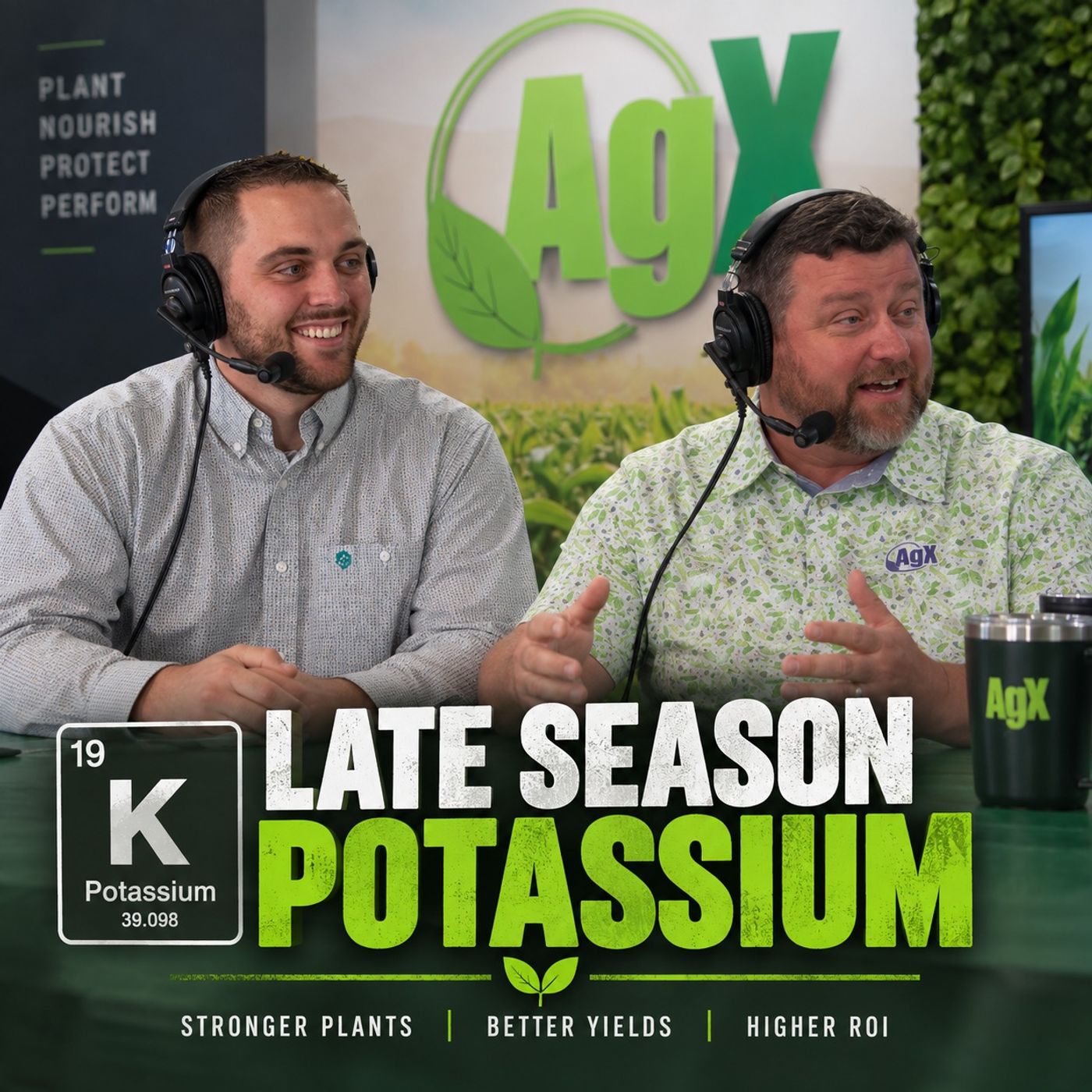
Potassium is a macronutrient crops need throughout the growing season, but simply having adequate soil levels doesn't guarantee the plant can access it. The AgXplore team explains that roots only explore a portion of the soil profile and potassium movement is heavily tied to water—creating a challenge during dry late-season conditions when crop demand can still be significant.
Dr. John and Ben discuss potassium acetate as a highly plant-available form and explain potassium's role in photosynthesis, stalk quality, standability, and the opening and closing of stomata. That stomatal function becomes especially important under heat and moisture stress because it affects transpiration and the plant's ability to continue moving water and nutrients.
The conversation then turns to timing. AgXplore's Nutri-K provides potassium acetate, while KSB combines potassium, sulfur, boron, and biostimulants. The team says late-season applications have produced positive results across several crops and geographies. In one replicated Wisconsin trial discussed in the episode, potassium treatments improved yield by roughly 5–10 bushels, with the guests citing a minimum ROI around 6-to-1 in that trial. They also found that stacking an earlier application with a later application performed better than a single application.
The bigger takeaway isn't simply to apply more potassium. It's about understanding the crop's demand curve and supplying “the right groceries at the right time.” Soil fertility still provides the foundation, but strategically timed nutrition may help keep the crop functioning and finishing stronger when environmental conditions make soil uptake more difficult.
Want Farm4Profit Merch? Custom order your favorite items today!
https://farmfocused.com/farm-4profit/
Don’t forget to like the podcast on all platforms and leave a review where ever you listen!
Website: www.Farm4Profit.com
Shareable episode link: https://intro-to-farm4profit.simplecast.com
Email address: [email protected]
Call/Text: 515.207.9640
Subscribe to YouTube: https://www.youtube.com/channel/UCSR8c1BrCjNDDI_Acku5Xqw
Follow us on TikTok: https://www.tiktok.com/@farm4profitllc
Connect with us on Facebook: https://www.facebook.com/Farm4ProfitLLC/
Farm4Profit Media is not a financial, legal, or tax advisor. Content is provided for informational purposes only, and we serve solely as a platform for third-party opinions. Any actions taken based on this content are at your own risk.
Hosted by Simplecast, an AdsWizz company. See pcm.adswizz.com for information about our collection and use of personal data for advertising.
Get every episode summarized
Each time Farm4Profit Podcast publishes, we email you a written briefing from the transcript — the topics, who appeared, and any specific claims, with the ad reads skipped.
Email me new episodesFree for 3 shows. No card needed.
Hosts & guests
Transcript ready
173 searchable segments. Every word is indexed and playable.
Full transcript
Farm4Profit Podcast — Your Soil Has Potassium. So Why Can’t Your Crop Get It?. Machine-transcribed; use the interactive transcript above to jump the player to any line.
From the first pass to the last load, Ag Leader helps make Harvest a dream by keeping your entire operation working together. In the combine, get seamless steering plus new zero corn header, row guidance and yield monitoring, all from one display. Then, with Cart Ace, see the whole operation and auto steer your grain cart for easy unloading on the go. Ag Leader, Harvest with Confidence. With Harvest Season already here, it's time to start preparing your fields for next years planting. Our friends at Brandt Agricultural Products have a high speed disc that is made to manage residue, condition your seedbed, level ruts and reclaim wetlands in the most challenging of conditions. Their high speed disc is built to last with high quality components, robotic welding, and a heavy duty frame that will deliver better ground engagement. For a limited time, you can receive a rebate of up to $10,000 and achieve better results with every pass in your field. Visit brandt.ca for more. That's branct.ca for more information. Welcome to another What's Working in Ag segment here at the Ag Explore booth at commodity
classic. This is where we learn all the great stuff because we have Dr. John and not Dr. Ben. Dr. Ben. So, you guys know these people, but real brief. John, what do you do for for Ag Ex? Dr. Vagron, I mean, I explore. Yeah, Ben. I'm the regional agronomist for Ag Explore based on Central Iowa. Farmer a little bit up there as well. Yep. Lows a little snow villain, flying stuff. Flying stuff. You're right. Let's right next to us. Dave, what are we talking about today? Patassium. Patassium and its effect on yield. So, macro nutrient. Definitely. Yep. So, what is so big about potassium? Go ahead. Now, start with it, bud. Patassium, when we like to start with the man curves, you guys know this. We've talked about this a hundred times. We need it when we start the plant and we need it really, really in a great amount in late season as well. Both corn, both soy beans. The trouble with it is is when we get into the soil, it's not always going to get into the plant, which is why we have to talk about effective ways to get it into the plant. Maybe you want to take over at this point. This is where the doctor comes from.
This is where the doctor comes from. Right. So, potassium key topic, right? We think about fertility this year. We think about fertility last year. Right. This idea of how are we getting potassium into the plant? What does it mean in the soil and our soil levels enough? Let's be frank. Right. How often does that what we're hearing about? Yeah. And so, when we think about potassium, let's start with man, how are we getting into the plant? So, we think about the corn plant growing, soy beans, wheat, whatever we want it to be. Right. We can take up potassium two ways. Our roots can either grow and it can come in contact and pull it in or we have mass diffusion, which is just simply water that's going to carry it over the roots. Because it runs with water. Yep. We'll run with water. Yep. Fair enough. And so, the problem with that, right? First of all, even our best hybrids, maybe occupy 5% of our soil volume. Right. So, we have a lot of soil that's never touched by the roots. Second of all, when we think late season, like you were talking about, how often is it dry for you guys? Yeah. It's dry a lot of the time. But again, so, we're not getting into the plant. Or at least pockets of dry. Right. Pockets of dry. And it's key times. Yep. And so, I think that's really where we have to start because we have to have pounds on the ground. Right. You can't
push enough potassium through a leaf to grow what we need. Yeah. But we need to figure out how we can be creative to get it in the plant when the plant needs it. Let's be honest, drive ROI. Because even if we grow yield, but we don't get an ROI to it, it doesn't really matter in long run. Yeah. So, old way, you spread, go out and spread pot ash on OOO60. Or maybe the white pot, what is that OOO61? Or something like that? Yep. That's the old school way. But we still need to do some of that. You still have to have soil. Right. But what are we talking about when and what form of these potassium? So, most specifically, we want to talk about potassium acetate. There's a research study back when John was in high school. So, 1960. Back when John was in high school. I see what you did there. Just because my grandkids, old as your kid. Yeah. That's about right. Actually, potassium acetate is four and a half times more available than any other pot ash, oh, Jesus, the least. Potassium product on the bottom. Yeah. Those words are so close to rock. Yeah. There are always trips me up. Potassium nitrate, anything like that. Potassium acetate is what we're after.
Okay. So, we want to be after an application timing where we can get in contact with the roots or we can bring it through the leaves. I was dated a research paper two years ago now, three years ago. Yeah. Just handful years ago. Two years ago. If you're looking at your base saturation on the soil test. So, we're not looking at the parts per million. We move over to the far right and we're looking at the base saturation. If we are less than 5% on that soil test, an application of potassium is going to pay. Okay. And it's about getting it in a plant available where it can use it at that time. Right. Let's go back to those demand curves. Yeah. I mean, that Ben brought up. We love looking at demand curves. And we know as that plant goes up, I used to tell my students your nutrient intake goes along with it. And that early season, potassium is doing some really key things that we like to look at late. It's going to help us with stock quality. Right. It's going to help us with that standability as we go through. It's going to help us with photosynthesis because it's going to keep those stomates open, right. The holes on those bottom of the leaves. And so, we have to kind of almost parse it into two different regions.
The vertical growth, the vegetative growth, and then that grain fill. I think it's kind of interesting when we think about potassium acetate because it's not nearly as high of an analysis as pot ashes, but it is so successful. One, because it's available with a plant right away. But two, what John just said, it's there for the opening and closing of the stomata. So, it's literally responsible for helping that plant reduce its stress. Seriously. Like, yeah, we apply potassium. It helps that plant close up when it's stressed, open up when it's not. Okay. So, we know it's important. What products are we looking at? Yep. So, really kind of looking two different forms. We have straight potassium acetate, right. It's a product called NutriK. And then we have another foliar, one that's really designed for the foliar side as well, called KSP. KSP. Yep. So, along with that KSP, so potassium, we also have sulfur, which is there for chlorophyll. And we just talked about how potassium is there for the stomata opening and closing. So, if we can increase the sulfur content and the leaf, we're going to see exponential results. And then we add the boron in there for growth of the plant. And if we're talking about that V5 timing on corn as well. Okay.
We did that on my farm. It's busier. Well, we did a lot of stuff on your farm days. And then he chopped it off for silage. And then you know, now it worked. I look good. Of course it worked. It looked really good. It looked really good. It did yield better than the year before they said too. So, I want to talk about that late season one, because that's the one thing that I've seen with funnicide, nutritional, whatever. It really seems like we're missing a little bit or maybe quitting too early. Completely agree with you. And as potassium, that's a part of that. It is. It's a key time frame, right? When we get to that late season, whether you're having moisture stress, heat stress, just simply the plant starting to reach the end of what it's genetics. It's going to do, right? That potassium has been brought up. It keeps those stomates open. So, just kind of think about this way. If we were at pizza hut, we had a straw, right? And if you kink that straw, now all of sudden we can't pull up anything from our drink. Our potassium does a very similar thing. If you think about the hole on the bottom of the leaf, it has two guard cells. It literally looks like a donut, right? I can go to food with something like that. But the potassium helps to keep those
stomates open. So, our straw stays open. So, now the plants transpiring and it's pulling nutrients up out of the soil. So, when our stomates close down, we don't pull water through this isolum. We don't suck those nutrients up for the plant to be able to use. Okay. So, with all the different nutrients that a plant could take in, where does potassium rate on all the different nutrients? Is it like top dog, middle dog, like where's that? I'm going to answer from my perspective. I personally think sulfur is probably number one, I would say. And then I put potassium, probably number two, which is kind of ironic because we have two of them in the same product, our KSB. Not coincidence. So, if I'm going out of VT funder side application, is that early enough or is that too late or should I be later? On corn, I think that's really good. On soybeans, we are packing a lot of potassium, those things are potassium hogs. We need a lot of potassium late. And if you're talking, I know you said VT, but I'm going to be just to the soybean, which would be like R1, R2.
That's a little too early. We're going to need some more potassium later than that as well. Okay. So, we've done a lot of research over the last two years. And actually this year, we sent up a lot of trials where we really played with timing. And so, we took products that had potassium like our KSB and we went early and we went KSB like with a funder side pass. And what we consistently see, I mean, it doesn't matter what geography, it can be Wisconsin, Indiana, Ohio, Missouri, even all the way down into Florida, we consistently are seeing positive ROI on your corn and your soybeans, even peanuts, when we put it on, went that later stage. And we're fully convinced, it's because it's keeping that plant going. Our plants are normally wanting to shut down, it keeps those straws open and it's really helping us to finish those crops out. Yep. What kind of improvement are you seeing in yield on corn or soybeans? So, we set up a full research replicated trial for replications up in Wisconsin, white water Wisconsin to be specific. We did not lose on a single application potassium,
whether it was our NutriKey, so that's potassium acetate by itself or with the tank mix of KSB, we would improve anywhere from five to ten bushel. And roughly, I don't know what the cost is, what would the ROI be on something like that? Six to one at a minimum. Yeah, it's about where we are from. But we talk about all the time, people like to go, yeah, paid for itself, well, then you lost. Yeah, and you're asking, you got to be better, better than paid for itself. Yep. Yep. So, one application was good of NutriKey or KSB, two applications is better, or the Pates for itself and kind of knocked it up into that next five. Are you talking the post and the late? Exactly. Yep. So, we did talk individually that we stacked up. Yep. Yep. So, on corn, that would have looked like our, I'm sorry, V4, V5, and then followed by an R1. So, soybeans, things are so tricky because it seems like we move from like V1 to R1, like overnight. But it would have been that same kind of respect of area. V2, V3, maybe R1, R2, maybe a little later than that R3-ish. Okay. And I think one important part to this is, it's more than just the fertilizer, right? When we look at it, when we look at those products,
we're building them with bio stimulants. And sometimes I think we do it at disservice, and I catch myself doing it all the time. It's like, oh, this is a potassium sulfur boron. Honestly, really, it's a bio stimulant product that has potassium sulfur and boron with there. Right, because that bio stimulant is really what's helping with that stress mitigation. It's helping with nutrient mobility in there. There's a hundred people probably within a stonesterof here that are just selling these bio stimulants by themselves to put in your co-ops, spray tank, or to put in your haggie. Yep. We put them with our products. Every single one of our products has a product that could be standing alone excellent. So, really it's about getting the right groceries at the right time. It is. Yeah. I'm the payroller. Got it. I've been schooled. By the professor. By the way, to get started, it should I hire a drone to go out into a trial or just jump in. So, I'm, be honest with you, I'm going to give you my perspective on something like KSB. I mean, we can give you probably over 200 replicated trials with a product like KSB from
Montana to the Delmar down to Florida and even Arizona. And it just, it's one of those products that consistently works because it's built with an agronomic reason. What's the best way to get, get, get find out more on these products? We're available really anywhere. That means the most common one, beagxplor.com, but we're on every social media. We're really active on Facebook, Twitter, Instagram, TikTok. They're not, not Twitter anymore, actually, whatever. We're all over. I should add what's a use rate on this stuff. So, most time we're running at one court. One court. That's moving the needle. Yep. With the court. I think that's a potassium acid. Important to bring out full circle, actually, because one court is not nearly enough pounds of potassium for corn or soybeans, but to what we've been speaking about with that stomata conductance, keeping that guard cell open. That is where we're seeing that greatest success. So, John, you talked demand curve and I talked about rate growth issues at the right time. When is the demand curve? Or how do we know when that spot? Yeah, I mean, so they've been published. There's great resources that are out there. But if you just kind of think about your plant's growth for the majority of your nutrients when your plant goes vertical, that's when your intake
goes vertical. Okay. That's what I tell people. It's the easiest way to remember it. Yeah. Shra goes up. Me more. Yep. Got it. Well, that's another what's working an egg from our friends at Ag Explorer. Great guys. Reach out to them. They are information and education first. That's what I love about you guys. And we had an episode earlier and they didn't even say anything about products. Just, I know. Education. I had to twist our own. We didn't throw our product name out there until you told us about it. Right. I know. And that's what I love about you guys. It's not just a push. It's about education. So, sir, thank you. Thank you guys for another great what's working in next segment. Appreciate it. Got it. Very good. We all know the farming comes with risk. But the question is, are you ready for it? Nationwide agribusiness is helping farmers think ahead with their farm risk ready plan. On October 19th, we'll sit down with Nationwide to talk more about identifying these risks and preparing your operation right here on the podcast before something happens. We look forward to sharing that episode with you until then you can check out more at Nationwide.com. It's important to get in and get the crop out and not leave it behind. And that's what we've achieved with the Estus Concave. I spend anywhere from eight to 900 hours a year in a combat.
With these concave, we've picked up productivity. It's 200 acre days to be a great day. And now we see 270, 280. These are a game changer. If you want a machine that's going to put out clean grain, every day all day, it's a night and day difference and anybody that doesn't have them should get them. Hey listeners, how about 25% off your next pair of boots? Well with dry shot, they're giving farm for profit listeners a heck of a deal through the end of 2026. So whether you're working cattle, walking fields are just trying to keep your feet dry and comfortable. Go get yourself a pair of dry shot boots. Visit dryshotUSA.com and use code F4P25 to get 25% off. That's F4P25 to get 25% off.
More episodes
More from Farm4Profit Podcast

He Bought 80 Acres. Then Asked Customers What to Grow.
Farm4Profit Podcast

Beyond the Farm: How Regan & Andrea Are Building Their Own Path
Farm4Profit Podcast

How Do You Move 23,000 Bushels of Grain Per Hour
Farm4Profit Podcast

Thin Margins, Expensive Nitrogen & the Agronomy Decisions That Pay
Farm4Profit Podcast