Get every episode summarized
Each time Interesting Things with JC publishes, we email you a written briefing from the transcript — the topics, who appeared, and any specific claims, with the ad reads skipped.
Email me new episodesFree for 3 shows. No card needed.
About this episode
“An army could announce itself without a single word. Before the first warrior came into view an unfamiliar sound, it might be already caring across the battlefield.”From the transcript
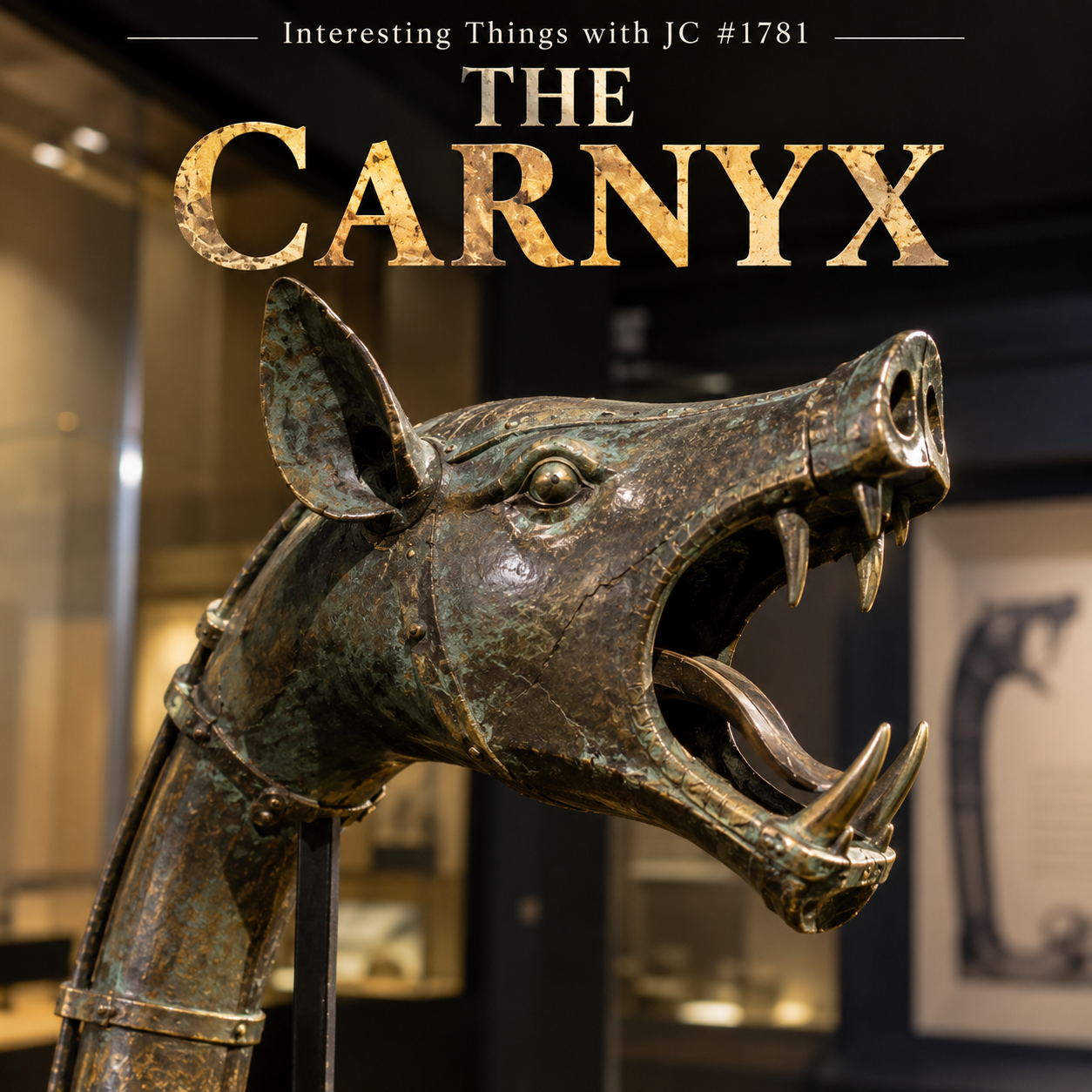
Interesting Things with JC #1781: "The Carnyx" – Celtic warriors raised bronze carnyxes nearly 10 feet high, blasting sound through open animal jaws above the battlefield. One surviving boar head had a hinged jaw and movable tongue that could rattle as it played, while seven carnyxes later found at a Gallic sanctuary showed the same instrument belonged beyond war.
Get every episode summarized
Each time Interesting Things with JC publishes, we email you a written briefing from the transcript — the topics, who appeared, and any specific claims, with the ad reads skipped.
Email me new episodesFree for 3 shows. No card needed.
Hosts & guests
Transcript ready
56 searchable segments. Every word is indexed and playable.
Full transcript
Interesting Things with JC — 1781: "The Carnyx". Machine-transcribed; use the interactive transcript above to jump the player to any line.
An army could announce itself without a single word. Before the first warrior came into view an unfamiliar sound, it might be already caring across the battlefield. Coming from a very long bronze horn held high above the men, at the very top was the head of an animal, sometimes a wild boar with its jaws open. And the sound became straight from its mouth. The instrument was called the Carnix. It was used by Celtic people during the last centuries BC and into the Roman period. The Carnix was a long metal trumpet that could stand roughly 10 feet or 3 meters tall. Many were played vertically with their animal heads raised above the warriors. The council described the noise of Celtic war horns and images of the Carnix appear
on Roman monuments and Celtic coins. But those images could tell historians only so much about an instrument that had largely disappeared. One important piece survived near Deskford, Scotland, where bronze boars head was discovered in 1816. It at once formed the bell of a Carnix and its construction offered many clues about how the instrument worked. The lower jaw was hinged and a movable tongue could add a rattling quality to the sound. In the early 1990s, a team led by musicologist John Perser, the use that Deskford had as the basis for reconstruction. In 1993, musician John Kenny played the resulting instrument bringing the sound of the Carnix back after nearly 2,000 years. It could produce sustained notes, change pitch, and had a wide range of sounds. The animal head was more than a decoration, although the exact sound of an ancient Carnix.
It actually remains impossible to establish with certainty. But then, in 2004, archaeologists working with Tantiac in Central France uncovered a deposit of ancient metal objects at a galaxy sanctuary. Among them were pieces of seven Carnixes, including enough material to recover one instrument almost completely. The Carnix had bore-shaped heads, while another had a serpent-like head. The discovery gave researchers substantial remains of several instruments found together in a documented archaeological setting, and their construction also showed that the Carnix was not limited to a single design. Now, one of the Tantiac instruments appears to have been played at an angle closer to horizontal rather than held straight up. The location of the discovery offered even yet another clue. The instruments were part of a deposit at a sanctuary, alongside many other metal objects, including weapons. And their presence there connected them to ritual activity, although archaeologists cannot
say precisely how they were used during ceremonies or why they were eventually deposited there. The Carnix was certainly associated with warfare, but the remains of Tantiac placed it within the ceremonial life of Celtic communities as well. We cannot establish which use came first, or whether every community treated the instrument in the exact same way. But what the discoveries have given us is a fuller understanding of an instrument that had long been known largely through the accounts of images left by others, because many who heard it, died on the battlefield. The Deskbird reconstruction allowed people to hear a Carnix again, and discoveries archeologically they revealed more about how these instruments were made and where they belonged. We can now build them, play them, and hear the remarkable range of sounds that they can produce. But what we cannot recover is everything those sounds meant to the people who first heard
them. These are interesting things with JC.
More episodes
More from Interesting Things with JC

1783: "Humanity is Unprepared for AI"
Interesting Things with JC

1782: "Why Sound Would Break Apart on Mars"
Interesting Things with JC

1780: "The Hoover Dam Angels"
Interesting Things with JC

1779: "The Encryption Keys Inside the Camera"
Interesting Things with JC