Get every episode summarized
Each time Interesting Things with JC publishes, we email you a written briefing from the transcript — the topics, who appeared, and any specific claims, with the ad reads skipped.
Email me new episodesFree for 3 shows. No card needed.
About this episode
“Imagine standing on Mars while someone talks to you from a hundred meters away. Their voice would have to travel through an atmosphere with less than one percent of Earth's surface pressure. And much of what they said, it would be very difficult to hear.”From the transcript
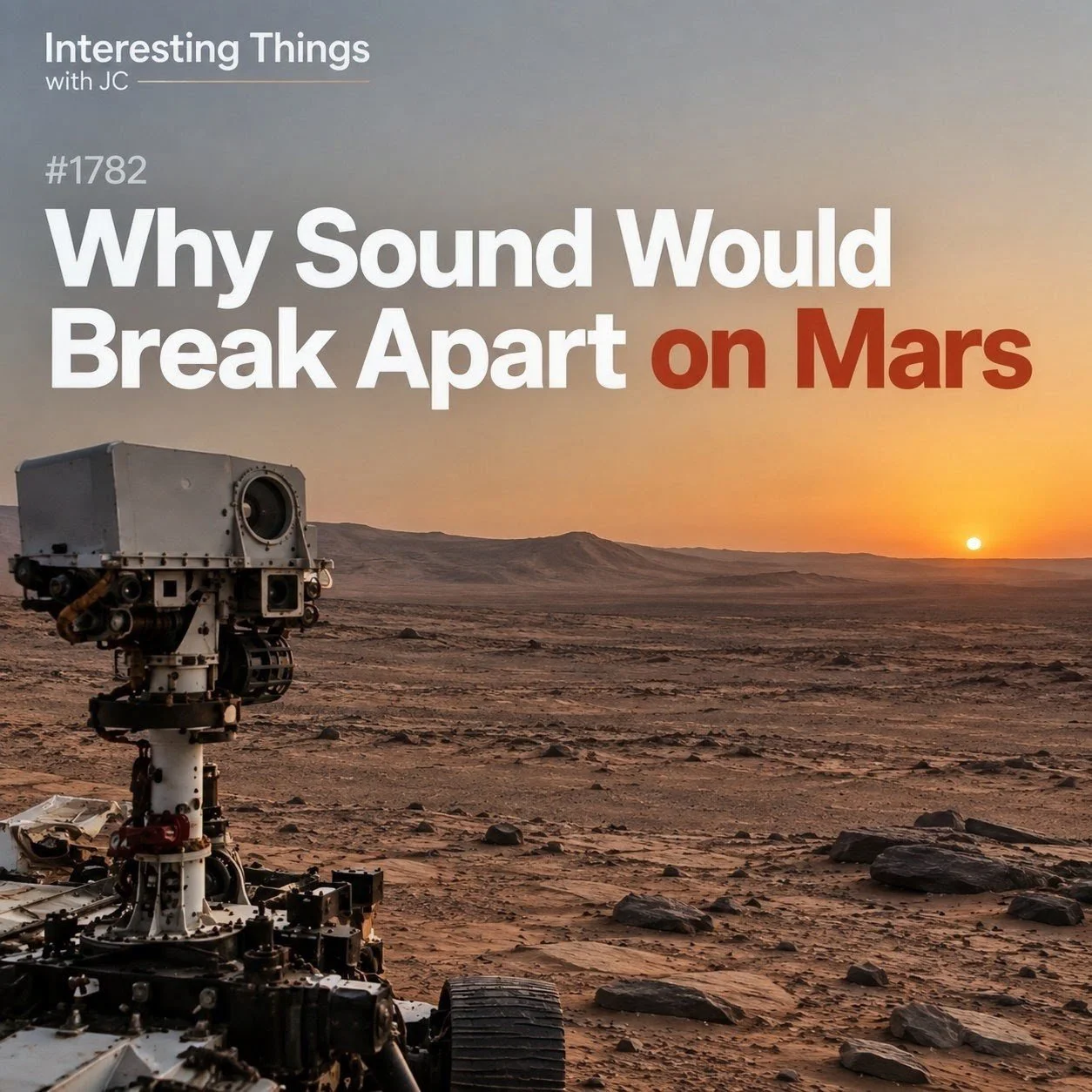
Interesting Things with JC #1782: "Why Sound Would Break Apart on Mars" – A human voice travels through Mars’s thin atmosphere, but its higher frequencies move faster than its lower ones. Over 100 meters, the higher frequencies arrive about 17 milliseconds earlier, while the atmosphere absorbs them more strongly with distance. The voice grows quieter as its frequencies separate and fade.
Get every episode summarized
Each time Interesting Things with JC publishes, we email you a written briefing from the transcript — the topics, who appeared, and any specific claims, with the ad reads skipped.
Email me new episodesFree for 3 shows. No card needed.
Hosts & guests
Transcript ready
28 searchable segments. Every word is indexed and playable.
Full transcript
Interesting Things with JC — 1782: "Why Sound Would Break Apart on Mars". Machine-transcribed; use the interactive transcript above to jump the player to any line.
Imagine standing on Mars while someone talks to you from a hundred meters away. Their voice would have to travel through an atmosphere with less than one percent of Earth's surface pressure. And much of what they said, it would be very difficult to hear. As Perseverance Rover gave scientists a way to investigate how sound behaves in that thin air. After landing February 2021, its microphones recorded Martian winds, mechanical noises, and the sharp sounds produced when it's laser struck nearby rocks. Those recordings confirmed that sound doesn't travel at a single speed on Mars. Lower frequency sounds move at approximately 240 meters per second or 787 feet per second. Higher frequency sounds travel closer to 250 meters per second, 820 feet per second.
The difference comes from carbon dioxide, which makes up most of the Martian atmosphere. Sound travels through gas as pressure waves. The dioxide molecules can absorb some of that energy through their internal vibrations, but the process takes time. At higher frequencies, those vibrations can't keep up with the changing pressure, and those sounds travel faster. Over 100 meters, 328 feet, the higher frequencies would arrive 17 milliseconds ahead of the lower tones. Mars' atmosphere also absorbs higher frequencies more strongly, causing them to fade rapidly with distance. So a distant human voice would become much quieter with its higher tones fading more quickly. The frequencies that survived would travel at slightly different speeds, changing the sound before it reached a listener. Perseverance's microphone gave scientists direct measurements of an effect that had been
predicted from the properties of the Martian atmosphere and on Mars, even the frequencies with the single sound don't necessarily travel together. These are interesting things with JC.
More episodes
More from Interesting Things with JC

1797: "A Reversible Weakness in Alzheimer’s Gene"
Interesting Things with JC

1796: “Free Fall Kinematics”
Interesting Things with JC

1795: “Do Redheads Have Special Powers for Survival?”
Interesting Things with JC

1794: "Best of Both Worlds - Van Halen - 5150"
Interesting Things with JC