Get every episode summarized
Each time Marketplace publishes, we email you a written briefing from the transcript — the topics, who appeared, and any specific claims, with the ad reads skipped.
Email me new episodesFree for 3 shows. No card needed.
About this episode
Marketplace is made possible by:
“Running a business is hard enough, so why make it harder with a dozen different apps that don't talk to each other? The only business software you'll ever need. It's an all-to-one, fully integrated platform that makes your work easier.”From the transcript
Despite Trump’s best efforts (a flurry of loosely targeted tariffs), the U.S. trade deficit is widening. But why is it widening? And what does it all have to do with foreign investment in government debt and the strength of the U.S. dollar? We’ll explain. Plus: Electric truck sales rev up amid record-high diesel prices, a 19th-century novelist popularized economic theory for her broad audience, and investors prep for upcoming Treasury auctions.
Every story has an economic angle. Want some in your inbox? Subscribe to our daily or weekly newsletter.
Marketplace is more than a radio show. Check out our original reporting and financial literacy content at marketplace.org — and consider making an investment in our future.
Read the stories in today’s episode:
- What exactly are investors looking for in this week's government bond auctions?
- The U.S. dollar is at its strongest in 18 months
- The Regency-era novelist who popularized economics through her books
- Here's why the trade deficit is growing
- As diesel prices soar, so do electric truck sales
- The algorithm knows you have a baby, and it will exploit that
Get every episode summarized
Each time Marketplace publishes, we email you a written briefing from the transcript — the topics, who appeared, and any specific claims, with the ad reads skipped.
Email me new episodesFree for 3 shows. No card needed.
Hosts & guests

Transcript ready
317 searchable segments. Every word is indexed and playable.
Full transcript
Marketplace — A tale of two deficits. Machine-transcribed; use the interactive transcript above to jump the player to any line.
Running a business is hard enough, so why make it harder with a dozen different apps that don't talk to each other? Introducing ODO. The only business software you'll ever need. It's an all-to-one, fully integrated platform that makes your work easier. From CRM, accounting, inventory, e-commerce, and more. And the best part, ODO replaces multiple expensive platforms for a fraction of the cost. This is why over thousands of businesses have made the switch. So why not you? Try ODO for free at odu.com. That's odu.com. This marketplace podcast is supported by the University of Illinois Geese College of Business. Earn a world-class MBA degree completely online at your own pace. Through their online MBA program, you'll learn from amazing faculty and network with classmates on a global scale without having to put your career on hold. Take your career to the next level by applying what you learn in real time. Get started at onlinemba.illinois.edu. That's onlinemba.illinois.edu.
I want you to think big picture today. Very big picture. From American public media. This is Marketplace. In Los Angeles, I'm Kyle Rizdal Monday, today, 5 October. Good as it always is. Have you along, everybody? There is a relative posity of economic data this week. We're going to get some consumer sentiment figures, some monthly trade data, as well, more on that in just a second. But we thought we would start today with our new best friend, the bond market. The Treasury Department is going to auction off a new round of government debt over the next couple of days. And therein, as Marketplace is just in home reports to get as going, will like clues about our economic future. A couple of weeks ago, the Treasury Department held an auction for two, five, and seven-year treasuries. And those auctions did not go particularly well.
That's Winnie Caesar, head of strategy credit sites. She says demand for treasuries was much weaker than expected. And Caesar says it's hard to pinpoint just one reason why. I think that this year, for the rates market in the US, has been death by a thousand paper cuts. Those paper cuts include concerns about long-term government debt, higher energy prices, which cause inflation more broadly. Also recent economic data that have been stronger than anticipated. Alex Wolff, global head of macro and fixed income strategy at JP Morgan, says investors are also unsure how the Federal Reserve is going to react to all of this. And that's occurring amid all the noise and volatility that we're seeing both in all prices and macro data. And it's creating a, I think, a difficult environment for those participating in markets to know what is right level of yields, where yields should be. And in recent weeks, investors have been looking for higher yields than the government's been offering. Investors have those same concerns ahead of this week's 10 and 30-year Treasury auctions. Chris Low, chief economist with FHN Financial, says today rates are higher across the board.
And that's simply jitters about the upcoming auctions. And Low says those jitters aren't just about the auctions themselves. What traders are telling you is that their primary concerns, inflation, excessive government spending, excessive government debt, all of those risks are going to remain in place. Which means investors think interest rates are going to keep rising. I'm Justin Howe from Marketplace. Here's an interest rate of no small interest to a large slice of the American economy. Mortgage news daily has the average 30-year mortgage at 7.61%. Stocks generally up to date technology in particular, we will have the details when we do the numbers. Seems the first couple of three elements in the program today are very big picture macroeconomically inclined.
Justin on bonds just now debris on the trade gap in a minute. Right now, though, Kayleigh Wells on the dollar. The greenback is the strongest it's been in a year and a half. And it's good news if you're planning to buy maybe a fancy new European car. It's good news if you're the US government and you're hoping for more foreign investment. But the reasons the dollar is going up may be not such great news. Here's Kayleigh. Two big reasons the dollar is going up right now. Says senior fellow Joe Gano at the Peterson Institute for International Economics. One, the US government has a lot of debt and that pushes up interest rates. And higher US interest rates attract foreign savers because they say it was a higher rate of return in the United States. More foreign investment means more demand for the dollar. The other reason it's strong now businesses in the US are also borrowing a lot too because of AI. There's just a lot of borrowing to finance data centers in the United States and foreigners are investing in that.
Meaning even more demand for the dollar. Strong dollar is good news for a very specific subset of consumers. If you want to go travel to Europe, it's great. Right? Your dollar is going to go much further and you can have your vacation for a little bit cheaper. Brendan McKenna with the European Financial Services Group Society General says for the rest of us who are not vacationing overseas. The US dollar fluctuates so much where you're probably not going to feel dollar strength or even dollar weakness and you're kind of regular data day purchases. Eventually the AI investment will calm down as will the war in the Middle East. Chris Vicki is head of futures and forex with the research company Tasty Life and he expects the dollar to weaken by the spring. And that wouldn't be a bad thing quite frankly because lower interest rates in the United States going in hand with a weaker dollar would provide a lot of. Stress relief here domestically because he says the same things that cause a weaker dollar lower interest rates cooling inflation. It would also help make day to day expenses for cash strapped Americans a little easier.
I'm Kayleigh Wells for Marketplace. The history of economics is dominated by men. Adam Smith, Thomas Malthus, David Ricardo, the list goes on. Said list of course leaves out half of the population including for us today. The British writer Mariah Edgeworth who lived and wrote back at the beginning of the 19th century. Edgeworth is the subject of a new book by Gina Smiley she is the Brussels bureau chief of the New York Times. Her book is called the invisible hand of Mariah Edgeworth. Janet's good to talk to you again. Thanks for having me. So tell me how you came to this story of Mariah Edgeworth. I was reading the worldly philosophers by Hillbrunner which is one of the classic economic histories.
And he has a little aside where he mentions Mariah Edgeworth having existed. And I had never heard of her and I am a big Regency novel nerd. So I was surprised I had never heard of her. So I ordered a bunch of her books and I was reading them and I just kept thinking to myself, this is not sort of casually mentioning economics she is hiding economics all through these books. And so I became really interested in why she was doing that went down a rabbit hole and you know that was years and years ago and here we are. Before we years and years ago. Before we get farther into her give us the land of economics in like 1800 right Adam Smith comes out with a wealth of nations in 1776. Where do we stand by 1800? We are still very much sort of first generation economics. People are still kind of getting to understand Adam Smith. Wealth of nations was a big heavy hard book. I think it's being reinterpreted in the wake of the French Revolution and sort of it is very much understood in the politics of the moment.
And so that's sort of how we come to Mariah Edgeworth. She's sort of writing at this moment when the wealth of nations, the reputation of the wealth of nations is still really solidifying. And what she does is she takes, I mean as you point out in this book, she takes literally some of his ideas and weaves them into these stories, these novels, these books that she is writing. Yeah, which is so interesting to me because she's taking these ideas that are incredibly complex. The people find very difficult to understand and she is putting them in the plots of novels that are often meant for women. In some cases meant for literal children like they are educational novels for kids. And she is simplifying them to point where those people can understand them and it is working so well that she while doing this manages to be one of the most famous authors in the English language. Jane Austin is a Mariah Edgeworth fan girl like she's obsessed with Mariah Edgeworth and is sending her letters and being like, please review my books. It is impossible to overstate how popular this woman is as she is writing the wealth of nations into fiction, which I think is really interesting.
I think so too, but look, we all know Jane Austin, nobody knows or until this book comes out and hits it big, nobody knows Mariah Edgeworth, what happened? I think a couple of things happened. The first and kind of most ironic one is that because she was putting so much heavy educational content into her plots, it got labeled boring. I think another thing that happened at the same time is English Irish relations were very, very strained and remained strained for a long time as we all know. And she was Anglo Irish born in England, raised mostly in England, had in the state in Ireland, but it was sort of fit into neither camp. And then I think the third thing is when it comes to economics, I think economics starts professionalizing around the middle of the 1800s. And as it professionalizes, it kind of rewrites the story to suggest that the women who were involved in the early years of economics were just popularizers. And in fact, they weren't doing a very good job of popularizing and et cetera, et cetera. Basically, they sort of drag the name of names of the women who were working in the field, kind of through the mud in order to be taken more seriously.
Let's not skip over that last bit about about the men and what they do to her memory. And honestly, the women throughout the history of economics says you know better than I back then and today economics is right with sexism and misogyny. Yeah, well, and you can really feel sort of the seeds of this getting planted in the years after my edge worth death. So Alfred Marshall writes the seminal text on the history of economics. And in a footnote to that, he really sort of denigrates what women have been doing to popularize economics. He calls them parasites. I think that sort of lives on to today to the point where, you know, I'm reading Hailbronner 10 years ago and he says that, you know, Mariah was the first one to think of economics, but there weren't really a lot of women in economics in the early years. And I think I hope that this book helps to dispel that myth. There were actually a lot of women in the early years of economics and they made major contributions. The thing that hits me about my edge worth contributions and obviously that's what this book is about.
It is how important she thinks it is for regular people to understand what's happening in the economy. That's the whole deal with her. Yes, she thinks that economics is kind of a toolbox, I think. She thinks this gives people the tools they need to make good decisions about their own lives. She buys this idea that the invisible hand of markets, that if we all sort of pursue our own self interest, capitalistic society as a whole be better off. But she kind of adds to that and says, you know, we need to have to understand our self interest in order to do that. Like, you need to give people the tools. And so I think that is her major project throughout her life is trying to give people those tools. Yeah. Gina Smileyck is at the moment the Brussels Beer Chief of the New York Times used to cover the Federal Reserve wrote a great book about that. Her latest is called the invisible hand of Mariah Edgeworth. Gina, thanks a lot. It was really good to talk to you. Thanks for having me. Nice to talk to you too. The President Trump has what might fairly be called an obsession with the US trade deficit.
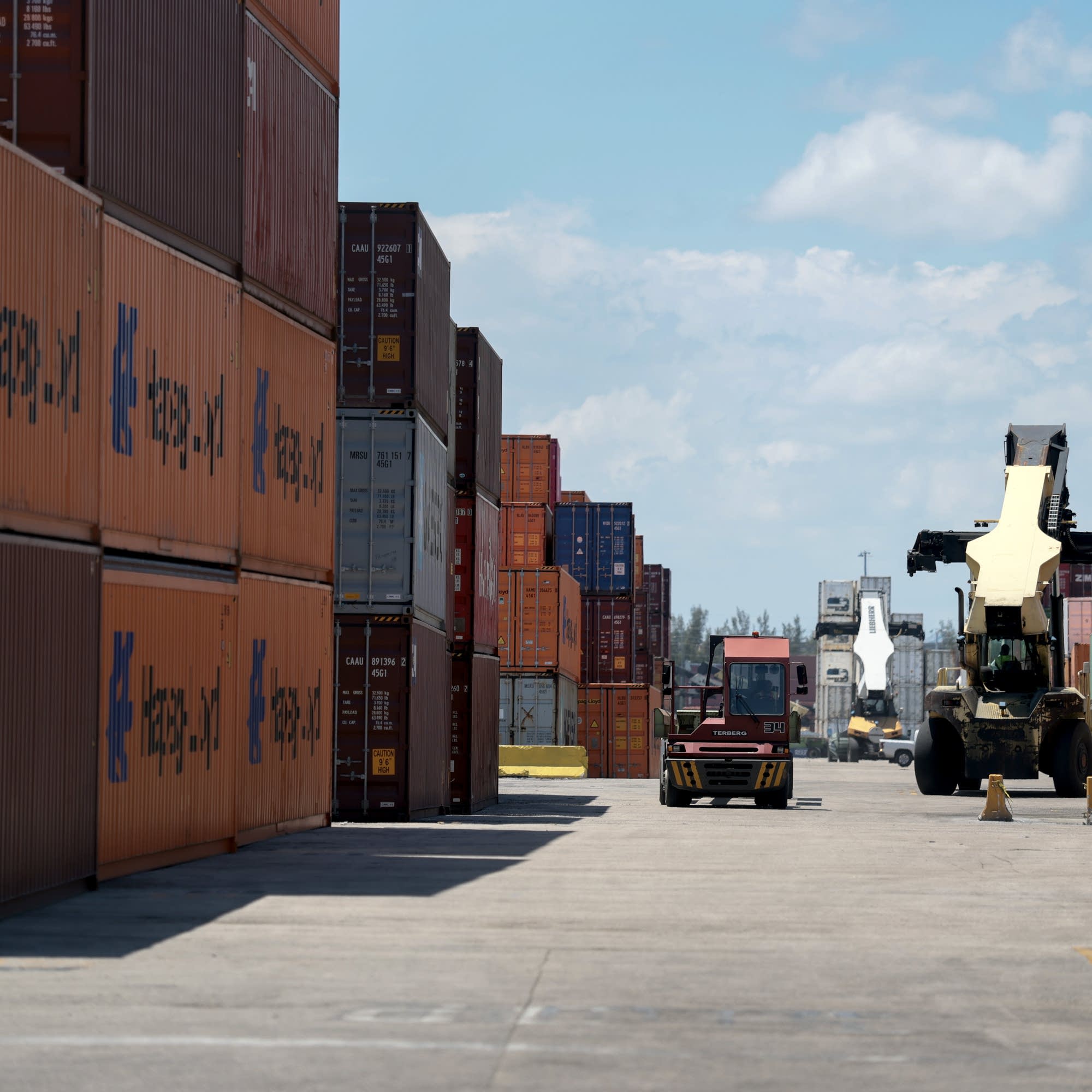
He believes, and we know this because he says it out loud, that the fact that we're importing more stuff than we sell overseas means that we are losing. Setting aside the fact that that's not actually true. When we get the latest update tomorrow morning, best guesses are the trade gaps going to be wider. Thanks in part to all the chips we are importing for the AI build out. There is though a more fundamental reason we've got such a big trade gap. And as Marketplace's pre-bittish or reports, that reason is probably not what you think. The trade deficit was like the whole point of the first Trump tariffs. It's the greatest theft in the history of the world. Like that is how they were deciding what country got what tariff. It was based on the US trade deficit with each country. Well, it turns out one of the big reasons we have such a big trade deficit in the first place is literally the US government, specifically all of its deficit spending.
Now you may be asking. What does this have to do with imports and exports? Joe Gagnol there at the Peterson Institute. Well, let's go on a little journey down the road of unintended economic consequences. So the government spends more than it has. So it has to borrow, right? It says, hey, everybody lend us your money. We will give you a good interest rate. Foreigners see that and they say, hey, you know, the US government is paying 4% to borrow in my own government is only paying 2%. I don't know. I put some money over there in the US. Now there's just one catch here, which is that two invests in the US, those foreigners need dollars. So you've got all these foreign investors looking for dollars, making dollars more popular, making dollars more expensive and stronger. And guess what? That is what makes imports look cheap to Americans, the strong dollar. This is why we import so much.
This is why you buy that deck chair on Amazon that was made in Vietnam and guess what a strong dollar does to our exports. It also makes our exports more expensive. More imports, fewer exports, bigger trade deficit. So that is how it works. The government's overspending causes borrowing, which strengthens the dollar, shifts imports and exports, contributes to the US trade deficit. We have a government that is $30 plus trillion in debt and part of the trade balance reflects that imbalance. Scott Linsa-Kum is with the Kato Institute. If American policy makers are really worried about the trade deficit, the number one thing they could do isn't enact a bunch of tariffs or trade agreements. It's balanced the budget. Now to be fair, it's not just our government gobbling up foreign investment and driving up the price of the dollar and therefore the trade deficit. Forders want dollars to invest in all kinds of US stuff like the AI boom or the stock market or US businesses.
So having a big trade deficit is really just a sign there's a lot of investment coming in, which is why for all the screaming and yelling about trade deficits, most economists don't really care that much. In New York, I'm Sir Rebeneshore from Marketplace. Coming up. The algorithm was telling her, hey it's time to have another one. Alright look, do not listen to everything the algorithm says, okay? First though, let's do the numbers. Down industrial is up 90 points today. Two tenths of 1% 51,267. The Nasdaq picked up 286 points about 1% 27,477. The S&P 500 gained 51 points. Two thirds of 1% 7773.
Brent Crude slid nearly 2% on the data hover right around $100 barrel national average by the buy for a gallon of regular gas $4.36. That's a good warning to triple A down 11 cents from one week ago. Bond's down yield on the 10 year T-note. 5.31%. I'm telling you peeps, you're listening to Marketplace. Running a business is hard enough, so why make it harder with a dozen different apps that don't talk to each other? Introducing Odo, the only business software you'll ever need. It's an all-to-one fully integrated platform that makes your work easier. From CRM, accounting, inventory, e-commerce, and more. And the best part Odo replaces multiple expensive platforms for a fraction of the cost. This is why over thousands of businesses have made the switch. So why not you? Try Odo for free at odu.com. That's odo.com This Marketplace podcast is sponsored by the University of Illinois Geese College of Business. Getting an MBA shouldn't mean pausing your career or breaking your budget.
The I MBA from Geese College of Business is a fully online, highly interactive degree that costs just over $27,000. It's designed for real-time application, meaning you can take what you learn from world-class faculty today and use it on the job tomorrow. Plus, there is no GMAT or GRE required for admission, and you'll collaborate with the diverse network of professionals from coast to coast and around the globe. Start building your future at onlinemba.illinois.edu. That's onlinemba.illinois.edu. Brought to you by the Capital One Saver Card. With Saver, you earn unlimited 3% cash back on dining, entertainment, and at grocery stores. That's unlimited cash back on ordering takeout from home or unlimited cash back on tickets to concerts and games. So grab a bite, grab a seat, and earn unlimited 3% cash back with the Saver Card. Capital One, what's in your wallet? Terms apply. See CapitalOne.com for details.
This is Marketplace. I'm Kai Rizzo. A gallon of diesel fuel right now? $6.32 on average says AAA. And that is changing the mileage math for truckers and delivery companies that are driving diesel-powered vehicles. FedEx has just ordered 2,000 all-electric trucks expected to be delivered by the end of next year. California has committed a billion dollars to electric truck rebate through 2030 and grain of salt because it's Tesla. But the company has just started mass production of a semi-truck that it says will be able to go 500 miles on one charge. Add all of that up and electric trucking is starting to look like more of a thing. Marketplace's Henrietta reports. Harbinger Motors makes electric versions of those box trucks that FedEx and UPS use. Ever since diesel prices started climbing, CEO John Harris says the size of customers orders has been increasing. People that we were talking to about 100 now they want to stick with 500 now they want to stick with a thousand.
There's not a lot of price transparency in this market, but electric trucks are generally more expensive than diesel versions for the truck itself and the charging infrastructure. On the other hand, electrons right now are a lot cheaper than diesel and trucking companies are noticing says Elaine Buckberg with Harvard's Salada Institute. I think that's going to make them think a lot more about that trade-offs between the upfront cost of the truck and the savings they get over the life of the truck. The high cost of diesel comes at a good moment for electric trucking says Lauren McDonald, chief analyst at charge economics. New models can go farther on a charge and states, including California, are offering incentives. That's what you've been seeing a lot of these big announcements because the companies want to get in there and get those grants before they run out. The party could slow down if incentives run dry and diesel prices fall, but one factor could keep it going says Craig Siegel, an advisor with the Federation of American Scientists, more predictable financing from lenders. They haven't ridden a lot of these loans, so you don't know quite how much to charge or getting a premium on your credit.
But as banks get more familiar with writing loans for electric trucks, Siegel says it could get a lot easier for trucking companies to switch. I'm Henry App for Marketplace. It's reasonably easy, most of the time, to ignore the ads the algorithms serve you online. Unless, you know, just for instance, you haven't slept in a week and you're willing to buy almost anything to get your new baby to just go to sleep. Baby products are a nearly 60 billion dollar year industry in this economy. Its favorite customers, of course, are sleep deprived parents. Jubilee Carrizanna wrote about the baby algorithm for the 19th. Walk into the program. It's good to have you on. Thanks for having me. So look, parenting is hard enough, mothering specifically is hard enough. And now there's this digital online baby industrial complex that's making it even nightmarish, right?
You know, and it's really intense. I started writing this story because I've experienced it when I had my son a couple years ago and then me and my editor who has also had a little daughter. We were sort of realizing that we had gone through the same thing, seen the onslaught of ads, scrolled our phones at two in the morning with the Fussy baby trying to figure out, did I buy the wrong thing? And then when we started talking to other moms, it felt like a lot of us had the same experience. Especially with your first child, the feeling is, if I screw this up, this kid's going to be ruined forever, right? So there's that pressure too. And the companies know it, by the way. It's most intense for first time parents, I think, because think about a first time parent as a consumer. You don't have any brand loyalty yet, right? You've never bought baby products. And you're much more likely to impulse buy for your kid than you are for yourself, right? So that's, that's where all of this sort of comes to a head. Also scale, by the way, I was astonished reading this piece, although I suppose it shouldn't surprise me.
The United States accounts for something like 10% of all baby product revenue, even though we've only got 4% of the population. Only China has more. And of course they have a much larger population. So if you think about it in terms of a share, it's really different here than it is in other countries. And you know, and we talk about it in the piece of thing. Part of that is lack of structural support, right? One of the questions I asked myself reporting, this is why did the US do this in a way that other places didn't? Well, so let's keep going with that. It's critical to emphasize here that we're the only industrialized economy with no paid parental leave. Yet no federal paper and so leave policy. The states have moved forward on it. Some of them, but, but we don't have a national policy. And that makes a world of a difference. And when you have less time, when you are going back to work seven weeks is the average going back to work within seven weeks. Seven weeks, think about that. That's crazy. Right. A two month old is not sleeping to the night. A two month old is probably not just not having a schedule. Right. Right. So, you know, if you want a life that's not a 24 hour circus,
you need to lean on something to give you some stability so that you can return to work. That's where the product step in. That is why paid leave is sort of an important part of the story because that is what makes the US singular from pretty much every other comfortable nation. Yeah. We are, of course, a digital online economy now back when my kids were little. There was literally there was babies are us and you would go and do it at babies are us. And now it's all on the phone, right? It's all on your mobile. It's babies are us. It's bye bye baby. We went to all those which are gone now, but we went to a prego expo. I saw that prego expo. Oh my goodness. When we were reporting this story and it was all these parents were clamoring to see these products in person because we've lost that sort of tactile experience. And so we rely so much more heavily online. We all know that companies know a boatload about us. It gets really personal really fast when you get into to maternal information.
I mean they can tell you when your due date is for crying out loud. They can figure it out and I mean we are volunteering that information right. You're putting it into a due date calendar online and spitting out a date. And now that information is sold and we know that it's sold. We know these companies are selling it. And then you're getting targeted ads and not just targeted, but targeted to the stage in pregnancy that you're at. So one of my one of my colleagues said that about a year and I have to share her daughter. She started getting ads for baby things again because the algorithm was telling her, hey it's time to have another one. Oh my goodness. Just on the way out here. Your kids going to be fine, right? I mean no matter what you buy, your kids going to be fine, right? That's the thing that really gave me a little bit of relief working on this story talking experts about it. They said it doesn't really matter that much. You know if you bought the $50 swaddle or the $30 swaddle or that is not the thing that makes the difference. You have a safe home, do you have a loving environment, do you have enough to eat? Those are the things that really make a difference. And the kids are going to be all right and that's because we care not because we bought the right swaddle.
Can't buy that. There you go. She barely covers on it at the end of the 19th. She covers the economy and childcare. She really thanks a lot. I appreciate your time. Thank you. This final note on the way out today I'll be quick as we're a little jammed on time. A reminder that we are actually in a truly global economy. Long time listeners might remember the Eurozone debt crisis of a decade or so ago, Greece and southern Europe most particularly. Well it turns out what's passed really is prologue but it is France this time whose debt levels and political gridlock are driving the Euro down against the dollar and raising fears that we are going to do it all over again.
The Mayor of Bavarian, Caitlin Ash John Gordon and Noia Carr, Steve Mullis and Stephanie Seek are the marketplace editing staff. Kelly Sovera is the news director and I'm Kai Rizdal Wee-Wills. See you tomorrow everybody. This is APM. Thank you to everybody who supported marketplace during our fall campaign. Your investment keeps trusted economic reporting available to millions of people. If you haven't donated yet there is still time, become a sustaining monthly investor today and helping your marketplace remains a steady source of clarity no matter what comes next. Please give now at marketplace.org.
And if you are closer to your next dream destination plus enjoy access to over 1000 airport lounges worldwide. The Capital One Venture X card. What's in your wallet? Terms apply lounge access to subject to change. See Capital One dot com for details.
More episodes


