Get every episode summarized
Each time Marketplace publishes, we email you a written briefing from the transcript — the topics, who appeared, and any specific claims, with the ad reads skipped.
Email me new episodesFree for 3 shows. No card needed.
About this episode
Marketplace is made possible by:
“Running a business is hard enough, so why make it harder with a dozen different apps that don't talk to each other? The only business software you'll ever need. It's an all-to-one, fully integrated platform that makes your work easier.”From the transcript
What happens to government debt, the budget deficit, and the overall economy if interest rates stay elevated? For a new report, the Congressional Budget Office crunched the numbers. By 2056, public debt would grow to an eye-popping 222% of GDP. Plus: Trump administration cuts decimated soil conservation programs, a new report highlights the impact of private equity investments on climate risk, and an uneventful Trump-Xi summit ends with a promise of more talks to come.
Every story has an economic angle. Want some in your inbox? Subscribe to our daily or weekly newsletter.
Marketplace is more than a radio show. Check out our original reporting and financial literacy content at marketplace.org — and consider making an investment in our future.
Read the stories in today’s episode:
Get every episode summarized
Each time Marketplace publishes, we email you a written briefing from the transcript — the topics, who appeared, and any specific claims, with the ad reads skipped.
Email me new episodesFree for 3 shows. No card needed.
Hosts & guests

Transcript ready
306 searchable segments. Every word is indexed and playable.
Full transcript
Marketplace — High interest rates could balloon the national debt. Machine-transcribed; use the interactive transcript above to jump the player to any line.
Running a business is hard enough, so why make it harder with a dozen different apps that don't talk to each other? Introducing ODO. The only business software you'll ever need. It's an all-to-one, fully integrated platform that makes your work easier. From CRM, accounting, inventory, e-commerce, and more. And the best part, ODO replaces multiple expensive platforms for a fraction of the cost. This is why over thousands of businesses have made the switch. So why not you? Try ODO for free at odu.com. That's odu.com. This marketplace podcast is brought to you by Wealth Enhancement, who asks, do you have a Wealth Blueprint? Your advisor might not offer that. Which means your plan could be missing tax strategies, retirement, estate planning, or more. See what a comprehensive plan has to offer. Find out what the Wealth Blueprint had no cost, and see what comprehensive planning can do for you. Though you'll wonder what you've been paying for, learn more at WealthEnhancement.com slash build.
We got some pandas. They got a bald eagle statue. We'll look at what else came out of this week's U.S.-China Summit. From American public media, this is Marketplace. In Denver, I'm Amy Scott, Inverkai Ristall. It's Friday, September 25th. Good to have you with us. Chinese President Xi Jinping wrapped up a three-day visit to Washington today. His first state visit in 11 years. But aside from plenty of pageantry and the exchange of animals, what was actually accomplished between the world's largest economic powers? We're going to get to it in our weekly wrap with Anna Swanson at the New York Times and Greg Ipp at the Wall Street Journal. Hi, you too. Hello. Anna, you're our resident trade reporter.
So was there any actual progress on that front in this state visit? So there's still not a lot of specificity, and it does look pretty limited. The two sides did agree to extend their trade truths for two months, kind of a minimal time period. The U.S. got a couple more pandas, which personally always very exciting. President Trump said that the farmers would be happy, but we don't have a lot of evidence to that effect yet. So essentially, there was a lot of pomp and circumstance, a state dinner that featured some tech titans, but not a lot of substance to the visit. And I think really the takeaway is, it's hard to do business and trade summit with a country when you're skeptical of doing business and trade with them. And that's really where the U.S. is with China now. A lot of advisors don't particularly want to lower tariffs or welcome auto investment into the United States from China.
So the question is just, what are they negotiating over? And it's really become just this kind of minimal truths that just keep space, like relations going. Yeah, and Greg, can you remind us what this truth covers and what's at stake? It's mostly about rare earth minerals, right? Yeah, well, if you cast a mind back little over a year when the trade war began, the United States put very high tariffs up to 100% or more on China, China responded by restricting exports of certain critical things like rare earths. The truth that was arrived at in Busan, South Korea basically said, we'll pull back some of our tariffs. They'll start releasing those exports again. And that's where we stand. That has now been extended for another couple of months. So I guess you could say that assuming that that then gets extended again, we're in kind of like an uneasy equilibrium, right? And it's not getting worse, but it's not getting better. And honestly, given that, I think the United States is on a long-term path
to decouple its economy from that of China, that's about all you can expect. It's not getting worse at a faster rate, but there's no great desire on the side of the United States. Or I think of China to really get much closer. Hmm. Well, another issue that was at least supposed to be on the agenda was AI. And Anna, as you said, there were some big US tech titans who attended a state dinner at the White House last night. But as you reported, there weren't any Chinese tech executives there. What if anything, do you make of that? Yeah, I thought that was really remarkable to have a state visit with a lot of prominent American business people. Tech people certainly were seated at the head table, but also other companies like Pfizer or G.A.R.O. Space. But no Chinese companies at all. And in the past, when the US has welcomed leaders from other countries, they do typically bring their business people with them. President Trump, when he went to China in May, brought a contingent of American business people.
I think that it shows that just how hard the relationship is at this point. The countries used to refer to business as kind of the ballast of the relationship. And that's just very thin at this point. And honestly, a lot of major Chinese companies, even in the internet space and the autospace, are unsanctionless, you know, lists of companies that cooperate with the military. So I think people felt that the optics of that would just be too much. But it certainly was, you know, kind of an interesting contrast with all the, you know, the supposed warmth and pomp and circumstance of that event. Hmm. Moving on to another big story this week, the bond market has gotten a lot of attention with yields on pretty much all US treasuries reaching around 5% or higher. Greg, can you just recap what's going on and what this means for, you know, the rest of us? Sure. Well, there's a few reasons why investors think that the US should be paying higher interest rates on its debt.
One, that's been there for a while is that we have very large debts and very large deficits. And they're not getting any better, notwithstanding the president's many promises to balance the budget. And so with all that debt out there and that's a global thing, by the way, investors are just very nervous and they want higher rates. We see this in Japan and France as well. So it's a global phenomenon. The other key thing, of course, is inflation. And this week we saw the price of oil go up. That spells more inflation. When you have that in people's minds, they worry that the Federal Reserve is going to respond by raising short term interest rates. Yet another reason why they would want higher rates on long term bonds. Now, all that said, we've those rates have gone up a lot in a very short period of time. And we now have yields that are as high if not higher than they were 20 years ago. And inflation isn't that much higher than it used to be. So it's hard to see why they should keep going up at this rate. Anna, a lot of people are asking, is this the new normal or maybe the era of cheap money we saw for so many years was not normal?
What do you think? Yeah, so yeah, I think Greg is absolutely right. There's this confluence of factors, obviously oil prices, higher inflation, the expectation for the Fed to high grades. Now the markets are placing nearly 70% odds on the Fed raising interest rates again in late October. Hopefully some of that with the war and oil prices could be passing at some point, though that has proved a very tricky situation for the administration to address and get passed. But it has been really, right now it is a very painful situation to consumers because of more costly mortgages and auto loans. And yeah, we will see if that's something that can be lowered in the near future. Yeah, and we're going to talk a little bit about how higher borrowing costs affect all of us coming up later in the show.
But that's it for now on a Swanson with the New York Times. Greg Ip is at the Wall Street Journal. Thank you both so much. Have a good weekend. All right, thanks. Have a great weekend, Anna. On Wall Street today, stocks were up. We'll have the details when we do the numbers. As Anna and Greg and I were just talking about when interest rates rise, all of us pay more to borrow, including the federal government. And this week the Congressional Budget Office put out a new report looking at what higher borrowing costs could mean for federal deficits, debt and the overall economy over the next 30 years.
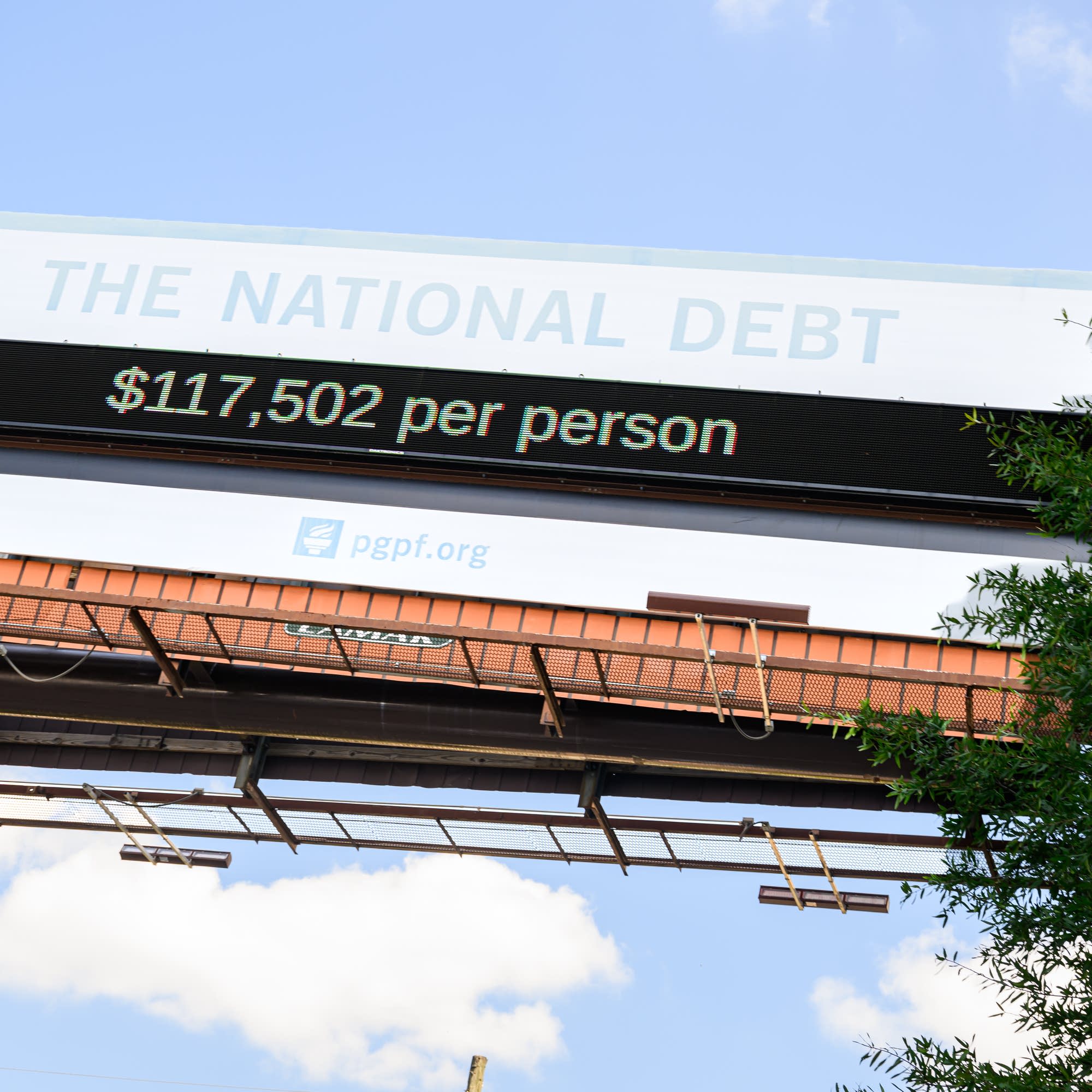
If interest rates rise, just one percentage point above the CBO's expectations. Incidentally, rates are already there. Marketplaces Nancy Marshall-Genzar breaks it down for us. Let's do a little time travel here to the year 2056. And let's say interest rates are still about 1 percentage point over the Congressional Budget Office's baseline, putting them at a bit more than 5%. Carolyn Bordeaux, Executive Director of the deficit watchdog group Concord Action, says the federal government's interest payments would have risen along with the higher interest rate. It doesn't have to rise by much to really balloon the interest payments that we are making on this debt. Bordeaux says just in the first 10 years of our timeline, we would have paid about $1.5 trillion more in interest, adding to our national debt, and also dragging down economic growth. Chris Towner, Policy Director at the Committee for Responsible Federal Budget, says that's because the higher rate the federal government was paying would make it harder for private companies to compete with it for loans to expand.
Because the government is going to always be able to pay an interest rate that is more attractive than private investment. And this legacy economy produces less tax revenue for the federal government. A B Gupta at Yale's Budget Lab says all this adds up to a higher budget deficit. Both because the government is paying higher interest rates on its existing debt and because more government borrowing shrinks the economy and increases the deficit indirectly. Gupta says the government could fight its way out of this quagmire. All we need is for Congress to undertake moderate sized, consistent, deficit reduction, and that will be enough to stabilize debt to GB going forward. That is the ratio of government debt to total economic output. If nothing changes, the CBO says with this higher than expected interest rate, debt held by the public would grow to 222% of GDP in fiscal year 2056. I'm Nancy Marshall-Gencer for Marketplace.
Between trade wars and inflation, extreme weather and drought, US farmers have been going through it. Add to the mix the Trump administration's cuts to the federal workforce, the Natural Resources Conservation Service, which helps farmers protect soil and water, lost nearly a quarter of its staff last year, harvest public media's Abigail Boatar reports. John Williams is walking me through the vegetable farm he manages in Central Illinois. All these white tubes coming up are tree tubes so there are little protections for newly planted trees. And the farm has a lot of new trees. Hazelnut, apple, and pear trees run in between the field and around the farm's perimeter.
The farm got funding to plant these trees through the Natural Resources Conservation Service, a federal agency under the US Department of Agriculture. Williams says the trees will help protect the farm's soil from strong winds and heavy rains. That will help keep more of our soil on our land and less from running downhill. NRCS staff in county offices across the nation help farmers like Williams implement practices that prevent soil erosion and improve soil health. The agency was founded almost a century ago in response to the dust bowl, but it lost 22% of its staff nation wide last year after President Donald Trump sweeping cuts to the federal workforce. Adam Grieby grows corn and soy on his farm in Central Minnesota. He was recently working on a project to prevent soil erosion. But then the NRCS staff where he was working with left the agency. And so I've gotten pushed to other offices. Grieby says he was sometimes stuck driving an hour to a different county office where he felt like he was starting from square one with new NRCS workers.
You kind of get pushed back to the bottom of the pile when you lose your your technician or engineer. Just across the state line was constant saw some of the steepest cuts to NRCS staff in the Midwest losing more than 30% of its workforce. Chuck and Deras is the policy director at Michael fields agricultural institute a Wisconsin nonprofit focused on sustainable agriculture. He says some highly agricultural counties are now without any NRCS staff at all. A lot of beginning farmers and a lot of people that are transitioning to grazing for the first time really rely on the technical assistance that they get alongside the cost share money. It's been a feast or famine at the NRCS in recent years. The Biden administration poured more than 19 billion dollars in additional funding for NRCS programs to address climate change. But those funds were rescinded by the Trump administration last year. You have this demand. You have this proven benefit for farmers. And yet they're taking money away from it.
That's Michael Hap with the Institute for Agriculture and Trade Policy a Minnesota based nonprofit. He recently analyzed how these cuts are impacting the agency's flagship program. The environmental quality incentives program had a 38% decrease in grants awarded from 2024 to 2025. Hap says a growing number of farmers are competing for this dwindling funding. It seems like conservation as an idea keeps getting more and more popular among farmers. We saw an increase in folks lining up out the door to apply for these programs at the same time that the number accepted went down. Harvest public media reached out to the USDA for comment, but officials did not respond. Hap says he worries farmers will start to get discouraged from applying for conservation funding through NRCS at all, which could damage conservation efforts for years to come. In Central Illinois, I'm Abigail Boatar for Marketplace. Coming up, 1.5 gigatons of greenhouse gas emissions annually.
That's a lot, but first let's do the numbers. The Dow Jones Industrial Average rose 410,000. Coming up, 1.5 gigatons of greenhouse gas emissions annually. That's a lot, but first let's do the numbers. The Dow Jones Industrial Average rose 478 points, 910% to close at 51,828. The NASDAQ climbed 129 points, almost half a percent. To finish at 27,068 and the S&P 500 rose 39 points, have a percent to end at 7743. For the week, the Dow added about 310%, the NASDAQ gained more than 2%, the S&P 500 rose 1 and 210%. Iran has proposed reopening the Strait of Hormuz in seven days if the U.S. agrees to end its blockade of Iranian ports.
Crude oil prices have fallen amid the talks. Brent Crude stands at 104 dollars a barrel. U.S.-West Texas Intermediate is about 92 dollars a barrel. Bond prices rose, the yield on the 10-year T-note fell to 5.17%. You're listening to Marketplace. Running a business is hard enough, so why make it harder with a dozen different apps that don't talk to each other? Introducing Odo. The only business software you'll ever need. It's an all-to-one fully integrated platform that makes your work easier. From CRM, accounting, inventory, e-commerce, and more. And the best part, Odo replaces multiple expensive platforms for a fraction of the cost. This is why over thousands of businesses have made the switch. So why not you? Try Odo for free at Odo.com. That's Odo.com. AI is only as smart as the data it's built on. When it comes to your e-commerce business, you don't need a general-purpose tool. You need an all-in-one intelligent shipping platform built to optimize your workflow.
And to help you make smarter decisions. That's ShipStation. Powered by specialized AI trained on decades of data from billions of worldwide shipments, ShipStation simply adapts to your business. It alerts you when stock is low, recommends the best pre-negotiated carrier rates, and automates everyday tasks to effortlessly save you time. With inventory sinking across sales channels and a branded returns portal, ShipStation handles the heavy lifting, keeping you in control, shipping made smarter. The sooner you switch, the sooner you start saving time and money. Get started with ShipStation today and get 60 days free at ShipStation.com with code Marketplace. That's shipstation.com, code Marketplace, shipstation.com, code Marketplace, taxes and fees apply. This Marketplace podcast is supported by the University of Illinois Geese College of Business. Earn a world-class MBA degree completely online at your own pace. Through their online MBA program, you'll learn from amazing faculty and network with classmates on a global scale
without having to put your career on hold. Take your career to the next level by applying what you learn in real time. Get started at onlinemba.illinois.edu. That's onlinemba.illinois.edu. Are you looking to invest in municipal bonds? For extra protection, buy bonds insured by assured guarantee. It guarantees 100% of your principal and interest will be paid when due. Assured guarantee has demonstrated its reliability and financial strength for nearly four decades. That's why the bonds they back are one of the safest investments you can make. Visit assuredgarranty.com. Assuredgarranty.a stronger bond. This is Marketplace. I'm Amy Scott. It's back to school season, which means for a lot of people the threat of a report card, looms large, but students start the only ones getting graded. A new scorecard out this month from a group of climate and environmental watchdogs
looks at the greenhouse gas emissions associated with private equity firms. By and large, the grades aren't so good. Amanda Mendoza is a senior researcher with the private equity stakeholder project. Thanks for joining us. Thank you so much for having me. I appreciate it. What is this climate risk scorecard? What goes into this? Yeah, absolutely. So it is developed by the private equity climate risks consortium. This is the third iteration of the scorecard report. And over the years, we've been able to build on our research in order to profile the energy portfolios of 20 of the major private equity firms. And we found that they produce an estimated 1.5 gigatons of greenhouse gas emissions annually through their fossil fuel investments. Wow. And who are some of the big players here? Are they household names or likely firms people don't necessarily know about? It's a mixture. So definitely some names that might be familiar to some folks.
Some of the big diversified firms are the Carlisle group, BlackRock, Blackstone. And then we also include a bunch of like infrastructure and energy specialist firms that aren't quite as large, but they do have very large energy portfolios, which is why we wanted to make sure we included them in the analysis. And what's the outcome that this consortium is looking for in shining a light on these investments? What would you like this scorecard to accomplish? Yeah, our basic purpose and our main audience here is for the investors in those private equity funds. So those are institutional investors like public pension funds and university endowments. And we want to make sure that we can give them the information, like the comprehensive information, to allow them to make appropriate investments. You know, this is US pensioners futures that are being invested in these private equity funds.
We also want to make sure that the public has this information because there is, as we all are well aware of, a massive sort of build out with the data center expansion and AI that is causing a lot more fossil fuel expansion as well. And the public really deserves to know who is behind that and the money that's being invested in it. There was a big push at the start of this decade to really try to decarbonize the financial system, all these net zero alliances forming and banking and asset management. And then, you know, there was a big backlash. Has that taken the pressure off these firms to decarbonize their own investments? You know, I think that it has. Even we've been doing this project for about five years now. A few years ago, there were a whole lot more net zero announcements that were coming out. There was a lot more posturing for green investments coming out. But with the sort of latest administration, sort of lack of regulation that we've seen lately,
we've definitely seen a change, especially with the investing in the AI data center build out as well. So how does this scorecard compare to previous years? Has there been any progress or do you see, you know, retreat? We've seen a very mixed, mixed results. We've had some firms that have made some progress as far as cleaning up their energy portfolios and transitioning. And then we've seen some other firms almost go the opposite way. And that would significantly harm their grade and their progress in transitioning their portfolio. Are these investments in fossil fuels profitable as the, you know, much of the global economy is shifting to renewable energy? We didn't analysis to look at the oil and gas funds that private equity have put forward.
And over the lifespan of those funds about in the past decade or so, we were able to find that, you know, while these have been marketed as high yield, high return funds, we found that the median fund returned only 2% more than investors contributed. And after accounting for inflation, investors actually lost money on average. And of course, as climate chaos and climate disasters get more intense, the physical risk to those assets are going to increase as well. And while the private equity firms continue to make profit off of these investments through fees, through dividend recapitalization and paybacks, it's the public pension funds and sort of the people who are faced with the potential consequences. Should those investments go wrong? Private equity, of course, exists to make money for its shareholders, right?
And as you've said, maybe these investments aren't as profitable as they could be. But should this industry be responsible for trying to create societal change? That's an interesting question. I think we would want to make sure that the investors themselves, who are the ones who are entrusting their pensioners financial future to the private equity firms, are enacting solid guardrails and standards for what they want to invest in. So we think that the pension funds themselves and the investment staff are the ones who might have the ability to change course here and to make sure that their own portfolios are aligned with the goals that they want to stick to for their transition plans. Have you talked to folks in these private equity firms? How do they respond to this critique? Yes, so as part of our methodology, it's really important to us to make sure that we have the most accurate data that we could possibly have.
So as a part of our methodology, we have reached out to each of the 20 private equity firms. Very few of them have responded with a few edits that needed to be made and we're always happy to make those edits and adjustments in the report. And then we've also followed up once the report has been published, offering to meet with them, to talk with them, be as a resource with them, as they sort of make their energy transition plans for their own companies as well. We haven't gotten any offers of meetings yet, but we're always open to discussing and being a resource to both investors and the private equity firms. All right, Amanda Mendoza is a senior researcher with the Private Equity Stay Colder Project. Thanks for your time. Thank you so much. As always, for more reporting on the economic story that is climate change, check out our podcast, How We Survive. This final note on the way out today, well, here's one way to protect your job in the AI revolution.
I saw this in Fast Company in a survey from software company, Vizier, nearly half of workers said they'd exaggerated their AI usage or expertise to colleagues or leadership to meet expectations. It's known as performative AI use and no wonder 45% of the workers said they felt pressured to use AI even when they're not confident in how to use it effectively. Our theme music was composed by BJ Leaderman, Marketplace's executive producer is Nancy Fregali. Joanne Griffith is the chief content officer, Neil Scarborough is the vice president and general manager, and I'm Amy Scott. Have a great weekend. We'll be back on Monday. This is APN.
These days you can get your news from anywhere. You got your tics talk, you got your little influencer. The influencer is not a real report. The influencer is sometimes ripping off real reporters. And today explained, is that what we're doing? No, no, well, you rigorously fact check our show. It's a Google Doc. So we do this because we want you to know that you can trust us. We make a news show for people who like facts. People like you? People like us. Our news show is called to date splint. Welcome to the newest grocery outlet location. Your couch. No parking lot. No shoes required. And the commute is approximately zero feet. Because now you can shop Instacart or DoorDash and get your grocery outlet favorites delivered right to your door with the same great item prices as in store. Your couch has never been this productive. Grocery outlet. Big deals. Now delivered.
More episodes


