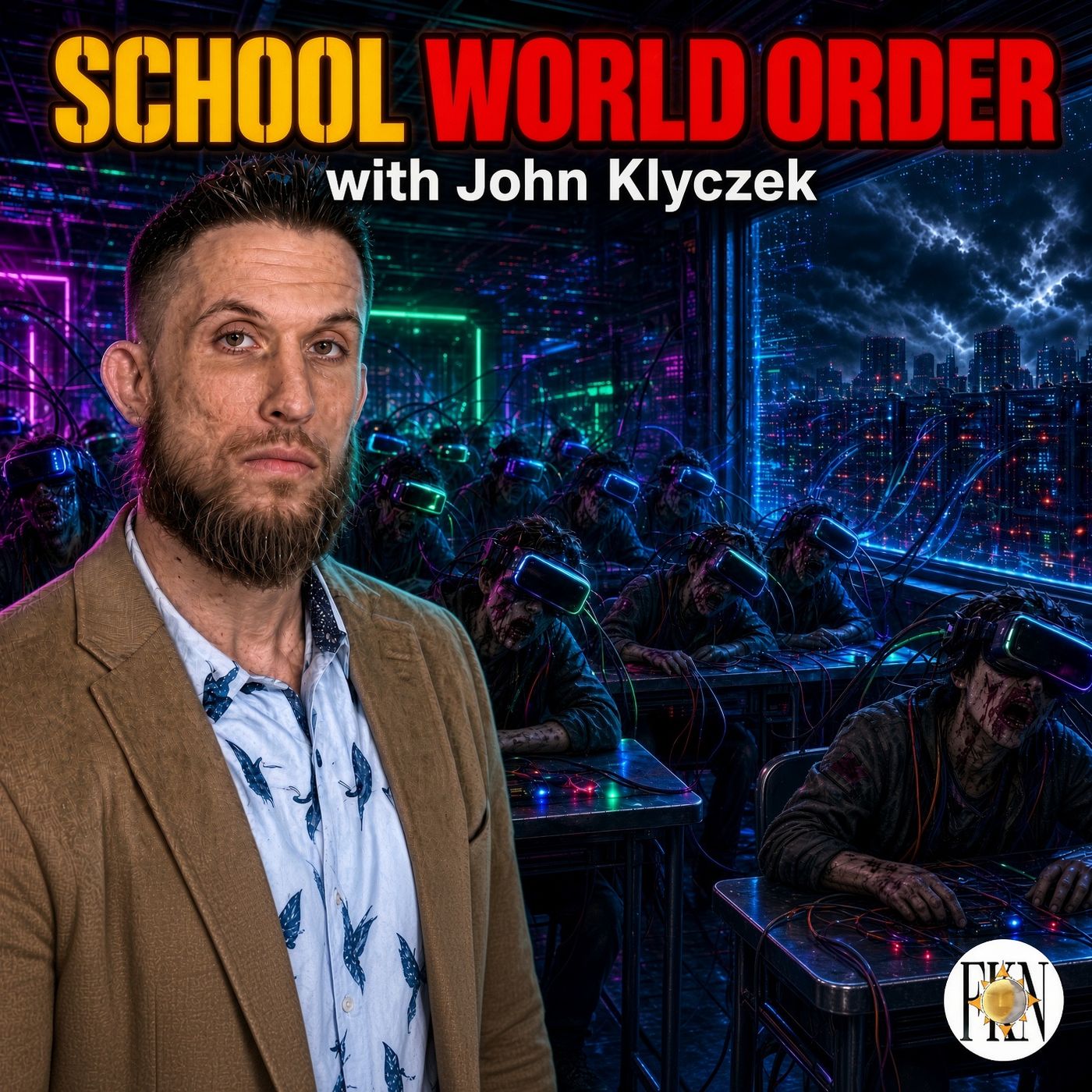
John Klyczek | School World Order, Algorithm Based Social Programming & Data Collection
Get every episode summarized
Each time Forbidden Knowledge News publishes, we email you a written briefing from the transcript — the topics, who appeared, and any specific claims, with the ad reads skipped.
Email me new episodesFree for 3 shows. No card needed.
About this episode
Forbidden Knowledge News is made possible by:
“Enjoy big savings with Red Hot deals at Vons and Albertsons!”From the transcript
https://www.schoolworldorder.info/
Forbidden Knowledge Network
https://forbiddenknowledge.news/
FKN Link Tree
https://linktr.ee/FKNlinks
Make a Donation to Forbidden Knowledge News
https://www.paypal.me/forbiddenknowledgene
https://buymeacoffee.com/forbidden
FKN Merch!
https://galactecfire.com/fkn/
Get C60 Power now!
https://go.shopc60.com/3J67C/KMKS9/
Code: FORBIDDEN10
We are back on YouTube!
https://youtube.com/@forbiddenknowledgenews?si=XQhXCjteMKYNUJSj
Backup channel
https://youtube.com/@fknshow1?si=tIoIjpUGeSoRNaEs
Doors of Perception is available now on Amazon Prime!
https://watch.amazon.com/detail?gti=amzn1.dv.gti.8a60e6c7-678d-4502-b335-adfbb30697b8&ref_=atv_lp_share_mv&r=web
Doors of Perception official trailer
https://youtu.be/F-VJ01kMSII?si=Ee6xwtUONA18HNLZ
Listen to Forbidden Knowledge News on clearair.fm every Tuesday, Thursday, and Saturday 12:15pm CST
https://clearair.fm/
Pick up Independent Media Token here
https://www.independentmediatoken.com/
Be prepared for any emergency with Prep Starts Now!
https://prepstartsnow.com/discount/FKN
Start your microdosing journey with Brainsupreme
Get 15% off your order here!!
https://brainsupreme.co/FKN15
Book a free consultation with Jennifer Halcame
[email protected]
Facebook page
https://www.facebook.com/profile.php?id=61561665957079&mibextid=ZbWKwL
Watch The Forbidden Documentary: Occult Louisiana on Tubi: https://link.tubi.tv/pGXW6chxCJb
Johnny Larson's artwork
https://www.patreon.com/JohnnyLarson
Sign up on Rokfin!
https://rokfin.com/fknplus
Podcasts
https://www.spreaker.com/show/forbidden
Available on all platforms
Support FKN on Spreaker
https://spreaker.page.link/KoPgfbEq8kcsR5oj9
FKN ON Rumble
https://rumble.com/c/FKNp
Get Cory Hughes books!
Lee Harvey Oswald In Black and White
https://www.amazon.com/dp/B0FJ2PQJRM
A Warning From History
Audio book
https://buymeacoffee.com/jfkbook/e/392579
https://www.buymeacoffee.com/jfkbook
https://www.amazon.com/Warning-History-Cory-Hughes/dp/B0CL14VQY6/ref=mp_s_a_1_1?crid=72HEFZQA7TAP&keywords=a+warning+from+history+cory+hughes&qid=1698861279&sprefix=a+warning+fro%2Caps%2C121&sr=8-1
https://coryhughes.org/
Our Facebook pages
https://www.facebook.com/forbiddenknowledgenewsconspiracy/
https://www.facebook.com/FKNNetwork/
@forbiddenknowledgenews1
@forbiddenknowledgenetwork
X
https://x.com/ForbiddenKnow10?t=uO5AqEtDuHdF9fXYtCUtfw&s=09
Email Forbidden Knowledge News
[email protected]
some music thanks to:
https://www.bensound.com/
ULFAPO3OJSCGN8LD
DGLBEYNSIXA6EMZJ
5FUXWYNC6WJNJKRS
8DH27IXE3D73E97D
C6JMAFZLSZDGTWFI
Become a supporter of this podcast: https://www.spreaker.com/podcast/forbidden-knowledge-news--3589233/support.
Get every episode summarized
Each time Forbidden Knowledge News publishes, we email you a written briefing from the transcript — the topics, who appeared, and any specific claims, with the ad reads skipped.
Email me new episodesFree for 3 shows. No card needed.
Hosts & guests
Transcript ready
898 searchable segments. Every word is indexed and playable.
Full transcript
Forbidden Knowledge News — John Klyczek | School World Order, Algorithm Based Social Programming & Data Collection. Machine-transcribed; use the interactive transcript above to jump the player to any line.
Enjoy big savings with Red Hot deals at Vons and Albertsons! This week, Signature Select Drumsticks or Thighs, Bone In Value Packs are 99 cents per pound with membership where applicable, and Alpharos, Arches on O'Bread, 20 ounces Select Varieties are 299 with Digital Coupon. Plus, get a 3-pound bag of Mandarin for 399 with Digital Coupon! Enjoy fresh and delicious savings every day of the week! Hurry in! These deals won't last! Visit Vons or Albertsons.com for more deals and ways to save! Being a nurse means being focused on others, on what someone else needs. To get through, to feel better, to get the job done. At Post University, our Advanced Nursing Degree programs are focused on what you need to succeed. With 100% online classes on your schedule and monthly start dates that are ready when you are, so you can go from RN to BSN, BSN to MSN, even MSN to DNP. Ready to move your nursing career forward? Apply now at post.edu.
Hello, friends! Just wanted to give you a heads up. The first 5 minutes or so of this interview, we had some bandwidth issues, we had to reconnect. John actually had to call in over the phone so that we could finish everything. But it was much better after the first 5 minutes. Please stick around through that! I hope you enjoy this episode. I think it's just going to get weirder and weirder and weirder and finally it's going to be so weird that people are going to have to talk about how weird it is. Welcome back to Forbidden Knowledge News! I'm your host, Chris Matthew. Today my guest is John Clizek. Be sure and watch my films, The Cult Louisiana's On 2B Doors of Perception on Amazon Prime. Also check out our merch shop. We've got great shirt designs, hoodies, use the link in the description to go check those out. I am booking guests for November. If you have suggestions or you'd like to be a guest, email me for Bidden Knowledge News
at gmail.com. Today I want to welcome back to the show John Clizek. He is a professor, researcher and author of School World Order, the Technocratic Globalization of Corporatized Education. John welcome back how you doing. Alright Chris, thanks for having me back. Thanks so much for coming back on. It's great to have you. Your work has been exploring the dark realms of technocracy and dystopian agendas that have crept into our education system. I can't imagine what our younger generations are experiencing today within the emerging technocratic AI-driven systems being implemented. For the purposes only of social programming and mind control in my perspective, but you not only bring attention to this dystopian reality, you offer solutions for parents that don't want their children brainwashed in the name of education. So there's a lot to get to. I'm looking forward to hearing about your latest research before we do.
Remind the audience a little bit about yourself and let them know how they can find out more. So I am John Clizek. I am the author of School World Order, the Technocratic Globalization of Corporatized Education. I published this back in 2019 right before lockdowns. And then I've continued my journalism building research. These are some of the more recent things I've done. Looking at some of the stuff with Paypal Maffee and the Trump Administration is what I've been covering the last couple of years. For people that might not have seen the previous interviews, I am the sort of the protégé of the air to the work of Charlotte Thompson is her beat. So she was the one that wrote the blibberdumming down of America. Blue the whistle on this thing called Project Bass Basic Education Skills through Technology was setting up public private partnerships between government and corporations, big tech corporations to implement.
BF Skinner's operating conditioning through the computers and to change academics to workforce training. And that's pretty much set the stage for everything that my book focuses on. Everything that my research since then has focused on as well. Right on, we're great introduction. I believe the last time you were on, it might have been the Biden administration. I don't think we had reached Trump 2.0 at this point. What are some of the most important aspects of this administration, particularly that you've been following as it relates to education? Yeah, so I kind of got in front of this administration. I kind of, some of the win early in 2024, just the way that I popped out to me that I highlighted, I think it was Frank Lutz basically. I was on an inter-panel of seeing an inter-MSNBC one day.
And you guys are making a margar, the more you go after him, the more he's with the Butler event. After that, it was pretty clear that the P-Pot is going to be the debut and it was, you know, you're going to come in and rescue us. So they did the prompt 25 thing. I looked at that. I got a heads up on some of the main policies, a bunch of call-over stuff in there. And so the main things were the, they were supposedly going to dismantle the Department of Education, but the other part was the school choice agenda. And so I wrote two articles for unlimited hangout. One looked at early February of the project, 2025 agenda. And then the second one was sort of an extension of that. And I looked at how the vouchers and neo vouchers were going to be facilitated through the digital wallet industry and how that was going to dovetail with the stable coin agenda
and also time and stuff like that. So we could maybe bounce around on all those. I mean, I made quite a few things on the table, some of them are a little dense, so maybe I'll just leave the menu there for you to pick at. Sure, man, for those that aren't familiar with school choice, this seems to be an important agenda that's coming down the pipeline. What is this consist of? So for those that maybe haven't read my book, you'll see that you actually tell you that that's basically the first kind of several chapters. So the book looks at sort of the corporation. It's not true. And so one of them, it'sization and corporatization in schooling has been a big. This is usually pushed heavily by Republican administrations, but the, well, there's two
branches. There's the charter schooling movement and then there's the vouchers and neo vouchers. So the charter schooling movement is private companies, education corporation schools that are private companies that are publicly subsidized. That's some virtual online charter schools like K12 Inc. And these provide the dashboards for all the various ed tech products that I've written about. The other branch of school choice is again, the vouchers and the neo vouchers. And these are just ways that the public tax dollars can be funneled into private schools, or their disreported home schools. But when we say home schools in this, and it's really what we mean is subsidizing ed tech product, or some form of virtual schooling. But the charter school, charter school, the concept of charter schools again, these are usually heavily promoted by Republican administrations, but the concept charter schooling was coined by Albert Shanker, who was the president of the American Federation of Teachers Union
for many, many years. He's also the member of the trilateral commission and was the president of a global union federation known as education international. One of the first, the first federal charter schooling bills were signed into law by Bill Clinton. And then Barack Obama, he selected Arnie Duncan to be his secretary of education. And Arnie Duncan got his sort of claim to fame by basically privatizing almost the entire Chicago public school system as CEO of CPS Chicago public school system through various charter school partnerships, et cetera. And so the charter schooling movement has largely been sort of locked in. I don't think there's a state in the country that doesn't have charter schools, you know, more or less all across the state. But the next wave that the current Trump administration is really pushing through that was always sort of lagging behind and not gaining the same traction.
It has to do with the vouchers and neo vouchers. This administration is focusing heavily on the neo vouchers instead of the vouchers. And I can explain why that is. It creates sort of a, we'll just call it a loophole or it removes the disbursement of the money's from the government one step between the government and whatever school it goes to. So that way they can skirt challenges that government dollars are funding religious institutions because there have been states where they've tried vouchers, they went straight to religious schools in those states. Those those were overturned. Can you tell us a little bit more about the difference between vouchers and neo vouchers? Yeah, so the voucher is the government gives you like coupon or check and it's authorized to be used at an accredited school with the government acknowledges. And that's all you can do. It goes straight from the government.
I mean, technically it goes in your hand or they might just deposit straight into the school after you black. But the neo vouchers, the education savings accounts and then the tax credit scholarships. Or a little different. So the edge of the USA is basically you get like a pool of money and that money can be used. You can personalize your spending of the basically neo voucher money certainly. So that like instead of just giving you a one off to go to a school, you could give it, you could maybe use part of it for tuition at a private school. You could use part of it for ed tech products. You could use part of it for tutoring. You could even use some of it for therapy sometimes if it has to do with learning disability. And then the scholarships, the only difference with most of the scholarships that sometimes these are like interchangeable. So we'll call them education scholarship accounts or you'll have an ESA distributed by what's
called a scholarship grant or scholarship funding organization. So you have this third party organization that it collects money that private donors, usually large companies give it allocated for. Dishing out again to the scholarship to the USA. And so this big, this company puts money in this SGO or this SFO, that company gets a write off from the government. Then the SGO or the SFO is entitled to use that money or is entitled to disperse it in any way they should fit. And so it could be some of them operate as what's called impact investment firm. And so they might only give scholarships out to help certain demographics. Certain, maybe it falls under like, you know, woke identity politics stuff. So maybe it's like, you want to help students of a particular gender identity or a particular
ethnicity or a particular socio-economic bracket. But the reason why they do the SGOs and the SFOs is because this gives them a loophole where they can basically the government can subsidize monies that pay for private schools but also potentially religious schools. And since the government's not giving the money directly to the school, the religious school through the like in a voucher, it's technically the SGO. The government is in the government isn't even really subsidizing the SGO. It's subsidizing the private company that donated to the SGO. So this is a way for them to try to get around that. But what I always try to tell people that, you know, that are, you know, a lot of what's driven sort of people to jump into the whole school of choice thing at this point in the game has to be just, it's basically anti-wold culture war stuff. And like, you know, people are so emotionally motivated by anything that's anti-wold.
You know, if you try to tell them anything more than, you know, what are some of the dangers of this other thing out of the frying pan and do the fire? They largely don't want to hear it. But what I try to tell them is that if you do that, what you're doing is you're bringing the government that you're trying to get rid of with all the woken-doctrination. You're bringing those strings attached to either that religious school or that private school or in the case of like homeschoolers, you know, they're appropriating the B-schooling and the unschooling rhetoric of Ivan Litch and John Gatto. And in those instances, you're bringing the government into your home. And you're also bringing big tech to data mind you as well. So that's what the neo vouchers do. And that's where the front administration is going. Enjoy big savings with red hot deals, advance an Albertsons. This week, Signature Select Drumsticks or Thighs, Bone In Value Packs, are 99 cents per pound with membership where applicable. And Alpharos, Arches on O'Bred, 20 ounces, select varieties are 299 with Digital Coupon. Plus get a 3 pound bag of mandarin for 399 with Digital Coupon.
Enjoy fresh and delicious savings every day of the week. Hurry in, these deals won't last. Visit vansheralbertons.com for more deals and ways to save. Right now at Subway, try the 499 Sub of the day. Get a different 6-inch sub every day for just 499 each, like Meatball Marinera on Mondays, Tuna on Tuesdays, and the BMT on Saturdays. It's a different 6-inch sub every day, packed with protein and your choice of chopped veggies for just 499 each. Or make it a meal with chips and a drink for just $2 more. But hurry, it's only for a limited time and only at Subway. Participate in restaurants, prices higher in Washington, Alaska, Hawaii, and on third-party delivery, add-ons, taxes, and fees for delivery additional. Enjoy big savings with Red Hot Deals, advance in Albrecht's sense. This week, signature select drumsticks or thighs, bone-in value packs, or 99 cents per pound with membership where applicable. And Alpharos, Arches on O'Bred, 20 ounces, select varieties are 299 with Digital Coupon. Plus get a 3 pound bag of mandarin for 399 with Digital Coupon.
Fresh and delicious savings every day of the week. Hurry in, these deals won't last. Visit vansheralbertons.com for more deals and ways to save. Right now at Subway, try the 499 Sub of the day. Get a different 6-inch sub every day for just 499 each, like Meatball Marinera on Mondays, Tuna on Tuesdays, and the BMT on Saturdays. It's a different 6-inch sub every day, packed with protein and your choice of chopped veggies for just 499 each. Or make it a meal with chips and a drink for just $2 more. But hurry, it's only for a limited time, and only at Subway. At participating restaurants, prices higher in Washington, Alaska, and Hawaii, and on third-party delivery, add-ons, taxes, and fees for delivery additional. Enjoy big savings with red hot deals at vans and albordsons. This week, Signature Select Drumsticks or Thies, Bone-in Value Packs, or $0.99 per pound with membership were applicable. And Alpharos, Artsisano Bread, 20 ounces, Select Varieties, or $2.99 with Digital Coupon. Plus get a 3-pound bag of mandrants for $3.99 with Digital Coupon.
Enjoy fresh and delicious savings every day of the week. Hurry in, these deals won't last. Visit vans or albordsons.com for more deals and ways to save. Speaking of big tech, what are some of the dystopian technological integrations that this current administration is trying to implement like adaptive learning? Well, as I noted in the pieces I wrote, the mascot for full-toys Corey D'Angelo, he pitches the idea that this is going to level the playing ground. If you are in a neighborhood that has not a great school, you shouldn't be stuck in that district. Well, here's the thing, if you're in a district that's not performing very well, probably in a district that's probably pretty poor.
And if you're in a district that's pretty poor, it's probably not much better schools around you. The access to transportation probably isn't so great. So realistically, practically, functionally, you're not going to be able to use that money to go to a better, actual school. Even if you could get to a private school somewhere nearby, the amount of money to give you isn't going to put against it. So the bulk of that money is going to go into ed tech. And so basically the idea here is that they're subsidizing the idea of the school choice stuff is to subsidize ed tech. And that's all the various technologies that I wrote about in my book. And that's the question of adaptive learning screen-based courseware of to the wearable stuff that they could use. The wearables are largely being pitched as to help the students learn disabilities, test aims, IDADHD, things like that. But now they have also the generative AI tutors. You're open AI, you're kind of academy, kind of me go.
I think the Prisha Kanmigo uses an open AI engine. But kind of academy is funded by Elon Musk. And you know, the adaptive learning coursewear like Newton, that's funded by Peter Field. And the head of the guy that holds a Ferrara that runs the company, he's a member of the World Economic Forum. He got his money from Peter Field at the World Economic Forum. He's field also a member of World Economic Forum. There's an article on the World Economic Forum website where Jose Ferrara was like, yeah, I met Phil here and he helped me find Newton. The wearables like Branko, the EEG wearable, the data-minus students' brainwaves, the Branko company that's created the head of that B-Cheng Han member of the World Economic Forum. The technology was developed by a Chinese-run state electronics company and Harvard academics. And I actually recently, apparently, have caused them some issues with finance, fundraising,
because they went and they requested that I retract my claim that they were in partnership with China's electronic state, they went and they felt they needed to just China's electronic corporation. But I was like, you know, I'm citing an ed surge article from 2017, which is still up, unfortunately, unlike me, most generalistic publications do not do a very good job of actually citing, certainly not in any exhaustive manner, their sources. But I don't know where they got it from, but they haven't retracted it. So that's all they do. I'm happy to retract it when you can either produce, you can show me that you have an ad, or you can get them to do it, because all I'm doing is reporting on what they said. And there are a whole several years older than mine. So I wondered, I saw recently in the, there's a brain computer interface company in China
called Miracle. I guess they got them on the market now, but these are non-invasive. And just so you know, brain co, like it doesn't just do the EEG data mining for like learning, they've got wearables, external, they're also working on internals, but they've got external that you can wear for to control, like if you're a paraplegic and you hook up one of these robot arms with like fingers, like you can control the fingers through this halo or this little node thing that they kind of clips to your ear or the through your temple. And I don't know when I saw that and I was like, I wonder if Miracle got that money instead of them. And it was very recently and they sent it to my school email. Instead of my actual journalism email, it's not weird. So yeah, those are the types of technology. I mean, basically the whole cybernetic grid for biopsychosocial profiling for social credit and ultimately for trans human engineers.
What are some of the ways that student data is being collected and how is it being used? Also are the wearables you were just mentioning being implemented on a widespread scale right now or we already seeing these being used in schools? Like I said, they're mainly used in like what they call the wellness center or mental health center. I usually call them mental health platforms. I like it. That's one of the schools where I actually use heart math at the wellness center. And so when you go to take your tests, if you have a learning disability, you test anxiety in particular, they'll sit you down with heart math. You put on wearable, you do the meditation and the thing tracks your heart rhythm and when it gets in what they call the heart coherence, which is whatever frequency or rhythm that they seem to be calm enough for you to be able to take the test and then you're ready to take the test. And so I know at least in one of the schools that I, where I add junk days, they use it.
Now just like with, you know, I don't know if your audience is familiar with what's called the look say method or nowadays they call it old language learning. But so my book also builds on the research of Anthony Sutton in the art introduction to the order of school and bones emergency pre-establishment. He got those. The membership catalog from Charlotte is a mentor whose father and grandfather were members of the order of school and bones. And one of the things he looks at is one of the first chapters in there is called how the order controlled education. He looks at how they basically funded the stimulus response psychology, which is the basis for the algorithm data mining and the adaptive learning course where the adaptive learning course for digital version of the skills, skills, analog teaching machines. But he also looks at sort of the how the order of school and bones is instrumental in creating this now called whole language learning. Ships from phonics to instead of was designed for deaf people at first.
This is the connection to what the whole idea about assistance technologies or basically educational pedagogies or methodologies that have been designed to help people with various disabilities, but then were mainstreamed to everybody else to accommodate or personalize learning for people who don't have. All right, so the idea was that for deaf people you can't really sound things out, so finally it doesn't work the same. So what you do is kind of like an associative like a show and a picture, you give them the whole word, associate the whole word with the image or the concept, versus sounding out the roots and the prefix and the suffix and then discerning the meaning based on that. But nowadays and you know anybody that they have heavily frowned on, I teach college level, I don't teach K-K-12, but I've heard that it's basically the same in K-12, but you know they don't really teach grammar anymore like that, they don't really teach filing anywhere they teach whole language learning.
And so you know, I'm sure there will come a time when some of this wearable stuff will be sort of mainstreamed. My prediction is that so now that we have the generative AI, the tutor bot, like eventually because these generative AI as my book lays out, it is built the neural networks and the machine learning actually is trained on all the various feedback loop, the data points that have been extrapolated from the different various devices. So they basically have been removing the students personally identifiable information, the AI, then it becomes user interaction information, the AI, they take that anonymized data and they run those patterns to machine learning and the neural networks, the outcomes, the AI that's able to pick up on those types of patterns and students, you know in their performance on a given module and then if they able to
extrapolate predictive analytics and then it can personalize what career pathway they go through, et cetera. Well, not only do they have sort of the cognitive behavioral feedback loops, but they also have the emotion recognitions, the social emotional learning feedback loop. So in other words, something like, um, time ego or the open AI tutor, it's trained on those types of algorithms and you don't really need a wearable, because if long as you have a camera on, they can make inferences on the same, a lot of the same emotional inferences based on your facial expression. But eventually like what they'll do is you'll have a personalized tutor bot, it'll follow you around on your phone or your device or whatever, it'll help coach you through the modules that you have to perform. And if you really want it to get a really good precise read feed on its personalizing algorithm, you'll want to have,
you know, a brain halo on and on. So that way it can, you know, it can make inferences about your emotional state that are more accurate. Not just in terms of like maybe what face especially expressions you're making, but like how how is your bio, uh, bio rhythm sort of correlate with that? Are the students data being collected from their entire digital online fingerprint, social media, any website they're interacting with, they're collecting data from it for these systems? So if you're looking at like something like Newton or Clever or smart, uh, smart Sparrow, right, Spacely, Dreamboxy, that thing, those apps are only going to be looking at the cognitive behavioral feedback. And if you're looking at the wearable, that thing's only going to be looking at the social emotional learning. Now, if you got the AI, like the generative AI that's programmed, right, with interact with it through the large language model programming, but right,
then it can read all those other feedback loop as well. Um, so like the AI is kind of, we're, we're crossing a threshold in which nice, there's my book sort of lays out. First comes the online platform that creates the dashboard where you put these applications. So the applications start to track these different data points or data patterns that eventually they're aggregated into the open AI, into the AI, the generative AI. And eventually, you know, uh, right crisis happens or you know, I always when I wrote the book, I figured we were going to have more time because legislatively, you'd have to, you know, there's things like hip hop and FERPA, I hit the governs healthcare records for a governs education records. Well, if you have a disability, a technology that's for disabled students, well, FERPA or HIPAA, like, right, it's a, it's a medical technology. If you, for people that have never taught,
you were not allowed to inquire about your students' disability status. They have to tell you, they have to get it from the disability services, right, because that would be asking them about medical records, which would violate HIPAA. Right. So, uh, at some point, like in sort of the, you know, just use the Chinese example because it's, you know, if you want to actually look at what this all is going to look like when it finally comes together, you know, the ABC documentary on their social credit system. Eventually, all that stuff goes on a unified block chain. Did you like and it's not just all the edtech data and the medical data, but it's also, as you know, your purchasing history, your social media records. Now, they got block cameras all over the place. It'll be, you know, your behavior in physical space and all of that will be aggregated to permit a restricted access to public and commercial services recursively. Right. So, what you do on your edtech, right, might affect your health care and your health care might affect your criminal
justice and that might affect whether or not you get a job. Right. Like, if you, if you type something, you're gonna say you write an essay and the opinion is, you know, politically incorrect and they think maybe that you have like your conspiracy is what's means you're like maybe your mental ill or you got a mental issue, right. And so, well, if you got a mental issue, well, you might be a terrorist and if you might be a terrorist, well, we can't let you go to work. See, and so that's how one data point can be used to sort of affect your, how you perform and behave between one domain of society is going to affect whether or not you're allowed to perform it in them. This data could also push a person in a certain direction based on the information that they've been given, you know, basically silo them in the direction that the data deems best for the individual student.
If you're a smart or a way to grow dinner at home, with garden, you can snip basil for pasta, harvest salad greens from your kitchen and grow fresh vegetables, herbs and flowers year round with a smart indoor hydroponic system and an AI gardener that helps do the work for you. And now that garden is HSA, FSA eligible, it's an even smarter way to bring fresh food home. From countertop herbs to salad and reach, garden turns your home into a year round source of fresh food. Shop garden today at mygarden.com. That's m-y-g-a-r-d-y-n dot com. Back to garden, back to life. This episode sponsored by Marathon Sports. Runners know the feeling. That moment when the shoe disappears. Your stride feels smooth. Your breathing settles in. And the run just clicks.
That's what Marathon Sports has been helping runners find for over 50 years. At Marathon Sports, their expert team uses the right fit process to match you with shoes and gear built for the way your body actually moves. No guesswork, no generic recommendations. Just real guidance from people who live and breathe running. Whether you're training for your next marathon, getting back into running or chasing a better everyday run, Marathon Sports helps you find what works for you. Visit marathonsports.com or stop into a Marathon Sports store today and experience the difference the right fit can make. Yeah, so again, the whole, all of the edtech stuff, the analytics are based on stimulus response, algorithms, stimulus response, on psychology. This is the basic sort of, I guess, algorithmic kernel of BS skinners analog teaching. So basically, the Wilhelm Blunt and Pat Vov, right, classical conditioning is basically just associative, like, you know,
you bring the bell, you bring up the food, dog associate, spell with food, right, and you can elicit an associative response. Well, then comes behaviorism with people like EL4 and I, they add punishments and rewards to sort of instead of this associative conditioning, we're transitioning towards eventually what skinner calls operative conditioning. So your, the punishments and rewards are being scheduled in a way to elicit you to perform desired operations, and that means operations desired by the state, you know, big tech, big government, the business, you know, the whole aggregate of all that. And so he just adds, you know, positive and negative. So that means either you remove or you add or remove a stimulus punishment reward. And the idea is that in this social credit system, they split in the society at large, we'll be at a skinner box. And so, you know, with automated instantaneous rewards and punishments,
it's in real time. So you're given, you know, you have to interact with all these digital overlays at your job at, by the way, I hope I don't lose the plot here, but I learned that, so the wearable, the EEG wearables, well, they have this, it's also in like for employers, they call it boss wear, and like, especially for remote workers, you put these earbuds in and the data mines your brain waves. So they can, they make inferences like, hey, you know, ain't typing those, you didn't do a data entry right now, you're doing a Facebook or something, right? Well, at, at Burger King, now they're going to put, they call it patty, you know, put it in a headset, have it boss, boss the workers around all day, tell them, and it's going to monitor whether or not, like they say, please, and thank you, you know, or, you know, hey, this, this, this, you left this burger to this patty on the, the, the grill for too long, or, you know, the pay table, and I'll
fix these cleaned, and I knew I was going to lose the plot when I did, well, I had decided to say that though, to illustrate, oh yeah, so that was right, so it's like, imagine, right, so you got, you go to school, you've got the wearable, you got the computer tablet, whatever, that's the stimulus, you have to respond to it, it's tracking you, paste the base on how you do it, you get a room order punishment, you know, you get a token that lets you go to the next module, or maybe you get a special recess or something, and then you get, then you go to work, and it's the same thing, right, did you say please, and thank you, did you, okay, you know, then you, then you, drive around, as you drive around, you know, the flock cameras, oh, you didn't use your signal when you switched, you know, your car itself, like, so all of these things are going to, in real time, do these digital sensors are going to be rewarding or punishing you, and that's going to shape and modify your behavior, and this is part of what I think the wearable, why they, why they want to
know about your internal things, it's like a given student, let's say, you know, you don't agree with the, what the professor or the teacher says, and you know, you want to write a paper that disagrees, but you know that you do that, it's probably not going to get a good grade, if you want to get a good grade, because you have, you know, you don't want to mess up the GPA for your job or whatever you're asking, but you're like, okay, I'm going to, I'm going to regurgitate the lecture and just write what teacher wants to hear, and then, you know, when I move on, I can express what I really believe when it matters, okay, well, if you get the wearable on, and you type the paper, and it's monitor, and you are your type in the paper, you'll get a flag, and it'll say, you know, like in 1984, where Winston's being tortured by O'Brien, and he's like, okay, I love big brother, he's like, no, no, no, Winston, that doesn't count, we know you, you have to actually, you can't just say it, you have to actually feel it, that's the belief, and you have to love big brother, so, you know, no, Jim, you know, you don't believe what you wrote, we know you actually, 90, I believe it,
but you actually, your emotional algorithms say that you're very much against and reverse to itself, write it again until you get it right, or something that worked, well, you know, Billy, we're happy you've been saying, please, and thank you, but we don't like your tone, or the way your heart rate is, you know, you seem to be a little disgruntled to be saying, please, and thank you, so, you know, it's a way that to really solidify the condition, because, you know, if you're only conditioning sort of what is externally observable, there's ways that you might be able to find a pocket in your own mind, in your own psyche, where you can have some liberty of consciousness, but, if this thing's making inferences on your internal state, you know, it'll, it'll really sort of, like, as you said, sort of silo you into self-censoring, not just what you say and do, but quite literally what you think and feel. Well, this isn't just a problem for our education system, they're trying to integrate this into law enforcement and governance on a
massive scale. There seems to be a level of predictability in behaviors as this technology grows to where they are going to be utilizing it for nefarious purposes, like pre-crime or some kind of law enforcement. Yeah, I mean, that's just the sort of holy grail end game, because that's by, once you're able to sort of, I kind of laid out the scenario, once you're able to through predictive policing, label somebody a potential terrorist because of a thought or a brain wave, you can remove them from the public conversation, you're moving from the civil discourse, you can remove, you know, this is why the first amendment is before the second amendment, because that's the most important part. I mean, usually if the second amendment, and, you know, by the time you have to physically defend yourself, you know what I mean? Like, most likely the outcomes aren't going to be good, even if you don't get the short end of that stick. I mean,
like, you want to be able to solve things with words and, you know, that's the whole idea of a civilization. So, once you, if you can remove public discourse, you know, there's, we're pretty much in a place where political activism, as we know it, you know what I mean, is disagreeing at all with policy could essentially be made the inference, but in the meantime, you know, I'm thinking about, you know, this all the national security, all the safety stuff like, maybe if you're not accurate to be honest, let's just say that. Okay, I mean, like, we've been seeing, you know, there's many, many, many cases of a flock camera or an axon or whatever, getting the license plate wrong, recognizing the face wrong, and then having somebody come in,
and arrest you, and then now you're more or less guilty until proven innocent. And I think there's been cases where, you know, interestingly, like, you know, in the persons like showing the police officer comes to the door, I think as the case with the woman that accused the take in the packet off the doorstep, and just like showing them her phone or they're like, you look, I'm showing you, I'm here at this time, like, no, no, no, the camera's set, you know, and like people, I got to really see like, I mean, and these are people who are adults, meaning they've lived in a world for many years, where you don't just defer to something of a data, a computer spits out, especially when someone's showing you physical artifacts to the contrary in your face. Like, if you can get adults who have operated in a
society where that was not the norm, to just not only just like, reflexively defer to whatever this algorithm says, but like actively argue with you while you're showing them contrary evidence in real space and time, what happens in a couple generations when people who have grown up with nothing but a generative AI tutor bot, hovering or helicoptering around them and having everything that they think either confirmed or denied through through through an AI, you know, I mean, like, you, you pretty much will be your date. And right now we have the human intermediary still, in most cases where we can appeal to real human emotions, whenever it's all AI and just technology or algorithms that we have to appeal to, that's a much different story and we can't rely on human
emotions to save us from anything anymore. Yeah, you know, I mean, and there will be humans being around, but there will not be human emotions, neither through the, neither through the machine nor through the human being that, you know what I mean, you might share cubicle with it for whatever. So, you know, I keep saying to people, there's a lot here, I'm gonna say something else, I'm gonna make a little prediction here, like I'm a little frustrated at all this, all this, all of a sudden, or what my book started writing it 10 years ago, got published 2019. Now all of a sudden, everybody's all of a sudden worried about AI, did your way late to the game? I'm sorry, your way late to the game and the thing you're freaking out about is not the right thing to be freaked out about. And the dialectic to spin play is very clever because you've got, on the one side,
you got the, you know, I'm just gonna use the heuristics that are used to frame public discourse, which are not accurate, but the left and the right, I'm just gonna use those terms. The left is all this acting like we care about AI and we're scared of data centers and block cameras and we need to come in and regulate and then on the right they're going, no, we don't want to regulate anything, we want their companies to do it themselves. So there's like a kernel of truth in both of these things, but neither one of them is enabling you to have the actual conversation. And the whole, the whole, what I think is this, so Trump was just, he was given the ball to be the break stuff and fix it later administration with the PayPal mafia maniacs, so they come in and ran an AI through, they state the blood in his own like ban and says they break a bunch of stuff and they get it all integrated, cause a bunch of disruptions, burn up all his political capital, and then you have the last GSA, whatever this new version of the left is going to be for at least four
or eight years, I'm pretty sure they're going to give it to him, I'm pretty sure they want them. I see the way I see Republicans behaving right now is like the inverse of how the Democrats behaved when they, when Trump got in in 20% you know what I mean? And it's like you look at it and you go like dude, if you, do you, do you want to win this election? I think you're happy. I think, and so what they're doing is, you know, they're saying like, oh, you don't want, well, they're right that you don't really want them to regulate it because I promise you when they get in, what they're going to do is they're going to make it so called equitable and it's going to be through, you're going to add like impact investing maybe at like, this is what I think it'll be something like they'll offer you maybe like a UBI to start off with, it's like a little baseline thing, but then like, you'll be given like, I mean, I don't know if we, because our thing broke up and we restarted the conversation, but impact investing, okay? Like you'll basically, you'll be given
tokenized allotments for AI assisted public services. And we talked by impact investment more in a little bit, but in the meantime, like the fear is like, you're an artificial super intelligence is going to, man, can I tell you that it was always AGI when I was writing my book and overlaid, it was always a artificial general intelligence, right? AGI was always the acronym. Why is also a nice feature in people say artificial super intelligence, ASI, all of a sudden? Well, because if you say artificial general intelligence, you know, general, general is like something in the middle there, you know, it's just, you know, like baseline mediocre, right? Part of your super problem, you're going to be scared of that, you know? And the thing you're not, you're supposed to be scared of is killer robot, you know, terminator and like, no, dude, what you need to be scared of and it broke out of the machine. I do not believe if it broke out of it, it's because it was
the parameters for it to be able to do or somehow enabled by a human being at some point. And then they go, oh, oh, oh, better come and regulate us. So what I think is, you know, what you need to be worried about is everything that happens, the data, my social credit, the pro flat, I think, like it's, it's not that the thing's going to be conscious and start running and, you know, there's the gonna be these new species running around. It's that analytics are going to run your life and micromanage everything about it. And so what I think they're going to do is, I think it's going to dub tail with an economic, a financial situate, some kind of financial crisis. I think maybe what'll happen is, at some point you're between this election and next election, the AI bubble is going to pop, they're going to go see what you want you to do, where's the layers, but you didn't. And then it'll be right around like an October surprise. They'll use that to blame why the currency is destroyed
because it's already been on its way out and you know, lockdowns and cares money help kind of pop up, prop up the bubble. But when they do that, it'll, they'll achieve two goals. One is, they'll get the, they'll onboard the AI with like government, they'll basically get a bailout. They'll be integrated with government. But then also they'll be able to, they'll be able to basically remove physical dollars, push everybody into the stablecoin. And the stablecoins are going to be programmable, they're digital dollars, they're blockchain, programmable, trackable, traceable. So basically like, let's go back to school at church. So you'll start off with a little UBI, it'll pay you with whatever, but like for education, your little AI bot is going to follow you around, it's going to based on your predictive analytics where things you can go in your career pathway, it's going to give you these tokens in the form of stablecoins through a voucher, a neo voucher scholarship. Then it's going to put, it's basically going to convert your potential educational
outcome into economic outcome. And there's all high road about this in the, in the most recent piece, it's from Project 2025 to the PayPal presidency. Basically, there's all this data where they look at education outcomes and they go and they say, well, if a student doesn't do so good in school, well then that costs the government money because later that means students might need to be reprained, maybe the student goes to jail, maybe they have mental health issues, all this stuff, cost the government money and subsidies and social programs, etc. So the social impact investments, which they have provisions for these and the Everest Institute, they call them pay for success. Basically, there's a public private partnership between the impact investment firm and the government and they go, hey, we can help you cover those losses, right? We can, we can help you cover those. So what they do is, since it's future monies, they put it in a security, they secure it, it's called a human capital bond. So now the student is attached to a human capital bond,
it's based on those predictive analytics and the impact investment firm sponsors the student to try to achieve those outcomes. The bond appreciates as the student deposits the AI data in based on whether or not it's actually performing well on those modules. And then as the bond appreciates, the impact investment firm makes its money back through the government. The government only pays out based on, so it's basically it's going to be public private management of like, it's the perfect merger of like the company town and the welfare state managed by big 10 under the guys using AI to make things equitable under the guys of regulating and helping marginalized people. That's that's that's what I think is going to happen. I hope I'm wrong, but that's what I think when we were discussing the human aspect, how we still have the ability to intermediate with humans,
especially for things like law enforcement or legal issues, that may be coming to an end sooner than we think. Do you think that we will also see the end of human teachers and human educators? Well, I'll tell you what, one of the schools where I adjump and I also tutor there, I lost a bunch of hours not to an AI bot necessarily, but to a private company, it uses an AI bot to data mine all of their outsourced tutor. Okay, so this company called up swing, and I looked it up, it's backed by a bunch of impact investment firms. It has a return on investment calculator on their page, and it's everything I just said where they say like they they calculate their, so there's a bot, okay, it's called Anna, I think it's a cute little term for analytics, and you can get and what it does is, so it intermediates everything the students do
through this virtual dashboard where they do actually interact with other humans, they're not affiliated with the institution, they're affiliated with this company up swing, so they'll be mental health services, and also do tutoring services, and this one bot is going to keep track of all of that, and you can go on up swing. I think it's .io, mostly the up swing company, if you go to my website or my YouTube channel, school world order, I made a video on it, you can you can see, you know, I show the bot, and there's like the way that they pitch the bot, it's like that like some little like, you know, a scene where it's supposedly a student, it's interacting with the bot through SMS, text messaging, and at, you know, at one point the bot is like, I love you, and it's like, I love you too, and it's telling each other, you love each other, okay, so it's a whole other thing, because it's like, you know, we're talking about like, sort of the effects on
interpersonal psychology of these bots, and you know, like having to interact with an emotional spot, but human beings, they're encouraging you to interact with it emotionally. I gotta tell you, if you're using, if you got mental health issues, I'm pretty sure bonding with an AI bot is not gonna help. I'm pretty sure, I'm pretty sure, especially if you're like a developing young adult, like, you know, in a staging your life when like, you know, you need to popping out of your comfort zone, like, you know what I mean, trying to learn how to like, you know what I mean, not like, being constantly affirmed by an algorithm that mimics a human being, but this thing, okay, it collects all the data on not just individual students, but also institution-wide, by class grade, by demographic, by age, it takes all that data, it gives it to the institution, so that the institution can take that data and apply for an impact
investment grid. So what I'm getting at is that I'm not, I haven't been replaced by an actual bot, but several of my hours have been replaced by a company that it's only matter of time before over there, an upswing, once the AI gets strong enough, or they just boot, they just boot the humans and then have the AI do everything. And I'm not seeing any pushback to actually stop the onboarding process. It's, I have to tell you, this year has been incredibly frustrating. Having done all the research and the work and haven't spent all the money and the time and the travel to get the word out, and now, you would think that I would be excited or happy that the conversations finally sort of, but it's not because the conversation is being steered in the wrong
direction, and when I look behind the curtain at the institutions at the actual school, like I was giving you an example with the AI cheating, it's not one school, not one school, I've had three different school, I use three different learning management systems, LMS, one is Blackboard, one is D2L, one is Candace, not a single one of them has a program built into it to scan or review the student essays for AI, you know, cheating basically. Wow. And I have to imagine I'd become a big problem recently. Dude, I, listen, I've been teaching for almost, I'm getting close to 20 years now, over 15, okay? So I've seen, you know, I've seen hundreds and hundreds of essays every semester. I know what the general spread looks like, and you know, and there might be, they're a little different, because I teach at a university, I teach at a big two-year school, and I teach at a
really small, kind of almost inner city two-year school. So, you know, there are different spreads, but within each school, there's like a given spread, you know, in terms of like, maybe a couple A's, you know, lots of C's, and then a bunch of people that have a hard time turning in the minimum. All of a sudden, dude, everybody, everybody's turning in, I have to say one thing I never saw before, was, you almost never saw a student go past the minimum. If they went past the minimum, it might be by like a page, maybe a page in a half, if it's like the long paper at the end, and it was 102, but dude, I'm getting people give me a 10-page paper, when it all requires it's 500 work, and with the big bold, with the big bold, with headings, bold-based, different fonts for the headings, bullet lists, the rule of three, the, it's not this, but that, like, and so,
I'll, listen, I'm not gonna, I've said it a million times. If you all want to maintain academic integrity, you need to, you need to onboard something, because I am not, if Chris, I would do nothing, I would spend all of my time doing nothing, but trying to prove that a large portion of all my students is using AI in some, in some way. And I'm not gonna, I mean, like that's it. They pitched this AI stuff, they always said that, it's gonna personalize learning, it's gonna make it so that teachers don't have to do a bunch of the housekeeping and like all this other stuff that, like, you could really actually do one-on-one, interact with your students now. More stuff that actually helps them do, all I see is the opposite. I see that I'm being put in a position where I have to do more labor towards things that have nothing to do with teaching and nothing to do with learning. And I finally had, you know, I'll see, because you can run it through a scanner, but like,
I finally had a first ever grade challenge with public school, who I was pretty sure used AI, but I wasn't good. And so the student had got a passing grade. They didn't like that they got a passing grade. They wanted a higher grade. So I had to write a like a five-page document to prove that the student used AI because it wasn't enough to run it through a scanner. I had to also, I had to use textual evidence, I had to use metadata evidence, and I had to use scanner evidence. Wow. And when I did all that, I set up the diet that the student realized, like, you know, so not only are they cheating more, but apparently they're like, they're involved in by the cheating, thinking that they, like, the student was clever enough to scrub the metadata, which is its own indicator, right? Unless you ask them, hey, produce me a file to show me, because the metadata shows whether they drafted it and stuff like that. And, you know, at the end of the day, it's like,
I was told, but I was talking to the chair about it, and they were like, I said, why don't we have a system where I don't, where this isn't even something that we have, but you can have turned it in, but turn it in only scans for other stuff that's already on the internet. So if it's a generative AI, there's no copy of it. So I can't turn it in, can't, can't, but I'd probably, and I'm not, you know, I know Whitney recently, and then it makes sense, you know, she wrote a piece on PanGram, and it's like, look, we're going to use AI to check AI, or use AI, you know, I mean, you're already, you know, you're spinning around the toilet bowl going down towards the drain, and I get that. But they told me that they said that, oh, this is what they said, they said, well, then if we did that, then that scanner would be getting the students data. I said, I don't want to say the person's name, I was like, so, you know, this person has my book, you know,
I gave it to them. They've known about it. I went during, this is at the same school, during lockdowns, I went in there, I was on the CARES committee to review the technology as an adjunct rep. I was the only person that asked any questions. I was very diplomatic. I didn't just say no, no, no, but I asked people, their proposals were things like, re-use simulator, not like a specific simulator from a specific company, no analysis assessment of a privacy policy, of efficacy, of how it actually works. And during that process, I was told, long story short, there's no such thing as privacy anymore. That's what I was told during the last show. Now, this time, what I was told about why we don't have a scanner is because we don't want the students data to get, which is it? Do we care about licensing or not? You know what I'm saying? What it is is they can't. It's money, man, it's money at the end of the day. It was money with the CARES money,
and it's money with the AI stuff because now he's, now he does it, is it profitable to maybe, you know, you can get rid of some teachers and tutors? I put also, you can get data for the impact, Fran. They can't come out, they can't save that because you'd look at them and go like, so they so now all of a sudden it's because we're concerned about it. And so when I see that, or these, I get these emails like, you know, like, we're having a workshop today on how we can integrate AI. I'm no, no, not doing it. Sorry, I know you. I'm so I'm ranting, but I mean, like, it's a good idea. Other than AI cheating, have you noticed any other major behavioral or intellectual changes from students in general? They've been interacting with AI for a good few years now. The technology has been developing at a pace that's astonishing. And people, like you
said, are even forming relationships with AI. It's getting pretty crazy. What are some of the things that you've noticed if anything besides the cheating? Well, the only time that I actually interact with human students anymore is when I took it because, you know, when they do lockdowns and, you know, wanted you to get your experimental health treatment. I wasn't doing that. And when they finally were like, hey, come back, I was like, I don't know that you're not going to like turn the tables and lock down and you know, that means I was like, I just can't still come to your profile a lot of times. And then Trump got in and destroyed the economy and gases also. It's like, well, you know, if I to drive to, well, the third school is not in the state. So I wouldn't drive that one. But to drive to, to buy we add jumps are called freeway flyers. Like, freeway flying in this economy, I probably spent half my money just going back and forth
to the school. So I'm, and the only reason I wasn't, you know, reason I'm in person tutoring is because they're like, hey, if you want to keep your hours, since now we got upswing, you kind of got to come in. But I come in. And, you know, and so that's it's hard for me to say, you know, I mean, like, I don't do like class discussions and like, it's really interact with the students on a, on a personal basis like that. And then the ones that I do, you know, it's in a tutoring session. So I don't get to see them for like a 16 week period. And like, I don't really see the whole arc of how they, how they are as a student. But, um, yeah, I mean, just in terms of, you know, when I, when I look at the work that is, it is producing, you know, and the other thing I used to do was, you know, especially in lockdown, there we got forced on the online. So I was pretty much, I was almost giving people indefinite opportunities to turn in late work. And at the end, I would be like, hey, you know,
you guys got a week left, you can still turn in stuff that's missing. I just didn't want, you know, you can't, for people who don't know, you can't write off student debt. There's no way to pay for it. Yeah. You know, that you keep that. And if you default on it, there's a lot of jobs that they, you can no longer get out idle. My goal is not to make, make my students' lives worse. I have to work within the system that I'm in. But, um, now, at the end, now at the end of this, you know, I had to stop doing that. I had to lock everything down because now it's just, it used to be, if you, if you gave out that opportunity, only the only people that would try it would be people that turned in and off where they were like, okay, wait a minute. If I do this, these two missing assignments, I might be able to pass people that hadn't turned anything in all semester will dump the entire course in like two days, clearly by AI. And I was just like, I'm mad at you. I can't do
it anymore. So I mean, it's just mainly, I would just say it's mainly that, you know, that's, that's, that's the, that's the main effects of it that I think, you know, do you think one of the desired outcomes from everything that's unfolding right now is to eliminate physical literature in books. We heard about the tech companies that are feeding old books and literature into their AI systems and then destroying the books themselves. Do you think that's part of a larger overall agenda? Well, I mean, you know, most likely, you know, I'm done a much, much research on it, but I, I, I don't see why it wouldn't be. You know, actually, I was, somebody wanted me to reach out to Ryan Christian about a project, last year at the back bar. I wanted to write something. I'm not like to be right. So, um, and I will say, you know, I, I will say this,
I have to say this, I, I, I, I, I, I hate to do this. I really do. But I do, I will use the, well, first of all, you kind of get in the habit of it because it's built into the search engine, right? So you use the search engine like old school. And the first thing you see is summary. And for the B times, when it's like, like, you know, even though, apparently, most of that have done a great job because we had a lot of technical difficulty still, but like, I've been rebuilding my computer and stuff. It was like really specific questions about like, hey, I've got this type of desktop. I got this type of a GPU, like, I need to do this. What, what can I get? How do I, how do I upgrade it? Like, and it'll give you pretty specific answers about, certainly about its own internal programming or at least, you know, technology in general. But I decided I was like, you know, I was like, looking up stuff for Ryan and I asked it. Because like, to find anything is like, does Ryan and Chris should never written anything article? And then he goes, well, he mainly does his video. I says, okay, yeah, but does he ever written anything? Oh, yes, he has
written some stuff. Says, give me a link to that. I can't give you a link to that. If you can't give me a link to it, and how do you know what it is? And then it goes and tells me good, that's good question. Well, I can scan it, but his stuff is considered, forget the word to use, but it was like flagged, and you know, so I don't know if it's because of stuff he did during lockdowns or whatever it was. It told me that it cannot give me a link to his stuff. It could only tell me about it. So I mean, that's like, if the AI is right, if it's, if there's things that it is programmed to not provide people access to, then why wouldn't why wouldn't old books that don't fit the narrative of whatever it wants people to believe, especially when like you say, you're looking at them, scanning the books, and then not putting the physical copy somewhere on, you know, either in a library or at least, I mean, do they, do they at least upload a PDF version of it to the cloud or something, or is it just in the, just in the machine learning of the AI? You know? Yeah, man, we're in a critical crossroads
right now. We have to decide what we want to interact with, what we want our children to interact with, where we're going to go collectively. Speaking of, have you noticed any positive changes in the pipeline and he push back overall against some of this technology that's coming out? I mean, I sort of, you know, I sort of noted some of the stuff that I see and I, you know, I'm a, and here's another, here's a, I'm a little, you know, people call me the blackpillar, whatever I guess, you know, I mean, I'm sorry that, if you want to be precise and you want to be accurate and you want to, you have to focus on the things that, you have to focus on the, on the worst outcome. I mean, it's just how I operate. Like, I mean, you know what I mean? I would love to be like, yeah, I want winning because people are getting upset. I'm, I, I mean, I just touched on some of the, like, ways and narratives being told, but the other thing that I don't get excited about is like,
you can't just get emotionally upset about something and then jump into whatever protests or, you know, whatever, whatever bills going to be tossed out there. At first of all, you have to wonder why, why the attention now? You know, my publisher, Chris Milligan, trying to book, you know, told me basically that, you know, I was talking about, when I first got the contract, how did I get out there and we were talking about some different media publications, like, that I have a thing I'd like to maybe get connected here in these like basically. So yeah, I've been, and heavily censored, he says, lost very short, which is if they really don't want you to see something, you just don't talk about it. If they really want to suppress something, you don't give it any attention. They totally have the ability to do so, you know, you have to wonder like why this type of motion? And then when people get, you know, it's like, you know, training martial arts, you know, and there's like, I grow up around a lot of people, I thought there were tough,
tough people that never wanted to train. Like, you know, also, you know, my mentality, you know, I'm like, dude, you don't just, if you can't get in here and do this with me every day and like, prepare for it, what makes you think you're going to be able to jump in the mix of this and have anything turn out the way that you, you think it's going to turn out, but what makes you think you're not going to be manipulated in the past? What do you think you're not going to be pulled around by your rage or your fear and drop into a worse situation? But, you know, here's another thing that I, you know, he's talking about like things that they're reacting. Anybody else finding curious that like a bunch is a mega people who are super pro Trump during 20th or 30th, yeah, we got to get him elected in 2024 and then basically all of last year, by the way, when I wrote those, those pieces on project 2025, you know, how many people told me you get to f out of the country, flagged Elon Musk, pulled them to the, what was it? To get
doge to investigate me, all kinds of nasty stuff. I mean, I'm not going to lie, I'm not going to cry, but like the sort of the thought leader in that spirit, he might find it weird that all the sudden now like a lot of them are almost pretty much saying vote, Democrat. Yeah. He's had Bernie Sanders and Steve, the chaos, the gist and ban and up there talking like they're on the same thing. Aren't you in the Epstein file dude like, you know, um, so the timing of that sort of the weird pivot from people that no one should be trusting at all at this point. Uh, it's again, it's, I'm almost, I'd almost rather see like a quiet or kind of underground kind of thing pushback than seeing this. All of this like I recently, I was just invited. Maybe I should say that because it was it's not maybe it's not polite or nice. I would just say this. I won't say that I was invited within studio,
interview at a particular or news outlet. It was, it was weird like why why am I all the sudden now? Yeah. I, I, um, I get the interview and I was a right wing institution, the game you copy, I think I posted it. Um, I don't think they posted it on their, I don't see it anywhere else and I don't know why I got a copy of it. But as much as I pulled my, my punches rhetorically so to speak because you know, it's an in studio thing and you're there on their turf and if you go too hard on their team, you're not going to, you know, waste your and by the way, they grow all the way to DC, get a dime for it and even get a parking voucher. Um, but, but, um, you know, it was like, well, if you guys are really, if you had me there because you're really worried about, hey, huh? Why didn't you put it out? Because you didn't like what I said about school choice
and and all that like because I so apparently I, this is polite as I was, I still went a little too rough on your team. Like so what, what, what, what I, my point in pointing that out is it's like, if you're serious about the issue, you know what I mean? Like, I wouldn't get these weird kind of like touching go kind of interviews where it's like, you know, my, my, my, my publisher said that he says it all the time. Uh, this is why there's a, because it was going to end on without the solution. I think I think we've mentioned this before. I'm sure he said he said it. It's very scary, but, it's very scary. Uh, very scary. So I just wonder if maybe they want, they, I'm useful to scare people into right, whatever, whatever solution they're going to, whatever fake solution they might want to offer. But if I get off, if I go off the rail, so to speak, and I scare them in the wrong direction, then it's not, I don't know. But I just, yeah, I'm not, um, yeah, I'm not super excited about, uh,
all the stuff is going, I will say here, I'll give you one, I'll give you one, the one, I think, I'll say that, um, so in the institution at the tutoring center, I did talk to the head of the tutoring center. I showed them all the stuff on upswing. And did it's great? Uh, worth being said was, I think I, I think I scared him a little bit over well, because if we're on the first thing, he said, well, I don't think it's, I don't, I don't know, and I'm not, what I could possibly do about his whole, like, you know, the whole system, like, I don't think there's anything. I don't know. But what is, so what he's trying, been trying to do is like, been trying to keep it afloat. And he has, he's kept us in there. And, uh, I explained to him the data implications. So he's trying to, he's trying to collect our own data on our, like, and compete in, you know, I don't, at least he's trying to do something, but I'm like, you can't scale our data, like you can scale AI. So they're just not useful for impact. But, like,
we have our conversations. And like, yeah, he's, like, that's, I guess that's the, you know, he's, he's trying to keep that place human as much as he can. And he knows, just like, you know, we've talked, like, you know, you can't just go head to head with the administrative, you know, you kind of, it's kind of a poker game, you know, just like they pretend like they care about data, we have to pretend like we're not anti AI or he doesn't. I don't, I'm not trying to do something. And that's the first time I've ever seen anybody actually, at least, try to do something to, you know, be some kind of pushback. I mean, it's a tiny little local thing. Um, I don't know, maybe, maybe there's other stuff like that happening at other institutions that I don't, that I'm not aware of. But I guess it has to start somewhere. Yeah, that,
that I honestly, even though it's like, you know, it's not like we were able to get up swing, get rid of it. Yeah. But I still am more, I think there's more, there's more there than there is in a lot of this media high ground around this. I don't think there's a, well, keep bringing the information and bring attention to this as is essential information before I let you go, remind the audience how they can pick up the book and find more about you. Uh, school world order info is the website. You can get the book from Trinetay or link to the book on the website, link to all the social media on the website, palace professor on x, school world order YouTube. Um, and yeah, that's uh, and most of my, my articles with, and all together, the website are on the way to tango. Awesome. John, thank you so much. We'll definitely do this
again in the future. And until next time, everyone have an excellent evening. We'll talk again tomorrow. We'll see you all then. Hey guys, I want to reintroduce you all to C 60 power. C 60 is a super antioxidant. It works at the cellular level to neutralize oxidative stress and free radicals. It promotes a healthy inflammatory response, a balanced immune and histamine response, and most people note an increase in energy and mental clarity when adding it to their daily morning routine. I started taking C 60 in 2020 and the benefits I've experienced are absolutely incredible. I used to be overweight, sick, and tired all the time. After six months of C 60 use, I lost tons of weight. I got all my energy back and I haven't even been six since then. I'm not saying that this is because of C 60 in any way, but it happened while I was taking it. One more thing to reiterate. It's a super antioxidant. Without making any big claims about
prevention of certain big bad illnesses, I'll say there's a reason the product is expensive. Because it works. Use the link in the description. Check out all their products, including gummies, oils, and even face creams. You'll get 10% off the entire order by using the link or code for Bidden Tin at checkout. Watch doors of perception now on Amazon Prime. Are you and your family prepared for an emergency? Maybe the fake alien invasion? Now is the time to prepare yourself and your family for any event. Check out Prep Starts now. Their mission is to provide high quality preparedness products that empower individuals and families to be ready for any situation. They're committed to delivering reliable, trusted gear to ensure your safety, security, and peace of mind in times of need. Their product selection is carefully
curated to provide you with the essential gear you need to stay prepared. From emergency kits to tactical tools, every item is chosen for its reliability and practicality. Prep Starts now understands the importance of family and their goal is to equip you with everything you need to build a solid plan for your family's preparedness. In today's ever-changing world, being prepared is more important than ever, and Prep Starts now is here to help you and your family stay ready with quality products and practical guidance. Use the link in the description and get 15% off your order. We live in an incredible age of information. More and more, we're discovering that we've been lied to and misled about much of our human history. Core Hughes is providing profound revelations about World War I, World War II, the JFK assassination, Martin Luther King's assassination,
and much, much more on his new substack Bloody History. Subscribe now for his little is $5 monthly. Just click that link right in the description to get started now and learn about our true history. Hello friends, if you're looking to start your therapeutic microdosing journey, but don't know where to start, especially when looking for the highest quality ingredients, including new tropics, and what you'd expect from a true microdose capsule. Check out our friends at Brain Supreme. They offer the absolute highest quality ingredients so you can start your microdosing journey knowing that you're getting top notch ingredients. To find out more, visit their website using that link right in the description and you can get 15% off your entire order.
More episodes
More from Forbidden Knowledge News

RBG Clip: Were Gifted Kids Being Recruited? | Lyn Buchanan
Forbidden Knowledge News

FKN Classics Double Feature! Lindsey Scharmyn - Planet Reset | Chris Loric - Gal...
Forbidden Knowledge News

Ryan Burns | Encounter With Shapeshifting Creature at Spacewolf Research, Parano...
Forbidden Knowledge News

Joshua Cutchin | The Inverted Path: Supernatural Disorientation & Travel Interru...
Forbidden Knowledge News