scienceDec 5, 202544:35pending
Lightning Strikes Mars: The First Detection of Electrical Discharges and NASA's New Look at Comet 3I Atlas
Get every episode summarized
Each time SpaceTime with Stuart Gary publishes, we email you a written briefing from the transcript — the topics, who appeared, and any specific claims, with the ad reads skipped.
Email me new episodesFree for 3 shows. No card needed.
About this episode
In this episode of SpaceTime, we explore groundbreaking discoveries and intriguing phenomena from Mars to the depths of space.
Lightning Strikes on Mars: A Historic Discovery
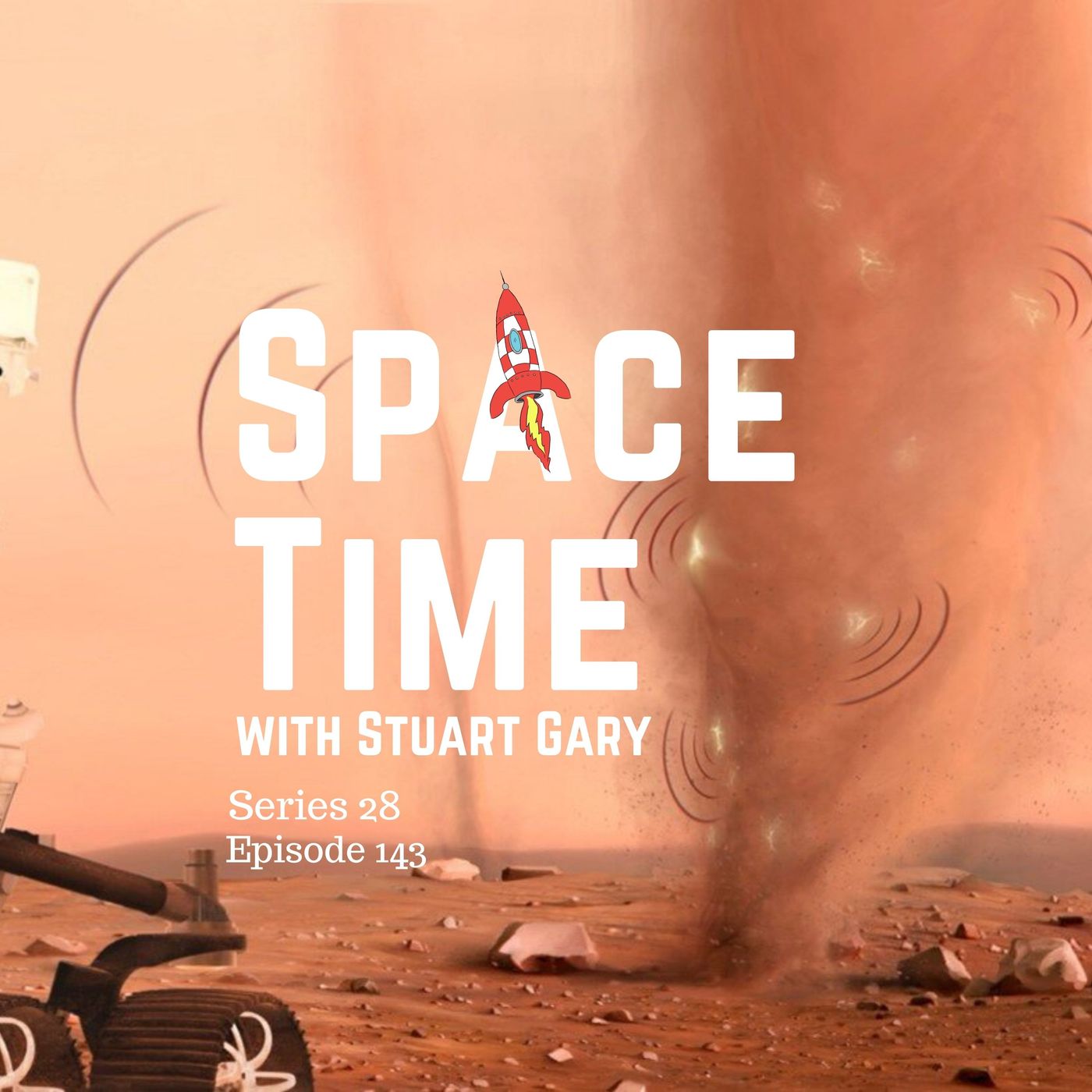
NASA's Perseverance Rover has made a remarkable find by detecting lightning in the Martian atmosphere for the first time. Recorded within two dust devils in Jezero Crater, the rover's Supercam microphone captured electromagnetic and acoustic signals indicative of electrical discharges. This discovery not only confirms long-held theories about Martian electrical activity but also reveals significant implications for the planet's atmospheric chemistry and potential hazards for future missions.
NASA's Observations of Interstellar Comet 3I Atlas
Following the European Space Agency's observations, NASA has released stunning images of interstellar comet 3I Atlas. As the comet passed close to Mars, NASA's MAVEN and Mars Reconnaissance Orbiter provided crucial data on its trajectory and chemical composition. These insights are helping astronomers piece together the comet's journey and origins, revealing potential clues about water in other star systems.
Moss in Space: Resilience Against the Void
A new study has shown that moss can survive the harsh conditions of space for up to 15 years. Researchers sent moss spores to the International Space Station, where they thrived despite exposure to the vacuum and extreme temperatures. This remarkable resilience could have implications for understanding life's potential to endure in extreme environments beyond Earth.
Skywatch: December Highlights
As the December solstice approaches, we take a look at the night sky's highlights, including the Geminids meteor shower and the ticking time bomb of Eta Carina. We also discuss the significance of the December solstice and the celestial events that define this time of year.
www.spacetimewithstuartgary.com
✍️ Episode References
Journal of Nature
NASA Reports
Journal of Eye Science
Become a supporter of this podcast: https://www.spreaker.com/podcast/spacetime-your-guide-to-space-astronomy--2458531/support.
(00:00:00) NASA's Mars Perseverance Rover has captured evidence of electrical discharges
(00:03:47) NASA publishes its own observations of the Interstellar Comet 3I Atlas
(00:07:26) Moss spores survive exposure to vacuum of space for up to 15 years
(00:09:40) The December solstice marks the beginning of winter in both hemispheres
(00:11:54) Axial precession causes a slow and continuous change in Earth's rotational axis
(00:15:11) Astronomers describe stars in terms of spectral types based on temperature and characteristics
(00:19:04) Two blue stars nearing end of their lives before exploding massive core collapse supernovae
(00:24:23) Just above the horizon is the constellation of Orion the Hunter
(00:34:04) Canopus talks about the effect of the Moon on stargazing
(00:37:03) The Southern Cross starts near the celestial equator and wanders far south
(00:39:06) There are two star clusters that we speak about quite often on the show
(00:41:50) The only planet that's up in the early evening is Saturn
Lightning Strikes on Mars: A Historic Discovery
NASA's Perseverance Rover has made a remarkable find by detecting lightning in the Martian atmosphere for the first time. Recorded within two dust devils in Jezero Crater, the rover's Supercam microphone captured electromagnetic and acoustic signals indicative of electrical discharges. This discovery not only confirms long-held theories about Martian electrical activity but also reveals significant implications for the planet's atmospheric chemistry and potential hazards for future missions.
NASA's Observations of Interstellar Comet 3I Atlas
Following the European Space Agency's observations, NASA has released stunning images of interstellar comet 3I Atlas. As the comet passed close to Mars, NASA's MAVEN and Mars Reconnaissance Orbiter provided crucial data on its trajectory and chemical composition. These insights are helping astronomers piece together the comet's journey and origins, revealing potential clues about water in other star systems.
Moss in Space: Resilience Against the Void
A new study has shown that moss can survive the harsh conditions of space for up to 15 years. Researchers sent moss spores to the International Space Station, where they thrived despite exposure to the vacuum and extreme temperatures. This remarkable resilience could have implications for understanding life's potential to endure in extreme environments beyond Earth.
Skywatch: December Highlights
As the December solstice approaches, we take a look at the night sky's highlights, including the Geminids meteor shower and the ticking time bomb of Eta Carina. We also discuss the significance of the December solstice and the celestial events that define this time of year.
www.spacetimewithstuartgary.com
✍️ Episode References
Journal of Nature
NASA Reports
Journal of Eye Science
Become a supporter of this podcast: https://www.spreaker.com/podcast/spacetime-your-guide-to-space-astronomy--2458531/support.
(00:00:00) NASA's Mars Perseverance Rover has captured evidence of electrical discharges
(00:03:47) NASA publishes its own observations of the Interstellar Comet 3I Atlas
(00:07:26) Moss spores survive exposure to vacuum of space for up to 15 years
(00:09:40) The December solstice marks the beginning of winter in both hemispheres
(00:11:54) Axial precession causes a slow and continuous change in Earth's rotational axis
(00:15:11) Astronomers describe stars in terms of spectral types based on temperature and characteristics
(00:19:04) Two blue stars nearing end of their lives before exploding massive core collapse supernovae
(00:24:23) Just above the horizon is the constellation of Orion the Hunter
(00:34:04) Canopus talks about the effect of the Moon on stargazing
(00:37:03) The Southern Cross starts near the celestial equator and wanders far south
(00:39:06) There are two star clusters that we speak about quite often on the show
(00:41:50) The only planet that's up in the early evening is Saturn
Get every episode summarized
Each time SpaceTime with Stuart Gary publishes, we email you a written briefing from the transcript — the topics, who appeared, and any specific claims, with the ad reads skipped.
Email me new episodesFree for 3 shows. No card needed.
Hosts & guests
No transcript yet
This episode has not been transcribed. Request it and it moves to the front of the queue.
More episodes
More from SpaceTime with Stuart Gary

Comet Births and Neptune's Secrets
SpaceTime with Stuart Gary
Sep 11, 202622:27completed

Molten Planets and Solar Storms: Unveiling Cosmic Wonders
SpaceTime with Stuart Gary
Sep 9, 202634:16completed

Dark Matter Signals and Lunar Origins: Exploring the Universe's Mysteries
SpaceTime with Stuart Gary
Sep 8, 202625:39pending

Discovering Blazars and SpaceX's New Spaceport
SpaceTime with Stuart Gary
Sep 4, 202618:54pending