Get every episode summarized
Each time Today, Explained publishes, we email you a written briefing from the transcript — the topics, who appeared, and any specific claims, with the ad reads skipped.
Email me new episodesFree for 3 shows. No card needed.
About this episode
“Support for Explanation to Me comes from Fetch Pet Insurance. Every six seconds, a pet owner in the US gets hit with a vet bill over $1,000. That's according to a study from a pet insurance company.”From the transcript
Get every episode summarized
Each time Today, Explained publishes, we email you a written briefing from the transcript — the topics, who appeared, and any specific claims, with the ad reads skipped.
Email me new episodesFree for 3 shows. No card needed.
Hosts & guests
Transcript ready
579 searchable segments. Every word is indexed and playable.
Full transcript
Today, Explained — Mass-produced fashion slop. Machine-transcribed; use the interactive transcript above to jump the player to any line.
Support for Explanation to Me comes from Fetch Pet Insurance. Are you a pet owner? Every six seconds, a pet owner in the US gets hit with a vet bill over $1,000. Always an unwelcome surprise. That's according to a study from a pet insurance company. That's where Fetch comes in. Fetch is the most complete pet insurance for dogs and cats according to ConsumerAdvocate.org. Get paid back up to 90% of vet bills at any vet in the US and Canada with claims paid back in as little as two days. Go to Fetch Pet.com-slave right now for your free quote. That's Fetch Pet.com-slave. Nourishedem-Rack is celebrating 125 years of Nordstrom with 125 of the best deals up to 65% off. All the stores and online, they're only here while supplies last. So shop today.
Great brands, great prices. That's why you rack. As a Gen Z person, I think that we grew up pretty concerned about the amount of waste that fast fashion produces. A whole heartedly reject fast fashion as much as humanly possible and try to shop in person. I had to FFF do actually want these or did Instagram just tell me I do. You've probably heard of Milrose Avenue. It's an iconic place to go shopping in LA and the other day, producer Denise Ghetto was there to check out a store called D-Tore. Let's go. The store's whole deal is that they sell secondhand clothes from influencers. Here is a viral trend right now. Butter Yellow, as we know. It's founder Megan Russell. She's filled the place with racks and racks of trendy Instagram ready clothes. But she loves a good throwback too. Hannah Montana. It's kinda crazy.
Yeah. Did anyone else wear these in middle school because they're back? Looks like a disco ball on pants. Oh, they're riding stones. Wow. How much would this retail? Let me check. We probably wrote it. Retail, $630. For sale here, $15. This is one of our more expensive items from all ranges, from Princess Polly, all the way up to luxury. So these are more expensive but you will definitely find $10 jeans in this rack. The store's brick and mortar but like a lot of fashion right now, it's shaped by the internet. The newmers follow influencers to dress like them right. So it's like why not be able to thrift their closet directly, being able to keep up with trends and also be sustainable and create a solution for influencers to just process through the sheer amount of clothing that they have because when your job is to post a new outfit every single day, you just acquire so much clothing.
Some of these girls are dropping off around 10 bags every single month full of clothes. I'm not an influencer but even I had a couple bags to purge the last time I cleaned out my closet. And I think that's something that we kind of need to grapple with as the fashion industry in general, like how quickly are these trends changing and how does that affect the environment and yeah, also how does that affect the consumer? You know, they're trying to keep up with these trends but things are just changing so rapidly. I'm John Quinhill and this week on Explanage Me From Vox, how algorithms transformed fashion and how we can be the taste makers again. I'm Emil Dahl, I'm a fashion journalist, I rate the backroom newsletter and I host the backroom podcast. Okay, I want to go back in time a little bit. Let's say it's 2007. I'm walking around the mall.
I'm looking at the store windows for the latest fashion trend, you know. I'm seeing what's that forever 21. I'm seeing what's that Charlotte Ruse. How did these stores decide what they were going to sell? I think at that time fashion really trickled down more from the runways and taste makers who were appointed, you know, the Anna Winters of Vogue. You are leading. You are not following. Or John Galliano at your... I just made dresses, I was picked out. Or Carl Lagerfeld at Chanel. The evolution cannot be stopped and will not be stopped tomorrow morning. These styles from these cult of personality designers would end up in the pages of Vogue and they would trickle down to the mall brands or the fashion brands. So taste was really coming from on high, let's say. I think we all know that scene from the Devil Wears Prada. It's seared into like everyone's brain now. It's Miranda Priestly.
What you don't know is that that sweater is not just blue, it's not turquoise, it's not lapis, it's actually serulian. Explaining how high fashion finds its way into the mainstream. And then serulian quickly showed up in the collections of eight different designers. I'm going to filter it down through the department stores and then trickle down down into some tragic casual corner where you know it out, fished it out of some clearance bin. Is that still the case today? I think you could argue that it's not the case at all anymore. When that movie was made, we didn't have the internet the way we know it today. We didn't have social media, we didn't have Instagram, which is crazy to think about. But social media has changed everything. And now what we're seeing is that mall brands, fast fashion brands, maybe there was higher end brands out there doing this too, they're looking for algorithmic inputs from the internet to figure out what people like and what will sell.
And then they're making products that way. Retailers take fewer risks, designers are asked to make what the data says people already want. The supply chain expert, I see a terrifying industrial evolution. This is not fast fashion, this is real time fashion. All the brands that you can think of, the nice brands is Zara, the four of our twenty one, the Opa Lee. Listen, she has them. She has been a juggernaut in the fast fashion space. And in fact, people call it ultra fast fashion, or I've also heard it called instant fashion. Why is it called instant fashion? Well the way it works is they use algorithms to track trends and what people are interested in. And then they make a few hundred of a very large number of different items and they test demand. And this model allowed them, this is according to the New York Times, to introduce around 4,700 new apparel styles per day.
Zara by comparison was producing around 20,000 a year. Oh my gosh, that's huge. Yeah, she and was revolutionary in pairing technology with the ability to produce things cheaply quickly in China. Can you talk a little bit about that algorithmic input a little bit? How do these companies decide what they're going to make and sell to people? That's probably like top secret information that they have or a top secret formula. But what we do know in the Wall Street Journal had a really interesting story about this brand addicted, which is sort of like a tween or teen women's clothing brand. And they're looking at according to the Wall Street Journal, what their customer is searching on the internet, what they're engaging with on social media and what celebrities like Haley Bieber wear. And their founder said that if she likes something we make more of it and we are praying they
have the Haley Bieber gene. I just got the Haley Bieber gap jeans. Let's see if they're worth the hype. If she doesn't like something it goes away. And he said they had already moved on from barrel jeans. Wow. Oh my gosh. Time to throw my pants away. Question mark, question mark. I know. It's crazy because I just started getting barrel jeans myself. Something that comes up time and time again when we talk about technology, when we talk about the internet is the inshitification. You know, things become slop. Have we seen that in fashion as well and what does that look like? I think we are seeing it in fashion. She and might tell you a top or five bucks or they used to pre-tariffs or address for 10 bucks. And these pieces are not designed to be worn for very long. You could order something from there and that she will be paper thin. I was wearing a pair of sheen shorts to the gym and guess what? The crotch split open mid workout. And they're so cheap that you just go and you replenish and you buy more. That to me I think is fashion slop.
However, I also want to acknowledge that a lot of people are not shopping at sheen because it's because they're pro slop. A lot of people are shopping at these fast fashion brands or these ultra fast fashion brands because that's what they can afford. I don't care what anyone says. I will continue shopping at sheen and team-o, especially if I can get $50 worth of outfits. I wasn't making that much money so guess what I did gang? I went where I could afford. There are just so many options. How do you make sense of it all? I find shopping to be less pleasant than ever before. Maybe precisely for that reason. I don't particularly enjoy the process of shopping online and sifting and you search something in Google and it's going to give you sponsored results or even if you search something wherever you shop. How do you know that you're getting the best thing for you? You know what I mean? I think that it's overwhelming to shop nowadays. I wonder this mass production, this kind of everything goes.
Is that promoting more personal style because kind of everything is out there or are we seeing less personal style because algorithms are kind of telling us what to wear and providing what we wear? I would say probably more. I just think it's, you know, there's so many options available for people when it comes to clothing and accessories and I think people can be really creative in a way that they probably couldn't be as creative when they didn't have as many options when, you know, I'm a millennial too and we were teens or tweens and we were going to the mall and that was kind of our set of options was what was available to us in the mall. Now there's just so many more options. In some ways I feel like fast fashion has made dressing originally harder but I actually think that on Instagram it's much easier to find smaller designers and fashion inspiration from creators who are wearing just really these brands and original combinations and making
a lot of their own stuff and so I actually feel like I'm seeing people in my life dressing more and more individually. People are really savvy about fashion now. They know, you know, in more detail how their clothes are made. They know about different designers and, you know, different vintage trends and different vintage looks that were significant in their day. So I think that the internet has really opened up kind of a world of possibilities for creative expression I guess when it comes to getting dressed. That particular brand of fashion savvy may feel new but it's actually a return to our old ways. That's next. Support for Explanation to Me comes from Fetch Pet Insurance.
After something that might surprise you, every six seconds a pet owner in the US gets hit with a vet bill over a thousand dollars. That's according to a study from a pet insurance company. Be prepared with Fetch Pet Insurance. Fetch is the most complete coverage for dogs and cats according to consumeradvocate.org. Fetch covers accidents, illnesses, diagnostics and more. Every vet in the US and Canada is in network. You can build a plan that fits your budget and, once approved, claims are paid back in as little as two days. To learn more, go to Fetch Pet.com-save. That's Fetch Pet.com-save. Support for Explanation comes from Framer if you want to create a website that looks great, feels handcrafted and comes together fast and seamlessly. Framer would like to recommend Framer. It's a complete website platform not just to build, so teams can launch and keep improving their sites in one place. It helps creators, teams and businesses ship production-ready sites faster than ever,
while getting every detail right. You're able to prompt, inspect, edit and publish in one place at a whole new pace. On Framer, agents and humans work in tandem, agents bring speed and scale while people bring taste, judgment and control. All of it takes place in the same workspace where the real site is designed, managed, reviewed and published. Those ideas land on the canvas, stay editable and can be published when the team is ready. Framer is an enterprise-level solution. Thousands of businesses from early-stage startups to Fortune 500s are choosing to build their websites in Framer, where changes take minutes instead of days. Learn how you can get more out of your site from a Framer specialist or let's get started building for free today at Framer.com-slave-explained for 30% off a Framer Pro Annual Plan that's Framer.com-slave-explained rules and restrictions may apply. I'm JQ. This is explained it to me. My name is Avery Treffelman and I make a podcast about fashion called Articles of Interest.
Avery knows all about the history of why we wear what we wear and how it got made. Our clothes are mostly mass-produced now but that was not the case in the 19th century. For the most part, you are buying cloth. You go and you buy pieces of cloth at a market and then you bring them to a tailor or you sew them yourself and that's how you get clothes. Initially there were no women's clothes ready made. This is part of where it became this very feminized activity to read the fashion plates and keep up with fashion because you had to sew your own stuff. You'd be like, what's everybody wearing, what's going on? What's a fashion plate? It's like a early pressing of like, here's what the styles are usually from France. But yeah, it's this idea of like, they're not ready made clothes for you. You got to figure it out yourself. You got to figure out what everybody else is doing and either instruct your seamstress or make it or later on in the 20th century buy a pattern, go to pairs.
Some people like to trace this all the way back to the court of Louis XIV in France and how he dictated consistent changes of the seasons, of fashion seasons, in order to support the French silk industry and he would intentionally change the colors and change the patterns so he could tell who was buying and who was supporting the silk makers in Leone and who wasn't. It was a very shrewd move. One to support domestic industry. Two, it was considered a bit of a strategic move to maintain his court because he was like, if everyone's so worried about how they're dressing, no one's going to come for my throne. And it was like a ultimate form of distraction. So that's the very, very root of it. That's a very root of like why France is fashion capital and why there are these consistent season changes is because the government of France has long invested in their fashion industry. That is why I use the changing of the seasons intentionally.
It really wasn't until I would say mid 1800s that it becomes a bit more widespread practice that you buy clothes that have already been made. Okay, so at this point Paris was very much the center of the universe for fashion and you know, it's still kind of is did ready made clothes change that at all? This is a very American phenomenon because it was this idea that in this ostensibly democratic experiment, we're all supposed to we all mean like white men are all supposed to dress equally. It's like this amazing new opportunity where you know, back in Europe, the Kingsward jewels and the Beggars War rags, but not this new democratic experiment. The statesman is going to dress the same as the merchant is going to dress the same as and this was a source of real moral panic, like maybe even the common criminal.
Like anyone could kind of wear a suit and you didn't really know who is who or what their background is. It created a lot of anxiety, but it was also this idea of a fresh start. And when you think about it, this sort of invents the practice of shopping. And it should be clear that like you were probably only doing this if you were a white man, which explains a lot. Shopping used to used to be considered a very masculine activity because they're like, I don't have time to sew. I don't have time to go to the tailor. I'm thinking about important things. I'm buying my clothes ready made. Where were they going to buy those ready made clothes? Brooks Brothers is always the company that I go back to. They didn't invent ready made clothes, but they were really on the vanguard of it and they're still around, which is incredible. And an initially ready made clothes were considered sort of lower class. And then they opened a store in Midtown and they happened very slowly that,
okay, then it was upper class men. Then they started making eventually. They started making clothes for women. This idea of mass-produced clothing as reputable fashion. That's something that can compete with a couture house in Europe. That's been growing extremely slowly over time. That growth sped up around the time a lot of American innovation did. World War II. France was occupied by the Nazis and Avery says that, along with the Boomin labor here at home, give the US what it needed to make its own work on clothing. The ready to wear fashion industry is very American. Like, we made that. And a big part of why is because we had a lot of labor. We had a lot of immigrants. We had a lot of like women working at home who were very easily exploited. And we lost. Not entirely, there still are some garments made in America, but by and large, we lost our manufacturing capacity somewhat intentionally
during the Cold War as a way to fight communism. And then later in the 1970s, we were encouraged to support the foreign markets in China and to prop them up to support capitalism. A factory is just a bunch of sewing machines on poorly paid workers. It's very easy to set up. And Avery says that kind of production led to the fast fashion empires we have now. It's very hard to just buy good quality clothes at a decent price. A lot of these manufacturers, especially abroad, have minimums. Like, they need to, you know, they're like, if you want us to make this shirt, you have to order 100,000 of this shirt. Like huge numbers. And so it's more expensive for smaller brands to make smaller quantities, which is why these like smaller brands end up being so expensive. And so now I think a lot of people looking to buy clothes are left with the choice of like, do I want cheap slop
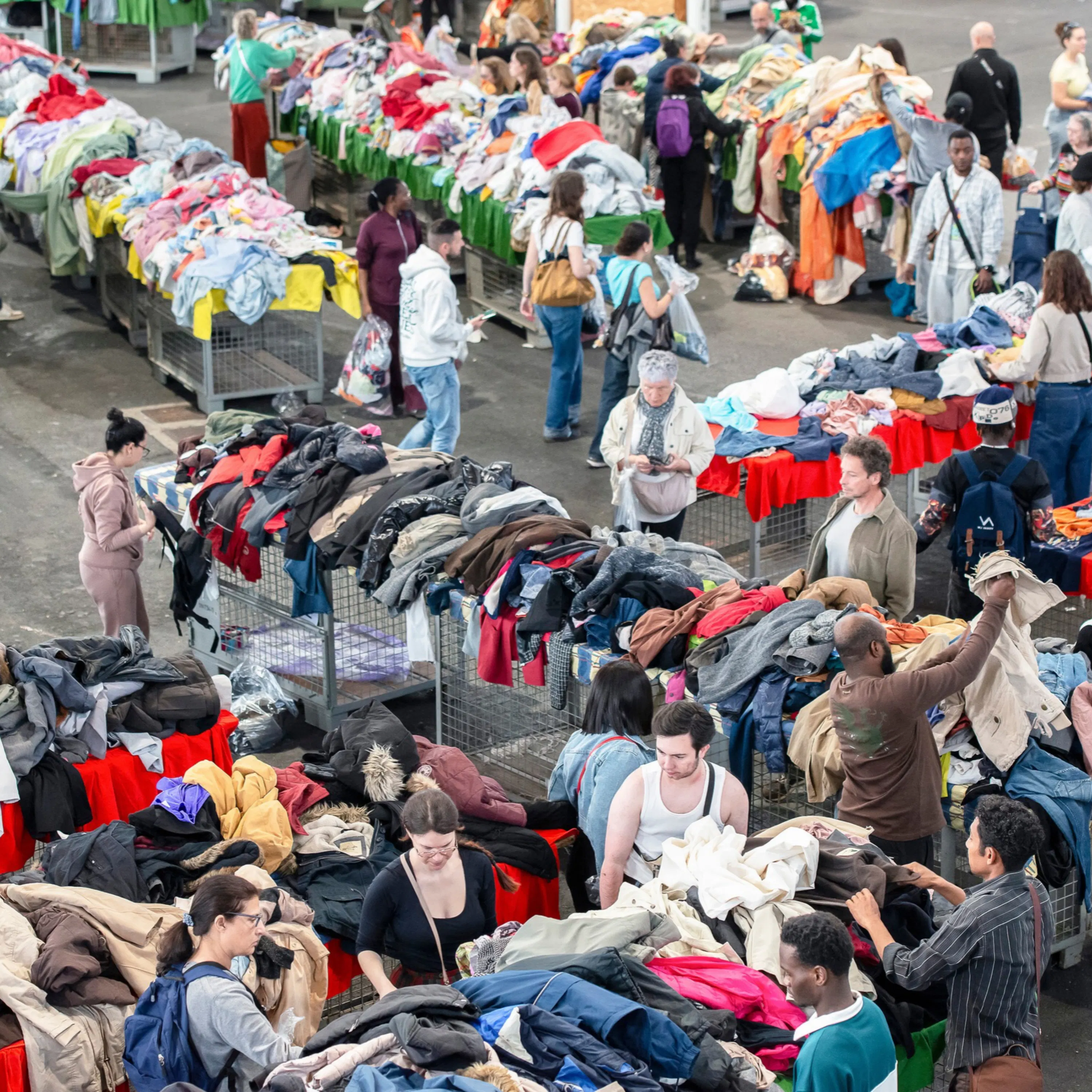
or very expensive, nice clothes. It's very hard to find something in the middle. Sometimes I'll just walk down the street and in a crowded thoroughfare and be like, look at all these clothing stores. They're packed. Racks and racks and racks and racks and racks are closed. I'm like, who's going to buy them all? Where are they all going? And it is really all to feed our voracious desire for novelty and variety. But it's hard because I don't want to just blame the consumer. I don't want to be like, it's our fault. We have to stop shopping. It's just the way that these systems have developed that making mass quantities of already made clothes in any color, any size, any fit you can imagine on like many floors of many buildings. It's the nature of capitalism. It's just supposed to grow and grow and grow and grow and grow.
One place those mass produced clothes end up on the racks of your local resell shop. That's coming up. Supported takes when comes from Tokaetry. When you're struggling with your mental health, the last thing you want to deal with is a complicated search to find the help you need. Tokaetry makes it easy to see a licensed psychiatrist online who takes your insurance in just a few days. Tokaetry is a 100% online Tokaetry practice that provides comprehensive evaluations, diagnosis, season ongoing medication management for conditions such as ADHD, anxiety, depression, bipolar OCD, PTSD, insomnia, so much more. You get to meet with a medical provider who can diagnose mental health conditions and prescribe your medication when it's needed and because it's 100% online, you have a lot more flexibility. Unlike therapy, only platforms Tokaetry is psychiatry. You're seeing a medical provider who can diagnose a mental health conditions and prescribe medication when it's appropriate.
All 800 plus clinicians are in network with major insurers, so you can maybe use your existing insurance instead of paying monthly subscriptions or out of network costs. You can head to Tokaetry.com slash explained to complete. The short assessment and get matched with an in network psychiatrist in just a few minutes. That's T-A-L-K-I-A-T-R-Y. Dotcom slash explained to get matched in minutes Tokaetry.com slash explained. Nourished from rack is celebrating 125 years of Nordstrom with 125 of the best deals up to 65% off. In stores and online, we're talking incredible savings on brands you love, like Vince, Sam Edelman, Ragnbone, All Saints and More. They're only here while supplies last, so shop today. Join the Nordy Club to unlock exclusive discounts, shop new arrivals first and more, plus buy online and pick up at your favorite rack store for free. Great brands, great prices, that's why you rack. This is explaining to me, I'm JQ.
Consider the thrift store. It's the place you go for clothes when you're on a budget, or if you want to find something, you can't get anywhere else. For the last sort of, probably, 100 years actually, it has had lots of moments where it's been cool within countercultures. That's Hannah Merriott. She's a former fashion editor at The Guardian. I think it's because people within countercultures, whether it's grunge or the surrealists in the 1920s or like the Rolling Stones in the 1960s, secondhand clothing was cool kind of because of the stigma. The stigma of being poor. I really think that has changed a lot recently. I think it was a gradual shift anyway, but I think it was very accelerated by various sort of things that happened in the pandemic, including just this absolute influx of apps that had been around for a while, but got very, very popular during that time, particularly among younger Gen Z consumers, who again, were looking for that sort of individuality.
Screen time on these apps sort of rocketed. Thrifting became a bit of a sort of social currency on social media platforms, especially on TikTok. Yo, I'm literally shaking, bro. I just had my craziest thrift all of all time. The reason you can't find anything at a thrift store is because you don't know how to thrift. But yeah, it's an absolutely vast ecosystem at the moment. No one else does it like the real real thousands of new arrivals daily. She just discovered the sweet sound of earning and saving money on vintage. Sell your clothes with no selling fees on D-POP. Buy what you love with the extra cash. And all of them have slightly different business models, slightly different sort of fees that they charge and so on. And slightly different audiences that they're reaching. I think the sort of the fact that thrifting could be cool, the could find individual pieces and so on, became much more mainstream as an idea during that time. And I think the stigma has really gone away and it's almost like reversed. One of the biggest second hand shops here in the US
is still Goodwill. Goodwill has a large selection of blue jeans. Denham Shirts, Denham Jackets. You'll also find great buys on T-shirt. And when you shop, you're Goodwill retail store. You support employment and training programs for people with barriers to employment. Can you walk me through how Goodwill has adapted and changed to the second hand boom? Yeah, that's incredibly interesting as well because I think neighborhood thrift stores of that kind are the sort of stores that people on low income do rely on more. It's somewhere that people have often been going for decades to get clothes that they can afford. But a lot of shoppers feel strongly that they've gone up a lot, that you can't find bugs anymore, that the bargains get sent online to either their website or are bought by resellers who sell them for an inflated price online. I think it's quite hard to get to the bottom of exactly how true all of that is, especially because Goodwill
is run as sort of like, I think it's like 150 autonomous sort of franchises and each of them set their own prices. But what I would say is you are seeing things like the Goodwill branching Connecticut is running this sort of thrift tour where they're charging 75 bucks to go on a coach. Goodwill has some bargains. You're gonna get a deal. Sign up for the next bus trip. You'll even get a meal. And you get like early access to a Goodwill store and then you get to go to another. But it's like, you know, you used to be able to buy like 10 things in Goodwill for 75 bucks. So yeah, I, you know, I think back to college and there's this thrift store, it's no longer with us. People would go to Georgia aftrift. And a lot of folks would be like, okay, I'm in college, I have $15. I need blazers for these internships. Or you know, you always hear,
hey, go to the Goodwill and the rich neighborhoods because that's where they're dropping off their designer stuff. But this is sounding like a real barrier to the people who need the second hand market. Like what's up with that? So I think that is quite sort of coordinated by management. There's Google lens now. So you can just take a picture of a shoe. And then, you know, then people working in the store might see that it's on D-POP for 50 bucks, let's say. They put it on for 50 bucks. It could be on, I think that's one of the differences between like the Goodwill model and online. Is that online is a bit of a waiting game. I think people expect to have their products on the website for months. And they might have to reprise them three times. It's a sort of a long term kind of situation. Whereas you would expect the products in Goodwill to be priced to move because it is a physical location. And that's getting a lot of donations.
But it sounds like there has been quite a lot of pressure in certain of the branches to match the prices to the online prices. And yeah, I do think people get left up. People who are already worried about money at the moment. It's so interesting that thrifting used to be this edgy, original thing where you find bargains, you find things that other people don't have. But it's really gone mainstream. Like has it sold out? Has it gone the way of fashion trends before it? Has it gone the way of like punk rock where it's a little mainstream and people are like, it's not what it used to be? You know, I remember when I was much younger people would say, oh, you got that second hand. Oh, you know, and I just don't think anyone would ever say that now because that's kind of how we shop. But I still think it is great if you find something original that you love that no one else has.
And I still think you're more likely to find it second hand. Or actually in certain other under the radar brands, then you are in fast fashion. And I think maybe this is a bit of a reaction to sort of, there's been probably like what, 30 years of fast fashion just getting faster and faster and faster. And I think we're all feeling a bit tired to move that sort of business model so we're trying to find other ways to shop and express ourselves. That's it for this week. Before we go, we want your help with an upcoming episode. The longevity movement is almost inescapable. We're constantly being told to optimize. Now that message is moving below the bell, we want to know what messages have you seen lately about reproductive health? Are you having any troubles separating the science from the snake oil? Give us a call at 1-800-618-8545
or email askvoxatvox.com. If you enjoy listening to this podcast, consider becoming a vox member. It comes with its perks, including ad free versions of this and other vox podcasts. Check out vox.com slash members to learn more. This episode was produced by Denise Gettah. It was edited by Jenny Lotton, fact checked by Melissa Hirsch, engineered by David Tattashor, our executive producer is Miranda Kennedy, and I'm your host, John Colony Hill. Thank you so much for listening. I'll talk to you soon. Bye. Bye. Bye. Bye. Bye. Bye. Bye. Bye. Bye. Bye. Bye. Brussels clean up nicely at Sweet Green. Maple glazed, roasted, and edges perfectly caramelized. Sweet Green's fall harvest is back on the menu, and the season's most overlooked little green vegetable is dressed to be devoured. You know what to do.
Order on the Sweet Green app. Fall savings are happening now at the Home Depot. Save up to $500 on select appliances. Plus, enjoy free delivery when you spend $998 or more. From prepping to cooking to cleaning up, Frigidaire has you covered. The custom flex temp drawer switches from fridge to freezer. With more than 15 cooking modes, including Stonebeck Pizza Mode, you can enjoy restaurant quality pizza in as little as two minutes. Then clean up with the Frigidaire dishwasher featuring the industry's fastest normal wash cycle. Shop fall savings now at the Home Depot. Off the belt, you'll have to wait for us to leave some space for online for details.
More episodes


