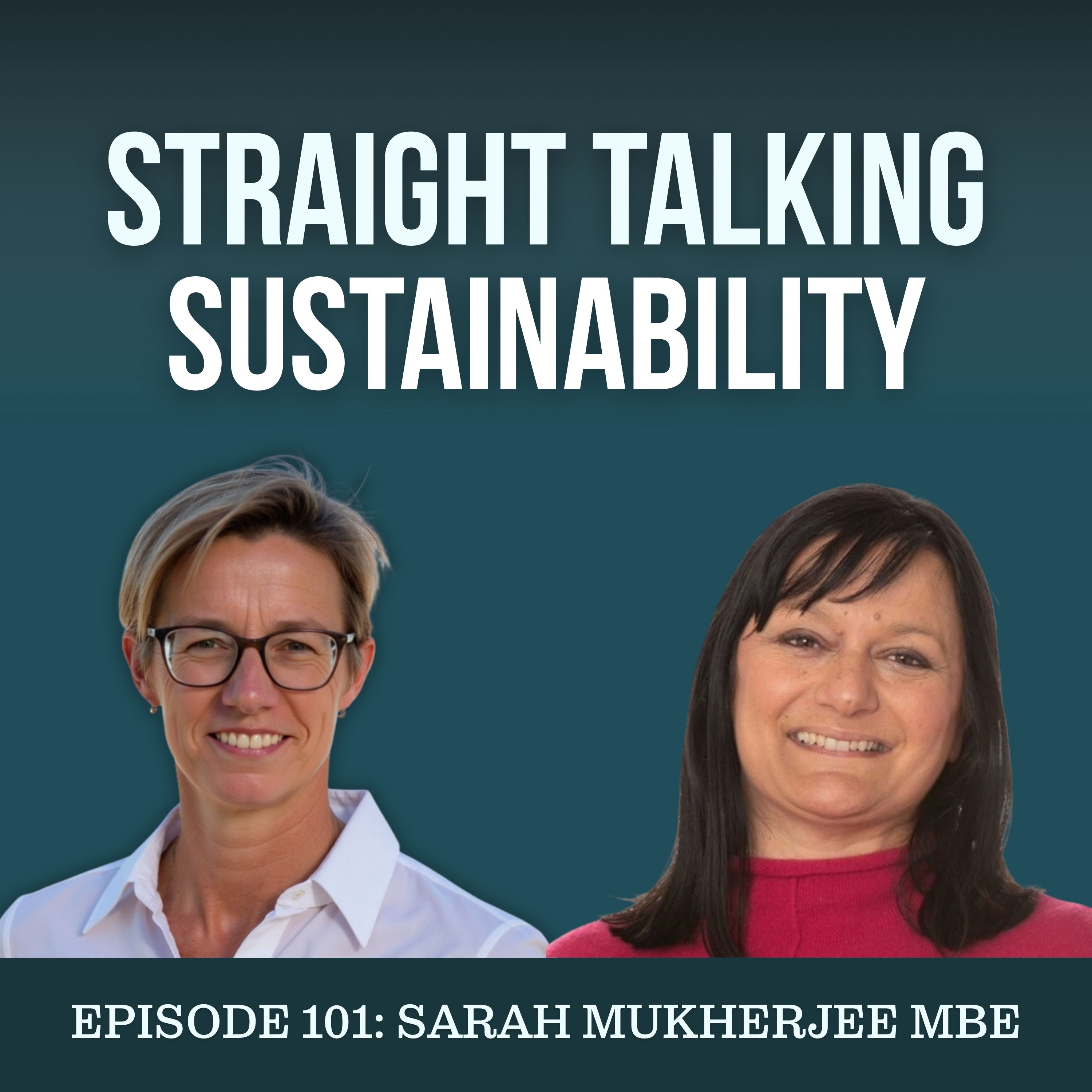
'Plan for 2... Stress test for 4' with Sarah Mukherjee CEO of ISEP
Get every episode summarized
Each time Straight Talking Sustainability publishes, we email you a written briefing from the transcript — the topics, who appeared, and any specific claims, with the ad reads skipped.
Email me new episodesFree for 3 shows. No card needed.
About this episode
“Every week I'm going to answer your questions and help you navigate the choppy waters of sustainability in your business and try to cut through the noise and focus and choose the actions that really stick for lasting impact.”From the transcript
Emma Burlow talks with Sarah Mukherjee, CEO of the Institute of Sustainability and Environmental Professionals, about the pressures facing sustainability professionals, the business case for climate resilience, AI, public engagement, optimism, and why failure is part of progress.
In this episode
- Why professional standards matter in sustainability, and how ISEP evolved from IEMA 01:10
- How ISEP supports more than 21,000 members across over 120 countries 05:43
- What the latest State of the Profession report reveals about political headwinds, resilience, and funding 08:29
- Why businesses are reframing sustainability as resilience, risk management, and business continuity 08:40
- The insurance and finance implications of weak climate adaptation plans 11:19
- Sarah Mukherjee’s advice: “Plan for 2, stress test for 4” degrees of warming 14:16
- How sustainability professionals can bring climate risk into boardroom conversations 16:53
- Why blaming and shaming people over flying can alienate the audiences sustainability needs to reach 19:40
- Focusing on material emissions and savings instead of treating every intervention as equal 25:51
- The opportunities and risks of AI for sustainability professionals 29:18
- Why AI-generated work still requires professional judgement, accountability, and human oversight 30:33
- The case for optimism, even when progress feels slower than the challenge 35:34
- Why sustainability professionals need permission to experiment, fail, learn, and try again 41:38
Key quotes
“Plan for 2, stress test for 4.”
Sarah Mukherjee explains how organisations can test whether their business models remain viable under more severe climate conditions 14:16.
“If you save carbon, if you save inputs, it’s going to save money.”
Sarah Mukherjee makes the case for connecting decarbonisation with resource efficiency and business savings 26:13.
“The way of losing it is to give up.”
Sarah Mukherjee reflects on the importance of persistence in sustainability work 38:12.
“The most important thing you can do is fail and then recover.”
Sarah Mukherjee discusses resilience, career setbacks, and the role of failure in professional development 42:30.
Listen for
Emma Burlow and Sarah Mukherjee challenge narrow sustainability messaging and argue for a more practical focus on resilience, business continuity, material emissions, financial risk, and solutions that people can realistically adopt 24:25.
Sarah Mukherjee MBE | LinkedIn
ISEP - Institute of Sustainability and Environmental Professionals
State of the Profession - ISEP
Book a Power Hour with Emma
https://calendly.com/emma-lighthouse/power-hour
Connect with Emma
Get every episode summarized
Each time Straight Talking Sustainability publishes, we email you a written briefing from the transcript — the topics, who appeared, and any specific claims, with the ad reads skipped.
Email me new episodesFree for 3 shows. No card needed.
Hosts & guests
Transcript ready
465 searchable segments. Every word is indexed and playable.
Full transcript
Straight Talking Sustainability — 'Plan for 2... Stress test for 4' with Sarah Mukherjee CEO of ISEP. Machine-transcribed; use the interactive transcript above to jump the player to any line.
Hi, welcome to Straight Talking Sustainability. I'm Emma Burlow. Every week I'm going to answer your questions and help you navigate the choppy waters of sustainability in your business and try to cut through the noise and focus and choose the actions that really stick for lasting impact. We're all about sharing and making connections. So are you ready? Should we dive in? Hello and welcome to this week's episode of Straight Talking Sustainability. I have another fabulous guest with me this week. I'm so pleased to welcome Sarah Mukaji. Thank you, Sarah. Sarah is the C.E.I. of ISAP, the Institute of Sustainability and Environmental Professionals. If you don't know about ISAP and you work in sustainability, you ought to know. So Sarah, good afternoon. Thank you so much, Emma. It's a real pleasure to come and have a conversation about the things that get into the skin of sustainability professionals and what we can do to where
the solutions are as well. Yeah, so if people don't know about ISAP, why should they know? Because we are the Global Professional Institute for anyone involved in sustainability or the environment. So we set up a couple of decades ago now by founders who recognised that in those days and it's still the case in some territories in the world, you could simply print yourself a business card with sustainability expert on it and then you could start doing sustainability, whatever you decided that meant. And it just meant there was no professional rigor, there were no standards, there was no accountability either. And so ISAP has developed over the years into that professional institution if you are involved in sustainability or environmental work. Like the law society, like the institution of several engineers, we're there to help your career to get your networking with people just like you around the world to develop policy, which we do all sorts of levels, but also to make sure that if you employ someone who is
ISAP trained, you know what you're getting. And if you are ISAP trained, you have a kind of professional stamp of recognition as to your skills and competences. Wow, okay. And so those of people who are still going, no, I've never heard of it, they might have heard of IEMA. Yes, so yes, we are the artist formerly known as IEMA last year. Right. Now the pennies are all dropping. Yeah, no one is playing IEMA, yes, I know. We change our name, which, I mean to your point is, you know, it was a bold move because obviously IEMA had a lot of name recognition and brand recognition, but we had a probably about two and a half year conversation with members about whether this was the name that we wanted for the next 25 years and whether it actually really recognised all the things that our members did and the answer was for members, we need something to recognise sustainability in the title. We had three or four that we asked them to choose from,
that all came from members, it was all member generated and IEMA said the new name that was head and shoulders the most popular four members. So that's where we are now. Oh, I totally agree, because what was it, was I instituted environmental management assessment? And assessment, that you see. Yeah, so that was a 90s thing, wasn't it? I'm a 90s girl, so that was definitely of its era. Yes, and when you introduce yourself, particularly to people who, you know, the sort of people that we as sustainability professionals want to influence, that policy makers, decision makers, they go to the Institute of what now, and then you just have to say with a professionalist, you have sustainability and environmental professionals, and we began to think, why can't we just say that in the title? So it's really clear. Tell it how it is. Yeah, that's what it says on the tin. Yes, exactly. And a straight talking. I like that. I like that. Would you love it? I would love that. No, I'm definitely all about that. And you were the BBC's environment correspondent. I didn't know that before today. So yeah, when dinosaurs
room the earth, years and years get, yes, so for quite a few years, so I mean, it was, yeah, it was a great job. And it was, yeah, I think you don't realise until you leave the BBC, just how easy your access is to anybody you want to talk to, pick up the phone and we get to talk to whoever you want to, pretty much, and they will be very generous in sharing their knowledge and understanding with you. I think like with all jobs, me, you come to a kind of natural point, what do you think? Do I stay here for another five years or do I go and do something different? And if I'm honest, the demand didn't drop, but there was always a, I mean, in the time out of the BBC, there was always another restructuring departments, we've all been through this in wherever we are, departments get smaller, but the work doesn't change. And there comes to point, we think, actually, I can't do what I think I need to do, given the demands that I now have on my time to produce stuff.
So there are, hopefully hundreds, maybe tens of people listening to this saying, oh my god, that's my life. Sarah, my department's getting smaller, but my job list is getting bigger. So, so thank you, first of all, for supporting the sector. I mean, we need that, we need rigor, we need some, you know, guide, guide rails. And how many members do you have? So, over 21,000 in more than 120 countries, and we also support about 300 businesses, some tiny, tiny businesses, some huge organizations, multinational companies, with, we'll recall it, corporate partnership, in fact, it's helping them skill up their workforce to understand sustainability wherever they are, and also to do that thing about bringing companies together so they can learn from each other. Yeah, so I know, I'm a carbon literacy trainer, and I know carbon literacy in ISEP have got
now got a partnership, which is, which is really, really great. So obviously, there's a training side of it, but it's nice to hear about the collaboration and the kind of learning side of it together, because it never ceases to amaze me how sustainable it is, everyone plowing their own furrow and hoping for the best, basically. Well, it can be quite a lonely place to be, you know, often you aren't what maybe one or two, or if you're lucky three or four, maybe more than that, in a, sometimes you longer organisations, and that ability to be able to, you know, go to, and we have regions around the world, is it going to a regional network meeting, or dial into one and say, I've got this problem, has anybody else got this problem? And we had that recently, actually, with a round table with a, someone, a parliament, senior parliamentarian, and actually there was the conversation with the parliamentarian, but also the conversation that was going on between members, but oh yeah, I have that problem, can we connect and
see, share, share best practice? Yeah, exactly, and I was talking to you before we came on air about why we started the podcast, and one of those was to share, you know, because, exactly, you get to this point in your career, and you only have to have a conversation with someone and they say, oh, but oh, you've got so much knowledge, you've got so much experience, and if you think about your 21,000 members, you know, the vastness of that knowledge, so yeah, first thing is, if you feel like you're plowing your own furrow, and you know, you're not getting anywhere, reach out, reach out, because people want to help. So one of the things I wanted to talk about today, one of a couple of things actually was some of the reports that you published, and one recently it came out over summer was the State of the profession report, so most of the people that listen to this podcast work in sustainability, okay? So what did that report tell us, Sarah? What should, what the lamb bells, what the trends, any key headlines you can share? Yes, I mean, I think
to be honest, you know, you will not surprise you that there is concern about the geopolitical situation at the moment and the political headwinds, although from the conversations that we had, people are finding different ways of doing the same thing, and this is particularly the case in, as you can imagine, they're in America, so people are not talking about sustainability anymore, they're talking about resilience, they are showing that risks are increasingly around the climate, not just about climate, but about the availability of raw materials about the circular economy. I think we were being quite surprised at how, although I suppose, you know, given that our members are working in sustainability and have roles within organisation, how relatively resilient funding has been, as though that has been a little bit shorter. Yeah, really, sure. I do get the impression when I talk to
businesses and business leaders, is it, it's almost the current situation politically has forced people to kind of pick a lane. So there are either going to be in the lane, but they say, do you know this is all nonsense? We don't need to take any notice of it, or they think, do you know, this is really important, and we need to start thinking about how this is going to affect us in five or ten years time. I will be interested to see what this is for the next year's report is like, because of course we've had that really unprecedented heat, wet, dry, depending on where you are in the world, and I think that has concentrated a lot of particularly minds in the ballroom about where you're going to get your supplies from in five or ten years time, and what your business is going to look like. Yeah, or business continuity, that's exactly. That didn't use to come up that much in conversations, my background is environmental management and auditing and all those sort of compliance things.
It would maybe come up there, but it wouldn't come up in broader sustainability. And now, I'm having much more conversations, and I'm grateful for that, even in the carbon arena, about continuity, about flooding, about heat, about staff welfare, about, you know, with the NHS, about increased patient numbers, even with an RNLI I was talking to this week, you know, having to completely rethink those crisis moments, or plan for those crisis moments. Luckily, they're very good at planning for crisis, but it does strike me that many organisations are not. Well, you know, it's not work-or-arty nonsense to not want your factory to be flooded, or to ensure that you have supply chains that are resilient for the next five or ten years. And if you talk to insurers in the insurance industry, they're really, it's really interesting,
because it has always been looked at the past to predict the future, and you simply can't do that now. You can't say in the last ten years we've, we've grown out this much money, because who knows? And I was talking, in fact, to somebody quite a senior person in the insurance sector recently, and he said, we're now giving discounts on insurance for people who have got robust sustainability plans. Well, if you think about it, if you're less likely to, you know, flooding or dry food, or it is as a business risk, if you have mitigated that risk, then you're less of a risk to your insurer. And you're beginning to hear that from some people in the finance sector as well. If you haven't got an adaptation resilience plan, including climate change, then you are a credit risk. Yeah, that's an interesting one. I might take that back, so I was telling you Sarah that just before we came on, I was talking to a client of mine who is
the sustainability representative, and they are struggling to get anybody on the board to really own this. And legal, I've actually, it's typical, it's taken someone new to come in to kind of go, we don't seem to have a business content utility plan. So they've gone to her to say, well, have we got one for climate, and she's like, well, no, if we haven't even gotten for normal stuff, we definitely haven't got one for climate. But now's a good time to bundle it all in, because the warehouse flooded last summer, and we had issues with engineers and the heat wave, and all this sort of stuff. But she can't get anybody to really take the, no one wants to take on a new thing. So let's just have a little talk about that sort of that you've been doing some work on the risks that you take as a director if you don't have that in place. So how do you start to communicate that? So I mean, as you can imagine, like, and it's part of the previous, our previous discuss we're going to round down to the new geopolitics, that it's exactly as you said, it's really easy
to dump sloths and go, I don't have to do that anymore, no more DEI, I know more climate change, I'm goodness for that. And it's really difficult to get people to take stuff on. There is a set a bit of a sense of, well, I won't be here in five years time, so, you know, I'm just looking at the next, I'm looking at the next quarter and the next half, you know, that's, I like, I have a strategy for the next five years, that's what the board will require of me. But I don't have to add climate change to that if I don't want to. If I can get away with that. So the point we make is if you are deliberately, if you're deliberately doing that and not, you know, just ignoring the risks that climate change are bringing, then you maybe not discharging your fiduciary duty as a director to an organisation. So we say plan for to stress test for four, as in degrees centigrade, if you do that last exercise, the business models kind of start fraying away really, if you're just super market or if you're
a logistics firm, and it's not just the heat itself, it's what happens as a result of that heat and the changes that happen in society as well. And the multi, yeah, multi-faceted, you know, in a crisis, the stuff that starts to go wrong. I know the NHS are pretty good at this. And I know some other organisations are planning quite comprehensively. But I work mainly because the ones I'm thinking of are charities, are kind of more infrastructure type based in the commercial world to your point. The director sit around that board table and it's all about next quarter's numbers basically. Basically. Yeah, totally, next quarter's. But at some point next quarter is going to be this stuff. Yeah, that quarter is now going to be the one. And it has happened really happened, I think, for quite a few businesses this summer. Bearing in mind that the climate experts are telling us
that next year is going to be worse. Then how do you make sure you've got stuff on the shelves to sell to people? If the Danube drops so you can't get any traffic up and down it, is that going to affect you? I mean, most organisations are in some way or the other plugged into the global network now. And that's not even beginning to include the geopolitical tensions and disruptions that there are. So I suppose the question you've got to ask yourself is are your shareholders going to be reading the same papers as you and making drawing the same conditions? And why the hell didn't you think about it? Why the hell didn't you think about it? It's obvious question. And I wonder what advice would you give then or advice do you give to sustain with your professional who's saying, look, Sarah, I've been raising this alarm endlessly. No one is listening. I mean, should they bring someone external in? Can you share a report? Because I think people do feel like they're banging their head against a brick wall or something. And I think doing all of this is fair enough in some cases. I think if you have,
if it was to go on million things to do, but if you manage to get permission to do even a headline desktop exercise on that plan for two stress tests for four and get that into a board committee and be quite clear about what the risks are, then you can start that conversation. I mean, they often happen bottom up or top down. So that's why, you know, that's why Al Gore is still going around with his slide. He's got a lot of slides. They're all really good slides, but he has a lot of slides. Al Gore is still going and talking to people and engaging in business business leaders because he's got the clout to do it. People will come, you know, leaders will come and listen to him. And it hasn't changed. That premise that we are ignoring this stuff as our peril has not changed. Plan for two stress tests for four. I like that. Yeah, it's last week, last week, before last
on the podcast, I was talking about when we're living through a heatwave, you know, as humans, and the clacks and so going off in our ears, we're like, warning, warning, warning, warning, and we walk back into work and it's like tumbleweed. I know as everyone was going to be hot last week and that's it. Move on. Put the air conditioning on. And so it's this weird place that the sustainability professional sits because they're like, can no one else see this that I can see? Right? And you know, it's good that we've got communities to support each other and I would encourage people obviously to reach out because that's quite a lonely place to be when you're like, can't they see what I can see? Yeah, totally. So I guess they've talked down, but also bottom up. So some of this, some of the action that we see in businesses is being driven by shareholders, by, you know, philanthropic donors, if you're in the not-for-profit space, they will be asking some by regulation to TCT, TNFD is driving some of the action as well. I do think,
and I do think that we have not done what we could do on this as sustainability professionals. I do think that we have allowed the kind of people space, public space, to be entirely people by people of a very small demographic, very, very affluent, but who treated it almost like a luxury pursuit and the things that we have been dying on a hill on. Now I know this would be a bit unpopular with some people, but I think we should stop banging on about flying personally. I think we alienate lots of people from non-brushish communities who want to go and see their family and I've had lots of quite heated arguments with people from Caribbean or Indian heritage who say, well, why am I saving the planet? If you're saying, I can't see my family, I also think it sounds like we're just sucking the fun out of life. Oh, you can't do this, you can't do that, you can't eat meat, you can't do this. It's very pointed. It is. So what can we do?
What can you do that's better? There are a million things. Exactly. There are a million things you can do that are better and make your life immeasurably better if you're thinking about putting sustainability first. So why don't we just concentrate on those? Yeah, no, I like that. We talk a lot about meat and people where they are. I had a great term from somebody on a course of mine that again was using flights to see their family and they said, I see those as love miles. Yeah, exactly. That's really important part of my life. I was training someone this week who keeps horses and has those animals and she's like, I live in a farmhouse, it's really poorly insulated, I have a big car because I've got horses. She said, but she's a sustainability professional. She said, and everyone says to me, oh, but you've got an SUV, you've got this, you've got that. And she's like, yeah, but I'm working in a company and I'm making so many changes in this multinational, this global company. That's where my influence is. It doesn't
mean that that SUV isn't important. And she's like, I'm going to change it. I really am. But everything has got to fall into place. So her change is going to be very different to a student living in one bed flat in London, right? A very different to, no, the global head of a bank who has to fly for work or something, right? So I'm completely agree. It's like partly Antonio, Pateras, everything everywhere I want at once. But everything everywhere I want at once is different for everybody. So just to say ban staff or even, you know, consider flying once a year or something, it's just impossible for some people. Well, that's fine if you fling everywhere you want to be. And now, you know, you know, you're sitting comfortably. Yeah, you can virtue signal with your mates, they will, I'm going to go to some set this year, but because, you know, you've got your second or third over there. Congratulations. But for the rest of us,
for young people, for people who save really hard for their holiday, one or two holidays a year, and it's a week where you don't have to think about how tough life is, then why are we telling them that they're bad for doing it? Because the outcome is they just stop listening to everything, including, including all the other messages that we have. So I think finding a way of making this just kind of relevant and normal, accessible to people's lives rather than blaming and shaming them. And I have to say, you know, the press is the worst of this. It is a, you know, consequence-free decision. You just, you can shut someone down, oh, well, we don't have to listen to you because you feel on the plane. You hypocritical. And that's because we're saying, oh, you can't do this. You can't do that. It is because the spotlight, and, you know, and I, you know, I wish there was less flying course. I do. I wish there was less, you know, airports, of course, I do. But I completely agree. I often have this conversation about people at COP and everyone
says, oh, but they all flew to get there. And my point is, how do you think people fly to get to any diplomatic negotiation? Like, they don't go on a boat to go to an economic conference or whatever, whatever. This is what those people do for a living to get together globally. And what is that? 20,000 people or something at COP? They're not going to fit on a Zoom call. And they're making the biggest decisions about, you know, the biggest things. It might be useful that they're together, you know? But yeah, this kind of noise is really unhelpful. So, so that risks. So if I may just, just on that point about the COP as well, we have members in, in South Sahara, Africa who say, if you made COP on us, if you put COP on a Zoom call, we would have had even less access. And we have very little access as it is because you can't rely necessarily on the infrastructure to be working perfectly. I thought that we were going to say the more access for people who couldn't afford to go because I know Brazil was very expensive for people.
Yes. So yes, I mean, there are different ways of looking at, but certainly that's what I've heard from our members is if you do that, all you do is that nobody's going to be listening to the person on the dodgy Zoom call. And that's just process. But yeah, it is really interesting to see that viewpoint. And I think my kind of, my saying of this week has been, that's not the point. That's also me on LinkedIn. Look at out of airports in a minute, but it was about plastic water bottles being sold in airports on mass, right? And I was like, I hate doing this. But sometimes you've got to say, guys, like, we've got to focus on the important stuff. Yeah, you know, I know. So we are, I say, we, you know, as a community, we are a little bit critical of this inward, very narrow band of thinking, isn't it? That's bad. This is good. You know, and I think you're right. We're not really reaching the middle mass. But I think actually we're really netting them. And
that has allowed across the world a political narrative to start saying, they can, these, these are just over a, yeah, he co-zellets, he quizzellets, yeah, overprivileged people who don't understand the way that you and I live. And they're trying to destroy the little enjoyment that you have me have flying his 2% of global emissions fast fashion is 10%. If you wanted to make it, we started on the I got country and me. Yeah, exactly. Yeah, it's a decarbonising business. And that's not saying, well, you've got to destroy your business. Well, that's by saying, look at all the stuff you could save. Here's the stuff that actually you could use again. I've had a few conversations recently with people who were actually interested in the money that we can help them save. And that is fantastic. Yes. Yes. If you save carbon, if you save them, it's just going to save money. They usually follow. I, you know, I always say carbon follows
the money. There's a reason it's called carbon accounting, because it follows the money. So the stuff you spend a lot of money on after, after wages is usually carbon heavy. Like certainly, it's slightly different in the service sector, but if you were in manufacturing or retail or anything like that. So if you're buying product, moving supplies, any of that, that is where your carbon is. And whilst there's always stuff you can do around, you know, employee commute or whatever, it's really because it's more because it's visible, not because it's really going to move any dial. So that sort of advice, I think is really good for people because I think we sometimes think we've got to do everything. And everything's, here's the thing. Everything's equal. So getting rid of the spoons in the canteen is somehow equal to the director's not flying first class is somehow equal to, I don't know, some supply chain coming from Blanger Dersh, but they're not equal. No. And although there are some interventions that
you can make that are, I'm going to give it that bottom line, that green teams in organisations who come up with ideas and they implement them. And it's really brought people in, it's brought people into the ideas. So there's some interventions, exactly so as you said, fewer napkins in the staff canteen or stir as instead of spoons. So that can have an end in itself, but it's not a carbon end or a resource end in team building and engagement. So people feel, yeah, I can actually make a difference. And look, we're working towards becoming a leaner and more resource-sufficient organisation as that. And also, I've met people in purchasing who I've never would have met before, legal or whatever it is. So that can, they can be great, but as you said, we shouldn't necessarily say all of these interventions are exactly the same because they're not and they have different good but different outcomes. Yeah. Now next week I'm going to be talking about this, I think with that, I like the project drawdown methodology that the reports say they write out. And it's really
stark, you know, when you start to see the massive difference that solar can make. So I think solar is one and two in the world now and then things like refrigerant so that the electrification of fleet and it's almost like we want to send that round to every environment profession in the world and just say, put this 10 things on your wall and just focus on those. There may be 20, right? So because you can't do them all, but you'll notice that lots of the things that we fixate on, like flying and plastic spoons and stuff are not, you know, they're way down the list. Yeah, they're way down the list. Absolutely. How interesting. So something else that everyone's fixated on, Sarah, is AI? Yes, yes. And that's if climate change is not going to kill us and AI is, apparently 10% of people think that it is. So tell us what you're doing around AI at the moment. So we have recently, very recently published some AI principles for sustainability professionals because it's back on. Yeah, absolutely right. We have been considering this. I mean,
there's an organisation as well from our own point of view in terms of there. You know, we have hunt, we have lots and lots of data points of our members and how do we make sure we protect that if we're trying to use AI to support better outcomes or not for profits. So we want to make sure that the money we invest goes straight to member benefit. But there are, as you quite rightly, point out, lots and lots of risks. So we have a document we've produced for members that really just talk about the risks and the opportunities and what, as a sustainability and professional, principles you should think about when you're using or developing AI. So obviously the first one is is governance. You have to make sure that not only if you've got the frameworks right, but it's appropriately governed. I mean, on the whole, a lot of this is there needs to be human intervention at some point. So, don't let machines take over basically. Yes, exactly. And as a
professional, as if you remember, I said when you're using AI, we would still expect you to ensure that there is human oversight and that you are thinking, you know, in terms of our code of practice, that you're treating people fairly, you're complying effectively, you're transparent. A lot of AI models do not, or they diminish the role and society of women, of people from non-brushes background or from people from non-cultivation races, of LGBTQ people, you know, that the models are not perfect and you always have to bear that in mind. And also, just, you cannot assume it just because something comes out of AI. It is necessarily true. I mean, absolutely. I know, I know that sounds sort of like everybody knows that, but it's still not true. Oh, no, we're starting to see it really starting to trip up. And what about the usage in terms of, you know, everyone's concerned about data centers and water and energy and that sort of thing,
what kind of advice can we give people? Well, again, I mean, in terms of the impact that in terms of kind of not limiting the usage, but using it effectively in a efficiently, I suppose. Well, yes. So that's, I mean, yes, you're right, that's part of the, the, the points that are made in the guidance document, but also that, you know, members have to take a accountability for the reliability of their work. You know, no matter how much you use it, it's up to you. You can't just say, oh, well, I did it. You're the professional. You have to stand by these figures, whether in the same as you would do if you had done them yourself. So, and you do have to think about the fact that you're right that this is not an impact for you to see. Not in high-three. No, there's electricity, there's water, there's all sorts of things that are being used to make that to come to that, you know,
bit that wants to present. A goodness. Yeah, it's like anything. We forget the kind of upstream emissions of it. So I think that's really important. And when I talk to people about AI, I'm like, do your homework, find out what the impact is. You know, use it cautiously, I guess, would be, but I liked what you said about you're the professional, you know, you've got to drive it. And I think as a profession, we really, I think we really do need to, not a part game. I don't think we're doing a bad job, but I think we need to demonstrate some of this rigor because we're having a hard enough job, like you say, from people criticizing the whole premise of the same ability that I think we could, we could be better at that, you know, as an industry. Yeah, there's a, it was really, and I'm sure a lot of people know about this because I've heard of a couple of people, one thing that one in the States, and I think one here as well, where legal firms had used AI to help support and to develop a case for their client. And the AI agent they used had made
stuff up, made up cases and made up judgments. And nobody checked. I mean, that was the thing that this was not checked by a person. And it went to court. And that, you know, I'm sure any lawyers or anybody who's legally trained on sort of just a deal, my goodness. Shibberman Timbers. Yeah, and I guess the same is true carbon accounting, isn't it? It's a devil unfortunate thing in the detail. So people can get that from your website, Sarah, or how can people access that? It is full members. I think we are doing a, if you send a send us your email details, we will give you a version of it. Well, hopefully there'll be a flurry, obviously, people who need to sign up as members after, after this. But I'm just going to say that about the use of AI, again, I'm a bit too faced for things because I understand there's an impact, of course, but I, but like we said about flying earlier, I also understand that there's a big fish that we need to not ignore, like getting off fossil fuels as quickly as we can. But I'm an
optimist. And I know we wanted to talk about this, Sarah, to say, really, professionals tend to be optimists. Why is that? Is that because we're just, we go into that profession because we're optimists or do we become optimists or watch, or watch, or, watch, or feeling on that? Well, I think it sometimes feels like I don't know if you've done any, or much, I know you're a runner, I don't know if you've done much hill walking where you're, you're walking up a hill and you think, ah, there's the summit and you get there and you realise it's just a flat bit before the next summit. Oh yeah, but there's so many. And, but you, and that becomes quite onerous and boring, but you forget how far you've come. And I do think, so send good wishes, little bit like that. And we feel that we just, every time you think you're almost there, then you get there and there's another dip and then, but actually look at how far we've come. Look at the fact that we would not even have been having this conversation in this podcast. I don't know, five years ago, 10 years ago,
you know, not at all. It would have been a completely different conversation. We were trying to make the case that actually reducing carbon was a good thing, not that, relatively speaking, not that long ago. And I know, I totally get why people are saying, well, this is, you know, we're not moving faster. Absolutely, we're not moving fast enough. But one of the nuances of being in a democratic system is that we have to bring people along with us to already a point. So I do think that we've come an awfully long way. We've got an awful long way to go, but we shouldn't forget the journey that we've already made. I think that's a brilliant point, Sarah. And I think it's, it's quite anxiety-inducing if that's a term and depressing for people who come into the sector now because it's like, well, can't you see what I can see? And to a degree, for those of us who have been in a long time, but again, I look back and the beginning of my career was compliance. So
and that was the only option. That was charity, basically, or conservation type work. And then it was all about proving the business case for years and years, efficiency and energy efficiency. And there was a whole kind of lean manufacturing stuff and industrial symbiosis and all those sort of waste things. And yeah, you know, I would say in the last 10 years, things have changed so dramatically. It's, it's, yeah, it's good. You know, it's good to see. Of course, I agree with you, it's never ever going to be quick enough. But when you see how quickly technology moves now, I'm an optimist because I don't think it will take us as long as say the last industrial revolution took or coming out of the second world war, or really, those big, big things. I'm quite optimistic that we could make quite big strides in decades, not, not 50 years. Absolutely. And I can, I,
I don't want to in any way demean or diminish people, you know, younger people coming in the first or second jobs and they just think this is just madness. Oh, it's quite horrific when you're in a point, yeah, is listening. Oh, and I was that person in the 19s, definitely. Yeah, exactly. But having, having said that, I do think that the way to keep us all going, the way of losing it is to give up. That's, you know, to stop. And I, you know, I do wonder whether, and part of the reason there is so much of this kind of hostility to the idea of climate change, everything else, is because it's starting to have an impact. People don't fight back against something they didn't, don't think as well as fighting back against. And if you talk to people like in the solar industry, I was with somebody recently, very, very senior and he said, well, in solar, you know, have a job for life, a job anyway, you want pretty much. And I couldn't have said that even three
years ago. And he, he also made this point that it's getting nasty now because it's having a business. Because it's starting to bite. Same with EVs. Same with heat pumps, either heat pump engineer around. And I said to my, I cannot get a heat pump engineer for love, nor money. Yeah, because there's just so much demand, because a load of people have had heat pumps in a couple of years on them service, you know, so there's, you know, there's, there's real big opportunities for people. And he's, but he was a plumber retrained heat pump engineer, you know, and I think we get so fixated with all the teething problems and people in their ears, going, yeah, but ever, heat pumps as low as a solar, there's all of that. And it's like we forget that this is a transition. It's a lumpy, right? And it's never going to be perfect. We might still be mown in about heat pumps in 50 years time, right? But I doubt it because we tend to solve, you know, mobile phones with this big one that came out. We tend to solve those problems, right? Yeah, you remember I got, when I was into, I was barely junior reporter, I was lent the mobile
phone, which is, I mean, it's like a suitcase. It was like a suitcase. Come on, you're a shirt. And you're a shirt. And I'm sure, I'm sure. And you had, and you had about a signal arranging about four feet, you know? Yeah. So I mean, it's hard when you're young to see that, but we really have come on. And yeah, we balance that all the time with, there's a lot of crap, we ought to be a lot more worried about. But, but big on optimism, I'm big on optimism, Sarah, not least because we're not optimistic all the time by any stretch, but we need it to maintain ourselves and to keep going because you're absolutely right. And that's a really important takeaway, I think, is that if we stop, we effectively have lost. Yeah, absolutely. Yes, I mean, because those are the only options aren't there. It's carrying on or saying, do you know what you're right? We would completely wrong. You're right. We're just going to, or I'm going to, I'm exhausted. I'm going to give up. That's, you know, that's what I fear for people when I see people, they're anxious,
they're burnt out, they're whatever. And it is a thing in our sector, isn't it? And I'm like, you're the most important thing here. Right? So I do feel like we need some sort of, maybe we could talk about that. We need some sort of arm-round support network, just say, you're not on your own, be you're doing a great job. What other things do you need? You know, so yeah, but that's been so fascinating. I wanted to just wrap up with something you said to me earlier that was about failing is important as succeeding. So what, what should I take away with that? So if you look at people's CVs and you come from, so I, you know, I came from a background where I was looked at a counsellor's state in Essex for most of my formative life. My mother was on her own for a lot of my life. I had a chaotic, chaotic childhood. And do you look at these CVs you think,
well, that's impossible, isn't it? And we always have a point of even looking at that. What they don't tell you is all the times, all the background that their person had for a start, what challenges they had. And you know, that they were going to go and do, I don't know, languages at university, and they didn't get the grades, so they ended up retaking. I never saw that on a CV or a kind of, because we were on a biog because we had to be hard. In addition to be perfect. Exactly. We hide it. So I think what we don't tell people is the most important thing you can do is fail and then recover. Yeah. And if you don't fail at something, then you don't have the resilience that will take you through later life. No, and it's so true in sustainability, though, because a lot of people that say to me, but what's the return on investment, what if it doesn't work? You know, I work in circularity a lot, and a lot of circular business models don't work, right? But we wouldn't have eBay invented and all those other things had somebody not done something and failed at it.
Okay, good. That's how we learn. And if you're working innovation, they love all that. Test, fail, repeat. Oh, no, no, it's sustainability. You've got to get it right first time, otherwise you'll never get any money for that every again. And I think we have to break that, you know, because it is innovation really. It's not just exactly. And we need to silicone valley mindset. If you talk to people who are involved in that kind of ecosystem, you know, they try something, they do it for six months, they work, but Billy owe at it. If they succeed, then they sell it onto somebody else, and if they fail, then they start again. Well, they've taken a whole load of learning from it. So maybe to start something we can take from today, you know, you know, get your professional qualifications, your belt and braces. So you get the respect of your nightmare, your peers, but those, you know, boardroom members, whoever it is, but actually be prepared to try stuff and fail and actually show what you learned from it. And if you think about that across a career, I think your point was really good, Sarah, those are the things that make the make those are the
things that make you absolutely. I didn't get into to law school, which I thought was going to get into to because I wanted to be a barrister, but I ended up, I ended up attempting. I was a chambermaid, which was not worth the hardest job I've ever done. I was, oh, incredible. I was, I pulled points and bars, a healthcare assistant, and eventually I got a scholarship to do a post-graduate journalism course. Because I saw it in the paper, and in the paper, as it was in those days, I thought, oh, gosh, that looks interesting. And look at it now. I know. Yeah, exactly. Yeah. So I think that's really been fascinating. And thank you for telling us a little bit about your journey as well, because as I said to you, most everybody listens to this podcast, I think, works and sustainability, lots of them are women. So it's great to see a woman, a woman CEO, ISAP. And thanks for joining us today. If you've enjoyed this episode of Thanks, Sarah, you can contact Sarah. I'm sure through ISAP or through LinkedIn. Great takeaways. Thank you. We got
through a lot there, Sarah. We did indeed. Thanks everybody. I will see you again next week. In the meantime, do like and review and rate the show. Leave us a little comment. I'd love to hear from you. And if you've enjoyed it, share it with somebody else who you think would enjoy it too. Thanks very much. Thanks for listening to Straight Talk and Sustainability. If you found this episode useful, please share it with somebody who you think needs to hear it. And don't forget to subscribe, follow, rate, review, all that stuff really helps more people find the podcast. I'd love to connect with you on LinkedIn. Or if you want to find out more about what we do, just visit us on lighthouse-sustainability.co.uk and you can subscribe to our newsletter, the beacon. I hope you join me next week for more Straight Talking, Sustainability.
More episodes
More from Straight Talking Sustainability

How to survive a sustainability recession
Straight Talking Sustainability
What 100 Episodes Have Taught Me
Straight Talking Sustainability

Can Sex Sell Climate Change? With Jessica Riches, Adult Content Creator
Straight Talking Sustainability
Should We Be Talking About 1.8°C?
Straight Talking Sustainability