Get every episode summarized
Each time The Brian Lehrer Show publishes, we email you a written briefing from the transcript — the topics, who appeared, and any specific claims, with the ad reads skipped.
Email me new episodesFree for 3 shows. No card needed.
About this episode
“Almost here for some things on the station that are new or different. Many things change as we get older, including our finances.”From the transcript
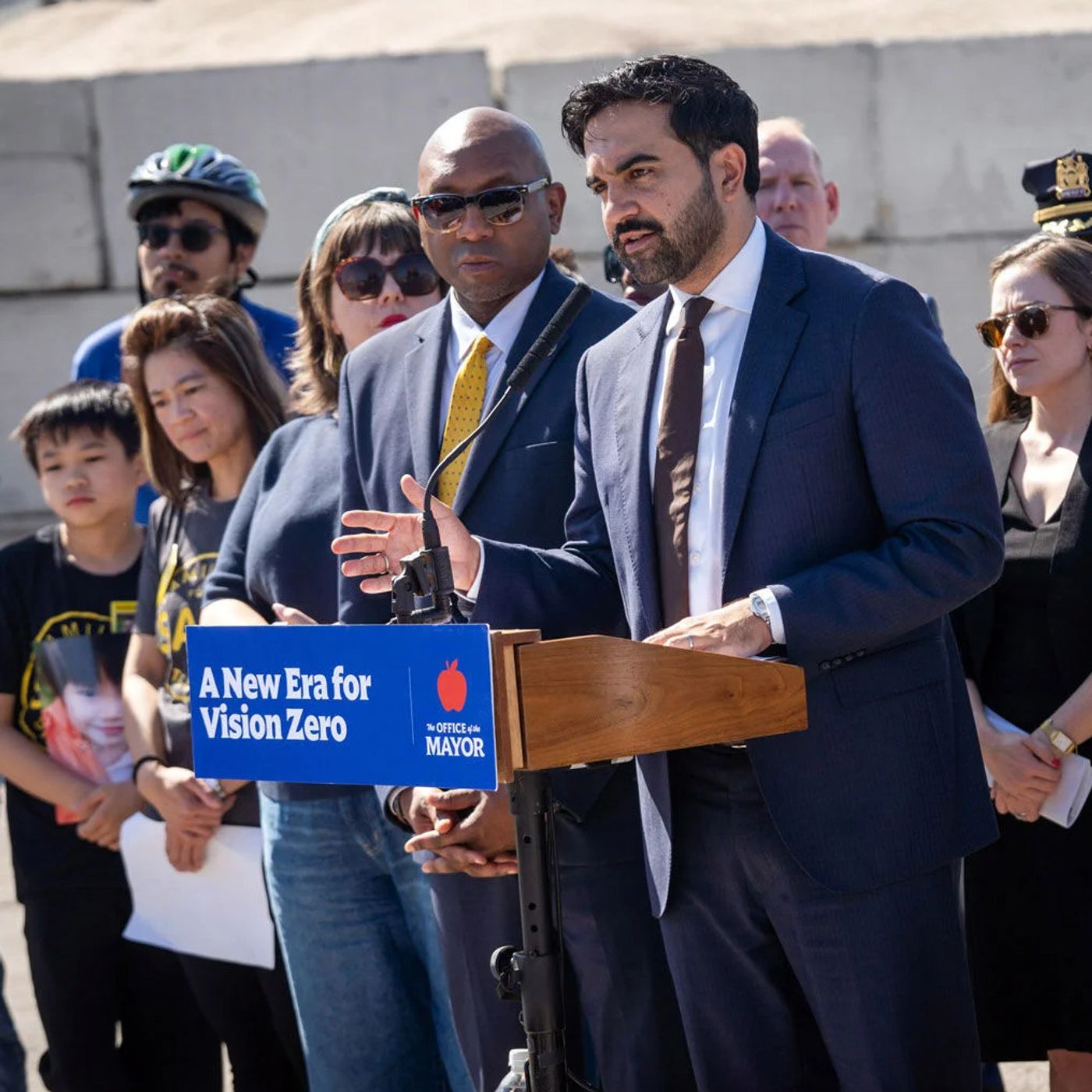
After a spate of hit-and-run deaths earlier this year, the Mamdani administration has released its new Vision Zero plan to reduce traffic fatalities. Stephen Nessen, transportation reporter for the WNYC Newsroom, reports on what's in the plan and how safety advocates are responding.
Photo: On September 15, 2026, NYC Mayor Zohran Mamdani announces new street safety measures aimed at preventing automobile accidents and pedestrian injuries. (Photo courtesy of City Hall/Office of the Mayor)
Hosted by Simplecast, an AdsWizz company. See pcm.adswizz.com for information about our collection and use of personal data for advertising.
Get every episode summarized
Each time The Brian Lehrer Show publishes, we email you a written briefing from the transcript — the topics, who appeared, and any specific claims, with the ad reads skipped.
Email me new episodesFree for 3 shows. No card needed.
Hosts & guests
Transcript ready
386 searchable segments. Every word is indexed and playable.
Full transcript
The Brian Lehrer Show — The Mamdani Administration's New Vision Zero. Machine-transcribed; use the interactive transcript above to jump the player to any line.
Almost here for some things on the station that are new or different. Many things change as we get older, including our finances. So coming up later on our new call and show, please advise, here, advice on money and aging from financial expert Amanda Holden, author of the book, How to Be a Rich Old Lady. That's on our new call and show, please advise right after Alison and all of it. That'll be at one o'clock this afternoon. And tonight, Thursday night, tonight at seven o'clock, I will be back co-hosting a three city special called Haiti on the Line about this TPS emergency for the Haitian community, along with colleagues from public radio stations in Miami and Boston, two other cities with large Haitian American populations. Two in, tonight at seven, tell your friends and family in Boston, Miami. People will be able to call in, even tell your friends and family in Haiti if we get some calls from there. It'll be great. We'll also be streaming that on YouTube.
So you'll be able to see us as well as hear us. That'll be at wnyc.org slash Haiti on the line. WNYC.org slash Haiti on the line. Please advise at one o'clock today Haiti on the line tonight at seven here on WNYC. Brian there on WNYC. Now we'll talk about the Maldonine administration's new vision zero plan. It's the first major traffic safety update of his tenure arriving after a summer of hidden run deaths that you've probably heard about. Maybe you even know people involved. And a die in, staged by advocates at city hall. The plan calls for pedestrian only districts calls for a crack down on reckless and impaired drivers. But some of that depends on Albany. And the mayor's team hasn't spelled out exactly how aware a lot of it will take shape.
Even if they get all the laws from the state legislature that they want, we'll also see if it includes anything new on MoPeds or eBikes. WNYC Transportation reporter Stephen Nesson has been covering the plan and the response to it. And he joins us now. Hey Stephen, welcome back to the show. Hey Brian, thanks for having me. And listeners, you are invited to what's your idea from making New York City street safer for pedestrian cyclists or drivers? What would you add to vision zero? And if you've been following the story of this new vision zero, reimagined by the Maldonine administration, how do you assess it? Or what questions do you have? Your friendly neighborhood transportation reporter Stephen Nesson will answer all of those to the best of his ability. 212-433-WNYC 212-433-9692 call or text. All right Stephen, what's new in Maldonine's version of vision zero? Well, one of the things that I thought was maybe most interesting was his or is his plan
for redesigning intersections. You've heard about the phrase day lighting. I assume you want to explain it? Yeah, absolutely. Basically, when you get to an intersection and you want to cross and there's a car parked right at the intersection, you start to have to look around the car to see if traffic's coming or if a cyclist is coming. And that's really dangerous. And obviously a lot of accidents happen at intersections. So one of the plans and this is not necessarily new per se because Eric Adams also, former mayor Adams had the same idea, is to fix a thousand of those intersections every year. And it became a little bit of a controversy because the DOT came out with that announcement during the Adams administration and then sort of walked it back, former DOT commissioner Edonna Sredriga has even wrote an op-ed in which he said that's a bad idea and it's actually dangerous because some cars can take a faster turn if there's not something physical at the intersection to slow them down.
So it became kind of mired in this sort of back and forth over how to fix these intersections. But ultimately, you know, Mamdani says they're committed to fixing a thousand intersections a year and they say during Adams administration that that team often just put up a sign that said, you know, no parking here and people of course would just park there. So they're committed to hardening, like putting a physical barrier to make it harder for vehicles to park there of course, like a rock or bike parking, things like that. So that's sort of one of the big things they're also committed to expanding Sammy's law, which folks might remember, empowers the city to lower the speed limit without asking permission from Albany, which is something that got past last year. But a couple years ago, it just sort of slowly been introduced into the city. So they're going to ramp that up so we could see more 15 mile per hour zones around the city as opposed to 20. On day lighting, because you just described different points of view on that, do you have
some independent transportation safety observers who come to actual sort of scientific conclusions about whether it enhances pedestrian safety or diminishes it if cars are parking close to the corner? Well, like when I said the waters were kind of muddied on this, the DOT did put out what it claimed to be a research report on this, but then that was debunked by several advocates. So I think it is messy, but I do think ultimately it is folks have found safety advocates have reported that it is safer to daylight intersections. All right. Another point from the plan, Transportation Commissioner Michael Flynn talked about designing streets so human mistakes don't turn fatal. What's an example of that? I mean, that is ultimately brine what vision zero is all about. That's sort of the definition of vision zero is to redesign the streets so that even if a driver loses control, somebody doesn't have to die because of that.
And so what that means is really physically separating cyclists from traffic or pedestrians from traffic. The city has all kinds of examples. There's the medians making them better. Those sort of crosswalks where pedestrians cross before vehicles that adds to safety on the streets, things like that. And creating, I think one of the things we're going to have to watch for is what they mean by pedestrian only zones. It sounds like they're going to create parts of the city where there is absolutely no vehicles allowed. That would obviously meet that goal. I'm waiting to back up for a minute for our listeners because we're saying vision zero like everybody knows what that is. It started in the De Blasio administration. He's the one who first introduced that term to the general public and every mayor since De Blasio has claimed the vision zero mantle. So how successful has vision zero, which obviously is a vision of zero traffic deaths?
How successful has it been at reducing traffic deaths since the Blasio launched it more than a decade ago now? Well, it depends what you define success by, right? I mean, are we at zero? Of course not. But I think the overall trend is generally in the right direction, although there's always spikes as well. You know, when these more high powered fast e-bikes hit the streets, the number of cyclists on e-mobility vehicles has increased. But you know, the number of pedestrian deaths last year was one of the lowest in years. So we see that as a positive sign. There's more bike lanes than ever before and while cyclists deaths are up slightly. And it fluctuates and we're talking about five or six deaths, which is of course terrible, but it's not hundreds of deaths. And so I think the streets are obviously safer than before vision zero when there was, you know, when there were fewer bike lanes and there was fewer emphasis on redesigning streets.
But it's not perfect. It is interesting though, you know, Hoboken, a very, very, very, very small city, very, very, very small square footage compared to New York City, but they've had no deaths since 2017. Well, they also do vision zero. So it's not, so it sounds like a crazy goal, but other global cities have hit it as well. Is the global, you know, is a global urban sort of thing. It's not just invented in New York City. Marsha and Brooklyn, you're on WNYC with a transportation reporter, Steven Nesson. Hi, Marsha. Hi, hi, Steven. Hello. Marsha, I think somewhat disappointed in the depth and width of the reporting. And it's not that I don't think you're telling us what we need to know as New Yorkers, but I witnessed the two tragic accidents. And literally it was on a corner for each of them that occurred in Park Slope when children were killed, the one on Prospect Park West near Third Street. When it's child in a bike lane with the bike lane and then the cars on the other side of it,
his ball got away from him. And he ran around the vehicle as a light changed and he was killed. And then I witnessed the woman who had been driving erratically in our neighborhood for a long time and I had even called our precinct with her license plate number. But of course, they can't respond to that as an allegation. And I witnessed her on the day she killed the two children turning onto ninth street from seventh avenue from the right hand lane. And how did I witness it? I was the car moving forward as she was doing that. So I am really in favor of more policing, specifically attuned to these types of egregious things. But I am not at all in the support of no vehicles. I am not at all in support of even the longer wait for pedestrians.
I'm not that I mind them. I earn a living using my vehicle. I've added time to my scheduling just to accommodate these regulations. It's made it difficult. I'm a senior citizen with cancer. I visit my doctors in the city. I also have issues with congestion pricing because of that. So I think that the reasonableness of these types of plans really have to be better thought out as to how they affect all of us. And my last comment is the other day coming down for street and park slope, I had to lie to people with their faces on their phone, crossed into the incoming traffic as I was proceeding forward. I slammed on my break, lowered my window and said to them, what the F are you doing? And they didn't care. And two other citizens of park slope decided to stay to meet.
They have the right away. I said, I had the life. They don't. Why are you empowering this type of bad pedestrian behavior? So when I hear you reporting on how that's going to be handled, I'll rethink my opposition to this plan. That's it. Marsha, thank you for your call. Let me follow up on one of the things that you said. And I can't imagine the trauma of being involved as a witness to those two child traffic deaths. I can't even imagine it. But when you as a driver are reluctant to back the head starts for pedestrians, you know, the last time we did a street safety segment on the show, I talked about an intersection right near where I live, where there was a traffic death recently. It's an intersection I cross frequently. And I always felt like I had to scurry across that because the light, you know, for the walk sign wasn't there very long.
And cars were making a lot of left turns there in the particular case. And after the death, they quickly changed it to where pedestrians do have a head start at that intersection. I for will for one feel much safer as I cross there frequently now. Why object to that? I don't object to a head start because brilliant. I also have dogs and I walk them all the time. And I'm very cautious and very worried about the quick left and right hand turns. So I appreciate the head starts. I don't know of 90 seconds is the right amount of time. And when people don't stop for people with walkers and canes, I will be the car that stops them and all the hunting behind me can go on for as long as it wants. Right. So it's about the length of the length of time and how much is necessary. Marsha, thank you very much for your call. Well, I guess if nothing else, Stephen,
Marsha's call is is an example of the complexity of these issues with all kinds of interests. And maybe she represents multiple ones of them just in her own experience. Definitely, definitely. And just to her point about enforcement, that is a big part of the mom Donnie plan, which is also a big question as well. You know, the NYPD is responsible for a lot of enforcement, but it doesn't always necessarily happen. And a lot of cycling advocates are the first to point out that police are the ones that frequently park illegally blocking bike lanes, making streets unsafe or, you know, placard abuse. These all sort of feed into, you know, keeping the streets clear and safe. But, you know, it is a big part of mom Donnie's vision zero plan to get dangerous cars off the streets, make sure that vehicles are registered, expanding the use of automated enforcement, cracking down on license plate fraud, you know, the ghost plates. And so they are relying on the NYPD to be partners in this.
And, you know, it's not clear how reliable that's going to be given the past performance. But, you know, anything can happen. And there's also, you know, a focus on illegal e-bikes. We've also seen a couple of dangerous crashes. So, you know, sometimes that focus turns toward, you know, getting those dangerous vehicles off the street, which is also controversial, controversial because, you know, vehicles kill far more people than scooters. Or e-bikes. So, like Marsha, you know, it is complex. Here's an enforcement text that just came in from Jason from Staten Island, kind of to some of the points you were just making. Listen to rights. My suggestion is enforcement. Every day I watch NYPD traffic cops and other officers turn their heads when they see blatant violations. There is a bizarre disconnect between the mayor's rhetoric and the behavior of the police department he supposedly controls. And I think you were just suggesting, Stephen. Tell me if I heard you right, that the mayor may have some difficulty in getting NYPD buy in,
even though he's their boss. Yep, you said it. You know, they are in charge of ticketing and enforcement and like the color we're saying, you know, if they're not even following the rules. And also, you know, they're just off on bigger other cases. And if that's not a priority, it's not a priority. But we do know that, you know, a very small number of drivers are responsible for, you know, the majority of the traffic deaths and they have well-documented histories of speeding and running red lights. So part of, you know, part of the Vision Zero plan is to sort of lobby state lawmakers to make it harder for those people to keep their license after having a certain number of penalties. And also, New York City's first super speeder program is going to go into effect soon where, you know, that was a bill that passed in Albany recently and will put a limiter on vehicles that are, you know, reach a certain threshold of running red lights or speed cameras. Right. I think you've been on with me before when I mocked that law for requiring 16 red light
camera violations before that speed limiting device gets imposed. Like why isn't it three 16? That's a reason they got to get the bill passed, right? They got to get the bill. Oh, yeah, I guess they needed enough buy in from enough legislators. Andres and Queens and Uber driver, you're on WNYC. Hi, Andres. Hi. Thank you for taking my call. From my point of view, I am agree with the Vision Zero program. I feel like we're already safer for the public. It's the worst. But as an Uber driver, I feel like all these streets are taking like bike lanes. And maybe for a small city, that may sense, but for a city like New York, you need some streets to be able for big trucks for taxis for all kind of vehicles. And so I feel like the city, it's like getting like a small and a small in the size of the streets.
But it's not thinking about you, you will need drivers and you will need a space for vehicles. Andres, thank you very much. I think a lot of drivers heads would be nodding in agreement, Steven. You've heard it before, right? Sure. And the plan does call for expanding the use of these drop off zones and commercial unloading zones. You may have seen it on your own block as well. The city is putting in more of these places for people to, you know, unload taxi passengers as well as all the Amazon and delivery trucks. So they are going to continue to expand the use of those unloading zones. I would say just as a pedestrian encyclist in the city, I don't, first of all, a lot of those zones just get filled up with cars that park illegally there. So that needs to get cleared out. But also taxis don't even necessarily take advantage of them. They'll still just drop off their passengers in the middle of the road or, you know, stop in the middle of the road to pick up people. So I think it requires everyone to participate in the program.
And the caller brings up confusion for drivers and probably cyclists alike, where sometimes it's not clear what's a bike lane and what's not a bike lane. I'll give you an example. I was recently walking on Maschilo Avenue in the Bronx, where I was considering taking a bike ride bike ride. And I noticed that it was that stretch of it was one lane in each direction. And it was both, you know, for cars, obviously, but also it was a designated bike lane. And there was a sign that says cars and bicyclists share the road. And I asked myself, would I actually feel safe biking on that where, you know, that it's just one lane and the bikes and the drivers share it. And it's widely used to get from place to place. You know, does it, does it, would everybody know what's going on there to avoid accidents? I don't know of any history of accidents there, but there are a lot of streets like that around the city.
Right. Right. Yeah, it's tough. I guess drivers have to share, but there's definitely way more protected bike lanes than ever before in the city right now. And the, you know, the mayor is very responsive to expanding that. He's a city bike user himself. So I've definitely seen a major expansion, even some existing two way bike lanes have been expanded under Mamdani already. So I think, you know, I don't know about Maschilo Avenue, Parkway, but you should talk to the mayor next time and have him take a look at that, expand it. Maybe so. He'll be on on September 29th, by the way, listeners, marker calendars. Another aspect of his vision zero plan is pedestrian only districts. What does that mean? That's a big mystery to us too. We're very curious about where that's going to be, what that might entail. But there's, there's very scant details about that in the program, but it is a first that we've heard. And, you know, for a long time, folks have called for car free spaces throughout the city.
We have, you know, the, on the weekends, they do it, but it would be very curious to see if there's a zone in Lower Manhattan, for example, where just there are no vehicles allowed at all. But that's a new one. And it will be interesting to see where it goes. You know, a lot of the things the Mamdani administration does is they first put out an announcement that's very intriguing. And then we have to wait several months to find out what, you know, the details actually entail. And just give us a sense of what Mamdani and the city government generally can do on its own and what they need Albany for. Because that is a part of your reporting, right? That a lot of this is somehow dependent on Albany. Absolutely. So part of it is the street design. They can redesign streets without getting approval in Albany. They can put in bike lanes. They can put in more of those pickup and drop off spots that I think really create more space and use space differently on the streets. But something they can't do, for example, is pass the drug driving bill.
This is something where they're hoping prosecutors will start to charge drivers who are impaired using other drugs that maybe aren't necessarily apparent other than alcohol or marijuana. So that would call for lawmakers in Albany to pass. They also want Albany to expand the seizure of license plates from reckless drivers and to create higher penalties for repeat offenders. Those are all things they're going to be lobbying Albany for. They're also lobbying the feds and to maybe crack down or reduce the number of oversized vehicles on city streets. Certainly we've spoken about the BQE and just the wear and tear. And a lot of that is just big trucks, trucks are bigger than ever before. So there's some new vehicle technology also to make these big trucks less polluting. I think they're going to be pushing for that, but that's totally out of their hands. NYPD enforcement, something they could do. Sorry, just the last thing I was going to say, you know, you asked what can they do? You know, they can enforce traffic rules in the city like we've been speaking about.
And that's on the NYPD. I'm going to take one more call and it happens to be on a topic that you just mentioned, which is oversized vehicles and Albert in Manhattan. Here I am, WNYC. Hello. Hi, Brian. Long time list, my first time caller actually. Good job. So I'm a cyclist, both for recreation and I left to run errands on the bicycle, used to device regularly. I'm also a driver. Drive mostly for work. And the topic of day lighting kind of came to mind. There was a recent article in New York Times about how the traffic deaths have increased tremendously with proliferation of the largest UVs and pickup trucks. And there was also reporting on that I've heard on WNYC a couple of years ago about that. And from personal experience, walking through an intersection, if a regular car is parked
at the corner, I can perfectly see what's going on. And if a SUV, a large SUV, a pickup truck, a park at the corner, I cannot see anything. Also, as a cyclist, if I'm riding in the city, I love bike lanes. I love bike lanes. But there are no bike lanes everywhere. So when I'm riding in the street, behind an SUV, which is pretty often these days, I have no vision. I can see like 10 feet in front of me. Yeah, I'm going to leave it there, Albert, because I get your point. We're running at a time. And Stephen, I'm going to throw in and call us again, Albert. Thank you for the first time call. Also on the oversized vehicles, listener texts, we need manufacturers of those huge escalades, and I guess other models of that size, to install child warning lights, because they can't
see kids when they're sitting in those high seats. Albert brought up the high seat visibility question two. So what could city policy do about that? Those cars are legal. They are legal. They don't think they're going to get into the nitty gritty of banning SUVs, because it would just be too messy. But the call is right, and I think that's why they're pushing for more day lighting as a method to just clear out those intersections, so cyclist, pedestrians, and even drivers can see what's around the corner. And we leave it there for now. Obviously, more to come on this topic from WNYC Transportation Reporter, Stephen Lesson, Steve, thanks a lot. Thanks, Brian. WNYC's journalism and storytelling is heard by millions of passionate listeners, sponsors of our programming gain our listeners attention, and their respect. Learn about how your organization can support WNYC and WNYC studios at sponsorship.wnyc.org.
More episodes
More from The Brian Lehrer Show

30 Issues in 30 Days: How Elections Work
The Brian Lehrer Show

Mayor Mamdani's 'Broken Windows' Promise
The Brian Lehrer Show

Anti-MAGA Insights
The Brian Lehrer Show

A Rancher Takes on Wildfire Management
The Brian Lehrer Show