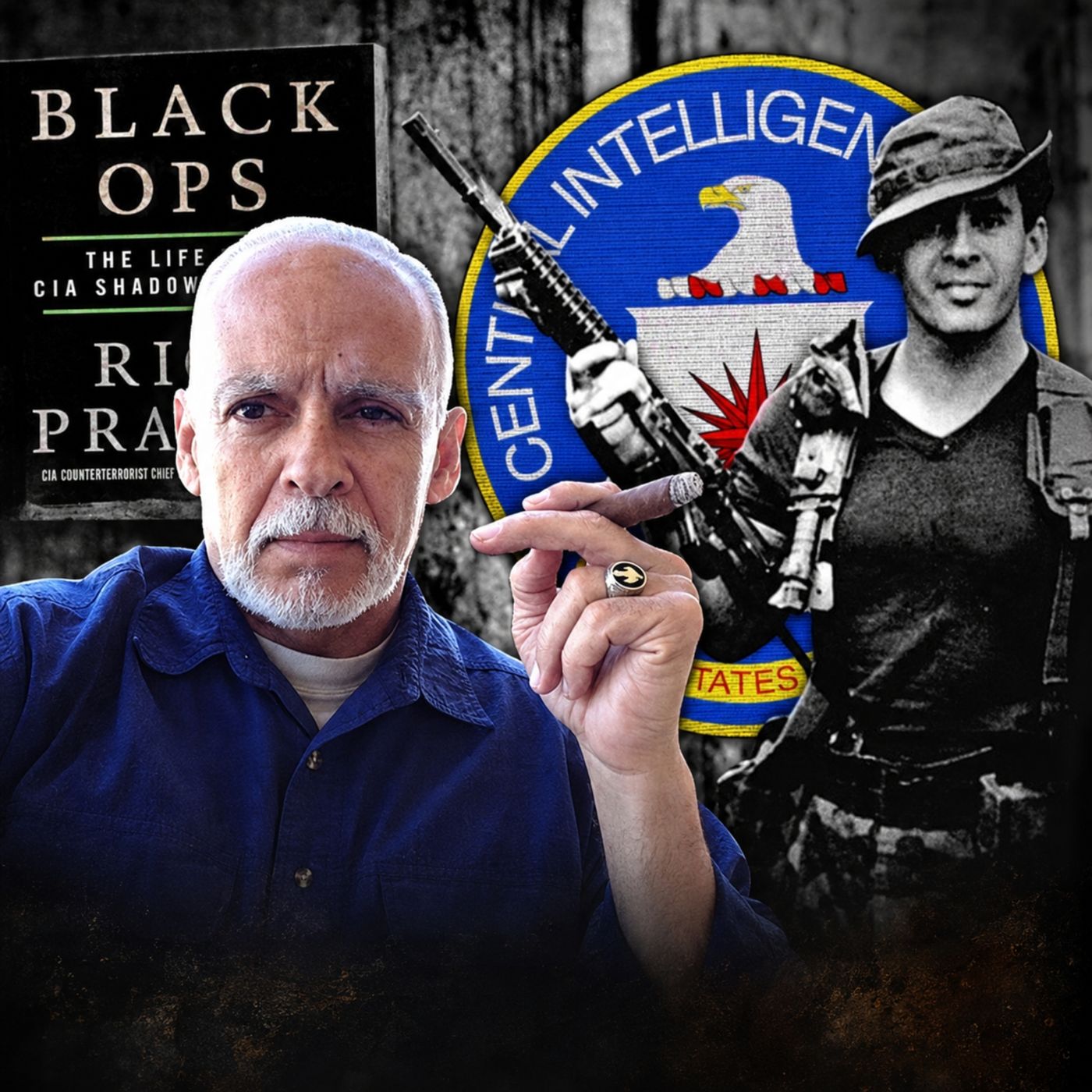
The Truth About CIA Hit Teams, Black Ops & Covert Action | Ric Prado (throwback)
Get every episode summarized
Each time The Team House publishes, we email you a written briefing from the transcript — the topics, who appeared, and any specific claims, with the ad reads skipped.
Email me new episodesFree for 3 shows. No card needed.
About this episode
“McDonald's is putting value back on the menu. Whether you're craving a Big Mac, McNuggets are sausage egg and cheese, McGrittle's, make it a meal, and save. Your favorite is now your wallet's favorite, too.”From the transcript
presented by VAER Watches
go to--> https://www.vaerwatches.com/theteamhouse
and get a free watch roll with your purchase & 20% off for activde duty, veteran, leo's & first responders.
Ric Prado is a former CIA operations officer who spent more than two decades working in some of the agency’s most demanding assignments, including counterterrorism, paramilitary operations, and overseas intelligence missions. He later chronicled his career in Black Ops: The Life of a CIA Shadow Warrior, offering a rare look at the covert side of U.S. national security.
Grab Ric's book here:
"Black Ops: The Life of a CIA Shadow Warrior"
https://www.amazon.com/Black-Ops-Life-Shadow-Warrior/dp/1250271843
Support our show here:
https://www.patreon.com/c/TheTeamHouse
00:00 – Start
01:19 – Escaping Castro’s Cuba as a Child
08:00 – Joining the Air Force & Becoming a Pararescueman
11:33 – Ric’s First Exposure to the CIA
15:00 – Undercover With the Contras in Honduras
23:16 – CIA Sabotage Missions Against the Sandinistas
26:31 – A Covert Mission Goes Wrong
35:23 – Running the Southern Front & the Iran-Contra Scandal
40:13 – Becoming a CIA Operations Officer
51:15 – Fighting Terrorists in the Philippines
57:35 – Ric Addresses the CIA Hitman Allegations
1:05:06 – The Original Bin Laden Task Force & North Korea Operations
1:18:08 – Building a CIA Intelligence Capability in Africa
1:22:17 – Inside CIA’s Counterterrorism Center on 9/11
1:31:55 – Building a New Post-9/11 Covert Operations Team
1:58:16 – Blackwater, Intelligence Operations & Life After the CIA
2:18:48 – How to Join the CIA & Advice for Future Officers
Become a supporter of this podcast: https://www.spreaker.com/podcast/the-team-house--5960890/support.
Get every episode summarized
Each time The Team House publishes, we email you a written briefing from the transcript — the topics, who appeared, and any specific claims, with the ad reads skipped.
Email me new episodesFree for 3 shows. No card needed.
Hosts & guests
Transcript ready
1,634 searchable segments. Every word is indexed and playable.
Full transcript
The Team House — The Truth About CIA Hit Teams, Black Ops & Covert Action | Ric Prado (throwback). Machine-transcribed; use the interactive transcript above to jump the player to any line.
McDonald's is putting value back on the menu. Whether you're craving a Big Mac, McNuggets are sausage egg and cheese, McGrittle's, make it a meal, and save. Your favorite is now your wallet's favorite, too. Extra-value meals are back. Get a big something extra. With a Big Mac or 10-piece McNuggets, fries and a medium Coke all for just $9. Limited time only, promotion pricing may be lower than meal pricing. Ba-da-ba-ba-ba! Meet the Red Bull Dragonberry Emergizer. It's one of the many new drinks out now. Who knew ice cold drinks could be so fire? Try them all, only at McDonald's. Hi, everyone. Welcome to the teamhouse. This is episode 145, I believe. Yes, episode 145. I'm Jack Murphy here with David Park. I'm back after my little stay in quarantine last week.
But JC and his boys didn't want me quite yet, so I'm back. And we are here. We're very happy to be here tonight with our guest, Rick Prado. He's the author of Black Ops, the life of a CIA shadow warrior. Started off kind of an interesting entry into the Central Intelligence Agency, coming from being an Air Force Parare Rescue Man. And then a paramilitary guy, and then rising to be the CTC Chief of Operations. So a very interesting career. I really enjoyed this book. And Rick, thank you so much for joining us tonight. Thank you for having me, guys. Absolutely, man. And I was wondering, you know, as we ask all of our guests about their origin story and kind of their upbringing and where they came from. And you, like several of the other guests we've had on the show, are Cuban American. And that experience and that immigration experience, I think had a really profound effect on you as a person, as a man. Could you tell us about that, about your family and how you came to America? Yeah, I'll be honored to.
I was about seven or eight years old when the revolution was peaking. I lived in a town near the mountains where Chegavata supposedly was operating in. And so at that age, I actually saw firefight trying to further my house. Literally one guy that was on the other side of the window and I was looking through the window to see what was going on. So I saw what what war does very early on. But what was really sobering for us was how quickly once Castro took over, that socialist mass came off and it was full communism, pretty, pretty much off the bat. Confiscation of properties, persecution of the opposition. I remember being barely nine years old in a half years old and being told that I had to go to the fields. And Tudor, farmers on how to read and write. And I'm eight years old.
But I was in uniform and in school, we were in uniform and they inculcated. If you hear and you parents say anything bad about the revolution, you got to turn them in. So it was a very toxic environment that even for a nine-year-old, I could understand and feel that this was so different to what I grew up with. My father, who was always a very decisive man and my first hero, he made up his mind as we're leaving. Unfortunately, he couldn't get out. My mom couldn't get out. So I was able to get out through a program called Peter Pan program. And the Peter Pan program was sponsored by the Catholic Church. So and during the two years that it ran, they brought out 14,000 plus kids, whose parents could not come out. So in early April of 62, I came to the United States by myself. 10 days later, two weeks later, I was in a orphanage in Pueblo, Colorado.
Now the Sacred Heart of Orphanage in Pueblo, Colorado. That would excel in itself was also an experience. So you know, and it's funny guys, a lot of people go, oh my god, you were so little you had to go through this so much. And I'm amazed that I was not as shook as I should have been perhaps. But I always remember more than anything else. And this is part of my impetus for things that I have done in life, is the courage of my parents to put an only child on an airplane, to a country that have never been into and may not even be able to visit. Not for economic reasons, we were middle class in Cuba, but for freedom. My dad had that innate passion for freedom, and his only child was not going to grow up in a coming to country. Yeah, that they loved you so much. They're willing to roll the dice like that with their with their boy. Yeah, when I when our oldest son was 10, I asked my wife, I think,
do you think that we would have the courage to do same? And we both agreed that you never know how you're going to react until you really do it. So it's a very tough decision. But at the same time, it was a hell of a lesson for me because that's the ultimate price that a parent can pay for the freedom of a child, right? Letting them go. Right. Did you have, you know, you were very young. Were you aware of what was going on? And you know, when they were when you were with this Catholic organization and they were bringing you to the States, did you have an overarching awareness of like what was going on? Yeah, you know, it's amazing. And I think that when you when you live a normal life, it's easier to forget the mundane stuff. But this was such a drastic change. So it's such a different period. You know, when we first moved up to Havana to try to get out of the country,
as soon as we drove in, I saw three guys hanging from trees and telephone poles, with signs around the next, I said, contour revolutionaries. So, you know, those things getting printed in your mind very, very early on. Now, it's funny because I remember clearly getting into the airport with my mom and dad, my mom crying. My dad, not too many years ago before he passed, told me that I told my mom, if you keep crying, I ain't going. And going through the glass that divided them from me, and that's the last thing I remember. I do not remember getting on the plane. I do not remember the flight to Miami. I do not remember where I sat. I only remember when I came through the doors is with my psych, you know, my memory comes back. And I saw the priest I was there with the sign from before of us that there was three other kids, two girls and two guys. So, I was very aware of it. And I think that these experiences in retrospect now were God's way of forging my metal.
So I would end up doing what I was supposed to put on the set of earth to do. And you did get reunited with your family. You grew up in Holi outside Miami, right? Yeah, my parents came out a little over eight months later. I was one of the lucky ones. There were kids whose parents never came out or came out five, six years later. So I lucked out in two reasons. One, the orphanage was a little violent because you have five different cultures in there and all orphans and all the, you know, but the treatment of the place was decent. There was no abuse that I knew of. And the main thing for me is they taught me English. That's all I did for those eight months was learn English from C-Spot Run books. And way before your time, guys. But the thing was when I went back to Miami, eight months later, I could at least help my parents catch a bus or do something like that. So it's amazing. Yeah. And then as you grew up and you know, went to a American high school and so forth,
what was that path that initially took you into the United States Air Force? Well, you know, I grew a conscience in my senior year just as I was about to graduate. It's, I guess it was a maturity chair shift. And I realized how good I have it. You know, I live in this wonderful country. I have a wonderful family, stability. Nobody's trying to take my dad's business away. And my parents are the ones who paid the price of that admission. So I developed a debt of honor. I honestly believe that I needed to show this country my gratitude for taking me and my family in and in a lot of my other family, extended family in. So the turning point actually was kind of interesting. It was my first semester in college. And the hippies put out a sign that the following day, they were going to take down the American flag in protest for Vietnam and burn it. And I said to myself, that ain't going to happen.
So I called a couple of my buddies from high school and it was about 20 hippies. There was about four or five of us, maybe six. And it wasn't a fair fight. And at the end of it, that flag was still flying. And I will tell you, I can still remember the blue sky and that flag waving and me feeling for the first time really, really good about myself. And you didn't just join the Air Force either. Like, you already must have had something in the back of your mind that you wanted to be an elite soldier. Well, you know, I've always been competitive. I started martial arts when I was 15. I had some great instructors that were former Marines and former this and that. But again, I think that God puts us where we're supposed to be. I chose Pararasku because I was taking an oceanography class. I was going to be a Marine Science Technician. And one of the guys on the class was a former PJ. And we ended up sitting together.
We ended up talking and eventually he told me all about Pararasku and I said, sign me up. So six months after not even, about four months after that incident with the hippies, I joined the Air Force Pararasku. Yeah. And what through that pipeline and got qualified and the PJs, you had some sort of formative experiences too. Well, I remember in your book, you talk about a plane crash that you responded to one time. And for the first time, really seeing kind of death on a large scale. Yeah, I had just literally just got my parade. And when the that I think it was flight L-1011 in Miami, 72 Christmas Eve or something like that, that the old terminal was screwed up and they thought they were altitude and they literally plowed into the Everglades. And we were summoned, I was doing hundreds of miles an hour to get back to base because I was at my parents' house and down at Homestead.
And yeah, I didn't get to do much because by the time I got there, the active, the duty team was already on the ground. But we did get to pull some of the bodies out and it was pretty gruesome and at the same time, some magical moments, 90 some people I believe it was that survived. So it was, again, part of that, the lessons in life that you see the fragility and the endurance of the body. And then what was your first exposure to the Central Intelligence Agency? Well, my reason for going into Paradesque was I wanted to go to Vietnam. And my number for draft was astronomical. My parents were very happy because they were confident that I would never get called and I show up and go, hey, I'm leaving in 30 days. So my goal was to go to Vietnam. And when I got out of, when I finally got my beret and the follow-on training, it was already 1973.
Vietnam was winding down. So in 74, I decided to stay in the reserves completely. I applied to the agency the first time they were not hiring. Those were really bad years for the agency in the military. Subsequently, around 79, I reapplied and this time they asked me to come in as a contract medic. I was writing rescue with Miami-Dade Fire Rescue. And, again, being a pararaskian, I was already an EMT-2. So it was an easy day for me to get into that. And so they needed a paramilitary medic to help their Special Activities Division ground branch guys. And that was my first exposure to those guys. They got to know me. I obviously made a good impression on them. I did my best to carry my weight. And I sluck would have it in 81 when Reagan took over.
And he decided to do something about the growing communist threat in Latin America. He declared a covert action program against the Sandinistas who declared themselves communist. And the agency did not have a native speaking, a native Spanish speaking guy with paramilitary background. So they tracked me down and that was my back dooring into a staff job. And that was kind of like this moment for you where you were like, not only yes, but hell yes. Like they didn't really need to recruit you. You were already recruited. Yeah, I mean, it was a lifelong dream. And it's funny because I remember when the guy called me, he says, look, we have something for you. Do well, when do you think you could come in? I said, I only have one question. This is full time or is this part time? I wasn't going to take it anymore part time. And they said, no, this is full time. And I said, I'm there. When do you want me here? He says, you don't want to know what it's about to go? I'm there. I'll sweep the floors. I'll do whatever. Exactly.
Bring it off you to the boss. I just want to get in. Yeah. So what was that like now? You're going to get brought into the belly of the beast. You didn't have a lot of like formal training with the agency at this point either. Zero. I have my street smarts. I had my martial arts background. You're medical training. And your workforce? Yep. In my parorescu-training, which was, you know, this beyond just the techniques of stuff is, you know, learning your, your limits, which are not what you usually think and being able to do things above and beyond. So that, you know, that that steals you, you know, you, I was pretty confident going in, but I had no training. There was no time. I literally was in the headquarters area for less than two weeks before I went to Honduras. Wow. And so what was like? Inalias. As Alex, right? Yes, that's correct. Captain Alex. Originally. So what was that like hitting the grads in Honduras and some of the people you work for
in the mission that you received at that point? Well, you know, again, I've lived the blessed life. I, I landed in Honduras. There was only five of us when this program started, you know, five years later, there was probably a hundred guys on the ground there. And my boss was Colonel Ray. He was legendary. He had jumped into Corrigador at the age of 17 or 18. Special Forces guy went to, it was our guy in Laos during the Vietnam time. A bigger than life guy, both physically and everything else. And he was just a wonderful boss. And he mentored me a lot. I mean, he was always very, very good about explaining what I needed to do. But at the same time, there was no time for micromanagement. I lived in those camps by myself. For the first 14 months of that program, I was the only American allowed to set foot in the contra camps. Because again, this was a covert operation. And as the title of my book Black Ops says, it indicates,
that's when you're doing operations where the American hand has to be remained hidden. So I was there as a Honduran captain. Eventually, I got promoted to quote unquote major with the requisite pay bump, of course. Of course she had. Yeah. And I thought it was really interesting in the book too. You talk about how it was sort of like, it started off as an Argentinian program. And then America sort of jumped on there. And you had as a young PM guy had to balance America's objectives with this Argentinian force there that was really not up to snuff. Yeah. The Argentines didn't do much for the cause. But they were the ones that were helping bringing in some old, Mauser rifles and stuff like that to give the conscious. And they're the ones that reached out to the CIA, even before Reagan took over. It's just nothing was being done until Reagan took over. So they were there, but they were literally just a city presence.
I remember only one time that one of those guys went to the camps with me. And I stayed and he went back into helicopter. So they were, and these guys were not paramilitary guys. These guys were primarily a thuggy police force. And that ruled, you know, Argentina at the time. And they were not contributed. And yeah, I mean, my boss put me in charge of their finances just to really dig it into them. Because we knew that they were screwing with us. And eventually they got kicked out. And you said there's some sort of like institutionalized racism, I guess, in the sense that you had these mosquito Indians and indigenous people that you assessed could be a very effective fighting force. But these guys were like, now fuck them. Like we don't even want to deal with them because they're inadequate or whatever. Yeah, it's again, the Argentines that were there were very prejudiced. The Nicaraguan's a lot less because again, they're all Nicaraguan.
So they just happen to be, you know, although the mosquitoes do not consider themselves Nicaraguan's, they want to be an autonomous nation. But they are natural hunter trackers, fighters. The jungle for them was their terrain. And it was obvious to me from the, from the very beginning that they had the fire in their belly. But for me, my job was to be equitable with all the camps that I had. And I had a real big fight with the one general that was there. And I'd remember clearly we're sitting across from each other at the style of my or. And he said, well, you know, this is going to go here and there. And I go, it's it. Sorry, general, that is not. Third of that is going to the mosquitoes. And he started to say something. I said, sir, I'm, you know who I am speaking for. And that is the decision. That's the logistics. How is going to be split up? And he literally had a pencil in his hand and he broke it. He was so angry. They weren't much you could do about it because it was our money. And we, we weren't going to put up with that crap.
It's kind of reminiscent of like when we have the like the former Vietnam guys on in the way, like the Vietnamese treated the Montenegro's and it's really, you know, and the, you know, the other natives, you know, the indigenous around there. That's correct. Good analogy. And so in the meantime, you're going around these camps. You're trying to train these guys up, um, potentially prepare them for an offensive against the Sandinistas, um, doing some limited cross-border raids, setting in some cash, shake-site locations to maybe support that offensive. Kind of what was a, uh, that I guess the escalation you could say of kind of like trying to build up this, this capability that you've been charged with. Well, you know, for when, when the first time I went to the camps, I, I was slack-john. I mean, these, these poor guys and gals had nothing. Most of them were barefoot. They had old, mauser bolt-action rifles, a few rusty AKs, captured from the Sandinistas. No medical facility, you know, food was almost non-existent. So the first thing for us was, you know, logistics, getting the logistics in there,
to provide them with medicine and food, regular food, uh, budgets, money. Instead of subsequently starting the training. And, and because I was the only guy allowed to the camps, I did all the training for these guys from patrolling to radio communications to head space and timing on a 50-cal, to the RPG 7, which I became pretty darn good with, uh, after training. We had 10 camps and I had to train them all. So, uh, I lived in the camps for the three years that I was there, a little over three years, and Monday through Friday, I slept in a jogo hammock. Wow. And, you know, guys, not ones that I wake up in the morning and say, what am I doing here? Right. Or, geez, I wish I wasn't here. You know, I had a wonderful career. I've had a wonderful life. But that period in my life was blessed. And at first, I didn't really, you know, understand why it felt so good. Because again, I'm, you know, I'm 30 years old.
I'm still more testosterone and brains. And, um, I realized that I was now being able to pay back for what they did to my parents. Because the same monster that had consumed Nicaragua, um, the Soviet Union using Cubans as proxy and, you know, the Nicaragua and Sandinistas being proxies for the Salvadorian insurgencies. You know, I was now there helping these guys and gals cut off some of those tentacles from this monster. So it really felt good. And, you know, every night, I would talk to the different guys and different campfires. And eventually, I would always ask, you know, why are you here? And each one had a very pure reason for being there. You know, they burned down my church. They raped my daughter. It wasn't geopolitics. It wasn't Marxism versus capitalism. Um, it was the purest. I want my freedom back for me and my family.
Right. It was freedom versus tyranny. Indeed. Yeah. And over time that they did go on the offense, as I recall, reading, um, but it was difficult as a covert program to keep those kind of logistics lines fed and keep these guys supplied, right? Yeah. They, uh, we did, uh, they were starting doing some raids and ambushes and patrolling and, uh, some sniper work and that kind of stuff that I taught them. Um, but again, the, the cushions were hitting around and come back or, or, or, once they had certain little safe areas, but they were all within 10, 20 miles of the border. And that's pretty, pretty thick country out there. So we needed the border logistics and eventually that started developing, um, you know, the logistic capability of, of air drops and helicopters, so at least the camps and then buying them horses and mules and whatever it took to carry some of that stuff inside. Do you want to talk a little bit about, uh, eventually you kind of moved over to doing,
I guess you could say strategic level operations with some of these sabotage missions that you kind of coordinated with the, um, mosquitoes and some of the other, other players, some of the other contras that were in this game. I thought that was a really interesting part of your book. Yeah. The, like, like I said, I was fascinated with them. These key toes because for one thing, you know, with the regular decaragoans, there was, there was no culture shock. You know, I spoke native Spanish. I, you know, I know the customs. There's a few words that are different, but that, that, that, there was no culture shock, but with a mosquito. It was very different. This is a very different society with the different language. There's probably more mosquitoes that speak English than they speak Spanish. Um, it's, it's really a fascinating, fascinating bunch of folks. But what happened was that headquarters came in, our headquarters came in and say, hey guys, all these rates and ambushes are really good and you guys are doing a great job with the building this force up. But we need to get the stand to send the needs to his attention. We need them to understand that this is not a rag tag, a bunch of, you know, rebels just trying
to overthrow the, we need to smack them. So during one of my trips to the, to the Mosquitja, I have my hat with my scuba badge on. And one of the mosquitoes comes up to me and he goes, you a diver and I go, yeah, I'm a military diver. And he goes, well, the six of us are, are lobster divers. And these guys were hardest woodpecker lips. I mean, you know, I kept that in mind. So that's when I came up with the idea of creating a team of, we call them the barracudas of Biscito divers that could infiltrate Nicaragua and do damage. And the first place that, that we chose, on, you know, after talking to them about, you know, realities was portocabases. Portocabases is the northern most, northeast, most port for Nicaragua. And that was the belly button where Cuba, or I should say, the Soviet Union via Cuba was bringing in all the, the paramilitary, you know, ammo and equipment and fuel and everything that they needed.
So doing damage to that pier was a very high priority and it was sent a message. So the requirement back went back to headquarters. It says, look, we got Prado says he's got some divers that he can train to military standards. I took the six to watch out. And the other four were like I said, just really dedicated to the cause. And headquarters is the one that came up with the actual device for lack of a better word. Based on 80 pounds of C4 that was placed under the pier. We went out there and it was one of these beautiful missions where, which are rare in our profession, where just about everything goes right. And our guys were able to blow it up. I was with them in the water when they, when they first launched. I was there, you know, when they got back, we went back to Honduras. And two days later, for the first time in my life, I saw satellite overhead afford to put basis and that was that was pretty thrilling.
And then there was another operation where things, it was a bridge, I believe, you guys tried to take out and that one kind of went a little disastrous. But you had some balls, I think, going in to kind of pull your boys out, right? That was an interesting one. Yeah, you know, when I speak to my brother and in pararrest you, that's that's the mission that I always talk about. And I gave a talk down in the Scuba School a couple of years ago, in Key West for the combat swimmers, exactly on that because I did go in and got my guys out, but the readers digest of the story is, you know, all of the sudden our success in particular basis motivated headquarters to say we need to do the same thing against Corinto. Now Corinto is in the opposite side on the West side, North West side of the country. And it is the economic belly button. This is where all their goods that they would sell or goods that they would buy would transit. And Port Corinto is actually like an island for lack of
better words and it has a bridge that connects it to the mainland and to the main highway. So the idea that they had asked us to do was to topple the bridge. You know, for platter charges on the pylons on the same side, get them to buckle over with a weight and you know, it would take them, at least a year or more to be able to repair that. So that would have been a hell of a blow. So I asked me if my guys could do it and I said, absolutely, that's easy day. But then there was a political curveball. And I've said this many, many times, you cannot run covert operations with politics, with the optics of politics. And this was they, well, you know, the mosquitoes did it in on the east coast. We want this to be a mixed team. So the regular FDN guys can also feel like they're they're contributing that there was a little bit of jealousy about the mosquitoes scoring the very first left hook to the jaw to these guys. So what they insisted on was says, I had the
divers that the boat crew was going to be with what the mosquito calls the Spaniards, the Spanish speaking, Mika, and I told my boss, I said, boss, you know, this ain't going to fly. These guys do not trust each other. He went upstairs with it and they came back and said, no, we're doing it that way. And I sent my team in two boats, two divers each and two boat pilots each. And they made it into Corinto. When they got to Corinto, they noticed a lot more traffic than they had that we had predicted maritime. They had expected. Yeah. So, you know, the the the tensions were high and the guys were jittery. And my divers said, look, you know, we're not going to get in the water because we know that you're going to leave us here. And, you know, you're talking eight guys on two boats. Everybody's got guns and explosives. So, you know, you don't want to get into a contest and they decided to regroup and said, look, you know, well, abort and come back and do it another time. Well, unfortunately,
we had given them these very high speed boats, but they were not see worthy as far as reliability. So both boats developed engine problems coming back. The first boat conquered out and actually was able to get into the mangroves just outside of Corinto. And the second boat made it out to the Gulf of Fonseca, but still in Nicaragua waters, when the boat went kaput. And I've been up for at least 24 hours already with these guys, you know, we had secure comms. I'm following their tracks, you know, what they were doing. I knew they were coming back. And I went to my boss, Leon, who was the base chief. And I said, Leon, you know, I'm not leaving my guys behind. He says, I know that. What do you have in mind? So what I did was reverted to my parariscute training. I got by helicopter pilot, these young Honduran pilots, the early 20s. And I told them that we were going to go out to see before we did. We, I've made some field expedient stable rigs, six of them. So I could get by,
you know, my four guys and myself out if that's what it took. And what we were going to do was I jumped in, well, I was carrying water, gas, tools, spark plugs and all that kind of stuff. And two sticks of C4, because I wasn't going to let that boat, a high speed boat to the Sandinistas and the evidence, because it was, you know, obviously, you know, something that was not native to the area. So I jumped into the water in what, what, when parariscute back then, we used to call them low and slow. So it's 15 knots and 15 feet above the water. Well, my Honduran pilots as good as they were, they were not water pilots. So the 15 foot rule did not apply here. So this was a high and slow. It was at least 35 feet when I jumped out of that damn thing. And, and it's, you know, I'm used to, the shorter ride, I'm going like, oh my god, this is, but I know it was, it was a good entry. And
we were able to start the boat and the boat, it was spark plugs. It was spark plugs. They had all fouled up their, their systems where we're not up to par. We went back to base to the island that we were at and that same boat, we refitted it. And now I went out with two of our boat captains. One was a Cuban Bay of pigs, the veteran who was the senior captain. And the other one was an American from our, from a maritime branch. And we needed to go back and get our second boat because our second boat had now spent, you know, 24 hours, how do you get a mangrove out, just outside Corinto. And they were dead in the water. They could not get the boat to start. So we went out there and the seas got really rough. There were at least 12 foot seas beaten to crap out of the, out of the boat. We lost, first, I think it was our UHF. We lost first. There was an aircraft in the air supporting us. We had VHF and, and, and, uh, icon radios. And, um, the Sandinistas,
obviously because of the helicopter incident that morning and all the chatter going back and forth, they knew something was going on. So they were out there and forced. And they started popping flares, um, you know, I'm probably a mile or so away from us, but I we didn't know that. We just seen flares coming up and light trying to light up the sky. And then they started doing recomb by fire where they would take and put rain, that, uh, rounds down range stop and see if anybody returned fire. And then they could, you know, gaggle on there. So, but I had an emiss, you know, an AR 15 and a, a browning nine millimeter. So I was not exactly set for a firefight. Right. And, um, so we were out there. We were able to, uh, triangulate where the boat was actually with the help of the aircraft and the communications and, uh, we were able to triangulate where they were at. And we high-tailed it back to, uh, to the island, uh, our base, uh, but our guys do that we were getting them in the morning. I promised them that. And I mean, I was beat to
hell. Um, the, once the adrenaline wore off, right. Um, you know, I've been up for probably close to 48 hours by then, uh, two adrenaline dumps, one with the, with a jump into the water and now spending hours out there bouncing around getting chased by Sandin Easter. So, um, I was smoked. Yeah. Well, when I got back from that, but the next morning we went out in six piranha boats that went out there and got the guys back out. So, um, the, the mission was, was an abortion, uh, but the rescue, uh, was what we're supposed to do for our folks. And I'm very proud to say, got me my first battle in the agency. That, that's amazing. And so you were down there for quite a while doing ops. Um, I guess did this whole thing come to the, the covert program down there come to its conclusion with Eugene Hassenfoss, uh, parachute, out of the airplane into the jungle. You want to talk about that a little bit? Yeah. Uh, you know, the, the, the American hand, uh, became obvious after,
after the first year and a half or so. That's when they, you know, after that, uh, I was able to have some help at the camps. They brought in some, um, um, former SF Spanish speaking guys. And, uh, so we had three of them. Very good guys. Uh, and they were at different camps, but I was still going to the camps because I was the equities. I was the guy that they knew, uh, in the camps. So I still did my, my regular visit to camps a week kind of stuff. Uh, so the American hand was starting to show. And, uh, but the Hassenfoss incident was much later. I mean, I was already gone. I left in 84. Uh, I went through spy school and then lo and behold, I got sent to Costa Rica. At the last minute, I was supposed to go to Salvador. My household goods were actually in Salvador already. And we were supposed to, I was just recently married. I had a, you know, my son was a couple of months old, uh, old, uh, old, uh, son. And, uh, they asked for me by name and Costa Rica because they wanted me to run the southern front, uh, which was a, in stark contrast to the
way we ran things in, in Honduras side of the house because the Costa Ricans were actually hostile to the conscious. They were afraid that the, the Sandinistas would retaliate if they supported the, the conscious. So they were literally hunting us down. And by us, I mean, mean included. They wanted to see who was helping these guys. So now I'm running, uh, these programs tried to, you know, recruiting people to give me help. We get people out through maritime means or air, air means. And at the same time, having a job at the embassy, coat and tie. Right. So it was, uh, more of a little, the miniature French resistance kind of concept where, you know, car pickups and all this, you know, crash cars, picking them up, taking them to meetings, you know, ex-foot trading them out of the country so they could get training, bring them back in, and all that kind of stuff. So it was a very, very different, uh, you know, mission. And that's when Hassan Fuss happened. Hassan Fuss was an air drop that was not meant for the south. It was actually
meant for the North FDN guys who had ventured, uh, further south. So when his, uh, when his aircraft was shot down, I got that night, I got a call immediately from the, uh, our radio or a, uh, come center. And the Nikkadaiwan center, uh, it said, hey, boss, you need to come in. There's something huge going on. So I hop went over and, um, they told me, says, the, uh, an American plane was shot down. Well, a resupply plane was shut down. And, um, we don't know if there's any survivors, but I said, I want every single available contra to form a line and start walking in that direction. We need to get to that site, recover anything classified, and see if we have any survivors. Well, you know, the ops plan, it was always for our pilots. If, if you crash landed in the south, start walking south because you're going to run to some country somewhere. Because we'd be looking for you. Well, Hassan Fuss didn't. Hassan Fuss, even though he was a former
Marine, um, he just stayed put. He, you know, made a jungle hammock out of his, uh, parachute. It was there when the stand that Eastus came and he had all kinds of compromising stuff on him, you know, phone numbers and names and, you know, who the, you know, who the pilots were and all that kind of stuff that we're doing the resupply. And that got the ball rolling. And yeah, that was the, the beginning of what eventually became the, the Iran country scandal. Wow. Hey, Jack, what's going on? Guess who our new presenting sponsor is. Tell us about it. We've heard a lot over the last few years about whether it's possible to build things in America. Our presenting sponsor today, Vera Watches, is putting that question to the test. Vera was founded in Venice, California in 2016 with a simple goal to rebuild US watchmaking while producing watches tough enough to withstand the toughest outdoor environments. Today, Vera's the largest independent watch assembler in America, assembling watches in California, Arizona, Rhode Island, and Alabama, while also manufacturing its leather straps in Illinois and
Florida. Every Vera Watch is built for active use with a guaranteed waterproof warranty, scratch resistant, sapphire crystals, and high quality materials and components throughout. That combination has helped Vera earn more than 10,000 five star customer reviews, including thousands from people who rely on their watches every day and demanding professional environments. All of us here at the teamhouse have been wearing our Vera watches for a while now. And you can check mine out right here. This is the Meridian Diver Watch and Navy Blue. It's a very classy watch. And this is the actual rubber dive watch band if you wanted to take it in salt water. But it also comes with a normal silver band and an nylon band if you prefer that. And what kind of watch are you wearing there? I have the C4 Tactical Field Watch. It's solar power too. I'm loving it. And it's funny because I
had this laying on my coffee table the other day actually my homey came in and to watch football or whatever and he's a watch guy and he's like, oh, is that that ver one? He I'm not even making this up. Like I'm not even bullshit. I'm like, holy shit. Yeah, they're going to be presenting sponsored for the teamhouse. And they sent us all a bunch of watches. Like, I love this watch and I literally sold the watch. I sent them the link, the teamhouse link. And I'm like, yo, buy a watch from this from this link because if you do buy a watch from that link, which is Vera watches.com slash the teamhouse, you want you purchase a watch, you get a free watch roll that you could fill up with three watches. So you could travel with your watches and stuff like that. It's really cool. It's leather. Yeah. And I was so excited when he was like, oh, is that that ver watch? I see it all the time. I was like so am that he came up with that. Yeah. It's nice. I really liked the like nice big watch face. You can find them at verwatches.com slash the teamhouse. That's V A E R watches.com slash the teamhouse. And if you use our link, you'll get a free watch roll with
$59 with your purchase. Also, there does all for a 20% discount for active duty military veterans and law enforcement and first responders. So you can check that out at any time. If you are any one of those, yeah, I'm excited about the sponsor. So I really hope people go and check out there. Yeah, absolutely. Meet the Red Bull Dragonberry Emergizer. It's one of the many new drinks out now. Who knew ice cold drinks could be so fire. Try them all. Only Admitta. Oh, Rick, I do want to point out you mentioned briefly. Your time down in Honduras. I mean, you were a CIA contractor, a paramilitary contractor. And then they realized, like I said, at a certain point, they're like, we have to formalize this guy and bring him in as a CIA officer. They put you through like a crash program at Georgetown. So you could get your degree because
you need a college degree to be a CIA officer. And then you go to the farm and now you're legit. And then we kind of swing back to Costa Rica, which you had mentioned. And then you get sent down to I'm guessing a South American country targeting another Marxist group. You want to tell us a little bit about that experience? Yeah, and again, it wasn't a planned thing. The same way the Costa Rica materialized this South American country that had two major communist insurgencies there. One Soviet back Cuban back that the other one is more of a Chinese mentality, you know, they're there. And very both were very in close affiliation with the darker traffickers. And that's how they got their money and guns. So I ended up going to this this country because again, my boss has said, this was a time where terrorism was just coming up. One of my mentors, Dewey Claridge, started the counterterror center
in 1986. So this is 1988. So just two years after the center was created, the agency started seeing the writing on the wall that we are going to be switching, not switching, but adding on to our operational directives, the fact that terrorism was going to be high on the OD. And you got to understand that there's a lot of difference between dealing with and recruiting people from the diplomatic or business circuit and, you know, meeting and developing and recruiting people from a walk of life revilances away. And so that that's why I think the beginning of the paramilitary guys really coming up to to the forefront because now you had guys who had military training, that kind of backbone and where operations officers, they started calling them dual track case officers. And that's why they asked me, you said, you got native Spanish,
you've proven yourself, this place down south is a mess. They really need you. And I said, yes, sir, I'm gone. And it was a great tour. I mean, it was my first CT tour. I actually recruited a terrorist, which is well detailed in the book. Through some coercion, but nonetheless, he provided some incredible information for for about a year. Took down a couple of cells of terrorist guys that were planning attacks against the US embassy, worked together with the DEA there. They had the program Stoke app was huge. And there were times I would go out with them in their helicopters and go out and debrief people out in Yakucho and Tingle Maria and all these places that were super Indian territory. So it was a great tour. There's one operation you talk about where at some portions, you kind of disguised yourself as like a hobo out of the street and put an electronic bug in the leg of a kitchen table. I thought that was pretty cool. Yeah, we had we had some
intel that these guys there were a terrorist cell that was meeting at this lady's house. And the lady, what they didn't know, the lady was friendly with a cop that reported the fact that these guys were kicking her out of the house to have meetings. So we infiltrated a table with a bug in the in the leg of it. And you know, battery pack that would last months. But now we had observation posts and the listening posts and LP OP in a building not too far back that was pretty high. But there's a thing called a path loss test that has to be done. You have to go and check to see what frequencies work best because this is a very fragile connection. So my job was to walk in front of that house back and forth a couple of times while hitting the button that would activate different signals. And the guys up there are doing their text stuff that I don't quite understand. And so I'm walking and I did I didn't I didn't shave for two or three days.
I didn't bathe for two and I had this, you know, local garb. So I looked more like a, you know, a regular native guy there with a, you know, growth of beard and a hat and dirty clothes. And I'm walking by the house. And as soon as I'm literally in front of the house, the door opens and five of these guys come out and literally bumped into me. The five guys. And being the kind of people that were they started chewing me out and, you know, I had a browning 9mm carries 15 rounds and I'm going like, I could ruin your day. Right. Right. You know, but at the same time, I already knew from, from, you know, my experiences before that in our, in our, in our, in our business, if you draw your weapon, your missions compromise. Right. So I had to really swallow my pride and say, but, but don't you know, I, I mean, they just walk off like a, like a little cholo that was hurt and they were laughing and, you know, they were, that was soccer ball in their hand. And, but we got the path off tests and we got them. Eventually, we broke up that. So yeah, you talk a lot of fun.
You talk about your book about that, that very notion, that subject that a lot of people see the CIA, especially guys like you as like a sassans, like you're these cold, cold stone cold killers. But the reality of being a CIA officer is like, if you have to draw your gun, if you have to get into a high speed pursuit, a car chase, your mission has failed. Like you blew it. You blew it. Yeah. Absolutely. And your mission not only failed, it could most likely be compromised, which then becomes a political embarrassment to us because we are Americans, no matter how much we try to hide it. And you know, you guys hit on something that's very important to me and that's the reason why I wrote the book was because as you know, most people learn from Hollywood. And the perception that my agency, the perception that people have of my agency is a maligned organization full of backstabbing treacherous, you know, maniacal killers that over through governments without congressional approvals and,
you know, womanize and drink and everything. Nothing could be further from the truth. And that was the main impetus for me to write the book because, look guys, we're a small agency. We're, you know, we're smaller than the FBI. We're definitely not major services like Army, Navy, or Air Force. And we have 137 stars on our ball of honor. And those are 137 souls, a lot of them anonymous who gave up their lives for this country. And to be portrayed in the way that Hollywood portrays the agency is something that I cannot watch those, well, I can watch a fantasy movie. I can want to James Bond movie and enjoy it because it's fantasy. Right. It's not real. I'm still waiting for my Austin Martin, right? But, you know, seeing these guys, it's just, it's completely different way of life. Yes, you have to have some skills. Yes, you have to know how to shoot because you have to survive. You have to be able to crash and bang and pit and do all these things. But if you are
doing that, that mission is compromised. And that's where awareness really kicks in over, you know, and the story is in the Philippines where awareness saved our lives. Do you do what? Talk to us about that about actually, if you don't mind, because like you bring up a really interesting point, and the fact that you were involved in, you know, the the the contra and sand and is a thing. Like that was kind of that's probably your first exposure to how you would get represented in the media back here because a lot of the media at the time was like the CIA's building these desquads, right? The School of America's and all this stuff. But that wasn't what was going on. You weren't building these teams to go in and savage villages. No, the contrary. I mean, that was something that they were prohibitive from doing, you know, the we always told them if you have collateral damage, you're doing more harm than good to the cause.
And we, you know, we, I'm not saying that didn't happen because war is war, right? But it was, it was pretty pretty much over with oversight. Yeah, I mean, you know, the it's the Chuck Doris good guys were black kind of for mentality. The people think that we have all these teams that going to go out there and shoot things up. Now, as you know, for our special activities division, special activity center now, a ground branch, the all those guys we all come from the the soft side of our military. So that's what makes us do attract case officers. We are regular case officers that happen to have these paramilitary skills that we can go to crappier places and and one of them was the Philippines. That's why that while I was sent there. So, so they're you're saying that you were never on a hit team that was stationed France ready to get called up in any moment to eliminate a target that inside of Paris. No, we did put I did put together and propose a program
at the end of my career. And that's later in the book. But that did establish the team that was supposed to be multipurpose. But you know, the reality is the the greater majority of CIA officers never shoot in anger. Because that is, you know, we're we're a trade craft base. We need to do whereas bugging a safe house or or recruiting somebody or do it a B&E and to an embassy, whatever it is. We have to be able to not be noticed. We need to fly under the radar. So there's places where you can't even carry a weapon. Right. So yeah, the the hit team concept. I mean, you know, there's a difference between stuff that goes on in Afghanistan and Iraq, for example, and you know, you have in a couple of other places. The rest of our work is on the streets. Especially we're back to that now. After 21 years of war, the military and the US government had realized that this started
about four four four four years ago, I guess. To hey, we got to do less war fighting and more war prevention. So that's why some of the restructuring that's going back on to, you know, train the trainers in different countries, bluckers, places like Ukraine and and get that going. So, but no, no hit teams. My tour in the in the Philippines was my first liaison tour. And I worked with with the police constabulary, the Navy and the the army there to fight the new people's army who were brutal. They were in the streets. So, in fact, the six or eight months before I got there, they had killed the legendary Nick Rowe in an assassination in Manila. And literally a month or so before I got there, they shot two Air Force guys up at Clark Air Force Base. And the teams that did this were called sparrows. The MPA sparrows and they were they were lethal. I mean, these guys knew what they were doing. They were stone cold killers. And then the other group that was down there that we
were also working against was the Abu Sayyaf down in the Minda Nau. And those are the radical Muslim gorillas down there. Did you ever get the meat? Teddy Medina after he was captured? No, sir. No, he's a sparrow hit man. I think you referenced him in your book. Yeah, he's the one that makes the video. Yeah, it's in YouTube that you could actually see how these guys operate. And I saw it firsthand. I mean, you know, these guys are pretty, pretty cold. I have a question for you about that. But I wanted to bring up first. There's a bit in Rick's book where you talk about as a young paramilitary guy. You'd always heard these rumors in the agency that there's this secret elite team behind the scenes, even more secret than we are that goes out and does these like hits and super secret stuff. And then you you went up to be like SIS three or four. I mean, you were pretty senior guy and you came to real. It's actually none of that exists. Those teams don't exist. No, I mean, we used to call it the agency of the basement.
You know, we kept saying there's got to be more to this. Listen, the agency does some incredibly stuff. Yeah, I mean, every officer in that agency was worth his or her salt. And you know, from reading the book that I have a lot of good stories about the dedication of some of our female officers. I'm a big fan of using females in the ways that we do for trade, craft and stuff. And but yeah, it's a completely different game. We always thought that, you know, and it was more of a joke, but we're going like, there's got to be, you know, I bet you there's something in that basement where there's somebody with the elite. Yeah, it's one of these fantasies of back of our minds, even though we're doing stuff that other people are fantasizing about doing. Right. Right. Pretty pretty cool. I think that everybody who's ever been like at, you know, at a high tier unit, you're always, you know, you always joke around about eventually, somebody's going to tap you on their shoulder go, you passed. Welcome to the real unit. You know, welcome to the real organization. Yeah, everybody jokes about that. And there you
know, and in the Philippines, when you're dealing with the sparrows, could you tell us the story about that time where you guys were coming out of a restaurant and like you almost got smoked. Like if you weren't paying attention to what was going on around you, you probably would have been in a pretty bad situation. Yeah, the, the lesson that I learned really quickly there was that awareness beats faster on every single time. What happened was it was six of us, two local captains army. And I had two of my texts and my, my, my office partner, my Davis, very good guy, via Nambat. And we have been, we would bring the text over to help them. They were doing a lot of signals and intercept of the insurgencies and decryption and all that kind of stuff. So we were giving them that kind of gear. And of course, we were also training them on acid handling and recruiting and getting intelligence and all this kind of stuff. So we had spent a long day and we went ahead dinner. We came out of this restaurant. And the, we were, me and Davis were the last two
guys. I was the last guy. Davis was second to last and walked out. And we moved to the right. And as soon as I broke through the door, I looked to my left. And I see three guys now the, the M.O. for the sparrows is that they carry a 45. Cocked no safety, inner crotch rounded like me. Well, we call what we call appendix now, but no hold no holster. What they do is they have their left hand in their pocket. And that's what holds the gun. And they push it up, bring it out, shoot you twice, re-holster and walk off. And before anybody even looks, you're gone. So we walk out. And I looked to my left and there's these three guys and they're huddled. And as soon as we come out, they looked at us, they stopped talking and they, they got three abreast and they started walking in front of us towards us. And I mean, we're talking yards here. We're not talking, you know, big distance. They were fairly close. And the two guys on the outside had their left hands in their pocket. So I immediately drew my weapon. And I tell you when I took the safety off,
that was the loudest click I ever heard in my life. And you know, unbeknownst to me, my, my, buddy Davis was doing exactly the same thing. As, as you know, you know, when you get that bolus of adrenaline, the first thing that happens is you get tunneled. You're, you're omnifocused on, on just that threat. And also auto-tary exclusion. You don't know. Davis might have been saying to me, holy shit, holy shit. I couldn't hear it. All I could see was these guys. And you know, imagine if somebody points a gun at me, I'm going to, this, this got to be a reaction. Like, whoa, whoa, hey, what's going on? Or, or, or, or I'm going to go for my weapon or something. Nothing. These guys, when they saw these two guns come up, they kept eye contact and they just walked right in front of three abreast all the way down the street. And the guy in the middle, I could read his mind. He was saying, we'll get you next time. And I said, no, you're not. But that, that was out, and, and what was really sad was that the only two of the six that noticed these guys was me and
Davis. Right. My two texts got shoot out badly. Well, we got back to to, to, to, to headquarters, you know, for not, you know, not paying attention because if we, if we would have tried, if I would have, if I would have reacted to these guys' weapons being out, I wouldn't be talking here. Right. Neither would Davis. Right. Rick, at this point, I'd like to ask you about some of the controversies that came up. You were fast-tracking, I guess you could say. I mean, you, you were having a successful career in the CIA. If you Google Rick Prado today, I mean, there's some pretty wild stuff that comes up about you about how you were a hitman down in Miami. You're doing these bombings and assassinations. In your book, you, you, at least a lude to have some of this stuff came about. And I'd like to really give you the opportunity to kind of address some of this stuff and talk about how this came about because I, I think that you've kind of been unfairly tarnished to tell you the
truth. I even, I even had a misperception about you, I think, until I read your book and heard your side of it, I was like, Oh, okay, that's where this came from. Yeah. Well, I, I'll make no, no, no excuses from my help bringing. I, I, I hung out with a wrong crowd when I was in high school. We were in robbing banks or, or doing shoot-em-ups, but we were always fighting and getting in trouble and all that kind of stuff. I had good grades of bad conduct. You know, we all thought we were tough guys. Everybody else was spoking dope. We're lifting weights and doing martial arts and getting in fights on the weekends kind of with hippies at the flagpole. Yeah, exactly. Well, that was, that was, that was a justified one. Like I said, that's the first one that really felt good. But, you know, the, the, some of the guys I grew up with became cops. Some of the guys that I grew up with became robbers and, and drug dealers. And when one of them became very, very famous, I got dragged. This was in 1990, late 91, I believe it was. I was in the Philippines. When I got called in because,
you know, it says, Hey, you know, you were associated with this guy. And we have sources saying that, you know, that you, you were, well, you know, his strong arm and all this other stuff, which is, it was all BS. I survived that. I mean, they did all kinds of background checks. They, they have fingerprints. D, you know, you name it a blood test. They even took out the past. Things of your foot at one point. Yeah, they were, they was, it was, it was actually handprints, I believe. They made me footprints also. They were, there was a crime scene where there was bloody prints. And they mentioned that to me. And I said, guys, I'll give you whatever you want. Yeah, feet, hands, whatever you want. You could do all the testing you want, all the polygraphs. And, you know, anybody who's been in the community or even in the periphery of the community, you know, two things. First of all, you know, the filtering process is very strict. The background checks are very deep financial, psychological, neighbors are asked, school teachers are
asked, you know, and you do go through several polygraph tests where all these questions get addressed. Their lifestyle polygraphs is not just, you know, have you ever stolen something? I'm talking about, you know, major stuff that there will be addressed. So that's the first thing that is, you know, points to the fallacy. The second part is, if I need, had been involved with any of that, that they could even justify much less proof, there's no way I would have continued in my career and rise to the ranks that I did. The sad thing is, is that what you're reading, that what you got to read was much later. Now, in 2009 is when my name was first ousted, I was working for the community. I had left, I had left, uh, CIA and I was working with Blackwater. Pretty much doing the same thing, supporting the, the, the US special operations world, writ large, our community. And I was building some very good capabilities worldwide and that was,
that was my job. Well, come the political downfall of Blackwater, um, I became that, that sticky booger between BlackOps, uh, Blackwater CIA, I recruited co-fer Black into Blackwater, uh, who was my boss in CTC and to this day, one of my greatest friends. Um, so that's when this myth started coming out. There was a guy, and I won't even mention his name, who came out with a stupid book that sold probably 20 copies and became an ebook. Um, and it was based on a narco trafficker who had been jailed. Uh, he was dying of cancer and he decided he was going to tell all, uh, tell, all kind of book and this guy put it out there. Um, it was shut down. They, uh, the, the, the lot of people in Miami prominent people in Miami, not me included because I was a prominent nori in Miami, um, loyered up and, and they, they kind of shut it down. But that's the sad thing.
It became popular because it was what people were looking at. It was CIA, Black operations, Blackwater, doing stuff that they weren't really doing. I mean, they did a fantastic job with protecting our, our state department and our agency folks. Um, but, um, yeah, it, it was a very hard period coming home to my wife and Talon Harry on a Thursday that tomorrow, I'm from page and the, and the newspaper saying that I'm the head of CIA's, uh, you, you know, hits once. You point out that you had a pretty airtight alibi for some of the crimes they were accusing you of because you were actually deployed with the agency overseas when they, when these crimes supposedly took place. Yeah, that, that, that, this was like, like I said, this was all the fantasy stuff that people can spin up. Uh, that, you know, we, we love conspiracy theories. Right. And, uh, because most people do not know what the agency is really about. And that's the, the, well, the purposes of my book. The second is communism, guys, this is not a joke. It's, it's, it's our enemy long term. So, excuse me, uh,
for, for, for them, it was, you know, a way of, now you had the guy who could tie in former CIA guy operations had this bad background when he was kid growing up. Right. And now he's doing this stuff at Blackwater and that just snowballed into, you know, these, these, these hit teams and all this kind of crap. So, um, yeah, uh, thank you for allowing me to, to clarify that because it was a very painful, but you know, I retired as an SIS 2, which is a major general, uh, rank, right equivalent. And you guys know that there's no way that as a GS 14, I was going to survive. And, and that they were going to cover up murders and stuff like that for me. It was, it was, it was, it was Rick Prado. Who's that? Right. Ever heard of him. Right. They would be like, yeah, never heard of this guy. Yeah. You're telling me that Rick, that like as a, as a senior CIA guy, you were not taking off your coat and tie at the end of the day, leaving your home, your two kids in high school, the wife you've been married to for 30 years and going doing hits
for the mob that that didn't happen. Uh, no. No. All right. So sure that they paid would have paid like five grand 10 grand a year. You know, like, that's just a, some walking around money, right? Chrome, chrome for my Harley. Right. So Rick, I think the next thing the agency had you doing, uh, going after hard targets, they sent you, I guess they're trying to make an honest man out of you after your paramilitary years, uh, sending you after North Korea. And you could tell us a little bit about what that entailed. Yeah, there's actually two episodes. I like to address the first one, which was the Bin Laden task force. Okay. Um, uh, I had just left a soul. I was the liaison guy in Seoul dealing with our sister service there in the A th army, uh, US, the, uh, A th army. And I went back to CTC and I was a branch chief Palestinian branch. And I hadn't been in the job two months when I got called up to the front office and the chief of operations. Uh, Jeff, uh,
came to me and said, uh, where your name has come up, his surface, to, um, be the deputy chief of station for a station that is going to be dedicated to a single terrorist and terrorist organization. And I said, are you interested? I go, of course, I mean, you know, deputy chief of station for a CTC station. Hell yeah. And he said, uh, who are we targeting? And he says, Usama Bin Laden. And I said, who? Uh, it he said exactly. So I'm a plank owner of the original, um, task force station. I was the deputy chief of station and senior ops guy. The chief was an analyst by the name of Mike Shoyer, brilliant, brilliant analyst, uh, who kind of went off the rails later on. Unfortunately, but, that's the very same unit that that capture Bin Laden, uh, later on. Uh, you know, you know, not capture, but when I allowed our seals to go over there and shoot them in the face kind of stuff. So, uh, I'm very proud of that association. And that was again, that was a polishing kind of my job
for me, uh, because it was definitely, uh, you know, dealing at a pretty high level. The North Korea accounts are very dear to my heart because again, I fought communism in five different incarnations by now, you know, uh, and they're, they're a pretty lethal bunch. So that's how I made senior grade. I was, uh, I was awarded the, uh, the Korea program, which was the deputy, uh, deputy division chief opposition. And, um, I, I, for two years, I had several very successful operations against the North Koreans where we took some of them down. They allowed me to talk about one of those in the book through some pretty good detail. Uh, because the, the main thing was, you know, the, the, the, uh, the ethos was that if you pitched a North Korean, they would spin in your face, Taekwondo, Taekwondo, you to death and, and walk out. And I'd say, well, that's not going to happen to other guys. So we made sure that what we pitched, we, we started doing these pitches. We were already had them compromised. We had them, uh, false flagged, uh, into activities that,
we could then go to our liaison counterparts and show and get them kicked out of the country. And of course, that's a huge black eye. Uh, you know, the, the biggest thing with North Korea that a lot of people do not understand. And I'd, I've briefed pretty high up in the military about it, is that everybody's omnifocus on the peninsula. Everything North Korea is in the peninsula, as far as people are concerned. And that's, that's not true. They have over 50 missions worldwide that are primarily intel collection and procurement of embargoed book, uh, goods. Uh-huh. That's what they do. And at the same time, they're also making book and targeting Americans, because if we ever go to war with North Korea, guess what those people are going to be doing to our missions? They're going to try to attack it. Right. Um, I don't know like, uh, how expansive your, your general knowledge is, but given, given your like relationships in, in the Adena scene stuff, would you say that the North Koreans are as sophisticated or more sophisticated or less sophisticated,
whatever, as like the Russians, the Chinese, the Iranians, and, and how they conduct their operations? No, they're, they're, they're, they're a lot rougher. Um, the Cubans are better than they are also, because the Cubans got a lot of trade from the Soviets. Um, yeah, the, the, the, the North Koreans are ruthless. Um, they control their, their country. It's, it's the most, it, hermetically sealed country in the world. And it has been for decades. Um, their operation overseas are not sophisticated, because let's face it, they only have two enemies, South Koreans and Americans. They don't have any other enemies. They're not going to attack Germans or British or anything. They don't care about them. It's Americans and the South Koreans, because that's what they want is to take over South Korea. And so, for them, they're, their, their operations are mostly illegal operations to get funding in order to buy the computers and the materials and whatever it is, that they cannot get because
of the embargo. That's how you make it up the, the ranks and their, their intel service. So they're, they're more of a criminal organization, um, with two enemies, you know, us and, and the South Koreans. And they, they, they, they'll deal in drugs. They, uh, smuggle people into the United States. That's the one they allowed me to talk about in the book. Um, and they're, they're really dirty players. I mean, there's, there's violent hopes and, yeah, the counterfeiting. Well, the supernote, yeah. Yeah. That's, that's a word class operation. And they're hacking capabilities. Yeah. Uh, you know, for, for, for a country is, uh, but again, it's closed as control in a sanction by the government to a, to a degree that is fine. That, I mean, that's how they get their goods. How, how does North Korea, though? Because I would think that when these people get out to another country to another station or location and they see how life is outside of North Korea, like they have to be a true blue believer. They're here in New York. They have to be
a true blue believer to not go, walk straight into an agency, you know, an embassy or whatever and go, hey, I have information on North Korea. Right. I like, how do they keep them under thumb? It's actually a very, very brutally. Um, first of all, you got to understand these people are heavily brainwashed. Okay. Yeah. But we do get defectors. I don't, we, we actually got a couple of high level defectors during during my tenure. But those are few and far between. What they do is, they do not send anybody overseas that doesn't leave at least one of their children behind. Mm-hmm. So if you have a daughter and a son, your daughter, your son will remain in North Korea. And that is their assurance that because if you do defect, that kid will be killed or worse. So in the book, it, I mean, you're saying you did get a couple of them to flip, but it sounds like a lot of them, you compromised and they, they basically told you to fuck off and went back home.
But it almost, I mean, I'm trying to read around the redactions that they agency put in here, of course. But it sounds like it was kind of like a death sentence for them, even that, even, even though they rejected you and turned you down, going back home, they were going back home compromised. Yeah, they were, they were going back home compromised and, and they were, you know, they had embarrassed the North Korean government. And we had helped them. That was the bottom line. Yeah. Yeah. Yeah. Their, their careers were finished and their operations were shut down. Because the one that I talked about was a guy that was actually, you know, doing some pretty, pretty nasty stuff, targeting the United States. And, you know, all that, all that blew up. And that was a pretty big embarrassment for them. And in that country, they were png'd. Yeah. Son of no God. It was another way to take them off the chess board. How do you, that's right. I don't want to like throw salt or whatever. But like, how do you feel when you see Americans, like professional basketball players, just celebrities or whomever who think that they're, who might think that they're doing good by going over there to be an ambassador. But,
how does that make you feel? Well, it, it, it works me because you got to understand that the same thing happens to Cuba. You know, you have these movie stars, primarily, they go to Cuba and they, you know, they worship the revolution and they come back with Che Guevara T-shirts without ever really knowing what Che Guevara really did. He, right. He was, he was an assassin. He killed people tied to telephone poles kind of stuff for interrogation. So, there's this, you know, we have politicians that go to Cuba. We have, you know, movie stars that go to Cuba and go to North Korea. And would they don't understand that this is, you know, Hanoi Jane kind of stuff. You're undermining your country and legitimizing a ruthless regime. I mean, Castro, it's been in power, well, the Castro regime has been in power for over 60 years. Right. And so has North Korea. Right. And those people have been, you know, annihilated to the opposition killed people enslaved, you know,
and how do you forgive that? And when, when I see people being that naive, and what scares me even more guys is this socialist utopia idea that is circulating in our youth, where, you know, hey, everything is free and everybody's equal and let's go far left. You know, people got to understand that that socialism is just a mass that communism wears. Well, you know what they say about that, that Marxism just hasn't been done right. That they have the answer, right? That these other kinds of things. But that's that's the joke for for for the for this is 1917, because name me one single country that has been under communist rule that has prospered. Right. Poland, Czechoslovakia, Cuba, Venezuela. Come on. I mean, Nicaragua, all those countries become worse, no matter what their problems are, once communist takes over. Yeah. And it's long term. Well, as you said, when the
mask drops, you often end up with Bolsheviks and Gaddafi's and Castro's and it's not a pretty situation. Absolutely. And guys, I mean, you know, what one of the things that that was amazing to me is that we were surprised that Putin did what it did with the with the Ukraine. Right. If you look at the history of the of the Soviet Union from Stalin to Kruchev to Putin, that kind of individual is the rule, not the exception. Second, he even said it when he took over power with the first thing he said, I will reconstitute the Soviet Union to its old glory. That's a clue. Right. Right. So, so you know, because we have heard like modern politicians praise the Cuban literacy program. Yeah. Oh, and their medical program, you know, it's amazing. You know, the Cuba, there is free education and everybody does get to learn to read and write just like in a lot of
the other countries of the world now. And that was the literacy campaigns and you know, and they taught the fact that they have more doctors than anybody else. And they do have a lot of doctors. But you know what? Most of those doctors do not work in the island. They literally prostitute those to Venezuela and other countries to be doctors and they charge that country a fee and the doctors get Kropola. So in an Cuba, a medicines, if you go to a pharmacy in Cuba, you're lucky if there's four bottles on the shelf. A lot of the families from from Miami have to send stuff to you know, to their family for antibiotics and get forbid that you have major major illnesses. So they have a lot of doctors, very bad medical capability. They have a lot of literate people, but they have no work. You could graduate from college and you're still on the streets hustling because there's very little business. Although that's changed a little bit.
There's a few little cracks on the on the bus there that we're hoping to lead to bigger things, but it is very, very, very disturbing for me because I know people that have died in every single one of those different, you know, incarnations fighting communism and it's just naive. So naive. Americans often have a very naive view of Cuba. I agree. Very well, they drive these old cars and it's very quaint for them. And it's like that's because they live in poverty, man. Like it's not it's not cool. You know, it's it's actually. Well, you know, and the big the biggest problem that we have here guys is that as Americans, we have us so good, we don't know how good we have it. Yeah. We have nothing. The average Americans has nothing to compare their lifestyle. Right. Um, you know, go to a third world country for 30 days. Right. And no iPad, no iPhone, get Montezuma's revenge as you try to teach kids how to read and write or purify water. And then you come back and say, Oh, gee, this place is so bad after all. Speaking of which Rick, can you
tell us about Shanker Law where you're in a East African country, I believe, although it's not named in here. Um, and you kind of got sent in to stand up a burgeoning intelligence capability. It was felt that our intelligence gathering capability was inadequate in this country. And they sent you in to stand up like a new station, I suppose. Yeah, we were we were there as a team. Oh my guys were, you know, former this or former that they were all case officers, but they were also had strong paramilitary skills. And we were sent there because the place had been dormant. Uh, we had not been doing much there. And this place was at the time and for the longest time, it was a radical Muslim country in Africa. Um, was a hotel for terrorists. Terrorists of all ilk could go there. And if they paid a fee, they they had protection. So we were there in the country trying to recruit sources that would tell us what was going on. Um, we were also there, uh, trying to
with the information that was provided from headquarters from other human sources or signals intelligence sources or satellite, trying to geolocate possible safe houses and stuff that the bad guys were operating out of. So in case we did have to go in there, at least we would know, okay, so and so lives in that house and drives that red car. So the biggest challenge for us, though, is this is an African country. 99% of the people are black. So most of our snooping and pooping was done with in disguise, literally wearing masks that resembled black Africans. Um, that, you know, if somebody saw you in the car, we'd never have a second thought that you were not anything, but, uh, but a person from that country. And it sounds like it was pretty austere out there too. Yeah. Yeah. It was, uh, we were top of the food chain. I mean, we, uh, we were loaded up, we were always gunned up. We were body armor and, uh, uh, going to places even at night, uh,
in in in soft skin vehicles, because we know we couldn't, you know, we couldn't have diplomatic, uh, diplomatic vehicles going on these operations. So we use, uh, local vehicles, thin skin and, and body armor and guns and, I mean, packs of cigarettes in case we came to a, uh, a checkpoint guard post or something checkpoint that you could give them a box of, they they would just let you go. Even with that, though, like they're, you know, they're even like with body armor and loaded for bear, like they're still gotta be that adrenaline spike because against a couple of technicals, like what's your thin skin vehicle? Oh, yeah, absolutely. Yeah. Well, you know, and you just touched on something that is very, very important. You may have guns on you or not have guns on you, but in art, like I said earlier in our business, you're, you're trying to fly under the radar. Right. Um, you're not reacting to, you know, you, you're not, you know, you're not targeting somebody for, you know, you're not taking down a house in Afghanistan and, you know, in a team outside, right, squeeze, squeeze, flash band,
go in kind of stuff. Um, you are doing trade craft based stuff. So when anything that is an anomaly, whether you're carrying a pistol or an M4 and whether you have body armor or not, you're reacting to a threat. And in, it's like in the Philippine situation, the adrenaline jolt is substantial. So when you're, when you're doing these things at night, um, you're doing it cool, common collected, but you have to be ready for, for, for a reaction. And we had a couple of episodes. I think they're one of them, at least, uh, show, you know, the, demonstrated in the book where, you know, they were, they were following us and we made sure that they understood that that wasn't going to lead to anything good for them. Yeah. So yeah. Wow. So as time goes on, Rick, we're greeting up to 2001. As one or, you were in CTC. As one, if you can tell us about that morning of 9-11 and what it was like in CTC that morning, yeah, attacks happened. We, we all know where we were that day. And, um, we all have the scars from it. Um, I took over as chief of ops
at the counterterror center in May of 2001. I had, that's when I came out of that Muslim radical country. And, um, I replaced by Fran Hanckrompton and, um, come 9-11, you know, we were getting an incredible amount of chatter about something going on with al-Qaeda. We knew that they were planning something major, um, because of the, the, the, the, the, the, the, the, the, the words that they were using, the, the level of, of, of, of transmissions that were going on, the activities of people that we had under surveillance worldwide. And then the opposite beginning to where all of the sudden, the people we were following disappear. Uh, and that's, that's, that's another clue, you know, that they're planning something, but we did not know what it was. So, um, yeah, I was standing outside cofers office when that first airplane hit, uh, hit the building and I saw it on the TV and, um, um, surely thereafter, we, we, it, oh, CTC was very eclectic in the sense that we had representation
from every federal agency there. We've always had secret service, DS, you know, military guys, uh, DEA guys, and we had an FAA guy that came to me after the first plane crash and he said, sir, we have a problem. And I said, what's up? He goes, we have four car, four aircraft that have activated their, you know, emergency signal and they're not responding. And right about that time, we see the second, because at first we thought it was assessed that it hit a building in New York, you know, that second was, uh, it was a lot clearer and that it was a very big aircraft. And now we do this was not a coincidence that this was an attack. And, you know, obviously, um, we, we rose to the, to the occasion as an agency, you know, the, uh, the rumors and the thought was that some, one of those planes was destined for the agency. One hit the Pentagon, one hit the, the, the twin towers and, and that one of them was going to be, uh, used against the agency because, you know, what a, what a great place to take down if, you know, if, uh, if you're, you're going to be
fighting a long-term war. And, uh, the, the, the, uh, the CIA and most federal buildings were evacuated. And the building was evacuated except for a great amount of people from CTC stayed. Co-fer made it clear. Hey, if you've got family issues, you got to go get your kid out of school, go, if you want to come back, come back, but it was an inordinate amount of, of men and women that stay behind. And, and people that were not even in the center would come from other divisions and say, we want to help. And they would stay. So, um, it, it was a very painful moment because we knew that, that, that, that, that something was about to happen. Uh, nothing of this magnitude or, or of this impact. Um, but it activated us. Uh, and we started, we started, uh, working on finding out who it was and what we were going to do about it. The, the way you write it in the book is like, people were tacking up maps of Afghanistan up on the wallwalk within an hour. Yep. Yeah.
Yeah. The, the, the, the, the, the, the energy level went through the roof. Um, I, I reached out to Hank Crumpton, who was just going down a Canberra to be the chief, real cushy job, especially for a great outdoor guy is like, he's a big hunter. And I called them up and I say, Hey, man, you know, um, we, we're talking, we need, we need, we need to kind of like you here to, to, to lead, uh, you know, from headquarters, uh, put together the, the, the, the stuff against Afghanistan. And God bless them. I mean, you know, his household goods were still unpacked and he came back, he came back to, to, to, to do that. So a lot of people stood up. We had, uh, two or three guys, um, the guy that became, uh, Hank Crumpton's deputy and special operations, uh, literally walked into my office two days after 9.11 or a day after 9.11 with his orders said, I have my retirement orders in my hand. If you give me any job, including bringing you coffee, I will tear these papers up as I like this guy.
While I G2, I'm a guy with a stud, you know, former, this former that, uh, and so I call Hank and I said, Hey, I think I got your deputy. And, um, to this day, we're, we're great friends and he's a great patriot, but we also had two other paramilitary guys who had actually left the agency and were working for Coca-Cola in executive cup, uh, level of jobs. And they came back. They, it's, same thing. They gave everything up to come back and not miss this fight. So that's very rewarding. And it's very telling of the quality of people that really, that are really drawn to the, uh, to the agency, not the Jason Barnes or the American made crap that's out there. Could you tell us about rolling up, quote unquote, Mustafa that month? In your, in your, in your, in your, in your, crush, he was on an, uh, in, in air quotes, Mustafa, he was on an airliner. He was a terrorist. Yeah. Yeah. Yeah. That's the name that we used for him because we weren't allowed to say the real name. This guy was a terrorist and, um, he was, um, he would, he would, he was captured after, after an
up that went bad, uh, for him and hijacking. And he had killed some Americans. So this, this analyst, um, from, from our, the center came over and said, tell us about this guy that is getting out of jail, uh, in this particular third world country and that, uh, and I said, so this right after 90, love it. And I said, so he says, well, we got paper on him with the, he killed Americans. So long wind of story is that we actually approached the right people in that country and made sure that when he got put on a plane, he would go the route that we wanted him to go through. And, um, he got on this airplane. He'd been in that jail in one of these third world countries for 14 years. And, um, he gets on the plane. He had seat window seat 17 A. B was bought, but nobody showed up. C was a, uh, a Japanese guy with Playboy and, and hustler magazines, who was actually a case officer.
Um, so, and behind him was one of my Navy's sealed buddies in case he got any ideas of doing anything awkward. And so the, the idea of the Japanese guy was no threat because he's an Asian. Right. Playboy magazine and hustler magazines. This guy hasn't seen a woman in 14 years. And the Japanese guy says, yeah, gozo, look at him. You know, they're used to look. So that distracted him for part of the flight because the, the, uh, the, the rules were when we got to a, that, that stoppoint in another country, uh, uh, very, very good ally. We had to get him before he said foot on the ground. We had to get him off the ladder. Um, because then, you know, if he said, I want a asylum, you're done. Right. And the things compromise. So this guy was well behaved all through when we landed. Uh, is this one of these aircraft that you either go forward, half the plane goes to the front and half the plane goes to the back and they have these long ladders. He was supposed
to go out the back. And when he got up, there was a, there was a lady that was part of our surveillance there. And I think she was FBI. And she made like a nanosecond eye contact with this guy. That's all it took. He freaked out and started going through the front of the airplane. Well, the van with the, with the two FBI guys and RSA D guys were in the back. The, uh, the FBI guys were going to put the coffin read them those rights. But we, you know, my guy, our guys were the ones who were going to duct tape them and grab them. So he starts instead of going out the back, he starts going out the front. We're trying to get cops to the van that it needs to go to the front. And my shielding buddy starts following the guy out to, to the front of the airplane. And the guy starts running. He doesn't even notice that this guy is behind him. He starts going down the stairs when the van pulls up. And he immediately looks at it turns around and starts running back up. And my, my buddy grabbed it by the neck and said, welcome to America, mother,
and through him in the van. So it's, uh, he ran right into the seal, right? Yep. Yeah, he was right there and he bumped into him. He grabbed it by the throat and told him, welcome, welcome to America. Yeah. That, you must have to have a lot of coordination, not only with you guys in the FBI, but you have to know if there's an air marshal on board because if they see something funny, they might respond in the wrong way. Absolutely. Absolutely. Well, this was a foreign, this was foreign aircraft. Right. Okay. It was an American aircraft and everything else, but no, that, that is a reality for us. They could be a regular, you know, I got security guy from that country. Right. Right. It's on that aircraft. But nothing was going to be done in the, in the aircraft. It was done at the bar, you know, where they were complaining. Right. So Rick, a kind of common theme in your career is that people come to you and ask you to stand up some new capability or some new intelligence station. Can you put together a team, find a guy to run it and you keep putting your own name in it because you can't, you can't step away from it. You can't let it go. You
will have to be, uh, be there on the ground. That's like a theme through your whole book that you love to be that guy that's there. Um, in 2002, they asked, they want to stand up a new capability at CIA. Could you tell us about the team you put together, the training you started to do, what you were trying to accomplish there? Well, actually, it was, it was, I was chief of ops at the center and you got to understand for a guy like me, chief of ops of, of CTC, does the get any sexier than that? Right. Um, it's, it's a, it's a very cool moniker and a great job and working with some incredible people. Uh, but I told co for us that, you know, we're, we're running short here on, we're doing great enough, Gannastan. We're, we're really kicking the bejesus out of them. But these guys are in all over the world, um, within punity and, you know, we need to be able to target these individuals and have the capability to neutralize their activity, disrupt their activity. Um, you know, if, if, uh, if we see that there is intelligence indicated
that whether it's Hezbollah or Hamas or Al-Qaeda or whoever ISIS didn't exist at the time. So, co for look to me, it was a Friday, he says, well, you're the chief of ops fix it. So I spent the weekend, um, writing up my op order and, and Monday, I briefed them and I said, this is what I want to do. And I told them, I said, look, we're not going to be targeting heads of, of organizations. We already got them in a lot of tests for us for that. Um, plus they're hard to, hard to get. You, they're not that as easy. Um, we're not after the shooters. This is not a punitive capability. This is a preventive and disruptive capability that I'm proposing. And the, the idea, the concept was target the soft underbelly of any criminal organization in terrorists or criminal, just like everybody else. And that's the support mechanisms because the support mechanism has to have and a public persona. You cannot be a support element if you cannot go to the lawyer or to the bank or to the safe house or get the doctor. Right. You know, those are the individuals that really
move organizations and when you eviscerate them there, um, that, that's, that's major damage. So in a nutshell, the concept was give me, say, 30 guys that we start making book on in different parts of the world. They're all terrorists or an aquatrafikers of that we know who they are. We know they're bad, but we know that they're a crucial elements of their support mechanisms. And we know that we have the intelligence to support that. So the idea was we aren't my team would go out and make book on these guys establish patterns of life and then come up with, you know, okay, so what car is he driving, where does he live, what boyfriend he has or girlfriend he has, you know, what must he goes or what bar he goes to, whatever it was, we knew what that individual was doing. And then we would come up with three operational scenarios where we could disrupt members of that organization when we had intelligence like we had in 9-11 prior to 9-11 that indicated
something was happening. And my argument to Cofur was and to the DCI, I said, sir, if we would have had this capability before 9-11 and we would have been able to grab three different al-Qaeda support guys in three different parts of the world, what do you think they would have done? Slam the breaks, we're penetrating. How did they know they neutralize three of our major guys? And I'm not talking about just killing them. I mean, I'm gonna tell you, you could duct tape them, audition, you could, you know, you could put drugs in their car or fake explosives in their car and compromise them to the locals, whatever, everything was on the table. But it was being able to have that capability on the books. And then Cofur says, I love it, I like it, get ready to brief the DCI and find me somebody who can lead this team, I already got them. He goes, who, I go, me, he kicked me out of his office. He says, you're my chief of ops, you're not going back on the street. Well, I circle back at
the afternoon with his deputy Ben Bach, who was a very dear friend of mine and we talked him and said, Bull of Buss, you know that me giving up the chief ops job is hard. But I know that this is in this is in my wheelhouse. And it's my concept, I believe in it and I can make it work. So he gave in and he allowed me to run the that that that program. Unfortunately, by this time we were already talking late 2002 by the time we got the group together and started doing our snooping. And, you know, the calcium from the spine and the testosterone started dropping with time. And politics kicked in. And, you know, you can't run special operations through the optic of with politics as an optic. But you did get the chance to brief Dick Cheney and Condoleezza Rice on the capability. Yeah. And I was very, very, very pleasantly surprised that they allowed me to to talk about that, that part of it. They allowed me to talk about the concept
and the briefing. They did not allow me to talk about the cool stuff that we did and we did cool stuff, but I can't talk about that. Yeah. But I did brief Dick Cheney and Condoleezza Rice on a particular one of these operations and the overall concept. So it did go operational. There were some things that got green lit. No, that was that was the problem. The Sheney and Condoleezza said, we love this. Keep developing it when you are ready to pull one of these come back and brief us and we'll brief the right people in Congress and we will get this done. This is the kind of stuff we we're we're supposed to be doing. And you're right, Rick. We wish that we would have had this capability before 90 level. But nothing was ever we were not allowed to do what we were supposed to be doing. And not from that level, but from level above you. Inside. Yeah. It was more of the agency. What was that like for you from having gone having
gone from a PJ to like a paramilitary guy on the ground, you know, in the whole contrast. And several years have worked into this than then to be told basically we don't need you. And then as you get up into the more SIS, which for people who don't know in the government is like an executive position. And we run into these internal blockades, even when even when the higher ups in the government are saying, yes, we want this. But people above you and the agency are, you know, whatever organization saying it's a political risk for us. Yeah, without a doubt. I mean, it was it was a sobering moment because there was a tipping point. And and to clarify, they they would have loved to kept the team on paper training. Right. Because it briefs really well. Right. You know, when you've already told the other vice president of the United States, you could do this. So their goal was in my deputy, who was always smarter than I ever was. He told me one day, he says, boss, the problem is they didn't expect us to succeed to the level that we
have this quickly. Right. Being able to stand up the team. So we had one particular target that was being sponsored by a very senior division chief to this day is a very dear front of mind. And we went and we were we had done incredible sleuth on work on this guy. We had him coming and going. We had, you know, literally we knew what he had for lunch. And we went to present it to the DDO and our DCI, the director of operations and director of the agency. And I'm sitting there briefing from notes, nothing electronic. All my all my programs were standalone stuff. And I'm briefing and briefing and they're asking questions. And we already had gone through a through a screening process by other senior guys about our trade craft and CI and all that past with flying colors. And when I finished the the the DDO said to the director, he said, well, Mr. director, I'll never forget the words. He said, there's no doubt in our minds that Prado and his
team cannot only do this, but get away with it. And I went, oh, yes. And then he said, however, comma, we have to look at the political implications of making this happen. The division chief that was on the table closed his book. He was a very dapper guy strained out his jacket, his suit, and walked out. I went downstairs. Jose Rodriguez had taken over for a cofer black. And so now he was the director. He was my boss in CTC. Jose and I've been been great. For instance, 1990s, early 1990s. And I went to him and say, hey, Pepe, you know, this just happened. And I can't keep this team. I had I had pick of the litter. You imagine, you mentioned SIS, you know, SIS for us is flag rank in the military is executive in high order. Three of my guys that were in the team with me, three, when they retired, one was an S two were SIS
fours was one was an SIS five. So I had pick of the litter. I had the guys with the with a PM Intel background that were meat eaters and intellectual and could run things. It could be at the NSC and all this happy horseshit. And I could keep these guys repulling upside down with popping grenades flash banks. You know, they had a career that they deserved. So that's that's what I you know, I told Jose, I said, we need to put this on the shelf. They were get serious about it. Then we can try to resuscitate it. But we got to get these guys back at the mainstream careers if now we're doing them harm. And then surely thereafter, I decided to pull the plug. I had had such a great ride, you know, up to then, including what we were able to do then just because the fact that I was able to put that together was a huge feel. You know, here I am a senior officer and I'm on, you know, I went from leading and managing, you know, three, four, five hundred people three before and five hundred after nine, eleven to a team of twelve, including two analysts. So
it was a demotion for lack of it. But those were the some of the best years of my life on the street. And I didn't want to end up in another bureaucratic position pushing paper as a this standard division chief or deputy division chief. Right. And I decided to pull the plug. Rick, I mean, you you talk about applying to other jobs in the agency and it became clear to you that I mean, sadly, you know, not not the ending of your career that you really wanted. But it became clear that they didn't really want you anymore. And so you kind of left the agency in a way that I think it would be natural to be very bitter about. And I think you were. You had some consternation about that. But I really respected what you wrote in your book that you kind of did some self reflection and thinking about that. And you realized that there are guys like like us, all of us who come away with some bad experiences. But if you let that make you bitter, it really comes
to define who you are as a man, who you are as a person and the entire rest of your life. And that if you become that person, it's like you're flushing everything you worked for and everything you fought for through your whole life down the toilet your entire career, 20 some odd years in your case. And you made a conscious decision not to be that person. And I was wondering if you could talk to us a little bit about that. I thought that was like that was really the message that really resonated with me reading us. Well, it was it was crucial for me. I had a couple of friends that had been ousted themselves. And they didn't get that one promotion that they knew that they deserve because it was politically given to somebody else. And this is the dangers of having agencies that are not run by operators. Operations needs to be run at the leadership level and on the street by people that know what the hell they're talking about. But so I was disappointed. I put in for three jobs.
They all said I was very qualified. But there was always bull. Oh, no, they gave it to so and so because he just came back from Boussin, Bura, or whatever the hell it was. And after the third one, I one of my friends did come up with a job which was to take over his. He was in charge of military affairs. And Dick was a very dear front of mine from from the counter days. And he said, Rick, I'm retired in six months. Come be my deputy for six months. And then you could take this as your SIS three automatic. And and I was going to take it. But then I said to myself, you know, I have spent the last two years on the ground a year before that in in Shangri-La before that been Lawn Station before that, you know, after that career and so and so and so on. Why do I want to end up my job holding hands of generals are coming to my building to get briefed on things, you know? Well, that's basically the way I looked at it. I said, this is I want to go on my high. And so I
put in my papers to retire. And you know, again, you heard about my upbringing. I learned very early on from my father and my grandfather, who's highlighted a lot in the book because he was again one of my first heroes that a man has to have a certain calmness when things are bad. And I didn't you know, I didn't blow a fuse. I didn't start throwing things. I was feeling it. And I remember when I turned my badge in and I got in that car, I had to lower the window because I, you know, I was choked up. I mean, this was this was a it was a very hard decision. I got home. We had a little gazebo that we had just built in back of our house in in Fairfax. And my wife, you know, we'll be married 40 years this year. So she knows we fairly well. And she saw me and she just turned around and started going the other direction. So I grabbed a very nice cigar and our Dutufuentes Maduro and a bottle of burlough of I'm sorry, Barolo Italian wine. And I sat in that
gazebo and I started going through my career. And you know, I believe in divine intervention. I believe that God does put us in our path. And I also believe that God puts things in our in our hearts and in our minds that it's we got to listen. And all of a sudden it came to me and I started from the very first day of the agency going through the people and what I did. And every time that it was a good person or a good op, I imagine taking a crystal marble and put it in in a vase. And every time that it was some alpha hotel that had really no business being my boss or or or political things, I would put that in a black marble and throw it in the trash can. And I went through the bottle of Barolo and the cigar through this whole process. And at the end, I was cleansed because I realized I said, you have had such an incredibly charmed life, much less career. I mean, being a
PJ was the highlight of my life at that time. And then, you know, getting into the agency. So how are you going to like you said very eloquently, how am I going to flush that down the toilet along with all this good stuff. And to this day, and I'm looking at it right now, it's a crush from where I'm sitting, I have a I bought a vase that has a dragon on it because that's my that's my that was my call sign. And it's full of crystal marbles and this got a knife stuck through it. And every time I get frustrated with things, I just look over there and it reminds me to focus on the positive things that we can do and quit bitching like a like, you know, can you show us, Rick? Can you show it to us? Yeah, I love to see it. Let me see if I can turn this thing around. You have to guide me here a little bit. Are you seeing that wall? You see the wall? Yeah, we see your monitor right now.
Okay. And the one to okay, so you see that there's a photo of me in two cars. Okay, tilt your laptop screen up for us, please. Oh, yeah. Okay. Yeah, yeah, yeah, we see the plaque. Okay. And then there's a vase there with the marbles and the knife through it. That's with okay. That's you've got you've got I mean, honestly, for most people, just the hero wall that you have behind you, like is a is massive. And then for you to turn your laptop around and it's an entire room of that is just I mean, it's just a testament to your incredible career. Yeah. Yeah. Well, you know, thank you guys, but you know, at the same time, it's a testament to the quality of people that we have in my agency. And I think that was really nice part of your book too, is that you spent some time talking about like people who looked after you, mentored you, taught you,
people who kind of like looked after you, even when they didn't even know you, they didn't really owe you anything. But they're like, yeah, this guy's doing the right thing. We want to we want to keep him on track. And I thought that was a really nice part of your book. Yeah, I mean, there's no successful operations officer in the agency that doesn't have memories that they can once they retire, they could put up on the wall. Of course, I have my para rescue stuff. I'm I always harp about that. I would have never gotten into the agency if I had not been a PJ. That was my path. So I have my para rescue stuff. I have my family stuff. And then I have, you know, it's my I love me wall. These are the things, you know, training with the DEA guys, Secret Service Firearms instructor course, you know, jumping in middle to the middle, Eastern country and getting my jump wings and all that kind of stuff is on the wall. And this is where I work. And that's kind of kind of motivates me. Yeah, that's amazing. Post career, Rick.
Not not a whole lot in your book about it. But you went, do we courage ask you to come and meet with him? I mean, a spy master, if ever there was one, a guy who knew how to run human networks like nobody else asked you to come and see him out on out on the West Coast. There's a little chapter here in your book about that. Can you tell us about that meeting and how how that happened? Yeah, well, do we clear it? It was the quintessential CIA James Bond guy. He was the dapper dresser. He always had Brioini suits on. I mean, he was always, and he became a mentor of mine because he was Casey's pit bull in the contra program. And he knew that for the, you know, the first year plus of that, that I was the only guy in the camp. So here I am, you know, a GS10, GS11, and he knows who Rick Prado is, Alex. So he was my mentor in many occasions, including
getting me, you know, the education. And he was instrumental in me getting into ground branch. So when he retired, obviously, I was there for him and we stayed in touch. And he was running some really incredible things. I mean, remember, he's the guy that created the kind of terrorism. That was his idea in his, he's the one that the first chief of that was Dewey Clarwich. So he calls me and what happened? I was running some other things that I would go to California out of San Diego, a couple of seal team buddies of mine there. And he, that's he lived, I just thought, I said, San Diego, so I would always call him, hey, you're free for lunch this and the other. And one of the times he called me at the house, he goes, hey, next time you come across, I need you to come over. I want to run some things by you. So it should think of us, no problem. So I go over there with my my seal buddy, Steve. And we sat down and he says, look, and you talk about I love B wall. He had an I love be living room. He had a 30 cow water cool machine
that at the end of the hall. I mean, he had the coolest stuff I ever seen. And he says, you know, Rick, I'm getting old. There's going to come a time when I'm going to have to back off the stuff. There's some programs that I want you to take over. And you know, I'm sitting here. I'm a slack job. He started to talk to me about these programs. And he says, you know, these are leads that I know that you could make and I did. I cannot talk about any of that. That's why it's not in the book. It's never been compromised. It's never made the news. So it's it's a very good period in my life. The things that I was able to do post retirement for for God in country again. You know, guys, since I went into paradescu, I never worked in anything that wasn't trying to contribute back and pay my debt of honor to the United States. I'm very proud of that. It's amazing. And you know, it's funny because we've had other Cuban Americans on. And this,
this is a very strong theme amongst Cuban Americans who have found their way into the military and whatnot that you know, that sense of getting out of Cuba and knowing what those forces that are arrayed, you know, against freedom look like a close and personal. And then the debt that they feel to the United States or, you know, to liberty that many of us, we might be patriotic or whatever, but we've never had to deal with that firsthand, you know, and how strongly that that flame burns is it's just incredible. Well, I think it goes back to the comment that I made earlier that you know, we don't know how good we have it in this country. And guys like myself and, you know, our Vietnamese folks that came over, the bit as well as that have come over, fleeing terrorism, fleeing communism, those individuals have something to compare it to. I mean, if you look,
if you look at our special operations, I thought I'd afford Bragg for seven years at the ASAP course. And I was always in awe of how many Asians and Hispanics were in the, in the, in the soft course. You know, it was, it was really refreshing for me to say, hey, these are all guys that we don't, you know, I don't, I don't call myself nobody in my family calls themselves Cuban Americans. We are Americans. Right. That happened to have been, you know, born in Cuba. And by the way, I got two boys that have been in service. And one of them has combat creds. I won't go any further because that's, you know, that's his life and, you know, we'll have him on down the line. I'm there. There's another interview. I'll hook you guys up at about 10 years. He's just a major right now. Ha, ha, ha, you know, two combat tours and a whole bunch of stuff. And the other one's, the other one also this six years in the military and it's going back now as an officer when he finishes his schooling. So anyway, the, for, for us, who have come from a different place, we worship the
United States because we see that it is far from perfect. It's made from humans. Let's face it. But it is the best thing that we have out there. And I don't care if, you know, if you're in Italy, or if you're in Germany, I wouldn't trade and I've been to all of them. I wouldn't trade any other country for, for what we have here in the United States. And, and I try to make that part of my book also. That's, that's, that's, that's the dead of honor that we should all have. Um, and I'm very proud to say that all three of my kids are serving in one way or another. I'll say that, I mean, we and the United States and, like, we are very fortunate to have them in the United States. Yeah. We obviously benefited from having so many Cuban Americans come here. We've interviewed Rubin Garcia, Eric Miyaris. I mean, we've really had some incredible folks on here, incredible stories. And, you know, and, and, you know, even though, you know, and it feels like
our government gets, I said, there's a guy like this after Vietnam, you know, it goes through these phases where ramps up these programs. And then the guys who can do those things when the government is like done, like, oh, like, that's all a little like much for us or politically intense for us. I, uh, let's, let's, you know, let's bring in the guys who, who haven't, you know, accomplished these missions for you and I, you know, for America to represent us now or to write these policies now where I feel as though like our government has a tendency to use people like you not use you because you're there for the purpose, but to, to use your abilities. So they're not using, I think the correct terminology would be that they don't use you the way that you're capable of being. Right. I think that that is that is the use your capabilities. But then when it when they want to distance themselves from it, you know, you guys aren't like,
you're not running the CIA now. Right. You know, it's like, okay, we're good. So Rick, uh, again, the last part of this, I think that we haven't really covered is you got hired by Eric Prince to go work at Blackwater after your time at the agency. Uh, what was going on there? I was the first CIA officer, uh, employed at Blackwater. And what happened was when I was doing the alleged training that I did at the end of my career, I didn't want to do it in any of our black sites because people know me. And if we're doing this kind of stuff, they're going to come to the right conclusion. So I already had met Eric because he was, um, providing the security for our guys in Kabul. So I, you know, in Blackwater at the time was, you know, a hut with a couple of ranges. It was, you know, it was a pretty modest, uh, setup, uh, little clubhouse and, you know, very, very, sterile. And I went to him and I said, look, you know, there's certain skills that I need to train on.
Um, and, you know, don't ask any questions. And I'll, I'll tell you what I need for training. And so that's when we got close and he was watching us, you know, using suppressed weapons and, you know, jump, you know, riding motorcycles and dump them and shooting over the tanks and all this kind of ninja stuff. And he was just fascinated. And, uh, so he said, look, you know, um, when I retired, he, he called me up and he said, uh, I want you to come. And I don't know exactly what you were doing, but I believe that that's the kind of stuff that our country needs to be able to do. And I don't want it this to be part of my business. I want to be this by my payback to, to, to, to the country. Um, and I'm going like, okay, so you mean I'm going to be doing exactly what I've done on my life, but now you're going to pay me corporate money. He goes, yeah, I said, okay, um, that'll work. And, um, the rest of his history, like I said, fortunately, I won't talk about those things because none of those, uh, capabilities were ever compromised.
Um, we had substantial successes, intelligent successes. This wasn't a hit teams, guys. We were, meet the Red Bull Dragonberry Emergized. It's one of the many new drinks out now. Who knew ice cold drinks could be so fire. Try them all only at my doubles. We're not, you know, shooting a boo, a boo out of, out of windows and stuff like that. We were, we were bringing home some really great intelligence, uh, with, with the, the capabilities that worldwide that we developed. And, um, you know, there's, there's a lot of controversy with Eric Prince. Um, now, uh, there was back then also that that was a political thing. Now, you know, supposedly he's involved in this and involved in that. I don't know anything about that. I, uh, I, uh, I still have them in high regards. I'm an intelligence officer, so I work from facts. And the facts are that I know that the Eric Prince that I worked with for eight years was a patriot.
And that these operations were not a business thing. As a matter of fact, they, they, they really just reimbursed us for our expenses to put these networks together and all my travel and all my recruiting and all this kind of stuff. Uh, and all the training of teams and all that other stuff, they were just reimbursed for it. So, um, it was a very, again, blessed again. I landed in a place where I know I made a difference for those years. And, um, you know, the, the book is my last firefight, you know, the, the book is my last attempt to, I just turned 71 last week. So, uh, you know, it's time I grow up and I just want to, you know, ride my horse, ride my motorcycle and chase my wife. You say in the book that you're working for the intelligence community, but not the CIA during that time frame. It was actually both, uh, on and off. It was, um, we had the menu of capabilities and, uh, when they needed to visit one of our capabilities, uh, all it was, it was, uh, open to all,
all, um, all, all intel and military whoever wanted everything. Um, yeah. But, but this was not, uh, assassinations. It was not renditions. It was, it was intelligence. Well, it, it could have been renditions. I'm not going to say that, I mean, we, we created overseas teams that were, you know, capable of doing intelligence work, et cetera. And that's as far as I will go. But it was not a punitive, uh, assassin squad that I guarantee you wasn't anything we were doing. Right. You know, because you also mentioned Dewey Clare, who also sort of maintained this, sort of intelligence apparatus even after sometimes for profit and sometimes just for fun, who's like something that you should be doing. What are your views on, on maintaining civilian outside of government or government sponsor, but maintaining civilian intelligence, uh, vehicles. Um, when the government doesn't see, you know, like, who do we have in
Afghanistan prior to 9-11? Like, why do we care about Afghanistan? But you have civilians who can or do do this kind of stuff. Where do you see their role in the future in going forward? It has, it has always been there, guys. Uh, you know, first of all, the main job of the agency is to recruit foreign assets that can give us the intelligence that our country needs to make the right geopolitical decisions and to survive. It's to how we take care of our folks, whether it's kind of terrorism, kind of narcotics, whether it's communism. How do we protect them? So, you know, that's the first thing that we do. The second thing that the agency does is covert action, black ops. And that is those operations mandated by the White House, um, under our title 50 authorities to do whatever they tell us is legal for us to do. Those are, it's because we got to hide the American hand. So for us to develop networks overseas, for example, you, you, you, you use the, the Afghanistan analogy. Well, you know, we did have people in Afghanistan. We had
the Northern Alliance. We had an incredible relationship with the Northern Alliance. I remember being in front of Congress and some staffer, you know, they look like still have pimples in his face. Ask me, well, why I understand that you just approved a large budget to supply helicopters to those narco trafficking guys in the North Alliance, Northern Alliance. And I said, uh, you better go back and read your, your history here. The Northern Alliance is the only ally that we have in Afghanistan. And those guys have four, the Taliban and they have four narco traffickers. We had just given them some helicopters, parts and money for their 17s. So, um, we developed these kind of sources and they, they can act as surrogates for us, collecting intelligence, doing surveillance. I mean, you know, you take three, what tragically white guys and you put them in Africa, you know, you're, your, your surveillance capabilities are limited. Even if you're wearing the fancy stuff. Right. Well, the force multiplier is recruit locals that you can vet,
polygraph, train and they become your long term sources on the ground. That's what the agency does extremely well. And, and when, and then outside of like the CIA and the DIA, these civilian organizations that are sort of a little bit more nebulous, but are, but are still conducting these ops. Do you feel like there's a place for them to fill in the gaps? You know, um, that, that's the, taint is not the right word, but it's that's one of the things that they alleged about Blackwater, you know, like, uh, and, and the thing is these organizations that do work for the community from civilian platforms are first and foremost for the most part, led by people that are former this, that are the other, uh, whether former agency, former seal teams like Eric and so on, and so on. And second, they are under the same scrutiny that the government is. You know,
they cannot just go out there and start whacking people or, or, you know, or doing illegal, everything is approved. The way that these things work with a private sector, or at least it did what I was in it, is the customer, usg would come to us and say, can you get this? Right. Can you get access to this? Can you recruit this? Can you compromise this? Let's say, uh, a, a, a web, you know, um, place so you could get to some people's computers, whatever it is. And then we would develop a plan. We would propose it. They would bless it. They would fund it. We would go out. We did it. We came back. They got the goods and everybody lived happily ever after. So, are they necessary? Of course. I mean, look, we are the, the only police in the world. And this is why I pray that the United States never gets forsaken. Um, because the day that we're forsaken, God has decided
that the world's going to end because we are the only thing standing between us and select allies. Don't get me wrong. But let's face it, neither my, my, my good friends for the Brits or the Aussies can take over for the United States if we are destroyed. Right. So, you know, uh, that, that capability has to be there. We, we have to have those kind of tools in, in our toolbox, whether they're contractors, whether it's foreign nationals, whether it's black ops, we have to be able to do that in order to fight the fight. You know, every, we play by pretty clean rules compared to our, to our competition. Right. Right. You know, we, we recruit for strengths where the Russians and the Chinese will recruit for weaknesses. They'll compromise somebody, you know, dope them up or put, you know, dope them and put on an 18 year old girl in a bed with him, whatever and take pictures. We don't do that. Right. But we still have to fight an MMA fight, not by Queen's Berry rules.
Right. Rex, on that, on that note, I have one user question from a folk guy watching the show. He wants to ask you, did you ever have any run-ins with the KGB or with Chinese intelligence during your career? No, I never worked directly against the KGB. I did have an experience when I was in China that they, obviously, would I go any room overseas? I, I trapped everything. So they had actually gone through my room and, and that kind of stuff. But I was an operational there anywhere. I was there with my family. I have worked the North Korean account face to face and the terrorists and the other stuff face to face, but not the KGB. We have a couple, a couple other questions from him real quick. Also, BPA Izzy. Thank you very, he said another great interview. Keep it up. Thank you very much for your genestination. When you were looking into OBL, some been on what were your opinions on
Alex station? Was it like the Manson family thing in the, or Mason family thing like in the Looming Towers? That is again, Hollywood, you know, dictating what the agency is supposed to be. Right. No, you know, the the Bin Laden Task Force, we started in late 95, early 96. And like I said, I'm a plank owner of it. I was a senior ops guy. We had two other case officers that were junior to me. We had the rest were analysts, including the chief, which was an analyst. They became the nucleus that grew and grew and grew into the, you know, the full Bin Laden Task Force of 9-11 kind of thing. There were some individuals in that task force that had been there for the duration. And that's where the Manson family idea comes from, you know, the Mike Shoreer is the God and all these people drink the Kool-Aid. That wasn't true. Now, later on in the career after
he was, after Mike got crushed, because Mike took everything very personal. That's what made him good. I took everything personal too. But he took, you know, the when we started seeing, let me back up, when we started Bin Laden eight months afterwards, we knew what had been Laden was doing every day. We had a guy named Billy Walhoes and charged of surveillance in Cartoum, a very dear friend of mine, legendary Green Beret from the Vietnam Mac Vsog Days that was photographing, following, you know, evaluating Bin Laden on a daily basis. And at that time, he proposed and we proposed through through through through an allocation a bunch of operations where we could have kidnapped him. Brought him to justice. We knew what he was doing. All the intel sources, human and everything else were indicating what he was doing, training terrorists and becoming a godfather. And we didn't. So when we had these opportunities, even after that, we had opportunities to neutralize Bin Laden.
And we didn't because the political will wasn't there. When we got hit with a cold. Yeah. And then the the the two embassies in Africa, uh-huh. There was a lot of people in in in the Bin Laden task force that took it very personal. Right. They took it very personal because they knew firsthand that we could have stopped this. Right. If we would have been interrupted back then. So again, it is it is prostituting the reality of what the agency is. Right. That we have people that were strong-knows and you know, really, uh, we, uh, fanatical about Bin Laden. Absolutely. That's what makes us good. Right. You know, you can't you got to believe in what you're doing if you're working, you know, 50 hour weeks all your life. Right. You know, um, but obviously what's self-in-holly, what is the Manson family and the, uh, the interesting kind of stuff. So the answer is, no. Yeah. And I mean, that must, I can't imagine how crushing that would be to be like the people on that
task force to to have, I guess that foresight. Right. And then, and then, and then, like you said, to call the embassies and then 9-11 and people are like, how did this happen? And these people who have been working this going, yeah, we know how it happened. We told you it was going to happen. Yeah. And you know, and that that's something that Mike, um, did, uh, that ended his career. Um, and I can't say I blame him. Right. But at the end of the day, we are a military-based organization where the chain of command and respect for the chain of command is something that, you know, we're a little better than the military because we could have a, a, a, a lieutenant talk to a general. Right. Um, but you still have to be respectful and you still have to make your point in a civil way. And my understanding, I was not there when it happened. Mike and, and a couple of other folks are with him. Um, you know, they, they really put the blame on, on the leadership and, you know, the blood. This blood is in your hands. Right. And you,
you don't do that rights. Yeah. What's kind of fun there. Um, we have a couple more. The book is Black Ops, the life of a CIA shadow warrior by Rick Prado. Yeah, guys, check it out. It's on Amazon. It's wherever you buy your books. I read a lot of these books for the show as you can tell. This was, this was a, this was a really insightful one. And I hope you guys will check it out. Um, Katie, thank you very much. Please ask Rick if he has an opinion on the Cuban Patriot Carlos Bringuer, Bringuer or Valerie Costa, Costa Cove, KGB chief in Mexico City. No comment of those. Okay. Um, and Brad, thank you very much. Was there any separation focus from DOD intel operations versus CIA, SAD in Afghanistan? I rack. There was collaboration in force. I mean, you know, like when 9-11 happened, immediately, I mean, days after we had a representative, some Delta force and the representative of some CLT 6 there. Waterloo to this day is a very good phenomenon. He ended up being the chief
of ops at Delta. So, you know, we, we have that cross-pollination has always been there. Like I said earlier, CTC, especially has always been very, you know, full of sister agencies and military and and and and stuff like that. Uh, in Afghanistan and Iraq, we worked a lot of things together. Um, especially in in in Iraq and Afghanistan when it came to exploitation of intelligence and being able to real time bounce it back to the action forces. And as, as I know, you've read about this, in Iraq and Afghanistan, there were times where the guys would go out to hit one house and they would end up hitting three because they would come out with, you know, the photo of somebody or a phone and then that would lead to another house. And before they even got back into their vehicles, they would go to the next house and we were they were hitting two or three three houses a night. So it was a very robust, um, cooperation and, um, yeah, it's it existed and very proud of that.
So what last question I have, what's next for Rick Prado 71 years old for your memoir? Here we are. What is what is next? What's in your sights? I want to stay in shape. I want to ride my horse. I want to ride my motorcycle and I want to spend as much time with my wife and my kids and grandkids and all that other stuff. So, so no, no mafia, no rendition, no, no, no assassinations. Yeah, definitely, definitely no mafia. I gave those up for lent back when I was 17 years old. But, um, look, I would be lying to you if I told you that if they knocked on my door tomorrow and they said, hey, could you handle this? And if I thought that I could, obviously, I'm not going to be jumping out of airplanes anymore. I've had three next surgeries because of free fall. And I am 71 years old. I'm in pretty good shape for an old man. But when you consider the model year and the, uh, the mileage, uh, the ninja stuff isn't there. But, you know, if they call me to do something,
I could never say no. Yeah. But that's not my intent. I'm not looking for it. I'm not looking for work. I've given up my stuff at Ford Bragg, which I loved. I love working the ASOT course because I was working with Raiders. I was working with Seals. I was working with PJs, Combat Controlers, and Green Berets. And it was so revitalizing for me to see these young guys with three, four tours in the combat, wanting to go back, willing to go back. Um, it will, it will recharge my batteries for months. So, uh, but I gave it all up because I, I need to, you know, I, I think I did after 51 years. Uh, this is it. Yeah. This is really it. Yeah. We didn't talk about it enough in in this interview, but about your wife, Carmen, who stuck by you through all this insanity. Um, just sounds like an incredible story. And of itself. Well, there's a couple of cool stories about her in the book, uh, little things that she was able to do. And there's, there's two stories that I'm very proud of that women, uh, that are that I highlighted because of their courage and conviction
ingenuity and dedication. And, um, yeah, I'm very proud of my wife. She's Cuban born also, by the way. So that, I think that that had a lot to do with, uh, her support. She knew, and you know, she's finding out about all this stuff. Now that she's reading the book. Um, and 90% of the stuff she had no idea except the things that she did for me. Yeah. Hey, we have a question from one of our Patreon subscribers. It might like a lot of people listening to this might have a lot of younger people. And he says, Dermus Prada, I was medically, uh, I was not medically qualified for the military. So I stayed in school right now. I'm my first year of university going to my bachelor's and computer information systems. And he wants to get his master's type of security. However, I want to join the agency when I'm done. Uh, but I want me to be part of like PM missions like you were, but I'm afraid it'll be the same story like when I tried to enlist. Um, can you tell us a bit about the different courses and how people who are interested in the agency might get get in it? Well, you know,
the, there's two distinct paths from the agency. One is through the paramilitary side. And that, is mostly I'm 99.9% former military folks. I can tell you, an example of very dear friend of mine, who was a case officer came to me and said, I want to go do this ninja stuff. And he started at CTC and he went to ground branch. And he retired as a GS 15 and he's a rotary and fixed wind pilot, skydiver shooter, looter, and he's got like four or five tours in the sandbox. But he did not have medical restrictions to do the paramilitary stuff. And you got to understand that the, the main problem with paramilitary stuff is you have to be physically able to help your partner. Let's face it, we fight, you know, we go into combat for God in country, but we end up fighting for the person that's left to you and ready. Yeah. So you have to be able to do certain things that that said, there are so many jobs in the agency that are exciting that they're dangerous that will let you get good training for
shooting and driving and all that other stuff. I know guys that have prosthetics. I have guys that have really bad bad eyesight. And so hand in, they end up being very successful operations officers, but not skydiving out of, you know, I was C 17 A to go into Iran. You know, that's I got to have. And some of those tech guys from what we've talked to in the past, some of those tech guys work side by side with like paramilitary officers and a lot of absolutely absolutely look, we could not exist as an agency without our intelligence officers or collect, you know, our analysts, the people that really have the brain cells and the patients to comb through thousands and thousands the Mike showyers of the world. Okay. Our technical capabilities are paramount for us in both the protecting our communications and exploiting communications technology cyber. All these things are incredible careers for the agency. We even have a paramilitary like organization in the DDS
and T, the director of science and technology, which are for the longest time they recall also especially activities division because these are guys and gals who are super high tech at bugging and doing all kinds of fancy stuff, we're compromising computers, but they're going out there and doing it themselves. So there's plenty of action in the in the agency at every level. Don't let your physical, you know, limitations keep you from applying to the agency. You will have, I think I'm a believer guys, you will have a great career in the agency in spite of the politics, that that existed permeate all all forms of government life. You will have a rewarding career. You really would. Folks, thanks Rick. Rick Prado Black Ops, this is the book. I hope you guys will go and check it out. Rick, thank you so much for joining us tonight on a Friday evening. We really
appreciate it and you share your story with us. Next week we're going to be back. We're going to have a barsock raider on the show, talk about his experience, the poing overseas. And Rick, final thoughts, anything you any final things you want to lay on us before we go. No, I really appreciate the support guys and I would be remiss if I didn't say that, you know, my book made the top 10 in the New York Times specialer list 10 days after he came out. So I'm very proud of that and the goal is to educate as many people as possible about what our agency and their government and our unsung heroes really do on a daily basis. Folks, like read the book and you know what is great about books like this and we've had these on before that, you know, when when somebody like Rick writes a book, it has to go through the pre publication review board, the CIA has to, they read it, they approve what's in it and you can go in and literally see where the CIA has blacked that out and
said, no, yeah, if you read my book, you can see where I filled in the blanks at my time. But read this book, you will not regret it. Rick, thank you so much. We really appreciate it. Thank you guys and thank you for what you do because you guys are supporting us and that's that huge. Thank you very much. Yeah, bless. We're really happy to help share the story, man. Yeah, thank you. Meet the Red Bull Dragonberry Emergizer. It's one of the many new drinks out now. Who knew ice cold drinks could be so fire? Try them all only at McDonald's.
More episodes
More from The Team House

Terror in the Cockpit: The Flydubai Hijacking Attempt | EYES ON GEOPOLITICS
The Team House

Inside the CIA, the White House & the Intelligence Purges | Julia Curlee
The Team House

Terror Plot Stopped Near RAF Fairford | EYES ON GEOPOLITICS
The Team House

Inside the FBI Hostage Rescue Team | Kyle Vowinkel
The Team House