Get every episode summarized
Each time Hub Podcasts publishes, we email you a written briefing from the transcript — the topics, who appeared, and any specific claims, with the ad reads skipped.
Email me new episodesFree for 3 shows. No card needed.
About this episode
“Over the past several years, one of the questions that many of us have been asking as conflict in the Middle East has raged on, and anti-Semitism, especially across the west, has continued to rise, is how media coverage has trended and how that trend has been…”From the transcript
Stephen Staley speaks with Jeremy Musighi, a tech entrepreneur and researcher, about his viral study examining media coverage of Israel over the past decade. Musighi discusses his findings on the disproportionate volume, persistence, and negative tone of Israel coverage compared to other global conflicts and humanitarian crises. They explore potential causes of media bias, the proliferation of genocide terminology in reporting, and how sustained negative coverage may fuel rising antisemitism across Western nations despite ceasefires.
The Hub is Canada’s fastest growing independent digital news outlet.
Subscribe to The Hub’s podcast feed to get all our best content:
https://tinyurl.com/3a7zpd7e (Apple)
https://tinyurl.com/y8akmfn7 (Spotify)
Watch a video version on YouTube: https://www.youtube.com/@TheHubCanada
Follow The Hub on X: https://x.com/thehubcanada?lang=en
CREDITS:
Daphne Liang - Producer and Editor
Stephen Staley - Host
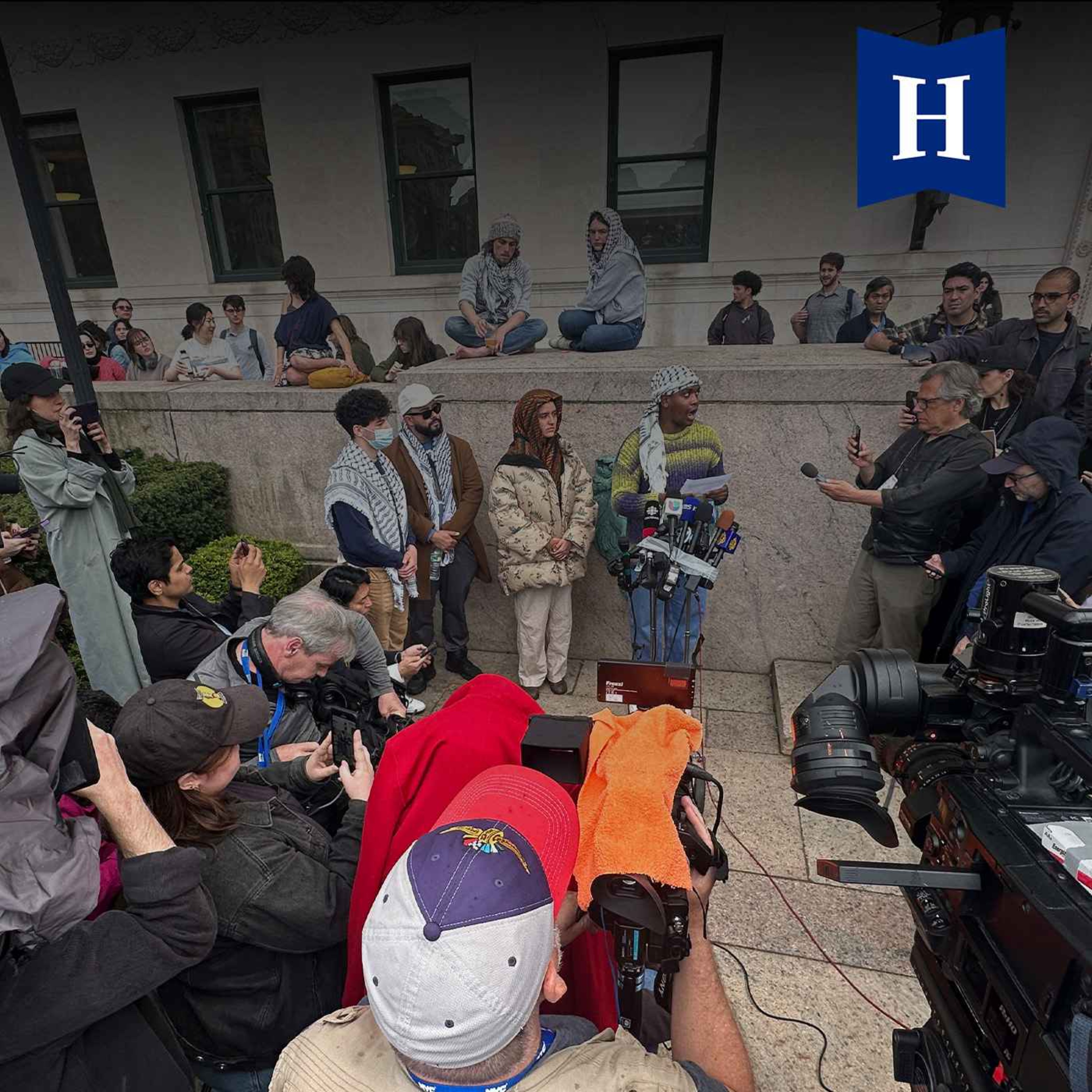
Ted Shaffrey/AP Photo - Photo Credit
Hosted on Acast. See acast.com/privacy for more information.
Get every episode summarized
Each time Hub Podcasts publishes, we email you a written briefing from the transcript — the topics, who appeared, and any specific claims, with the ad reads skipped.
Email me new episodesFree for 3 shows. No card needed.
Transcript ready
147 searchable segments. Every word is indexed and playable.
Full transcript
Hub Podcasts — Why does Israel get so much media attention?. Machine-transcribed; use the interactive transcript above to jump the player to any line.
Over the past several years, one of the questions that many of us have been asking as conflict in the Middle East has raged on, and anti-Semitism, especially across the west, has continued to rise, is how media coverage has trended and how that trend has been justified. I'm pleased to be joined today by Jeremy Musiki, who did a fascinating piece of research, which went viral last week, documenting analytically and pretty deeply how media coverage of Israel has been trending over the past few years. So Jeremy, thank you so much for joining us here today. Thank you, my pleasure and appreciate the end of it. So I guess just to start things off for those of our audience who aren't as immersed in the world of X as I am, because your police did go pretty viral. Can you just summarize sort of the central things that your research uncovered? Sure. So to start with like high level context,
I think as you've been noticing as well, there's this growing cultural obsession with Israel, and it's something that I have been thinking a lot about, and particularly I didn't think that that was happening spontaneously out of nowhere. I felt that there must be some continuous stimulus that would be causing that as a reaction to the stimulus. And so I wanted to conduct some research to learn how much the media talks about Israel and in what way? Because my hypothesis was that this was a media-figured obsession. As far as just my background, I guess I'm a researcher now, but that's not really my background
or profession. I'm a tech startup founder and investor, and I just have a deep curiosity in about media influence and propaganda. So I like to go down rabbit holes sometimes. What I did was I found this project called GDELT, which is the largest open index of the world's news content. I was able to connect via their API and sample the huge data set of the last 10 years of media coverage, both articles and closed captions from live TV broadcasts. I cast two, okay, I didn't realize that. So from broadcast as well. Yeah, I sampled closed captions from BBC News, CNN, Fox, and MSNBC. And so in that process, there are many fine details, but I'll just kind of quickly touch on it by
saying like what I wanted to do was, you know, this treasure trove of content, I wanted to decipher which country it's about, where the outlet is based, so that I could eliminate content in which the subject country and the outlet country are the same. So you removed domestic content basically or domestic coverage. Right. Got it. So it didn't want articles about Israel by Israeli media sources and same thing for every other country that I included in the study, which were many different countries. So we just had on the screen by the way I'm not sure if you saw, we had the chart showing the kind of overwhelming disparity, both pre and post war, which is featured in your piece. It's pretty shocking. Yeah, the data was pretty shocking. So what I found was that
there were three things that stood out. Number one was the volume of coverage. So Israel has been number one on a per capita basis, nine of the last 10 years in terms of the amount of pure media coverage about the country. The second was, and by the way, there was only the only year where it wasn't was the year that the Russia-Ukrain war broke out. So yeah. The second was the persistence or duration. So I wanted to know how long this went on, which actually it's kind of included in the first stat, which is normally a story, a media story would kind of peak and then fall. And the world has a habit of moving on pretty quickly from one story to the next.
And what was very abnormal about Israel not only is the volume, but also the persistence. So the story, it's like it's the one story that never goes away. It's the one story that for some reason is always top of mind and is always on the on the media agenda. There's always something to talk about in Israel. And you know, part of the research was to specifically compare coverage of Israel to other countries that have experienced wars, conflicts, catastrophes over this 10 year period. To have like a more clear comparison between the two, between Israel and the rest of the world, sort of like not just Israel versus Switzerland. And the third thing that came up from the data was the tone, which is extremely negative. Israel was, and this is also data from GDELT. So GDELT
provides, you know, you can access every word of every article and every word through the close captioning of the live TV broadcast. So you can measure sentiment of positive percentage of positive words and percentages of negative words per each report. And Israel scored extremely low in terms of being very negative, more negative than, you know, Iran, Syria, Lebanon, China, Sudan, where there was the worst genocide even catastrophe during this 10 year period by far. So in summary, like the data on all three fronts really showed me what I suspected, which was that there is an unnatural bias in coverage of Israel and the media. Right, your Griffiths here, the publisher of the hub. Well, we've got a busy autumn 2026 underway. We're covering a trade war with the United States each and every day. Parliament is
soon set to return. A big thank you to our many corporate advertisers industry associations who help underwrite our journalism and analysis. It's a distinguished group ranging from Atco to Rio Tinto to Rogers Shopify, RBC, Interact. The list goes on and on. If you're a major Canadian company or industry association that has an important message or idea that you would like to communicate to Canadians, please reach out to me directly. Publisher at the hub.ca. We'd love to learn more about your issues and ideas and hope you connect with a hub platform that is now generating over two million engagements with Canadians each and every month, 200,000 hours of user interaction. Again, that email publisher at the hub.ca. Look forward to connecting with you and working together
to bring your messages and ideas to Canadians. I want to touch on a few of those points. The sustainment piece I found really interesting is something we've covered a bit here at the hub as well, which is less about media coverage and more about how the rise of anti-Semitism that we've seen in Canada, which is where we're located, didn't abate when the conflict in Gaza ended, which was notionally the justification behind a lot of the early demonstrations and movement there. I actually have the chart. I'll put it up. It's one of you could talk about that sustainment period and how despite it existed before the conflict, but even when the ceasefire came into effect, the sustainment of the negative coverage about Israel didn't abate. Can you walk us through that a little moment? Yeah. Also just a comment on that. There are still mass rallies happening to end the genocide,
even though the war, which was never a genocide, has been in ceasefire for 11 months, almost a year now. Yeah. But yeah, the coverage has not slowed down. I actually looked into the data over the last 11 months since the ceasefire. I don't have it exactly in front of me, but I recall from reading it earlier. Israel was still number one per capita in media coverage and eight out of these last 10 months, I measured last 10 months since the ceasefire started. Are viewers going to see on the screen, the Ukraine conflict, which was massive news across the world, even that conflict had a natural flow-off period as the conflict progressed and there was less immediate news in it compared to Israel, which has really not eased off at all. Yeah. It's in a league of its own.
So one of the things I wanted to ask you is you mentioned a little bit given you can track sentiment across even broadcast coverage was the negative tone that accompanied much of the coverage of Israel over the last 10 years, but particularly since the conflict started. You know, negative relative to Russia and Ukraine, negative to Syria, negative compared to Iran, which during, you know, within the last count of years slaughtered tens of thousands of its own people in a kind of a pure act of repression. I was wondering, did your research uncover any of the kind of the causes of that? Is it biased reporting? Is it biased sourcing? Is it relying on kind of Hamas Ministry of, or the Gaza Ministry of Health, which is Hamas? What's kind of, can you break down what the kind of factors were that led to the negative tone in the coverage? So there's, there's, there's data that shows sort of what happened and then there's the other
question of intent, which is what we all want to understand, which is not, which is the harder part. Yeah. So I don't claim to have data that proves intent is very difficult to prove demonstrably. But I think the data does, you know, convincingly show that there's a bias, it's statistically significant and, you know, it's undeniable. The cover, you know, the tone, the negative tone, one of the, the rebuttals that someone might say was like, well, there's been, you know, they're covering a conflict. So of course, the tone is going to be negative. And that's specifically why I did two things as part of the study. One is comparing the tone of Israel's coverage, specifically to places where the worst catastrophes of the last 10 years and conflicts have happened.
There was a period in the Congo and I don't want to give you the wrong dates, but this came up during my research. There was a period in the Congo where there was extreme turmoil. And the UN's data shows that a child, and I hate to say this, it feels terrible, a child was raped every 30 minutes. During that year. Okay, like that gives me chills saying that. And Israel was still covered more negatively and much more in volume and duration than the Congo was, but like not even close. Same with Sudan, I think you walked through that, you know, that the massive conflict in Sudan, which led to the displacement of tens of millions of people, still didn't come close to mirroring the tone and volume of coverage of Israel.
Right. And then we also looked at Israel during years where there was no conflict. Right. Right. So in the year of 2019, for example, Israel was still ranked super high in coverage and super low on tone. So it's, it's, you can't really explain it away with the whole conflict being. Yeah. Another thing that you document and it's, it's demonstrable in the research is the rise of the use of the terminology around genocide and how it went from being kind of a fraction of a percent to like almost overnight being, I mean, you can give the numbers. It's above 10% of the kind of coverage of Israel used that terminology. Was there like a clear inflection point or a trigger? Like it seems, it seems almost beyond belief that almost overnight media across the world adopt a
similar set of language for something that is at best arguable, but at worst not close to being true. So how do you, how do you account for that or explain that or how does, what is the research surface in terms of in terms of that genocide terminology? Yeah. So the genocide terminology was present, even in, you know, much smaller levels like less than half a percent of all coverage. I mean, like that's still significant in 2019, for example. In early 2023, it was at like 1% that's interesting. And, and then after October 7th, it spiked from October to November of 2023, it skyrocketed to 7.6%. In 2024, it was up as high as, I'm sorry, January of 2024
was up as high as almost 16%. So just unpacking that, that's 16% of all coverage of Israel, refer, use the terminology. Okay. Yeah, that that word was included. So that's, that's for, let me just be clear that that's one month. That's January of 2024. Yeah. During that month, 15.8% of media coverage of Israel included the word genocide. So when people like myself and perhaps you kind of look around and wonder like, how is this word so pervasive? Like, why is this like, it just seems so like deeply drilled into so many people's minds that's like almost completely eat it. The numbers are, are screaming at us in terms of why, right? Like, if you keep seeing that every day and you associate that word with Israel, it's predictable that you'll have people
around the world that will repetitively say that and think that that's happening. Even when there's no war, even when there's a ceasefire, even though there was never a genocide to begin with, even though the population of Gaza increased during the time of the war, even though the IDF has the capability to wipe out every single person in Gaza very quickly with the weapons and technology that they have, even though Hamas uses human shields, right? Like we can go forever. Despite all of that. Yeah. Look, it's, it's, it's fascinating. I think, you know, in some respects for those of us who've been like, attentively falling in this, it affirms what we sort of see and feel and hear in the media around us. I do think that for those who are interested, Jeremy's research is worth reading in full. It can be found at profound.af. It's a very detailed analytical piece to
use to massive data set as he mentioned. So I encourage our readers to check it out and see the underlying data for them for themselves. Look, I think that this broader topic of media focus, media bias sort of media herd mentality is something that that we've been covering for some time and will continue to and really value your contribution and you taking the time to join us and walk us through your research. It is very valuable. Thank you. Appreciate it and happy to share this with the world. Jeremy, we see you. Thank you for joining us here at the
More episodes
More from Hub Podcasts

Is Prime Minister Carney politically invincible?
Hub Podcasts

Carney’s moves on building and labour are an outright rejection of Trudeau econo...
Hub Podcasts

Is Canada really planning for a U.S. military invasion?
Hub Podcasts

Does Mark Carney have the stomach for abundance politics?
Hub Podcasts